Maharashtra State Board Class 9 Science Solutions Chapter 15 Life Processes in Living Organisms
Class 9 Science Chapter 15 Life Processes in Living Organisms Textbook Questions and Answers
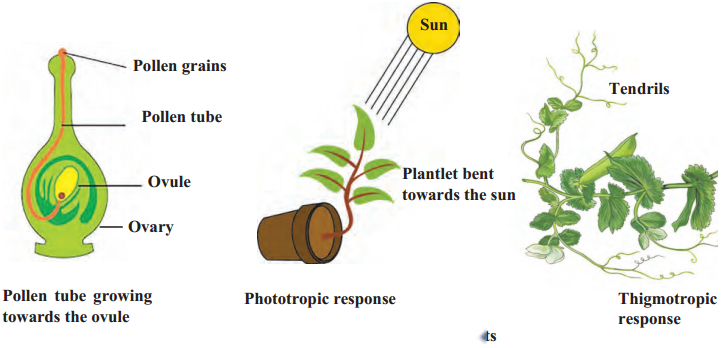
1. Match the pairs and explain.
Column ‘A’ | Column ‘B’ |
(1) Growth of pollen tube towards ovules | (a) Gravitropic movement |
Answer:
(1 – b),
(2 – c),
(3 – a),
(4 – e).
2. Complete the paragraph.
The milk was on the stove. Rasika was engrossed in watching television. She smelled something burning. She ran towards the kitchen. The milk was boiling over. She held the vessel with her bare hands but, screaming, she let it go at once. This activity was controlled by ……………….. cells. Special ends of ……………….. in these cells collected the information, from where it was transferred to the ……………….. and then towards the terminal end of the ……………….. The chemicals produced at the terminal end passed through the minute space i.e. ……………….. In this way, ……………….. were conducted in the body and the process of ……………….. was completed by conducting the impulses from ……………….. to ………………
(Nerve, muscle cell, impulse, dendrite, synapse, axon, reflex action, cell body)
Answer:
nerve, dendrite, cell body, axon, synapse, impulses, reflex action, nerve, muscle cell.
3. Write notes on Root pressure, Transpiration, Nerve cell, Human brain, Reflex action
4. Name the hormones of the following endocrine glands and the function of each.
Pituitary, Thyroid, Adrenal, Thymus, Testis, Ovary.
Life Processes In Living Organisms Class 9 Question 1.
Pituitary:
Answer:
Hormone | Function |
(i) Growth hormone | Stimulates growth of bones. |
(ii) Adrenocorticotropic hormone | Stimulates adrenal gland. |
(iii) Thyroid-stimulating hormone | Stimulates thyroid gland. |
(iv) Prolactin | Stimulates milk production. |
(v) Follicle-stimulating hormone | Controls growth of gonads. |
(vi) Luteinizing hormone | Controls menstrual cycle and ovulation. |
(vii) Oxytocin | Contracts uterus during parturition. |
(viii) Antidiuretic hormone | Regulates water-level in the body. |
Class 9 Science Chapter 15 Life Processes In Living Organisms Question 2.
Thyroid
Answer:
Hormone | Function | |
(i) Thyroxine | Controls growth of body and metabolic activities. | |
(ii) Calcitonin | Controls calcium metabolism and calcium level in blood. |
Life Processes In Living Organisms Class 9 Exercise Question 3.
Adrenal
Answer:
Hormone | Function |
(i) Adrenalin and nor-adrenalin | Controls behaviour during crisis and emotional situation. |
(ii) Corticosteroid | Maintains balance of Na+and K+and stimulates metabolism. |
9th Class Science Chapter 15 Life Processes In Living Organisms Exercise Question 4.
Thymus
Answer:
Hormone | Function |
Thymosin | Control the cells which give rise to immunity. |
Hormone | Function |
Testosterone | Stimulates growth of secondary sexual characteristics like beard, mustache, hoarse voice etc. in men. |
Std 9 Science Chapter 15 Life Processes In Living Organisms Question 6.
Ovary
Answer:
Hormone | Function |
(i) Oestrogen | Stimulates growth of the endometrium. Stimulates growth of secondary sexual characteristics in women. |
(ii) Progesterone | Prepares the endometrium for conception and maintains pregnancy. |
5. Draw and label the diagrams.
Human endocrine glands, Human brain, Nephron, Nerve cell, Human excretory system.
15. Life Processes In Living Organisms Question 1.
Human endocrine glands
Answer:
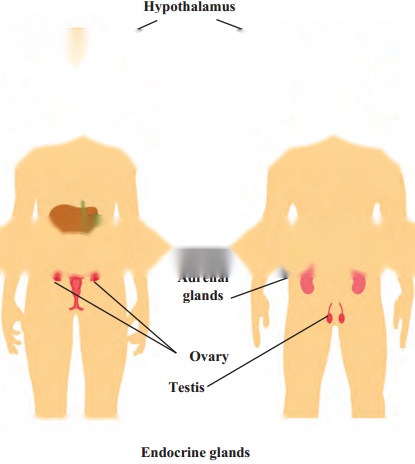
15 Life Processes In Living Organisms Question 2.
Human brain
Answer:
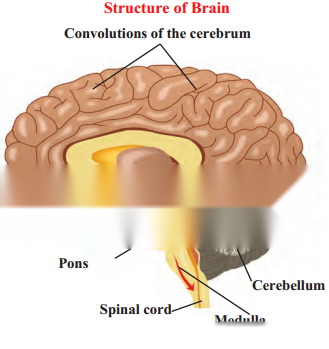
Life Processes In Living Organisms 9th Class Notes Question 3.
Nephron
Answer:
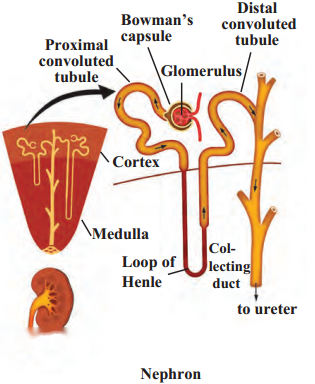
Life Processes In Living Organisms Class 9 Questions And Answers Question 4.
Nerve cell
Answer:
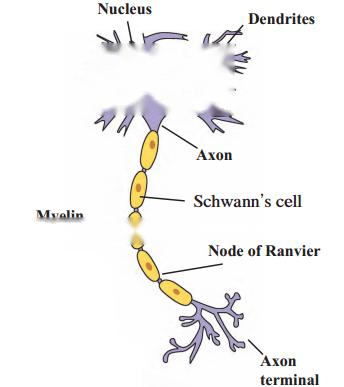
Life Processes In Living Organisms Class 9 Solutions Question 5.
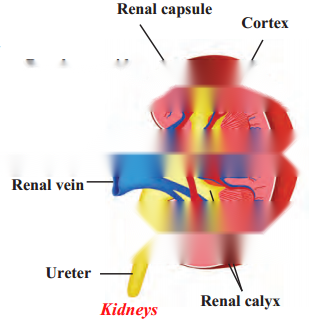
Human excretory system
Answer:
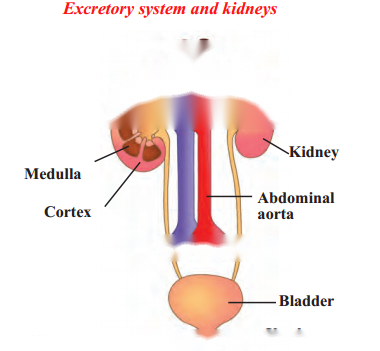
6. Answer the following.
a. Explain chemical co-ordination in humans and give the names and functions of some hormones.
Answer:
Chemical co-ordination in humans :
Hormone | Function |
(1) Growth hormone | Stimulates growth of bones. |
(2) Luteinizing hormone | Controls menstrual cycle and ovulation. |
(3) Thyroxine | Controls growth of body and metabolic activities. |
(4) Insulin | Stimulates liver to convert excess blood glucose to glycogen. |
(5) Testosterone | Stimulates growth of secondary sexual characters like beard, mustache, hoarse voice, etc. in men. |
Names and functions of some hormones:
b. Explain the difference between the excretory system of humans and plants.
Answer:
Excretory system of humans | Excretory system of plants |
(i) In humans, the excretory system carries out the function of the removal of waste from the body. | (i) In plants, there is no special system or organ for excretion. |
(ii) Waste substances are generally eliminated out of the body | (ii) Most of the waste substances are stored in the leaves, flowers, fruits and bark of the stem. |
(iii) The excretory products are urea, uric acid, ammonia, etc. | (iii) The excretory products are gum, resin, latex of rubber, etc. |
c. Explain co-ordination in plants with the help of suitable examples.
Answer:
7. Explain in your own words with suitable examples.
a. What is meant by co-ordination?
Answer:
b. How does excretion occur in human beings?
Answer:
c. How is excretion in plants useful to human beings?
Answer:
d. Describe the transportation system in plants.
Answer:
Class 9 Science Chapter 15 Life Processes in Living Organisms Intext Questions and Answers
Class 9 Science Chapter 15 Life Processes In Living Organisms Exercise Question 1.
How do the digestive system and respiratory system work?
Answer:
(a) Digestive system:
(b) Respiratory system:
Thus, the digestive and respiratory systems work in co-ordination with each other to produce energy from food.
Life Processes In Living Organisms Exercise Question 2.
Previously you have performed the activity of observing a branch covered in a plastic bag. What did you observe in that activity?
Answer:
Life Process In Living Organism Exercise Question 3.
Which are the sensory organs of an organism? What is their function?
Answer:
15 Life Processes In Living Organisms Class 9 Question 4.
Where are the gustatory and olfactory nerves to be found?
Answer:
Answer the following questions:
15.Life Processes In Living Organisms Question 1.
Why do we eat fruits and vegetables? Do the plants also need minerals like we do?
Answer:
Life Processes In Living Organisms Class 9 Notes Question 2.
From where do plants get inorganic substances other than carbon dioxide and oxygen?
Answer:
Plants get inorganic substances like nitrogen, phosphorus, magnesium, manganese, sodium etc. from the soil. Soil is the nearest and richest source of these elements.
9th Std Science Chapter 15 Life Processes In Living Organisms Question 3.
At least a small quantity of garbage or waste is produced every day in each house. What will happen if you keep this garbage for many days in your house?
Answer:
Life Processes In Living Organisms Exercise Class 9 Question 4.
Sometimes, while eating we bite our own finger or tongue by mistake.
Answer:
9th Class Science 15 Chapter Life Processes In Living Organisms Question 5.
Sometimes, we choke while eating in a hurry.
Answer:
Life Processes In Living Organisms Class 9 Extra Questions Question 6.
An injury to the medulla oblongata can lead to death. Why?
Answer:
Life Processes In Living Organisms Class 9 Maharashtra Board Question 7.
You may have seen how a drunken person struggles to maintain his body balance. An excess of alcohol in the body causes one to lose control over it. Why does this happen? Find out the reason with help of the internet.
Answer:
9th Life Processes In Living Organisms 5 Question 8.
Why does this happen?
(a) Leaves of plants fall off in a particular season.
Answer:
(b) Fruits, flowers fall off after a certain period of time.
Answer:
(c) Substances like resin, gum, etc. are given out of the plant body.
Answer:
15 Life Processes In Living Organisms Exercise Question 9.
Which waste products are produced in our body through metabolic activities?
Answer:
The waste products formed in our body through metabolic activities are urea, uric acid, ammonia, carbon dioxide etc.
Life Processes In Living Organisms 9th Class Exercise Question 10.
As compared to the monsoons and winter a very small quantity of urine is produced in the summer season. Why is it so?
Answer:
In summer, we sweat more due to excess heat. So, the body tries to conserve water by reducing urine formation. This is to prevent dehydration.
Answer the following questions:
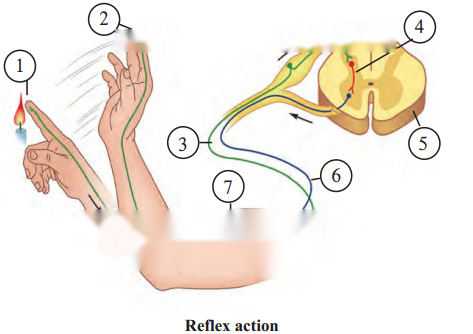
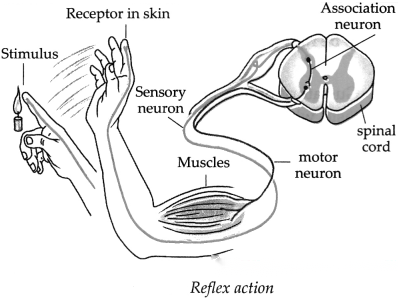
(a) What is happening at 1 and 2?
At 1 stimulus of heat is received by thermo-receptors in the skin. At 2, the hand is withdrawn instantly.
(b) Which nerve carried the impulse to the point marked 3? In which direction is it conducting the impulse?
Answer:
Sensory nerve carried the impulse to the point marked 3. The impulse is conducted from the skin towards the spinal cord.
(c) Which is the nerve shown by 4?
Answer:
The nerve shown by 4 is association neuron. It is present in the gray matter of the spinal cord. It receives the sensory impulse, interprets it and generates impulse.
(d) Which is the organ marked as 5?
Answer:
Spinal cord.
(e) At 6, which nerve is conducting the response impulse?
Answer:
Motor nerve.
(f) At 7, where has the impulse reached? What is its effect?
Answer:
At 7, the impulse has reached the muscles of the hand. As a result, the muscles contract and the hand is withdrawn instantly in response to the stimulus of heat.
Question 5
Maharashtra Board Solution
Sketch and label:
Solution & Step-by-Step Answer:
(6) Observe the figure and list down functions for ‘A’ and ‘B’
Answer the following questions:
Question 1
Maharashtra Board Solution
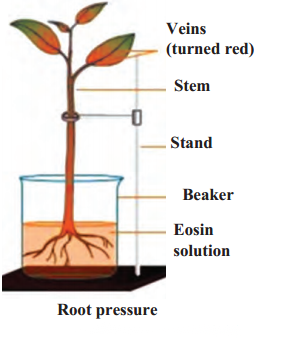
Take a small plant like balsam or tuberose with its roots intact. Wash and clean its roots. As shown in the fig, keep it in the water containing a stain like safranin or eosin. Observe the stem and the veins of the leaves after 2-3 hours.
Solution & Step-by-Step Answer:
Question 2
Maharashtra Board Solution
Take a transverse section of the stem of a plant and observe the stained xylem under a compound microscope.
Solution & Step-by-Step Answer:
The xylem elements appear pinkish as the eosin solution is conducted upwards through the xylem. From this we infer that the xylem is responsible for the conduction of water and minerals in the plant.
Question 3
Maharashtra Board Solution
Observe your mother while she cuts the elephant’s foot (Amorphophallus) or arum leaves. Your hands may also begin to itch if you try to cut these leaves. Why does this happen? Try to find out. Ask your mother what she does to prevent the itching.
Solution & Step-by-Step Answer:
Class 9 Science Chapter 15 Life Processes in Living Organisms Additional Important Questions and Answers Choose and write the correct options.
Question 1
Maharashtra Board Solution
The transport of food produced in leaves to each cell in the plant body is called ……………………………. (a) Transpiration (b) Root pressure (c) Translocation (d) Ascent of sap
Solution & Step-by-Step Answer:
(c) translocation
Question 2
Maharashtra Board Solution
Kidneys filter blood about ……………………………. times every day. (a) 100 (b) 200 (c) 300 (d) 400
Solution & Step-by-Step Answer:
(d) 400
Question 3
Maharashtra Board Solution
About ……………………………. of blood is sent through the dialysis machine at one time. (a) 500 ml (b) 5 l (c) 200 ml (d) 400 ml
Solution & Step-by-Step Answer:
(a) 500 ml
Question 4
Maharashtra Board Solution
The movement of plant towards the source of light is called ……………………………. movement. (a) chemotropic (b) hydrotropic (c) phototropic (d) gravitropic
Solution & Step-by-Step Answer:
(c) phototropic
Question 5
Maharashtra Board Solution
The movement of root system towards stimulus of gravity is called ……………………………. movement. (a) phototropic (b) gravitropic (c) hydrotropic (d) chemotropic
Solution & Step-by-Step Answer:
(b) gravitropic
Question 6
Maharashtra Board Solution
The movement of root system towards stimulus of water is called ……………………………. movement. (a) Phototropic (b) Gravitropic (c) Hydrotropic (d) Chemiotropic
Solution & Step-by-Step Answer:
(c) hydrotropic
Question 7
Maharashtra Board Solution
Hormone ……………………………. helps in stem elongation. (a) Auxin (b) Gibberellin (c) Cytokinin (d) Abscisic acid
Solution & Step-by-Step Answer:
(b) Gibberellin
Question 8
Maharashtra Board Solution
Hormone ……………………………. helps in cell division. (a) Auxin (b) Gibberellin (c) Cytokinin (d) Abscisic acid
Solution & Step-by-Step Answer:
(c) Cytokinin
Question 9
Maharashtra Board Solution
The hormone ……………………………. is effective in prevention and retardation of growth, leaf wilting, etc. (a) Auxin (b) Cytokinin (c) Gibberellin (d) Abscisic acid
Solution & Step-by-Step Answer:
(d) Abscisic acid
Question 10
Maharashtra Board Solution
……………………………. neurons conduct impulses from the sensory organs to the brain and the spinal cord, (a) Sensory (b) Motor (c) Association (d) All of these
Solution & Step-by-Step Answer:
(a) Sensory
Question 11
Maharashtra Board Solution
The brain of an adult human weighs about ……………………………. (a) 500 – 600 grams (b) 2 – 3 kilograms (c) 1300 -1400 grams (d) 1500 -1600 grams
Solution & Step-by-Step Answer:
(c) 1300 – 1400 grams
Question 12
Maharashtra Board Solution
……………………………. is the largest part of the brain. (a) Cerebrum (b) Cerebellum (c) Medulla oblongata (d) Spinal cord
Solution & Step-by-Step Answer:
(a) Cerebrum
Question 13
Maharashtra Board Solution
There are two triangular swollen structure called ……………………………. on the upper side of the medulla oblongata. (a) Ventricles (b) Meninges (c) Pyramids (d) Pons
Solution & Step-by-Step Answer:
(c) Pyramids
Question 14
Maharashtra Board Solution
Control of voluntary movements is done by ……………………………. (a) Cerebrum (b) Cerebellum (c) Medulla oblongala (d) Spinal cord
Solution & Step-by-Step Answer:
(a) Cerebrum
Question 15
Maharashtra Board Solution
Co-ordination of voluntary movements is done by ……………………………. (a) cerebrum (b) cerebellum (c) medulla oblongata (d) spinal cord
Solution & Step-by-Step Answer:
(b) cerebellum
Question 16
Maharashtra Board Solution
Control of involuntary activities like the beating of the heart, blood circulation, breathing etc. are controlled by ……………………………. (a) Spinal cord (b) Cerebrum (c) Cerebellum (d) Medulla oblongata
Solution & Step-by-Step Answer:
(d) Medulla oblongata
Question 17
Maharashtra Board Solution
The function of cerebrum is to ……………………………. (a) control of voluntary movements (b) co-ordination of voluntary movements (c) control of involuntary activities (d) maintaining the body balance
Solution & Step-by-Step Answer:
(a) control of voluntary movements
Question 18
Maharashtra Board Solution
The function of cerebellum is ……………………………. (a) to control of voluntary movements (b) to maintain the body balance (c) to control of involuntary activities (d) to co-ordinate of voluntary movements
Solution & Step-by-Step Answer:
(b) to maintain the body balance
Question 19
Maharashtra Board Solution
Hormone ……………………………. stimulates the liver to convert excess blood glucose into glycogen. (a) Glucagon (b) insulin (c) Somatostatin (d) Pancreatic polypeptide
Solution & Step-by-Step Answer:
(a) Glucagon
Question 20
Maharashtra Board Solution
Hormone ……………………………. controls behaviour during crisis and emotional situation. (a) Thyroxine (b) Parathormone (c) Adrenalin and Nor adrenalin (d) Somatostatin
Solution & Step-by-Step Answer:
(c) Adrenalin and Nor adrenalin
Question 21
Maharashtra Board Solution
……………………………. controls menstrual cycle and ovulation. (a) Prolactin (b) Oxytocin (c) Luteinizing hormone (d) Progesterone
Solution & Step-by-Step Answer:
(c) Luteinizing hormone
Question 22
Maharashtra Board Solution
……………………………. stimulates growth of secondary sexual characteristics in men. (a) Thymosin (b) Testosterone (c) Oestrogen (d) Thyroxine
Solution & Step-by-Step Answer:
(b) Testosterone
Question 23
Maharashtra Board Solution
……………………………. occurs through stomata. (a) Translocation (b) Perspiration (c) Transpiration (d) Conduction
Solution & Step-by-Step Answer:
(c) Transpiration
Question 24
Maharashtra Board Solution
……………………………. performs the important role of pushing the water up during the night time. (a) Translocation (b) Root pressure (c) Transpiration pull (d) None of these
Solution & Step-by-Step Answer:
(b) Root pressure
Question 25
Maharashtra Board Solution
In plants, gaseous substances are given out by ……………………………. (a) Root pressure (b) Osmosis (c) Diffusion (d) Translocation
Solution & Step-by-Step Answer:
(c) diffusion
Question 26
Maharashtra Board Solution
Each kidney has approximately ……………………………. nephrons. (a) 1 lakh (b) 10,000 (c) 10 lakh (d) 50 lakh
Solution & Step-by-Step Answer:
(c) 10 lakh
Question 27
Maharashtra Board Solution
Insulin is secreted by the ……………………………. of the pancreas. (a) Alpha cells (b) Beta cells (c) Delta cells (d) F cells
Solution & Step-by-Step Answer:
(b) Beta cells
Select the odd man out:
Question 1
Maharashtra Board Solution
Skin, Brain, Kidneys, Lungs.
Solution & Step-by-Step Answer:
Brain – It is a controlling organ whereas the others are excretory orgAnswer:
Question 2
Maharashtra Board Solution
Gum, Resin, Urea, Latex
Solution & Step-by-Step Answer:
Urea – It is an excretory product of animals whereas the others are excretory products of plants.
Question 3
Maharashtra Board Solution
Gibberellin, Auxin, Thyroxine, Cytokinin.
Solution & Step-by-Step Answer:
Thyroxine – It is a hormone in animals whereas the others are hormones in plants.
Question 4
Maharashtra Board Solution
Dendrite, Cell body, Axon, Synapse.
Solution & Step-by-Step Answer:
Synapse – It is a minute space between two adjacent neurons whereas the others are parts of the neuron.
Question 5
Maharashtra Board Solution
Thyroxine, Calcitonin, Insulin, Auxin.
Solution & Step-by-Step Answer:
Auxin – It is a plant hormone whereas the others are hormones in human beings.
Complete the Analogy: (1) Water : Xylem :: Food : ……………………………. Match the columns:
Question 1
Maharashtra Board Solution
|
Column ‘A’ | Column ‘B’ |
(1) Gibberellins | (a) Enlargement of cells |
(1 – b),
(2 – c),
(3 – d),
(4 – a).
Question 1
Maharashtra Board Solution
Solution & Step-by-Step Answer:
(1 – b),
(2 – d), (3 – a), (4 – c). State whether the following statements are true or false. Correct the false statements.
Question 1
Maharashtra Board Solution
Plants need less energy as compared to animals.
Solution & Step-by-Step Answer:
True
Question 2
Maharashtra Board Solution
Xylem conducts food whereas phloem conducts water.
Solution & Step-by-Step Answer:
False. Xylem conducts water whereas phloem conducts food.
Question 3
Maharashtra Board Solution
The loss of water from the plants is known as translocation.
Solution & Step-by-Step Answer:
False. The loss of water from the plants is known as transpiration.
Question 4
Maharashtra Board Solution
Calcium oxalate crystals present in some plants are called resins.
Solution & Step-by-Step Answer:
False. Calcium oxalate crystals present in some plants are called raphides.
Question 5
Maharashtra Board Solution
Root pressure helps to push the water up in plants during night time.
Solution & Step-by-Step Answer:
True
Question 6
Maharashtra Board Solution
Translocation is carried out by phloem in downward direction.
Solution & Step-by-Step Answer:
False. Translocation is carried out by phloem in both upward and downward direction.
Question 7
Maharashtra Board Solution
In unicellular organisms, waste materials are directly eliminated across the cell surface.
Solution & Step-by-Step Answer:
True
Question 8
Maharashtra Board Solution
Urea is produced in the liver.
Solution & Step-by-Step Answer:
True
Question 9
Maharashtra Board Solution
Systematic regulation of different processes is called co-ordination.
Solution & Step-by-Step Answer:
False. Systematic regulation of different processes is called control.
Question 10
Maharashtra Board Solution
A hormone auxin produced in the apical part of the shoot helps in enlargement of cells.
Solution & Step-by-Step Answer:
True
Question 11
Maharashtra Board Solution
Gibberellin helps in prevention and retardation of growth, leaf wilting etc.
Solution & Step-by-Step Answer:
False. Abscisic acid helps in prevention and retardation of growth, leaf wilting etc.
Question 12
Maharashtra Board Solution
The movement shown by venus fly trap while trapping an insect is a growth relevant movement.
Solution & Step-by-Step Answer:
False. The movement shown by venus fly trap while trapping an insect is a growth irrelevant movement.
Question 13
Maharashtra Board Solution
The lotus flower opens during night time while that of tuberose (polyanthus) opens during day time.
Solution & Step-by-Step Answer:
False. The lotus flower opens during day time while that of tuberose (polyanthus) opens during night time.
Question 14
Maharashtra Board Solution
Sensory neurons conduct impulses from the brain and the spinal cord to effector organs like muscles or glands.
Solution & Step-by-Step Answer:
False. Sensory neurons conduct impulses from the sensory organs to the brain and the spinal cord.
Question 15
Maharashtra Board Solution
There are 31 pairs of cranial nerves.
Solution & Step-by-Step Answer:
False. There are 12 pairs of cranial nerves.
Question 16
Maharashtra Board Solution
Activities like heart beat, blood circulation, breathing, sneezing, etc. are controlled by cerebellum.
Solution & Step-by-Step Answer:
False. Activities like heart beat, blood circulation, breathing, sneezing, etc. are controlled by cerebellum.
Question 17
Maharashtra Board Solution
Spinal nerves are associated with head, thorax and abdomen.
Solution & Step-by-Step Answer:
False. Spinal nerves are associated with arms, legs, skin and some other parts of the body.
Question 18
Maharashtra Board Solution
Nerve impulses are slow and long lasting whereas action of hormones is fast and short lived.
Solution & Step-by-Step Answer:
False. Nerve impulses are fast and short lived whereas action of hormones is slow and long lasting.
Question 19
Maharashtra Board Solution
Reflex actions are controlled by cerebellum.
Solution & Step-by-Step Answer:
False. Reflex actions are controlled by spinal cord.
Question 20
Maharashtra Board Solution
Thyroid stimulating hormone is secreted by the pituitary gland.
Solution & Step-by-Step Answer:
True
Question 21
Maharashtra Board Solution
The hormone thymosin is secreted by the thyroid gland.
Solution & Step-by-Step Answer:
False. The hormone thymosin is secreted by the thymus gland.
Question 22
Maharashtra Board Solution
Parathormone controls metabolism of calcium and phosphorns.
Solution & Step-by-Step Answer:
True
Question 23
Maharashtra Board Solution
The right kidney is slightly lower than the left kidney.
Solution & Step-by-Step Answer:
True
Name the following:
Question 1
Maharashtra Board Solution
The structural and functional unit of the nervous system.
Solution & Step-by-Step Answer:
Newtron.
Question 2
Maharashtra Board Solution
The network of capillaries in the Bowman’s capsule.
Solution & Step-by-Step Answer:
Glomerulus.
Question 3
Maharashtra Board Solution
The minute space between two adjacent nervous.
Solution & Step-by-Step Answer:
Synapse.
Question 4
Maharashtra Board Solution
The special cells which bring about control and co-ordination.
Solution & Step-by-Step Answer:
Neurons.
Question 5
Maharashtra Board Solution
The cavities present in various parts of the brain.
Solution & Step-by-Step Answer:
Ventricles.
Question 6
Maharashtra Board Solution
The long tubular cavity of the spinal cord.
Solution & Step-by-Step Answer:
Central Canal.
Question 7
Maharashtra Board Solution
The thread like fibrous structure at the end of the spinal cord.
Solution & Step-by-Step Answer:
Filum terminale.
Give scientific reasons:
Question 1
Maharashtra Board Solution
It is necessary to remove harmful and waste substances from the body.
Solution & Step-by-Step Answer:
Question 2
Maharashtra Board Solution
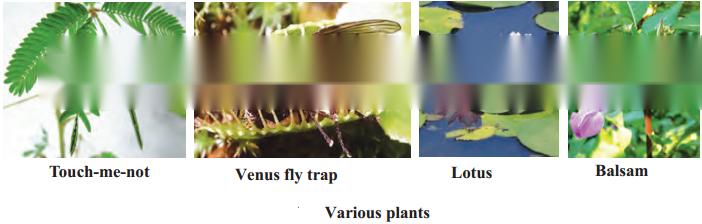
In plants like Touch-me-not (Mimosa), movement also occurs at the places other than where it has been touched.
Solution & Step-by-Step Answer:
Question 3
Maharashtra Board Solution
Endocrine glands are also called ductless glands.
Solution & Step-by-Step Answer:
Define the following:
Question 1
Maharashtra Board Solution
Transportation
Solution & Step-by-Step Answer:
The process by which a substance either synthesized or absorbed in one part of the body reaches another is called as transportation.
Question 2
Maharashtra Board Solution
Control
Solution & Step-by-Step Answer:
Systematic regulation of different processes is called as control.
Question 3
Maharashtra Board Solution
Coordination
Solution & Step-by-Step Answer:
Bringing about the different processes in the proper sequence is called as co-ordination.
Question 4
Maharashtra Board Solution
Tropism or Tropic movement
Solution & Step-by-Step Answer:
Movement or growth of any part of the plant in response to an external stimulus is called as tropism or tropic movement.
Question 5
Maharashtra Board Solution
Excretion
Solution & Step-by-Step Answer:
Removal of waste or harmful substances from the body is called excretion.
Question 6
Maharashtra Board Solution
Dialysis
Solution & Step-by-Step Answer:
The process of separating the nitrogenous waste from the blood with the help of a man?made machine is called dialysis.
Question 7
Maharashtra Board Solution
Reflex action
Solution & Step-by-Step Answer:
An immediate and involuntary response given to a stimulus from the environment is called a reflex action.
Question 8
Maharashtra Board Solution
Homeostasis
Solution & Step-by-Step Answer:
Proper co-ordination between various systems of an organism helps to maintain a state of equilibrium called homeostasis.
Question 9
Maharashtra Board Solution
Tropism
Solution & Step-by-Step Answer:
Movement or growth of any part of the plant in response to an external stimulus is called tropism.
Distinguish between:
Question 1
Maharashtra Board Solution
Nervous control and Chemical control
Solution & Step-by-Step Answer:
Question 2
Maharashtra Board Solution
Growth relevant movements and growth irrelevant movements
Solution & Step-by-Step Answer:
Question 3
Maharashtra Board Solution
Cerebrum and Cerebellum
Solution & Step-by-Step Answer:
Write short notes:
Question 1
Maharashtra Board Solution
Root Pressure
Solution & Step-by-Step Answer:
Question 2
Maharashtra Board Solution
Transpiration
Solution & Step-by-Step Answer:
Question 3
Maharashtra Board Solution
Nerve cell
Solution & Step-by-Step Answer:
Question 4
Maharashtra Board Solution
Reflex action
Solution & Step-by-Step Answer:
Question 5
Maharashtra Board Solution
Spinal cord
Solution & Step-by-Step Answer:
Question 6
Maharashtra Board Solution
Dialysis
Solution & Step-by-Step Answer:
Draw neat and labelled diagrams:
Question 1
Maharashtra Board Solution
Vertical Section of Kidney
Solution & Step-by-Step Answer:
Question 2
Maharashtra Board Solution
Reflex action
Solution & Step-by-Step Answer:
Name the hormones of the following endocrine glands and the function of each:
Question 1
Maharashtra Board Solution
Parathyroid
Solution & Step-by-Step Answer:
Question 2
Maharashtra Board Solution
Pancreas
Solution & Step-by-Step Answer:
Complete the following table of plant hormones with their functions:
State the functions of different parts of the brain.
Answer the following:
Question 1
Maharashtra Board Solution
How do plants bring about movements in them?
Solution & Step-by-Step Answer:
Answer the following:
Question 1
Maharashtra Board Solution
What are growth-irrelevant movements? Give examples.
Solution & Step-by-Step Answer:
Question 2
Maharashtra Board Solution
Which are the different types of nerve cells or neurons? OR How are nerve cells classified according to their functions?
Solution & Step-by-Step Answer:
According to their functions, nerve cells are classified into three types:
Question 3
Maharashtra Board Solution
What are the different parts of the human nervous system?
Solution & Step-by-Step Answer:
The human nervous system can be divided into the following three parts.
Question 4
Maharashtra Board Solution
Describe the structure of the central nervous system.
Solution & Step-by-Step Answer:
Question 5
Maharashtra Board Solution
Which are the two types of peripheral nerves?
Solution & Step-by-Step Answer:
Peripheral nerves are of two types: (a) Cranial nerves:
(b) Spinal nerves:
Question 6
Maharashtra Board Solution
How do plants get rid of their excretory products?
Solution & Step-by-Step Answer:
Answer in detail:
Question 1
Maharashtra Board Solution
Explain how food and other substances are transported in plants? OR Explain translocation in plants.
Solution & Step-by-Step Answer:
Question 2
Maharashtra Board Solution
What is tropic movement? Describe the different types of tropic movements. OR What are growth relevant movements? Describe the different types of growth relevant movements.
Solution & Step-by-Step Answer:
Movement or growth of any part of the plant in response to an external stimulus is called tropic movement or tropism.
The different types of tropic movements are: All the above-mentioned movements of plants are related with growth, hence are called growth relevant movement.
Question 3
Maharashtra Board Solution
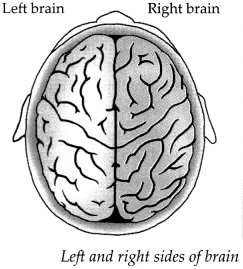
Write short note on : Human Brain
Solution & Step-by-Step Answer:
Human brain is made up of following parts: (a) Cerebrum: (b) Cerebellum: (c) Medulla Oblongata: (6) How are nerve impulses conducted in the body? Read More: FEDERALBNK Pivot Point Calculator |