Maharashtra State Board Class 9 Science Solutions Chapter 13 Carbon: An Important Element
Class 9 Science Chapter 13 Carbon: An Important Element Textbook Questions and Answers
1. Select the proper option and complete the statements
(single, all, double, ionic, carbon, give and take, hydrogen, multiple, share, most, covalent)
a. A carbon atom forms a ….……………. bond with other atoms. In this bond the two atoms ….electrons.
Answer:
covalent, share
b. All the carbon bonds in a saturated hydrocarbon ….……………. electrons.
Answer:
share
c. At least one carbon bond in an unsaturated hydrocarbon is ….…………….
Answer:
multiple
d. ….……………. is the essential element in all the organic compounds.
Answer:
Carbon
e. The element hydrogen is present in ….. organic compound.
Answer:
all
2. Answer the following questions
a. Why are carbon and its compounds used as fuels?
Answer:
(i) The name ‘carbon’ is derived from Latin word ‘carbo’meaning coal. In the earth’s crust, carbon is present to an extent of approximately 0.27% in the form of carbonate, coal and petroleum. One of the non-crystalline and amorphous form of carbon is coal. Coal is a fossil fuel.
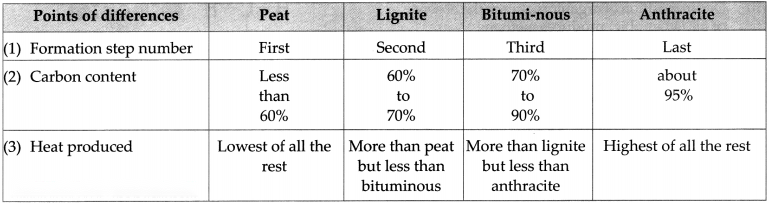
(ii) Peat, lignite, bituminous and anthracite are the four types of coal in the increasing order of their carbon content and heat produced respectively. Charcoal and coke are the other amorphous forms of carbon used as fuel.
(iii) Compounds of carbon such as hydrocarbons consist of carbon and hydrogen and they are easily combustible. For example, methane (CH4) which occurs in natural gas is highly inflammable. It bums by reacting with oxygen to give a bluish flame. In this reaction, 213 Kcal/mol of heat is given out. Methane bums completely.
Chemical reaction:
CH4+ 2O2→ CO2+ 2H2O + Heat
(iv) Thus when hydrocarbons are burnt in air, large amount of heat is evolved with formation of carbon dioxide (CO2) and water (H2O). Due to evolution of heat on combustion, carbon and its compounds are used as fuels.
b. In which compound forms does carbon occur?
Answer:
Carbon in its combined state exists as various compounds such as:
c. Write the uses of the diamond.
Answer:
Uses of diamonds are:
3. Explain the difference:
a. Diamond and graphite.
Answer:
Diamond | Graphite |
(i) Diamond is a brilliant, hard and crystalline allotrope of carbon. | (i) Graphite is a black, soft, brittle and slippery crystalline allotrope of carbon. |
(ii) In diamonds, every carbon atom is bonded to four neighbouring atoms by covalent bonds forming tetragonal three dimensional structure which makes it very hard. | (ii) In graphite, every carbon atom is bonded to three other carbon atoms by covalent bonds in such a way that a hexagonal layered structure is formed. A graphite crystal is made of many such layers of carbon atoms. These layers slip over each other on applying pressure. |
(iii) Density of diamond is 3.5 g/cm3. | (iii) Density of graphite is 1.9 to 2.3 g/cm3. |
(iv) Diamond is a bad conductor of electricity as it does not have free electrons. | (iv) Inside each layer of graphite, free electrons move continuously within the entire layer. Hence, graphite is a good conductor of electricity. |
b. Crystalline and non-crystalline forms of carbon.
Answer:
Crystalline forms of carbon | Non-crystalline forms of carbon |
(i) A crystalline form has a regular and definite arrangement of atoms. | (i) A non-crystalline form does not have a regular and definite arrangement of atoms. |
4. Write scientific reasons
a. Graphite is a conductor of electricity.
Answer:
b. Graphite is not used in ornaments.
Answer:
c. Limewater turns milky when CO2is passed through it.
Answer:
d. Biogas is an eco-friendly fuel.
Answer:
5. Explain the following.
a. Diamond, graphite and fullerenes are crystalline forms of carbon.
Answer:
b. Methane is called marsh gas.
Answer:
c. Petrol, diesel, coal are fossil fuels.
Answer:
(i) A fossil fuel is a fuel formed by natural processes, such as anaerobic decomposition of buried dead organisms. Fossil fuels contain high percentage of carbon. The word carbon is derived from the Latin word ‘Carbo’ meaning coal.
(ii) Coal is formed from the remains of trees and other vegetation. Approximately 350 million years ago, these remains were trapped on the bottom of swamps, accumulating layer after layer and creating a dense material called peat. As this peat was buried under more and more ground, the high temperature and pressure transformed it into coal.
(iii) Petrol and diesel are obtained from mineral oil. Mineral oil also called as crude oil or petroleum oil is formed from the remains of plants and animals that lived in the seas millions of years ago. This plant and animal matter has been drawn down and subjected to extremes of temperature and pressure over millions of years ago.
(iv) Mineral oil is commonly formed in rocks under the sea bed. The word petroleum is derived from Latin word ‘Rock oil’. Petrol and Diesel are obtained from mineral oil by the process called as fractional distillation.
Thus petrol, diesel and coal are fossil fuels.
d. Uses of various allotropes of carbon.
e. Use of CO2in fire extinguisher.
Answer:
f. Practical uses of CO2.
Answer:
Practical uses of CO2are:
6. Write two physical properties each.
a. Diamond
Answer:
Properties of diamond are:
b. Charcoal
Answer:
c. Fullerene
Answer:
Properties of fullerenes are:
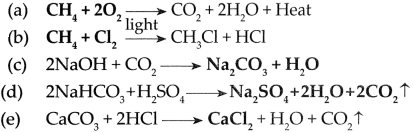
7. Complete the following Chemical reactions.
1. ………………..+………………..→ CO + 2H2O + Heat
2. ………………..+………………..→ HCl + Cl + HCl
3. 2 NaOH + CO2→………………..+………………..
Answer:
8. Write answers to the following in detail.
a. What are the different types of coal? What are their uses?
Answer:
Coal is a fossil fuel. It contains carbon, hydrogen and oxygen. It also contains nitrogen, phosphorus and sulphur. It occurs in the solid state. It is of four types.
Uses of coal:
b. How will you prove experimentally that graphite is good conductor of electricity?
Answer:
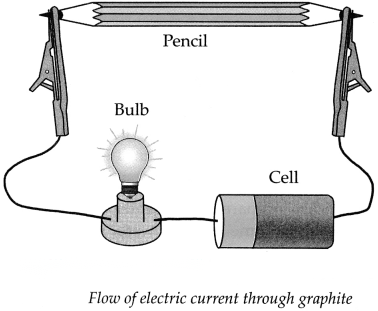
Apparatus required: Lead pendi, electrical wires, battery/cell, small bulb, etc.
Step-I: Remove the lead from a pencil and assemble the apparatus as shown in the diagram.
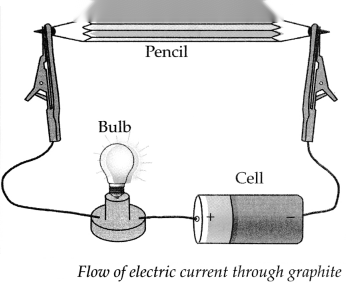
Step-II:
c. Explain the properties of carbon.
Answer:
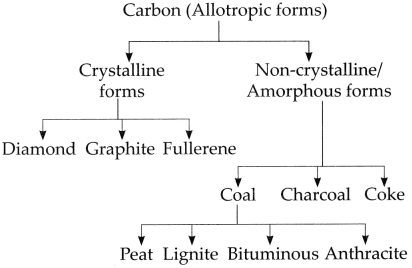
Allotropic nature of Carbon: Some elements occur in nature in more than one form. The chemical properties of these different forms are the same but their physical properties are different. This property of elements is called allotropy. Carbon shows the property of allotropy.
Carbon allotropes are of two types:
(A) Crystalline forms:
Carbon has three crystalline allotropes: Diamond, Graphite and Fullerene. Properties of crystalline forms of carbon are as follows:
(B) Amorphous forms or non-crystalline forms: Coal, charcoal, coke are the non-crystalline forms of carbon.
Properties of non-crystalline forms of carbon are as follows:
d. Classify carbon.
Answer:
Carbon is classified as follows:
9. How will you verify the properties of carbon dioxide?
Answer:
Properties of carbon dioxide can be verified in the following ways:
Class 9 Science Chapter 13 Carbon: An Important Element Intext Questions and Answers
Can you recall?
Answer the following questions:
Class 9 Science Chapter 13 Carbon: An Important Element Additional Important Questions and Answers
Choose and write the correct option:
Name the following:
Match the columns:
Column ‘A’ | Column ‘B’ |
(1) Diamond | (a) Hexagonal layered structure |
(1-b),
(2- c),
(3 – a)
Question 2
Maharashtra Board Solution
Solution & Step-by-Step Answer:
(1 – c),
(2 – a), (3 – d), (4 – b)
Question 3
Maharashtra Board Solution
|
Column ‘A’ | Column ‘B’ |
(1) Propyne | (a) CH3– CH2– CH3(b) CH3– C = CH |
(1 – b),
(2 – c),
(3 – a)
Question 4
Maharashtra Board Solution
Solution & Step-by-Step Answer:
(1 – b),
(2 – c), (3 – a)
Question 5
Maharashtra Board Solution
|
Column ‘A | Column ‘B’ |
(1) Water gas | (a) CH4(b) CO + H2(c) CO2(d) CO + H2+ CO2+ N2 |
(1 – b),
(2 – a),
(3 – d),
(4 – c)
State whether the following statements are true or false. Correct the false statement.
(1) Study of organic compounds is called as organic chemistry.
(2) Hydrocarbons with double bonds are called as saturated hydrocarbons.
(3) Ethene is saturated hydrocarbon.
(4) Covalent compounds are good conductor of electricity.
(5) Methane is a covalent compound.
(6) Covalent compounds are soluble in organic solvents.
(7) Graphite is used in making lubricants and lead pencils.
(8) The density of diamond is 9.8 g/cm3.
(9) Diamond knives are used in eye surgery.
(10) Fullerenes are used as insulators.
(11) Coke is used in production of water gas i.e. (CO2+ H2O).
(12) Structural formula of propyne is CH3– C = CH.
(13) COz is used to make aerated drinks.
(14) Methane gas is black in colour.
(15) Production of biogas is aerobic process.
Answer:
(1) True
(2) False. Hydrocarbons with double bonds are called as Unsaturated hydrocarbons.
(3) False. Ethene is Unsaturated hydrocarbon.
(4) False. Covalent compounds are bad conductor of electricity.
(5) True
(6) True
(7) True
(8) False: The density of diamond is 3.5 g/cm3.
(9) True
(10) True
(11) False. Coke is used in production of water gas i.e. (CO + H2).
(12) False. Structural formula of propyne is CH3– C = CH.
(13) True
(14) False. Methane gas is colourless.
(15) False. Production of biogas is anaerobic process.
Find the odd man out:
Question 1
Maharashtra Board Solution
Propane, Methane, Ethene, Pentane.
Solution & Step-by-Step Answer:
Ethene. It is an unsaturated hydrocarbon with double bond between two carbon atoms while rest are saturated hydrocarbons with single bond between two carbon atoms.
Question 2
Maharashtra Board Solution
CH4, C2H6, C3H8, CaCO3.
Solution & Step-by-Step Answer:
CaCO3. It is a salt which is an inorganic’ compound, while rest are hydrocarbon compounds, i.e. organic compounds.
Question 3
Maharashtra Board Solution
C2H2, C3H8, C2H6, CH4.
Solution & Step-by-Step Answer:
C2H2. It is an unsaturated hydrocarbon with triple bonds while rest are saturated hydrocarbons with single bonds between two carbon atoms.
Question 4
Maharashtra Board Solution
Diamond, Fullerene, Graphite, Methane.
Solution & Step-by-Step Answer:
Methane. It is a marsh gas while rest are allotropes of carbon.
Question 5
Maharashtra Board Solution
Coal, Petroleum, Natural gas, Cotton
Solution & Step-by-Step Answer:
Cotton. Cotton is a natural fibre while rest all are fossil fuels.
Question 6
Maharashtra Board Solution
Cotton, Silk, Proteins, Wool
Solution & Step-by-Step Answer:
Proteins. Proteins are carbonaceous nutrients while rest all are natural fibres.
Question 7
Maharashtra Board Solution
Carbohydrates, Coal, Proteins, Fats
Solution & Step-by-Step Answer:
Coal. Coal is a fossil fuel while rest all are carbonaceous nutrients.
Question 8
Maharashtra Board Solution
Peat, Charcoal, Lignite, Bituminous
Solution & Step-by-Step Answer:
Charcoal. Charcoal is a non-crystalline form of carbon while rest all are types of coal.
Question 9
Maharashtra Board Solution
Lubricants, Electrodes, Ornaments, Arc Lamps
Solution & Step-by-Step Answer:
Ornaments. Ornaments are made from diamonds while rest all are made from graphite.
Write the correlated terms: (1) Propene : Double bond :: Propyne : …………………….. Give scientific reasons:
Question 1
Maharashtra Board Solution
Covalent compounds have low melting and boiling points.
Solution & Step-by-Step Answer:
Question 2
Maharashtra Board Solution
Graphite is a good conductor of electricity whereas diamond is a non-conductor of electricity.
Solution & Step-by-Step Answer:
Question 3
Maharashtra Board Solution
Graphite is used as a lubricant.
Solution & Step-by-Step Answer:
Question 4
Maharashtra Board Solution
Methane is used as a domestic fuel.
Solution & Step-by-Step Answer:
Answer in short:
Question 1
Maharashtra Board Solution
What was the contribution of chemist Wohier in organic chemistry?
Solution & Step-by-Step Answer:
Question 2
Maharashtra Board Solution
With neat diagram explain the structure of diamond. Ans. |
Question 3
Maharashtra Board Solution
With neat diagram explain the structure of graphite?
Solution & Step-by-Step Answer:
block bg-white dark:bg-slate-900/80 border-l-4 border-emerald-500 rounded-r-xl p-5 my-3 shadow-xs border border-slate-200/60 dark:border-slate-800">
Solution & Step-by-Step Answer:
Question 4
Maharashtra Board Solution
Give the properties of graphite.
Solution & Step-by-Step Answer:
Properties of graphite are:
Question 5
Maharashtra Board Solution
Give the uses of graphite.
Solution & Step-by-Step Answer:
Uses of graphite are:
Question 6
Maharashtra Board Solution
Give the uses of fullerenes.
Solution & Step-by-Step Answer:
Uses of Fullerenes are:
Question 7
Maharashtra Board Solution
What is Coal?
Solution & Step-by-Step Answer:
Question 8
Maharashtra Board Solution
What is Coke?
Solution & Step-by-Step Answer:
The pure coal that remains when coal gas has been taken away from coal, is called coke.
Question 9
Maharashtra Board Solution
Give the uses of Coal.
Solution & Step-by-Step Answer:
Uses of Coal are:
Question 10
Maharashtra Board Solution
Give the uses of Coke.
Solution & Step-by-Step Answer:
Uses of Coke are:
Question 11
Maharashtra Board Solution
Name the types of coal and give the differences in them.
Solution & Step-by-Step Answer:
The four types of coal are Peat, Lignite, Bituminous and Anthracite.
Question 12
Maharashtra Board Solution
Give the properties of covalent compounds.
Solution & Step-by-Step Answer:
Properties of covalent compounds:
Question 13
Maharashtra Board Solution
What are saturated hydrocarbons? Give examples.
Solution & Step-by-Step Answer:
Question 14
Maharashtra Board Solution
What are unsaturated hydrocarbons? Give examples.
Solution & Step-by-Step Answer:
Question 15
Maharashtra Board Solution
Give the following information of carbon dioxide: Molecular formula, Molecular mass, Melting point, Percentage occurrence in air.
Solution & Step-by-Step Answer:
Molecular formula – CO2, Molecular mass – 44, Melting point -56.6 °C Percentage occurrence in air – 0.03%.
Question 16
Maharashtra Board Solution
Give the physical and chemical properties of carbon dioxide.
Solution & Step-by-Step Answer:
Physical properties of carbon dioxide are:
Chemical properties of carbon dioxide are:
Question 17
Maharashtra Board Solution
Give the uses of Carbon dioxide.
Solution & Step-by-Step Answer:
Uses of Carbon dioxide are:
Question 18
Maharashtra Board Solution
Give the occurrence of methane.
Solution & Step-by-Step Answer:
The occurrence of methane is as follows:
Question 19
Maharashtra Board Solution
Give the physical properties of methane.
Solution & Step-by-Step Answer:
Physical properties of methane are:
Question 20
Maharashtra Board Solution
Give the uses of methane.
Solution & Step-by-Step Answer:
Uses of methane are:
Question 21
Maharashtra Board Solution
How is methane formed? Give structural formula and electron dot model of methane.
Solution & Step-by-Step Answer:
Question 22
Maharashtra Board Solution
What are organic and inorganic compounds?
Solution & Step-by-Step Answer:
Compounds obtained directly or indirectly from plants and animals are called organic compounds and compounds obtained from minerals are called inorganic compounds.
Question 23
Maharashtra Board Solution
What is allotropy?
Solution & Step-by-Step Answer:
Question 24
Maharashtra Board Solution
What are basic organic compounds? What are they also called as?
Solution & Step-by-Step Answer:
Write a balanced chemical equation and explain the following chemical reactions.
Question 1
Maharashtra Board Solution
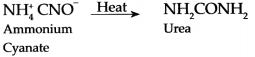
Preparation of urea from Ammonium cyanate:
Solution & Step-by-Step Answer:
Organic compound Urea can be synthesized from an inorganic compound Ammonium cyanate.
Question 2
Maharashtra Board Solution
Coal when burnt in air
Solution & Step-by-Step Answer:
When coal is burnt in air, the carbon present in coal combines with oxygen present in air to form carbon dioxide gas.
Question 3
Maharashtra Board Solution
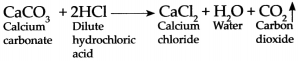
Calcium carbonate reacts with dilute hydrochloric acid:
Solution & Step-by-Step Answer:
When Calcium carbonate reacts with dilute hydrochloric add it forms Caldum chloride, water and Carbon dioxide gas is evolved.
Question 4
Maharashtra Board Solution
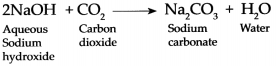
Carbon dioxide is passed through an aqueous solution of Sodium hydroxide:
Solution & Step-by-Step Answer:
When Carbon dioxide gas is passed through an aqueous solution of Sodium hydroxide it forms Sodium carbonate and Water.
Question 5
Maharashtra Board Solution
Carbon dioxide is passed through an aqueous solution of Sodium carbonate:
Solution & Step-by-Step Answer:
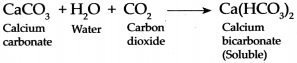
When carbon dioxide is passed through an aqueous solution of Sodium carbonate, it forms Sodium bicarbonate.
Question 6
Maharashtra Board Solution
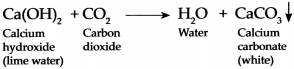
Carbon dioxide is passed through freshly prepared lime water for a short duration and then for longer duration:
Solution & Step-by-Step Answer:
When Carbon dioxide is passed through freshly prepared lime water, it forms water and white precipitate of Calcium carbonate because of which lime water turns milky.
Question 7
Maharashtra Board Solution
Carbon dioxide gas is dissolved in water.
Solution & Step-by-Step Answer:
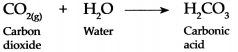
Carboh dioxide gas is fairly soluble in water, it dissolves in water under pressure to form Carbonic acid.
Question 8
Maharashtra Board Solution
Sodium bicarbonate reacts with dilute Sulphuric acid, (reaction in fire extinguisher):
Solution & Step-by-Step Answer:
When Sodium bicarbonate reacts with dilute Sulphuric acid it forms Sodium sulphate, water and Carbon dioxide gas.
Question 9
Maharashtra Board Solution
Methane gas is burnt in air:
Solution & Step-by-Step Answer:
Methane is highly inflammable, it burns in air with a bluish flame and combines with oxygen present in air to form Carbon dioxide and water. In these reaction 213 kcal/mol of heat is given out.
Question 10
Maharashtra Board Solution
Methane and Chlorine gases react with each other.
Solution & Step-by-Step Answer:
Methane and chlorine gases react with each other at the temperature of 250 °C to 400 °C in presence of ultra voilet light and form mainly Methyl chloride (Chloromethane and ‘ Hydrogen chloride) This reaction is called Chlorination of methane.
Question 11
Maharashtra Board Solution
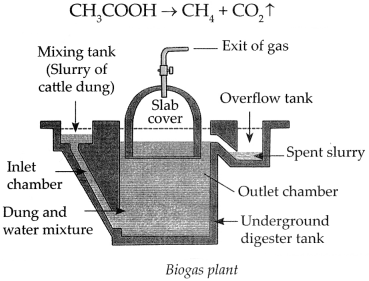
Production of methane gas in biogas plant.
Solution & Step-by-Step Answer:
In biogas plant, microbes act on the bio-degradable complex organic compounds and produce organic acids.
The methanogenic bacteria act on the organic acids to produce Methane gas and Carbon dioxide gas.
Question 12
Maharashtra Board Solution
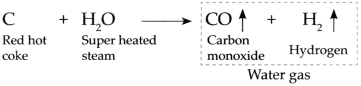
Production of water gas:
Solution & Step-by-Step Answer:
When super heated steam is passed over red hot coke at high temperature, it forms carbon monoxide gas and hydrogen gas.
This gaseous product of carbon monoxide gas and hydrogen gas together is called as water gas. With the help of ne abelled diagram explain the following:
Question 1
Maharashtra Board Solution
Regular fire extinguisher.
Solution & Step-by-Step Answer:
Question 2
Maharashtra Board Solution
Biogas plant.
Solution & Step-by-Step Answer:
Chemical reaction:
Answer the following
Question 1
Maharashtra Board Solution
What happens when substances like milk, sugar, wool, dry leaves, hair and seeds are heated strongly in hard glass test tube?
Solution & Step-by-Step Answer:
When milk, sugar, wool, dry leaves, hair and seeds are heated strongly in hard glass test tube, they get charred and a black substance is left behind. This black substance is carbon.
Answer the following questions:
Question 1
Maharashtra Board Solution
Take some milk in an evaporating dish. Heat the evaporating dish on a bunsen burner. What remains behind at the bottom of an evaporating dish on complete evaporation of the milk?
Solution & Step-by-Step Answer:
Question 2
Maharashtra Board Solution
Take small samples of sugar, wool, dry leaves, hair, seeds, split pulses and plastic in separate test tubes. Heat each test tube and observe the changes taking place in the substances. What does the black substance in each test tube indicate?
Solution & Step-by-Step Answer:
Question 3
Maharashtra Board Solution
Apparatus : Coal, match box, moist litmus paper, etc. |






Procedure : Ignite the coal. Hold the moist blue litmus paper over the gas released on igniting the coal. Note the observation.
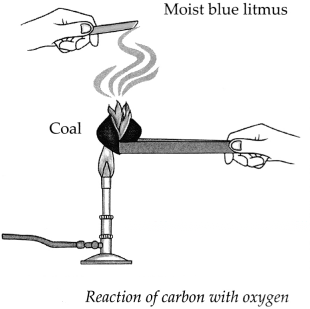
(a) With which gas in the air does the coal react on igniting?
Coal reacts with oxygen gas present in the air, on igniting.
(b) What is the substance formed?
Answer:
The substance formed is carbon dioxide.
(c) What change takes place in the litmus paper?
Answer:
The moist blue litmus paper turns red.
(d) Write down the chemical reaction taking place in the above procedure.
Answer:
(i) Carbon combines with oxygen to form Carbon dioxide gas.
(ii) This C02 combines with water present on moist blue litmus paper to form Carbonic acid which turns blue litmus to red.


Question 4
Maharashtra Board Solution
Apparatus : Pencil, electrical wires, battery/ cell, small bulb, water, kerosene, test tube, lead pencils, etc.
Procedure : Remove the lead from a pencil and arrange the apparatus as shown in the above diagram. Note your observations for the following.
(a) What is the colour of lead in the pencil?.
Solution & Step-by-Step Answer:
The colour of the lead in the pencil is black as it is made from graphite which is an allotrophic form of carbon.
(b) Try to break lead with your hand. (c) Start the electric current in the circuit and observe. What did you find? (d) Take some water in a test tube. Take some kerosene in another test tube. Put lead dust in both the test tube. What did you observe?
Question 5
Maharashtra Board Solution
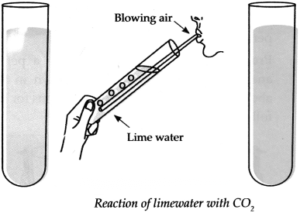
Apparatus : Test tube, straw, lime water, etc. |
Procedure: Take freshly prepared lime water in a test tube. Blow air in it for some time through the straw and observe the lime water. Note the observation.
(a) What did you see?
When we blow air through the straw in freshly prepared lime water, it turns milky.
(b) What might be the reason behind the change?
Answer:
Freshly prepared lime water is obtained by dissolving lime (CaO) in water (H2O).

When we blow air through the straw in lime water, carbon dioxide (CO2) present in the air reacts with lime water to form white precipitate (insoluble substance) of Calcium Carbonate (CaCO3) due to which lime water turns milky.

Question 6
Maharashtra Board Solution
With the help of a neat labelled diagram explain the laboratory preparation of Carbon dioxide gas.
Solution & Step-by-Step Answer:
The laboratory preparation of Carbon dioxide gas is as follows:
Apparatus : Retort stand, round bottom flask, thistle funnel, gas delivery tube, gas jars. Procedure: |