Maharashtra State Board Class 9 Science Solutions Chapter 5 Acids, Bases and Salts
Class 9 Science Chapter 11 Reflection of Light Textbook Questions and Answers
1. Answer the following questions.
a. Explain the difference between a plane mirror, a concave mirror and a convex mirror with respect to the type and size of the images produced.
Answer:
Plane mirror | Concave mirror | Convex mirror | |
Type of image | Virtual and Erect | Virtual (erect) as well as Real (inverted) | Virtual and Erect |
Size of image | Same size | Diminished, Same size and magnified | Diminished |
b. Describe the positions of the source of light with respect to a concave mirror in
1. Torch light
2. Projector lamp
3. Floodlight
Answer:
(a) Torch light: The source of light is placed at the focus.
(b) Projector lamp : The source of light is placed at the centre of curvature.
(c) Flood light : The source of light is placed just beyond the centre of curvature.
c. Why are concave mirrors used in solar devices?
Answer:
d. Why are the mirrors fitted on the outside of cars convex?
Answer:
e. Why does obtaining the image of the sun on a paper with the help of a concave mirror burn the paper?
Answer:
f. If a spherical mirror breaks, what type of mirrors are the individual pieces?
Answer:
2. What sign conventions are used for reflection from a spherical mirror?
Answer:
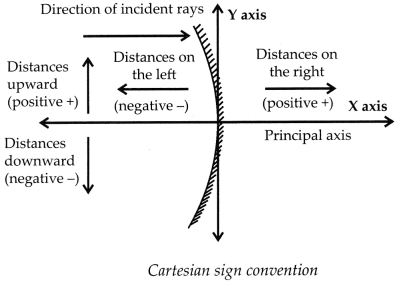
According to the Cartesian sign convention, the pole of the mirror is taken as the origin. The principal axis is taken as the X-axis of the frame of reference. The sign conventions are as follows.
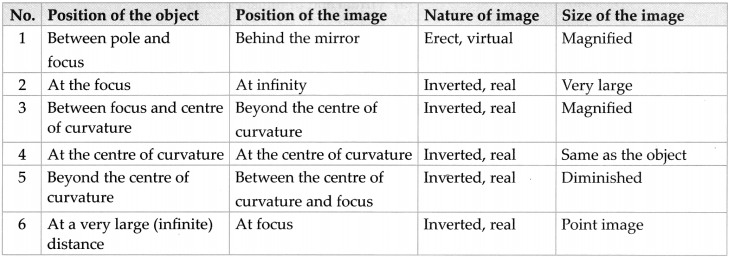
3. Draw ray diagrams for the cases of images obtained in concave mirrors as described in the table on page 122.
Answer:
(a) A ray diagram for object at infinity for a concave mirror.
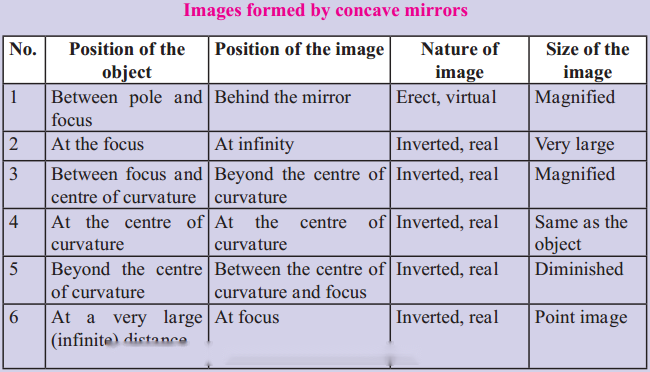
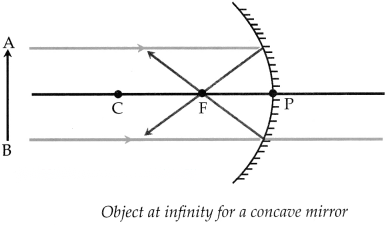
Image position | Nature of image |
At focus | Real, inverted and point image |
(b) A ray diagram for object beyond centre of curvature for a concave mirror.
An object beyond centre of curvature for a concave mirror
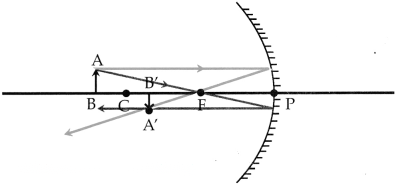
Image position | Nature of image |
Between the centre of curvature and focus. | Real, inverted and diminished. |
(c) A ray diagram for object at the centre of curvature for a concave mirror.
Object at centre of Curva fu re be a concave mirror.
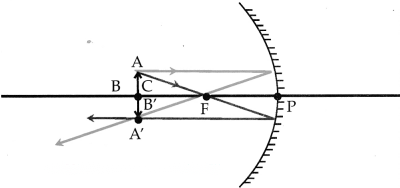
Image position | Nature of image |
At the centre of curvature. | Real, inverted and same size |
(d) A ray diagram for object between F and C for a concave mirror.
Object between F & C for a concave mirror
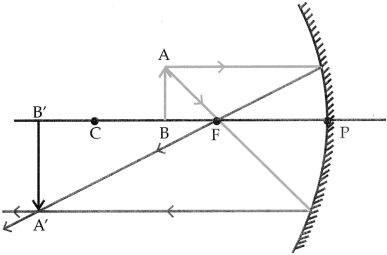
Image position | Nature of image |
Beyond the centre of curvature. | Real, inverted and magnified. |
(e) A ray diagram for obj ect at focus for a concave mirror.
Object at focus for a concave mirror.
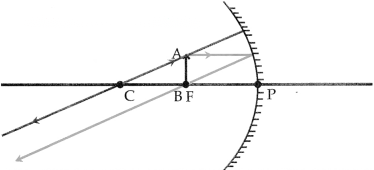
Image position | Nature of image |
At infinity. | Real, inverted and highly magnified. |
(f) A ray diagram for object between pole and focus for a concave mirror.
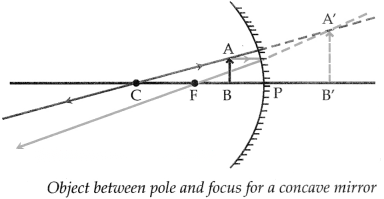
Image position | Nature of image |
Behind the mirror. | Virtual, erect and magnified. |
4. Which type of mirrors are used in the following?
Periscope, floodlights, shaving mirror, kaleidoscope, street lights, headlamps of a car.
Answer:
Objects | Type of Mirror |
Periscope | Plane mirror |
Floodlights | Concave mirror |
Shaving mirror | Concave mirror |
Kaleidoscope | Plane mirror |
Street lights | Convex mirror |
Head lamps of car | Concave mirror |
5. Solve the following examples
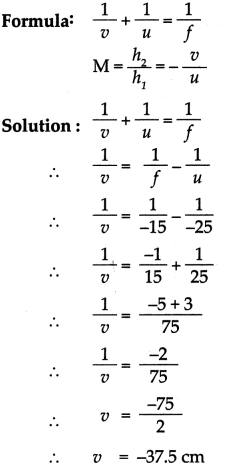
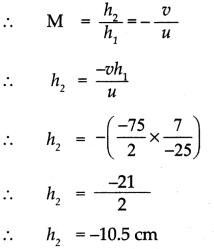
a. An object of height 7 cm is kept at a distance of 25 cm in front of a concave mirror. The focal length of the mirror is 15 cm. At what distance from the mirror should a screen be kept so as to get a clear image? What will be the size and nature of the image?
Solution:
Given: Object size (h1) = 7 cm
Object distance (u) = -25 cm
Focal length (f) = -15cm
To find: Image distance (u) = ?
Image size (h2) = ?
The screen should be kept 373 cm in front of the mirror. The image is real.
The height of the image is 10.5 cm, it is an inverted and enlarged image.
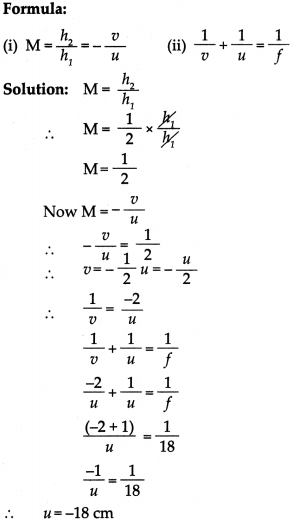
b. A convex mirror has a focal length of 18 cm. The image of an object kept in front of the mirror is half the height of the object. What is the distance of the object from the mirror?
Solution:
Given: Image size (h2) =1/2h1
Focal length (f) = 18 cm
To find: Object distance (u) ?
The object is placed in front of the convex mirror at a distance of 18 cm.
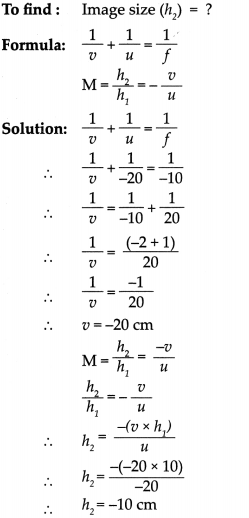
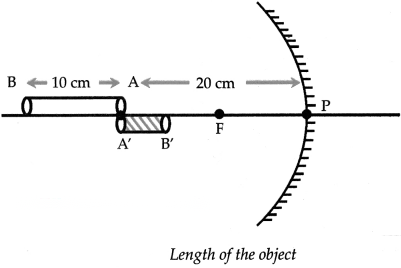
c. A 10 cm long stick is kept in front of a concave mirror having focal length of 10 cm in such a way that the end of the stick closest to the pole is at a distance of 20 cm. What will be the length of the image?
Solution:
Given: Object size (h1) = 10 cm
Object distance (u) = -20 cm
Focal length (f) = -10 cm
The height of the image is 10 cm and it is a real and inverted image.
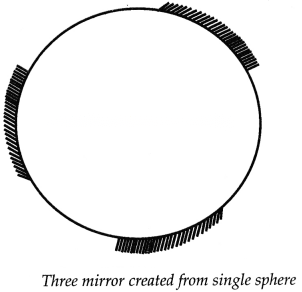
6. Three mirrors are created from a single sphere. Which of the following:
pole, centre of curvature, radius of curvature, principal axis – will be common to them and which will not be common?
Answer:
Class 9 Science Chapter 11 Reflection of Light Intext Questions and Answers
Class 9 Science Chapter 11 Reflection Of Light Question 1.
What is light
Answer:
Light is a form of electromagnetic radiation that produces the sensation of vision.
9th Class Science Chapter 11 Reflection Of Light Exercise Question 2.
What is a mirror?
Answer:
A mirror is a reflecting surface which reflects light and creates clear images.
9th Class Science Chapter 11 Reflection Of Light Exercise Answer Question 3.
Principal Focus of Concave and Convex Mirror.
Answer:
Principal Focus of the Concave Mirror | Principal Focus of the Convex Mirror |
(i) Incident rays which are parallel to the principal axis of a concave mirror, after reflection from the mirror, meet at a particular point in front of the mirror on the principal axis. This point (F) is called the principal focus of the concave mirror. | (i) Incident rays parallel to the principal axis, after reflection, appear to come from a particular point behind the mirror lying along the principal axis. This point is called the principal focus of the convex mirror. |
9th Class Science Chapter 11 Reflection Of Light Notes Question 4.
If we hold a page of a book in front of a mirror, we see laterally inverted letters in the mirror. Why does it happen?
Answer:
11 Reflection Of Light Exercise Question 5.
Which letters of the English alphabet form images that look the same as the original letters?
Answer:
A, H, I, M, O, T, U, V, W, X, Y
9th Science Chapter 11 Reflection Of Light Exercise Question 6.
When a person stands in front of a plane mirror, how is the image formed? What is the nature of the image?
Answer:
Answer the following questions:
Reflection Of Light Class 9 Questions And Answers Question 1.
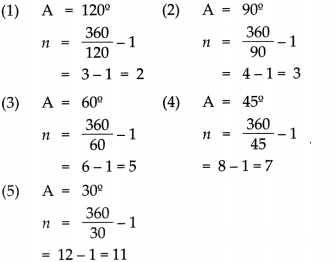
Place two plane mirrors at an angle of 90a to each other. Place a small object between them. Images will be formed in both mirrors. How many images do you see? Now change the angle between the mirrors as given in the following table and count the number of images each time. How is this number related to the measure of the angle?
Answer:
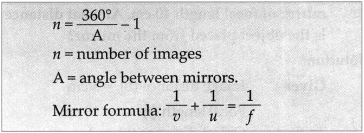
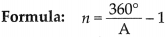
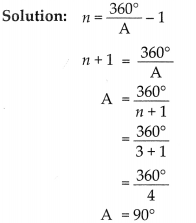
The Relation between the angle between the mirrors and the number of images formed is given by
n = number of images,
A = angle between the mirrors
Angle | Number of images |
120° | 2 |
90s | 3 |
60® | 5 |
45® | 7 |
30® | 11 |
Class 9 Science Chapter 11 Reflection of Light Additional Important Questions and Answers
Can you recall?
9th Class Science Chapter 11 Reflection Of Light Question 1.
What is meant by reflection of light and what are the types of reflection?
Answer:
The bouncing back of light when it hits an opaque surface is called reflection of light. The two types of reflection are regular and irregular reflection.
Reflection Of Light Class 9 Exercise Answers Question 2.
What are the laws of reflection.
Answer:
Choose and the correct option:
Class 9th Science Chapter 11 Reflection Of Light Question Answer Question 1.
If the reflected rays do not actually meet, such an image is called as image.
(a) real
(b) virtual
(c) magnified
(d) inverted
Answer:
(b) virtual
Class 9 Science Chapter 11 Reflection Of Light Exercise Solutions Question 2.
In a plane mirror, the perpendicular distance of the image from the mirror is equal to
(a) the perpendicular distance of the source from the object.
(b) the perpendicular distance of the source from the mirror.
(c) the parallel distance of the source from the object.
(d) the parallel distance of the source from the mirror.
Answer:
(b) the perpendicular distance of the source from the mirror
Reflection Of Light Class 9 Notes Pdf Maharashtra Board Question 3.
The image formed in a convex mirror is always
(a) virtual, smaller and behind the mirror
(b) virtual, smaller and in front of the mirror
(c) real, smaller and behind the mirror
(d) real, smaller and in front of the mirror
Answer:
(a) virtual, smaller and behind the mirror
Reflection Of Light Class 9 Solutions Question 4.
images can be displayed on a screen.
(a) Virtual
(b) Real
(c) Virtual and erect
(d) Virtual and inverted
Answer:
(b) Real
9th Class Science Chapter 11 Reflection Of Light Exercise Pdf Question 5.
A concave mirror is also called as a mirror.
(a) converging
(b) diverging
(c) plane
(d) outward curved
Answer:
(a) converging
9th Science Chapter 11 Reflection Of Light Question 6.
The centre of the mirror surface is called its
(a) pole
(b) centre of curvature
(c) principal axis
(d) focus
Answer:
(a) pole
Class 9 Science Chapter 11 Question Answer Reflection Of Light Question 7.
According to the new sign convention, the of the mirror is taken as origin.
(a) focus
(b) pole
(c) optical centre
(d) centre of curvature
Answer:
(b) pole
Class 9 Science Chapter 11 Reflection Of Light Exercise Question 8.
A convex mirror is also called as a mirror.
(a) converging
(b) plane
(c) diverging
(d) inward curved
Answer:
(c) diverging
Reflection Of Light Class 9 Maharashtra Board Question 9.
In order to see the full image of a person standing in front of a mirror, the minimum height of the mirror must be
(a) same height as that of the person
(b) double the height of the person
(c) half the height of the person
(d) quarter the height of the person
Answer:
(c) half the height of the person
Reflection Of Light Exercise 9th Class Question 10.
If the inner surface of the spherical mirror is reflecting, then it is a mirror, and if the outer surface is reflecting then it is mirror.
(a) convex, concave
(b) convex, plane
(c) concave, plane
(d) concave, convex
Answer:
(d) concave, convex
9th Std Science Chapter 11 Reflection Of Light Question 11.
The image formed by a concave mirror is
(a) always virtual and erect
(b) always virtual and inverted
(c) virtual if the object is placed between the pole and the focus
(d) virtual if the object is beyond the focus
Answer:
(c) virtual if the object is placed between the pole and the focus
Find the odd man out:
Answer the following in one sentence:
Match the columns:
Column ‘A’ | Column ‘B’ |
(1) Plane mirror | (a) Rear view mirror |
(2) Concave mirror | (b) At laughing gallery |
(3) Convex mirror | (c) At a hair dresser |
(4) Irregularcurved mirror | (d) At a dentist |
(1 – c),
(2 – d),
(3 – a),
(4 – b)
Question 2
Maharashtra Board Solution
Solution & Step-by-Step Answer:
(1 – b),
(2 – c), (3 – a) State whether the following statements are true or false. Correct the false statements: (1) If the mirrors are kept at right angle to each other, then the number of images formed will be 4. Give scientific reasons:
Question 1
Maharashtra Board Solution
A concave mirror is called a converging mirror.
Solution & Step-by-Step Answer:
Question 2
Maharashtra Board Solution
Concave mirrors are used in torches and in car headlights.
Solution & Step-by-Step Answer:
Question 3
Maharashtra Board Solution
A dentist uses a concave mirror while examining teeth.
Solution & Step-by-Step Answer:
Solve the following numerlcals. Tips for solving numerical: Type – A
Question 1
Maharashtra Board Solution
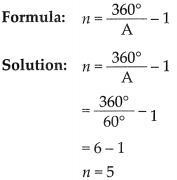
A bird is sitting in front of two plane mirrors inclined at an angle of 600 to each other. How many images does the bird see in the mirror?
Solution & Step-by-Step Answer:
Given : Angle between mirror A = 600 To find: Number of images formed n = ? The brrd sees 5 images in the mirror.
Question 2
Maharashtra Board Solution
A coin is kept in front of two plane mirrors inclined to each other. If 3 images of the coin are seen then what is the angle A between the mirrors?
Solution & Step-by-Step Answer:
Given: no. of images formed n =3 To find: Angle between mirror A =? The mirrors are inclined atan angle of 900 to each other.
Question 3
Maharashtra Board Solution
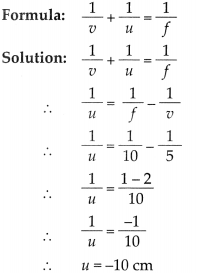
An image is formed 5 cm behind a convex mirror of focal length 10 cm. At what distance is the object placed from the mirror?
Solution & Step-by-Step Answer:
Given: Image distance (u) = 5 cm Focal length (f) = 10 an To find: Object distance (u) = ? The object is placed at a distance of 10 cm in front of the mirror.
Question 4
Maharashtra Board Solution
An object placed 20 cm in front of a convex mirror is found to have an image 15cm behind the mirror. Find the focal length of the mirror.
Solution & Step-by-Step Answer:
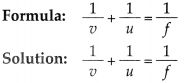
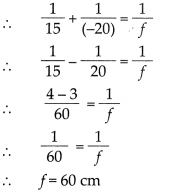
Given: Object distance (u) = -20 cm Image distance (u) = 15 cm To find: focal length (f) = ? The focal length of the convex mirror is 60 cm.
Numerical For Practice
Question 5
Maharashtra Board Solution
An object is placed at a distance of 36 cm from a concave mirror of focal length 12 cm. Find the image distance.
Solution & Step-by-Step Answer:
-18 cm
Question 6
Maharashtra Board Solution
An arrow is placed at a distance of 25 cm from a diverging mirror of focal length 20 cm. Find the image distance.
Solution & Step-by-Step Answer:
11.1 cm
Type – B
Question 1
Maharashtra Board Solution
An object 4cm in height is placed at a distance of 36 cm from a concave mirror. The image is formed 18 cm in the front of the mirror. Find the height of the image.
Solution & Step-by-Step Answer:
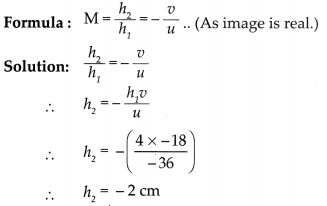
Given: Object height (h1) = 4 cm Image distance (u) = -18 cm Object distance (u) = -36 cm To find: Height of image (h2) = ? The height of the image is 2 cm and it is inverted.
Question 2
Maharashtra Board Solution
An object 2 cm high is placed at a distance of 16cm from a concave mirror which produces a real image 3 cm high. Find the image distance.
Solution & Step-by-Step Answer:
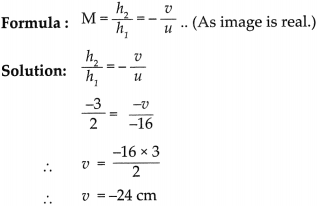
Given: Object height (h1) = 2 cm Object distance (u) = -16 cm Image height (h2) = -3 cm To find: Image distance (u) = ? The image is formed at a distance of 24 cm in front of the mirror.
Numericals For Practice
Question 3
Maharashtra Board Solution
An object 10cm in height is placed at a distance of 36 cm from a concave mirror. 1f the image is formed at a distance of 18 cm in front of the mirror, find the height of the image.
Solution & Step-by-Step Answer:
-5cm
Question 4
Maharashtra Board Solution
A converging mirror forms a real image of height 4 cm of an object of height 1 cm placed 20 cm away from the mirror. Find the image distance.
Solution & Step-by-Step Answer:
-80cm
Type – C
Question 1
Maharashtra Board Solution
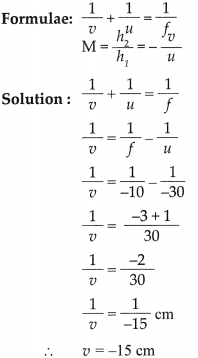
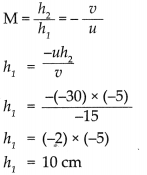
Rajashree wants to get an inverted image of height 5 cm of an object kept at a distance of 30 cm from a concave mirror. The focal length of the mirror is 10 cm. At what distance from the mirror should she place the screen? What will be the type of the image, and what is the height of the object?
Solution & Step-by-Step Answer:
Given: Focal length = f = -10 cm, Object distance = u = -30 cm Height of the image = h2 = 7 cm To find: Height of the object = h1 = ? Image distance = u =? Rajashree has to place the screen 15 cm to the left of the mirror. Magnification formula The height of the object is 10 cm. Thus, the image will be real and diminished.
Question 2
Maharashtra Board Solution
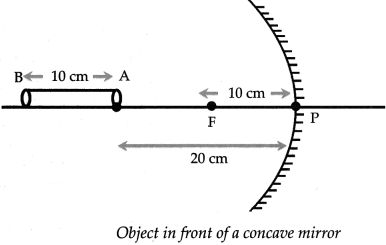
A 10 cm long stick is kept horizontally in front of the concave mirror having focal length of 10 cm in such a way that the end of the stick closest to the pole is at a distance of 20 cm. What will be the length of the image?
Solution & Step-by-Step Answer:
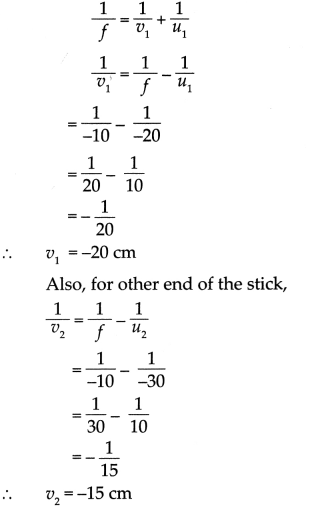
The stick is kept parallel to the Principal axis. Distance between A and P is 20 cm. Say u1 = 20 cm. Hence, the other end of the stick is at distance, u2 = (u1 + 10) = 30 cm from pole of the mirror. Using mirror formula for concave mirror, Solution: Here, negative signs indicate that images are formed on the left of the mirror.
The length of the image formed ?s given by, u = u2– u1= 15 – (-20) = 5cm. Numerical For Practice
Question 3
Maharashtra Board Solution
An object 2 cm in height is placed at a distance of 16 cm from a concave mirror. If the focal length of the mirror is 9.6 cm., find the image distance, nature and size of the image.
Solution & Step-by-Step Answer:
u = -24 an, h2 = -3 cm; real, inverted and enlarged.
Question 4
Maharashtra Board Solution
An arrow of 2.5cm height is placed at a distance of 25 cm from a diverging mirror of focal length 20 cm. Find the nature, position and size of the image formed.
Solution & Step-by-Step Answer:
v = 11.1cm, h1 = 1.1cm; virtual and in dimirrished form.
Define the following:
Question 1
Maharashtra Board Solution
Centre of curvature of mirror (C) Ans. The centre of the sphere of which the mirror is a parte is called the centre of curvature of the mirror. |

Question 2
Maharashtra Board Solution
The radius of curvature (R)
Solution & Step-by-Step Answer:
block bg-white dark:bg-slate-900/80 border-l-4 border-emerald-500 rounded-r-xl p-5 my-3 shadow-xs border border-slate-200/60 dark:border-slate-800">
Solution & Step-by-Step Answer:
The radius of the sphere of which the mirror is a part, is called the radius of curvature of the mirror.
Question 3
Maharashtra Board Solution
Pole (P)
Solution & Step-by-Step Answer:
The centre of the mirror surface is called its pole.
Question 4
Maharashtra Board Solution
The principal axis of a mirror
Solution & Step-by-Step Answer:
The straight line passing through the pole and centre of curvature of the mirror is called its principal axis.
Question 5
Maharashtra Board Solution
The focus of a concave mirror (F)
Solution & Step-by-Step Answer:
Incident rays which are parallel to the principal axis of a concave mirror, after reflection from the mirror, meet at a particular point in front of the mirror on the principal axis. This point (F) is called the principal focus of the concave mirror.
Question 6
Maharashtra Board Solution
Focus of a convex mirror (F)
Solution & Step-by-Step Answer:
Incident rays parallel to the principal axis, after reflection, appear to come from a particular point behind the mirror lying along the principal axis. This point is called the principal focus of the convex mirror.
Question 7
Maharashtra Board Solution
Focal length of a mirror (f)
Solution & Step-by-Step Answer:
The distance (f) between the pole and the principal focus of the mirror is called the focal length. This distance is half of the radius of curvature of the mirror.
Answer the following in short:
Question 1
Maharashtra Board Solution
What are the rules for drawing ray diagrams for the formation of image by spherical mirror?
Solution & Step-by-Step Answer:
The rules are as follows :
Distinguish between:
Question 1
Maharashtra Board Solution
Convex mirror and Concave mirror
Solution & Step-by-Step Answer:
Question 2
Maharashtra Board Solution
Real image and Virtual image
Solution & Step-by-Step Answer:
Answer the following questions:
Question 1
Maharashtra Board Solution
If we keep the mirrors parallel to each other, how many images will we see ?
Solution & Step-by-Step Answer:
When two mirrors are kept parallel to each other infinite images are formed, this is because light gets reflected infinite times.
Answer in detail:
Question 1
Maharashtra Board Solution
What sign conventions are used for reflection from a spherical mirror?
Solution & Step-by-Step Answer:
According to the Cartesian sign convention, the pole of the mirror is taken as the origin. The principal axis is taken as the X-axis of the frame of reference. The sign conventions are as follows.
Question 2
Maharashtra Board Solution
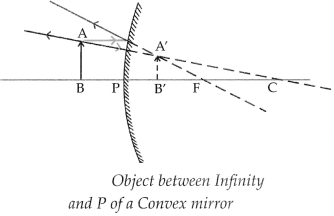
Draw ray diagrams for the image obtained in convex mirrors.
Solution & Step-by-Step Answer:
Question 3
Maharashtra Board Solution
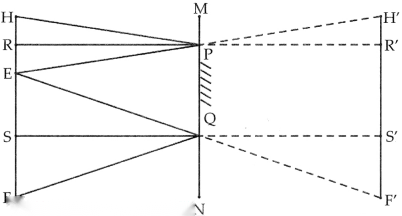
In order to see the full image of a person standing in front of a mirror, the minimum height of the mirror must be half the height of the person. Explain.
Solution & Step-by-Step Answer:
Proof: For this, RP and QS must be perpendicular to the mirror. Minimum height of the mirror
Question 4
Maharashtra Board Solution
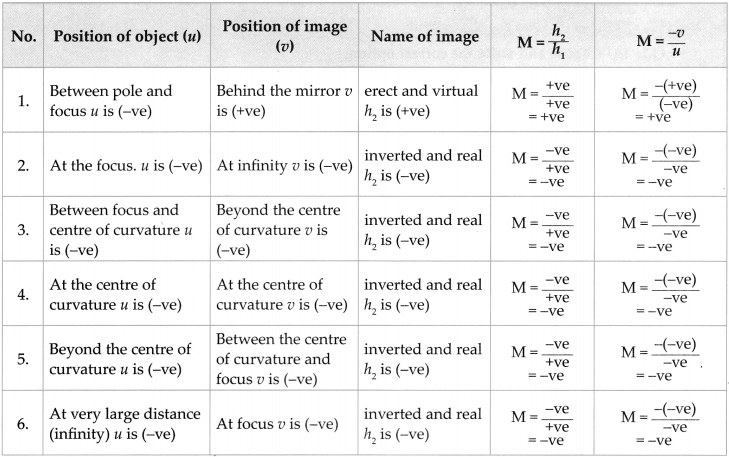
Determine the sign of magnification in each of the 6 cases in the table and verify that they are same using formulae and
Solution & Step-by-Step Answer:
Question 5
Maharashtra Board Solution
Explain the images formed by concave mirrors with respect to position of the image and object and also the Nature and size of image
Solution & Step-by-Step Answer:
|