Maharashtra State Board Class 9 My English Coursebook Solutions Chapter 3.1 Coromandel Fishers
My English Coursebook Std 9 Guide Chapter 3.1 Coromandel Fishers Textbook Questions and Answers
Warming up:
Chit-chat
Expanding Horizons
Question (a)
Write as many words as you can, related to the following. You should have at least twenty words each. You may refer to your geography textbook or other sources for that purpose. Then try to find English words/items for the ones you have written.
Answer:
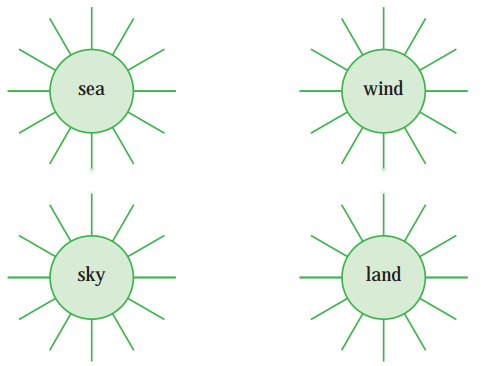
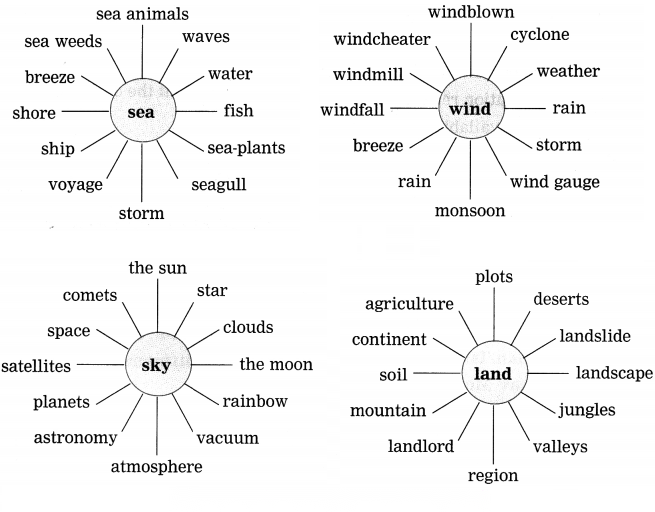
Question (b)
Prepare a bilingual glossary for each of these topics:
Question (c)
Arrange the glossary in two ways:
1. According to the alphabetical order of letters in your mother tongue.
2. According to the alphabetical order ‘a-z’
[Students may attempt (b) & (c) above on ther own.
English Workshop:
Answer the following questions.
Question (a)
How many stanzas are there in the poem?
Answer:
There are three stanzas in the poem.
Question (b)
How many lines are there in the poem?
Answer:
There are twelve lines in the poem.
Question (c)
List the rhyming words in each stanza:
Answer:
2.You know that many poems have rhyming words or rhymes at the end of the lines in each stanza. The pattern of rhyming is usually shown with the help of small letters such as ‘a’, ‘b’, ‘c’, etc. This pattern of rhyme is known as the rhyme scheme. The rhyme scheme of each stanza in this poem is aabb. Verify.
3. What do the following expressions refer to? Write in a word or phrase:
Question 1
Maharashtra Board Solution
What do the following expressions refer to? Write in a word or phrase: |
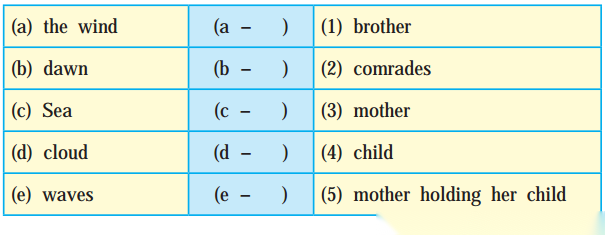
4. Match the following:
Question 1
Maharashtra Board Solution
Match the following:
Solution & Step-by-Step Answer:
(a) the wind – child (b) dawn – mother holding her child (c) sea – mother (d) cloud – brother (e) waves – comrades
5. Find and write the lines in the poem that refer to:
Question 1
Maharashtra Board Solution
Find and write the lines in the poem that refer to: (a) early morning (b) evening (c) full moon night
Solution & Step-by-Step Answer:
(a) early morning: Rise, brother, rise; the wakening skies pray to the morning light. (b) evening: What though we toss at the fall of the sun where the hand of the sea-god drives? (b) full moon light: And sweet are the sands at the full o’ the moon with the sound of the voices we love
6. Write the lines that show that the fishermen are not afraid of the sea or of drowning.
Question 1
Maharashtra Board Solution
Write the lines that show that the fishermen are not afraid of the sea or of drowning.
Solution & Step-by-Step Answer:
He who holds the storm by the hair, will hide in his breast our lives.
7. In the last stanza, two lines refer to a landscape, and two lines refer to a ‘seascape’. Which are they? Copy them from the poem correctly:
Question 1
Maharashtra Board Solution
In the last stanza, two lines refer to a landscape, and two lines refer to a ‘seascape’. < Which are they? Copy them from the poem correctly:
Solution & Step-by-Step Answer:
8. Using the internet, find photographs /pictures of landscapes /seascapes to illustrate the images used in the poem.
Question 1
Maharashtra Board Solution
Using the internet, find photographs /pictures of landscapes /seascapes to illustrate the images used in the poem. |

9. Select a few lines from your favourite nature poem in your mother tongue and translate them into English.
Question 1
Maharashtra Board Solution
Select a few lines from your favourite nature poem in your mother tongue and translate them into English.
Solution & Step-by-Step Answer:
block bg-white dark:bg-slate-900/80 border-l-4 border-emerald-500 rounded-r-xl p-5 my-3 shadow-xs border border-slate-200/60 dark:border-slate-800">
Solution & Step-by-Step Answer:
1. Title: Coromandel Fishers 2. Poet/Poetess: This poem is written by Sarojini Naidu.
3. Theme/Central Idea: The theme of the poem is that when human beings come together for a common purpose, no force or adversary can adversary can block their way. There could be risk in any challenging enterprise, but human progress depends on facing them courageously. 4. Rhyme Scheme: The rhyme scheme of the poem is ‘aabb’. 5. Figure of Speech: Simile, Metaphor 6. Special Feature: This is a didactic poem. A didactic poem is an instructive one. It is aimed at imparting certain advice or some moral principles. “When we come together for a common purpose and put our faith in God, we can accomplish great things” – This is the moral principle of this poem. 7. Favourite Lines: My favourite lines from the poem are : 8. Why I like the poem: I like this poem because it imparts a very positive message. It says that if we trust in God and do our work promptly, success is ours. My English Coursebook 9th Class Solutions Chapter 3.1 Coromandel Fishers Additional Important Questions and Answers Simple Factual Activities:
Question 1
Maharashtra Board Solution
Who holds the storm by the hair?
Solution & Step-by-Step Answer:
God holds the storm by the hair.
Question 2
Maharashtra Board Solution
What type of boat do the fishermen use?
Solution & Step-by-Step Answer:
The fishermen use catamaran boats.
Complex Factual Activities :
Question 1
Maharashtra Board Solution
As the sea-gull flies away calling it appears as though, he is showing the way-What does the way lead to?
Solution & Step-by-Step Answer:
The way leads the fishermen to the sea where plenty of fish can be caught.
Paragraph format: The title of the poem is ‘Coromandel Fishers.’ The poem is written by Sarojini Naidu. The theme of the poem is that when human beings come together for a common purpose, no force or adversary can block their way. There could be risk in any challenging enterprise, but human progress depends on facing them courageously. The fishermen in the poem prove this fact. The rhyme scheme of the poem is ‘aabb’. The figures of speech in the poem are simile and Metaphor. The special feature of this poem is that it a didactic poem. It is an instructive poem which is aimed at imparting certain advice or some moral principles. “ When we come together for a common purpose and put our faith in God, we can accomplish great things. ” This is the moral principle of this poem. My favourite lines from the poem are: 1. “He who holds the storm by the hair, will hide in his breast our lives.” This line shows the fishermen put their full faith in the sea-god. |