Maharashtra State Board Class 9 English Kumarbharati Solutions Chapter 1.5 The Necklace
English Kumarbharati 9th Solutions Chapter 1.5 The Necklace Textbook Questions and Answers
Warming up :
Talking About Myself :
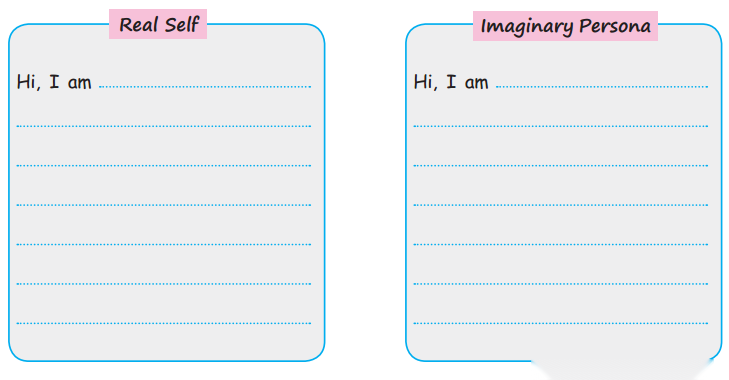
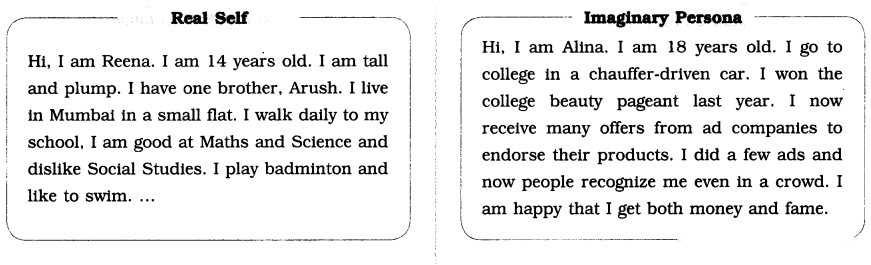
1. Write a few lines about yourself – your name, appearance, family, the place where you live, your school, your friends, neighbours, relatives, your likes, dislikes, hobbies, what you are good at, etc.
Now create an imaginary ‘persona’ for yourself. It can be quite different from your real self. Or, you may choose a fictional character – a character from a novel, story, etc. Write a few lines about this imaginary persona and introduce yourself in that role.
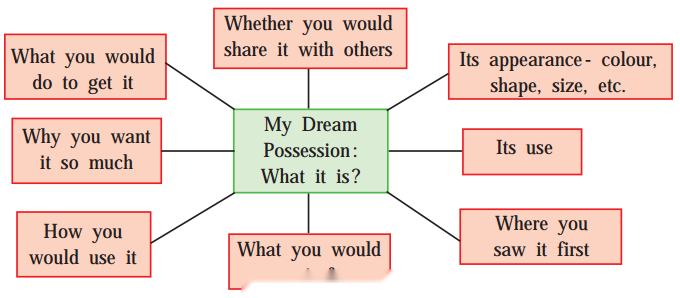
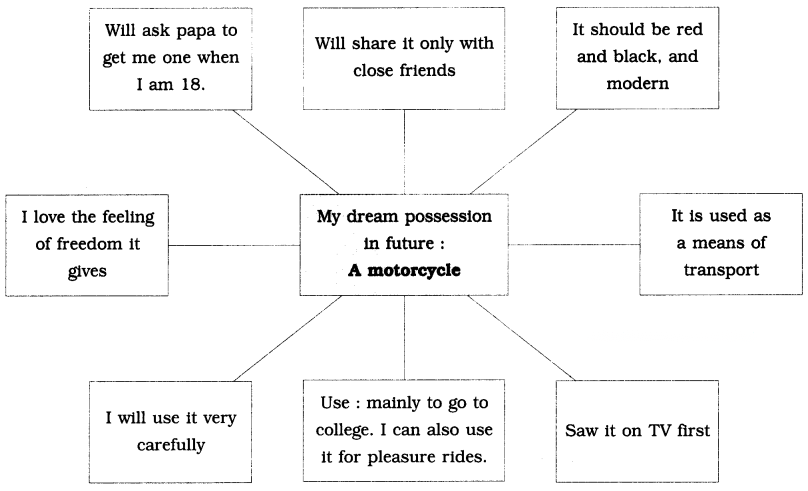
My Dream Possession :
Is there something that you would like to own more than anything else? Describe your dream possession with the help of the following points. You may add your own points, too.
Part – I
English Workshop :
1. Read each of the following sentences aloud. Write who said it and to whom.
(a) “Look, here’s something for you.”
(b) “Why, the dress you go to the theatre in!”
(c) “I would rather not go to the party.”
(d) “Choose, my dear.”
(e) “You have nothing else?”
(f) “Would you lend lue this, just this?”
(g) “What ! … how ! … That’s impossible!”
Question a.
“Look, here’s something for you.”
Answer:
Mathilde’s husband said this to Mathilde.
Question b.
“Why, the dress you go to the theatre in!”
Answer:
Mathilde’s husband said this to Mathilde.
Question c.
“I would rather not go to the party.”
Answer:
Mathilde said this to her husband.
Question d.
“Choose, my dear.”
Answer: Madame Forestier said this to Mathilde.
Question e.
“You have nothing else?”
Answer:
Mathilde said this to Madame Forestier.
Question f.
“Would you lend me this, just this?”
Answer:
Mathilde said this to Madame Forestier.
2. Write a few lines about what Mathilde had and what she dreamt about.
3. Write what you think about the following thoughts and actions of Mathilde.
(a) Mathilde was beautiful, and so she wanted to marry an aristocrat.
(b) Mathilde was sad because she did not get any luxuries.
(c) Mathilde felt that her house was shabby and poorly furnished.
(d) Mathilde wanted other people to envy her.
(e) Mathilde was not happy to see the invitation.
(f) Mathilde wanted a new dress for herself.
(g) Mathilde borrowed a diamond necklace from her friend and wore it to the party.
(h) Mathilde lost the necklace.
Question a.
Mathilde was beautiful and so she wanted to many an aristocrat.
Answer:
I think that this is a natural but childish wish. What Mathilde does not realize is that happiness does not lie in money or status. It depends on the character of a person.
Question b.
Mathilde was sad because she did not get any luxuries.
Answer:
I feel sympathetic towards Mathilde. Everyone wants luxuries, but not everyone can get them. Mathilde should have realized this and been content with whatever she had. She should have tried to improve her living conditions in some way.
Question c.
Mathilde felt that her house was shabby and poorly furnished.
Answer:
This shows Mathilde’s inability to deal with reality. Mathilde should have tried to make the house a home by keeping it clean and doing things with love, instead of looking at the material things that were there.
Question d.
Mathilde wanted other people to envy her.
Answer:
This is a very natural feeling. To some extent, we all want others to admire and envy us; but Mathilde should have kept this feeling under control.
Question e.
Mathilde was not happy to see the invitation.
Answer:
This Is a natural reaction on her part, for she wanted to be well-dressed and look pretty when she went to an important party. However, she should not have disappointed her husband by immediately showing her unhappiness. She could have later presented her case less bluntly.
Question f.
Mathilde wanted a new dress for herself.
Answer:
Mathilde was young and pretty and wanted new things. But she should have first asked her husband what he had saved the money for, and then decided what was more important – her dress or his gun. He was very generous and she should also have shown some genuine consideration.
Question g.
Mathilde borrowed a diamond necklace from her friend and wore it to the party.
Answer:
Mathilde should not have borrowed such an expensive necklace just to show off. One should never borrow expensive things from others.
Question h.
Mathilde lost the necklace.
Answer:
Mathilde was very thrilled by her own triumph at the party. She forgot everything in the revelry. In my opinion, she should have taken care and not been so Irresponsible, especially when she was wearing borrowed jewels.
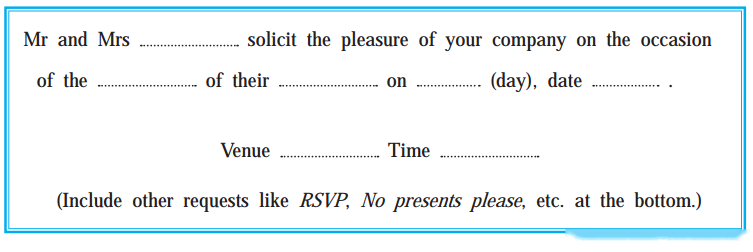
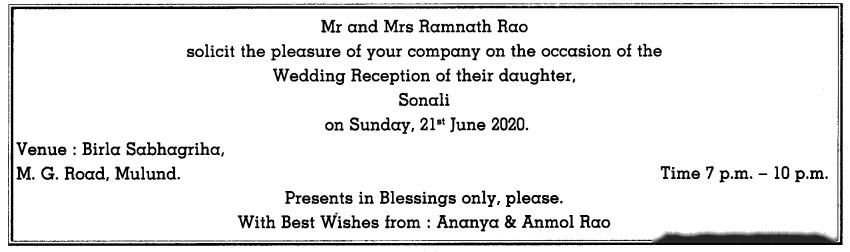
4. Prepare a formal invitation using the following format:
5. Read the following :
1. In all these phrases we see some words used before the nouns.
2. They specify or make it clear what noun we are talking about. These words that are used at the beginning of a noun phrase are known as determiners.
3. Determiners include articles (a, an, the), possessive pronouns (my, our, your, her, etc.), demonstratives (words like this, that), quantifiers (much, many, etc.), numerals, etc.
4. Write your phrases using each of type of determiner.
Part – II
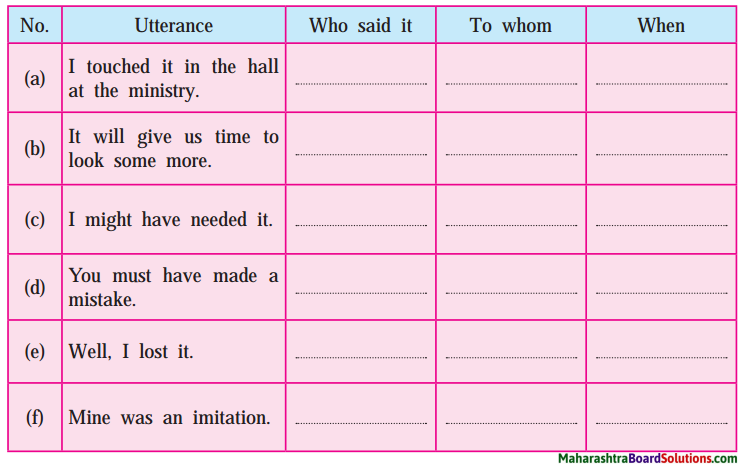
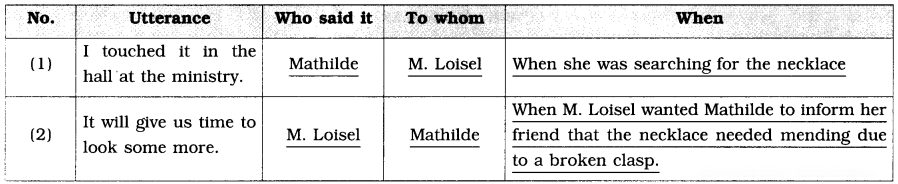
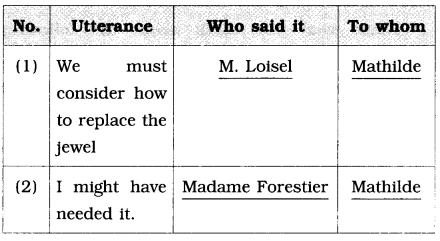
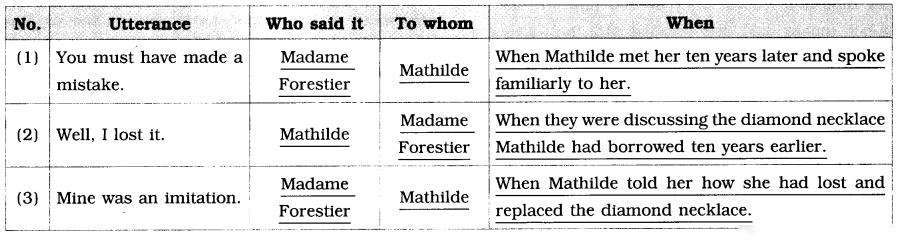
1. Complete the following table.
2. Write what you think about the following thoughts and actions of Mathilde :
Question a.
Mathilde despaired over the loss of her necklace.
Answer:
Mathilde was frightened that she had lost a j valuable necklace and she would have to replace it. She realised her mistake in borrowing such a valuable jewel. Anyone else in her place would have felt the same.
Question b.
Mathilde wrote a note to her friend as dictated by her husband.
Answer:
I think that Mathilde realized her foolishness and was now willing to listen to whatever her husband i said to make good the loss of the necklace.
Question c.
Mathilde and her husband decided to replace the necklace.
Answer:
Yes, that was the right thing to do, for Mathilde had borrowed the necklace. Madame Forestier had been generous to give it. Mathilde could not allow her friend to suffer a loss because of her foolishness.
Question d.
Mathilde returned the diamond necklace to her friend.
Answer:
There was no other option for her under the circumstances. Mathilde was foolish but honest. She also had enough pride not to want to be in debt.
Question e.
Mathilde did not tell her friend about the loss and the replacement.
Answer:
I think that Mathilde was proud and did not want to accept her carelessness in front of her friend.
Question f.
Mathilde worked very very hard to pay the debt.
Answer:
I appreciate Mathilde for working very hard even though she did not like it. She did this in order to pay off the debt which she had got into because of her foolishness in borrowing the necklace.
Question g.
Mathilde and her husband paid off the debt in ten years.
Answer:
I respect both Mathilde and her husband for working so hard for so many years, and living in poverty in order to pay off the debt. They did not take any easy way out.
Question h.
Mathilde told her friend about the lost necklace.
Answer:
Maybe it was a foolish action on Mathilde’s part. Mathilde will now feel terrible when she knows that she wasted ten years of her life struggling to replace the imitation necklace.
3. Form pairs. Discuss how ‘Part II’ of the story could have been different. Write your storyline in the form of bullets showing the main events.
4. Imagine what must have happened after Mathilde’s friend discovered that the diamonds were real. Do you think she would return the necklace to Mathilde? Would that make Mathilde happy?
Question 1
Maharashtra Board Solution
Imagine what must have happened after Mathilde’s friend discovered that the diamonds were real. Do you think she would return the necklace to Mathilde? Would that make Mathilde happy?
Solution & Step-by-Step Answer:
block bg-white dark:bg-slate-900/80 border-l-4 border-emerald-500 rounded-r-xl p-5 my-3 shadow-xs border border-slate-200/60 dark:border-slate-800">
Solution & Step-by-Step Answer:
Mathilde’s friend, Madame Forestier, has been shown to be a kind-hearted and generous woman. She was also rich. So she would have probably returned the necklace to Mathilde. Mathilde, proud but greedy, would probably have taken it and been happy. But she would have been unhappy over the lost years of her youth.
5. Discuss the following and write about each in your own words in 5-6 lines.
Question 1
Maharashtra Board Solution
Discuss the following and write about each in your own words in 5-6 lines. (a) What would you do, if something like this happens to you? (b) What opinion do you form about Mathilde’s husband from her story? (c) Which events in the story (Part I and Part II) changed Mathilde’s life? |
6. Read, recall and remember. Read the table of verb forms given below.
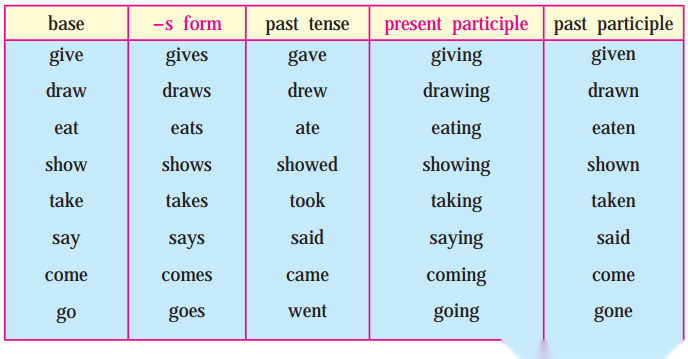
The base form is used as an infinitive: You may go. She will go, in orders: Go home; and in the simple present tense: I go to school. We go home. Do you go there every day? The children/They go up, etc.
Note that we use the ‘-s form’ with ‘he’, ‘she’, ‘it’, third-person singular subjects to show the simple present.
The past tense form has ‘-ed’ at the end. But many commonly used verbs have different past tense forms.
Examples: came, went, spoke.
The ‘-ing’ form is known as the present participle. It is used with forms of ‘be’ to show continuous action
Examples: I am eating You were eating She was eating It is also used in certain constructions like He sat copying a manuscript.
The past participle used with forms of ‘have’ shows completed action –
Examples: I have eaten. They have come, etc.
It is also used in certain constructions like ‘They looked at each other, stunned! It is also used in passive constructions.
(a) Make a table of verb forms for your own reference. Try to arrange the verbs in alphabetical order. Keep adding new verbs to your table from time to time. When you write, check your work to see whether you have used the correct verb form.
(b) List at least 10 verbs, the last letter of which is doubled in the present participle.
Example: put – putting
(c) List at least 10 verbs, the last letter of which is doubled in the past participle.
Example: write – written
(d) List at least 10 verbs, the last letter of which is doubled in the past tense form.
Example: sob – sobbed.
7. Read: ‘The Gift of the Magi’ by O. Henry.
Question 1
Maharashtra Board Solution
Read: ‘The Gift of the Magi’ by O. Henry. |
English Kumarbharati 9th Digest Chapter 1.5 The Necklace Additional Important Questions and
Read the following passages carefully and complete the activities:
Simple Factual Activity:
Question 1
Maharashtra Board Solution
Write whether the following statements are True or False:
Solution & Step-by-Step Answer:
block bg-white dark:bg-slate-900/80 border-l-4 border-emerald-500 rounded-r-xl p-5 my-3 shadow-xs border border-slate-200/60 dark:border-slate-800">
Solution & Step-by-Step Answer:
Complex Factual Activity:
Question 1
Maharashtra Board Solution
Why was Mathilde married to a ‘minor official’?
Solution & Step-by-Step Answer:
Mathilde, a pretty and charming girl, was born into a family of clerks. She had no means of becoming known, understood, loved or be wedded to an aristocrat. So she was married to a ‘minor official’,
Question 2
Maharashtra Board Solution
Why did Mathilde weep with misery after visiting her schoolmate?
Solution & Step-by-Step Answer:
Mathilde had no rich dresses and no jewels, and these were the only things she loved. She found that her schoolmate, who was rich, had all the things that she, Mathilde, wanted so desperately. Hence, she wept with regret, despair and misery after visiting her schoolmate.
Activity-based on Vocabulary :
Question 1
Maharashtra Board Solution
Match the following nouns with their adjectives : |
A | B |
1. minor | (a) house |
2. shabby | (b) mansion |
3. palatial | (c) friends |
4. close | (d) official |