Maharashtra State Board Class 9 My English Coursebook Solutions Chapter 1.4 The Story of Tea
My English Coursebook Std 9 Digest Chapter 1.4 The Story of Tea Textbook Questions and Answers
Warming up!
Chit-chat:
Write the names of as many beverages as you can within two minutes. What do the following beverages remind you of? Draw word webs to show your associations.
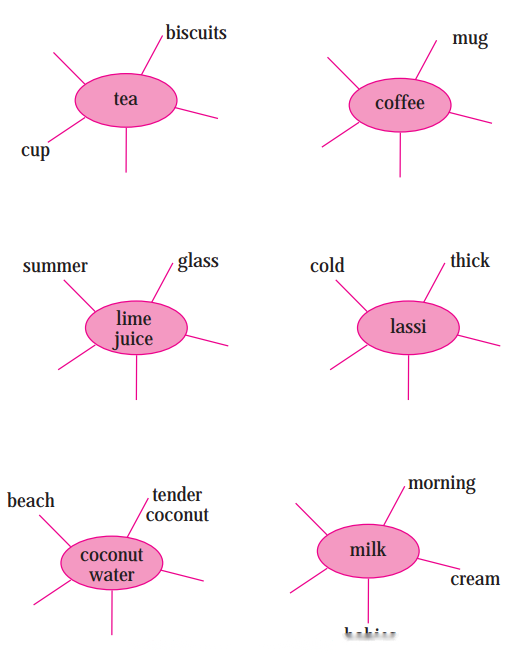
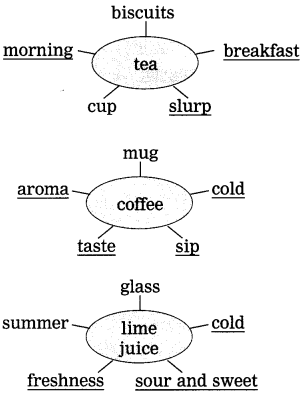
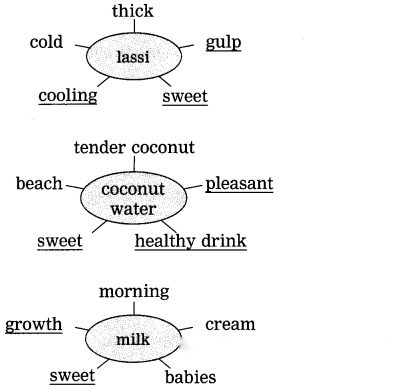
English Workshop:
1. List all the names of Geographical places mentioned in the passage.
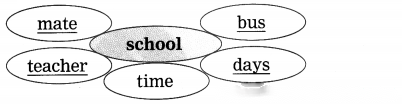
2. Make smaller words using the letters in the given words. (At least 5 words each)
3. From the passage, copy correctly any three sentences that begin with ‘How’.
Question 1
Maharashtra Board Solution
From the passage, copy correctly any three sentences that begin with ‘How’.
4. Find the meanings of the following from a good dictionary :
Question 1
Maharashtra Board
Solution & Step-by-Step Answer:
Find the meanings of the following from a good dictionary :
|
5. List the words related to
(a) agriculture
(b) chemistry from this passage.
Question 1
Maharashtra Board Solution
List the words related to (a) agriculture (b) chemistry from this passage. |
6. Complete the following sentences with the help of the passage:
Question 1. |
Complete the following sentences with the help of the passage:
(a) Camellia sinensis is an evergreen plant that grows in
(b) The teas we buy are usually classified according to
(c) In many countries around the world, tea drinking is an
(d) Our body produces chemicals called
(a) Camellia sinensis is an evergreen plant that grows intropical and sub-tropical climates.
(b) The teas we buy are usually classified according tothe size of their leaves.
(c) In many countries around the world, tea drinking is an
(d) Our body produces chemicals called
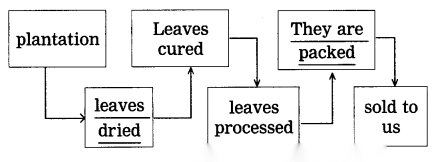
7. Prepare a flow chart to show the growth and journey of tea from the plantation to our homes. Use information from the lesson.
Question 1
Maharashtra Board Solution
Prepare a flow chart to show the growth and journey of tea from the plantation to our homes. Use information from the lesson.
Solution & Step-by-Step Answer:
Language Study: 8.From the passage, find all the words or pairs of words that begin with ‘tea’. 9.Sometimes the form of a verb in a sentence names the action but does not change according to tense, number or person. Such a form is known as a non-finite form or an ui1lnitii. An infinitive is used with or without ‘to’. My English Coursebook 9th Class Solutions Chapter 1.4 The Story of Tea Additional Important Questions and Answers Read the following passage and do the activities: Simple Factual Activity:
Question 1
Maharashtra Board Solution
Complete the sentences using the information given in the passage: (Answers are directly given.)
Solution & Step-by-Step Answer:
Question 2
Maharashtra Board Solution
Complete the following sentences using the information given in the passage : (Answers are directly given.)
Solution & Step-by-Step Answer:
Question 3
Maharashtra Board Solution
Write whether the following statements are True or False : (Answers are directly given.)
Solution & Step-by-Step Answer:
Question 4
Maharashtra Board Solution
Complete the following sentences with the help of the information given in the passage : (Answers are directly given.)
Solution & Step-by-Step Answer:
Question 5
Maharashtra Board Solution
Choose the correct alternatives and complete the following sentences : (Answers are directly given.) Question a. In Russia, tea is made and served in …………... (a) cups (b) pots (c) samovars
Solution & Step-by-Step Answer:
(c) samovars
Question b. Question c. Question d. Complex Factual Activities:
Question 1
Maharashtra Board Solution
Which geographical conditions (features) are required for growing tea plants?
Solution & Step-by-Step Answer:
Tea plants require tropical and sub-tropical climates. They need at least 100-125 cm of rainfall and acidic soils. They grow well on hill slopes at elevations of up to 1500 metres where they acquire a richer flavour at that height.
Question 2
Maharashtra Board Solution
Why are tea plants pruned?
Solution & Step-by-Step Answer:
The tea plants are pruned and kept at height of about three feet to make it possible for them to ; pluck the tea leaves easily.
Question 3
Maharashtra Board Solution
How is tea the beverage made?
Solution & Step-by-Step Answer:
Tea is made by brewing, that is by infusing tea leaves in boiling water.
Question 4
Maharashtra Board Solution
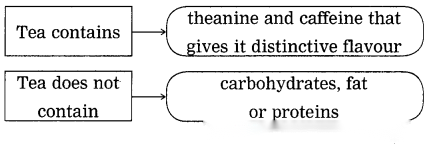
Complete the web: (Answer are directly given.)
Solution & Step-by-Step Answer:
Question 5
Maharashtra Board Solution
Who was Emperor Shennong? Why did he carry out further investigations about tea?
Solution & Step-by-Step Answer:
Emperor Shennong was the father of Chinese agriculture and medicine. On drinking the boiled water of tea leaves, he was amazed by the rich flavour and the refreshing quality of the infusion he was so excited that he decided to carry out further investigation.
Question 6
Maharashtra Board Solution
Arrange the following sentences in proper order of their occurrence : 1. Japanese priests studying under Buddhist teachers in China carried tea seeds and leaves to Japan. 2. Turkish traders began to bargain for tea on the border of Mongolia. 3. Bodhidharma, a Buddhist monk introduced tea among his disciples in China. 4. The Chinese Emperor Hui Tsung failed to notice that Mongolia had actually taken over his empire.
Solution & Step-by-Step Answer:
3. Bodhidharma, a Buddhist monk introduced tea among his disciples in China. 1. Japanese priests studying under Buddhist teachers in China carried tea seeds and leaves to Japan. 2. Turkish traders began to bargain for tea on border of Mongolia. 4. The Chinese Emperor Hui Tsung failed to notice that Mongolia had actually taken over his empire.
Question 7
Maharashtra Board Solution
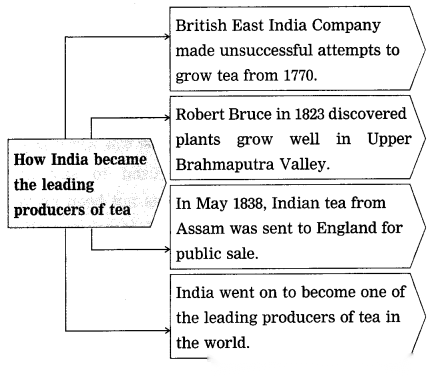
Complete the web : (Answers are directly given.)
Solution & Step-by-Step Answer:
Question 8
Maharashtra Board Solution
Guess the origin of the Marathi word ‘Chaim’:
Solution & Step-by-Step Answer:
Instead of earlier word ‘t’u’ Chinese started using ‘ch’a’ to describe tea. The word ‘Ch’a’ was close to the Hindi word ‘chai’ and was used all over India. Then slightly changed word ‘chaha’ was used in Marathi. It was the combination of the words ‘ch’a’ and ‘chai’ in Marathi version.
Question 9
Maharashtra Board Solution
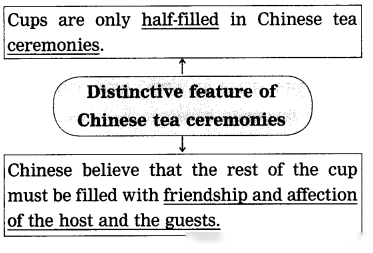
Complete the following choosing information from the passage :
Solution & Step-by-Step Answer:
Question 10
Maharashtra Board Solution
How do Indians like to have their tea?
Solution & Step-by-Step Answer:
Most Indians like to have their tea hot with a good deal of milk and sugar in it. In the rainy season, tea is brewed with ginger to give it additional medicinal properties. Some others add spices like cardamom, cloves or mace to add to its taste and flavour. They have their morning and evening tea after spicy snacks. Some connoisseurs enjoy delicately flavoured jasmine tea, green tea, lemon tea and even iced tea.
Activities based on vocabulary:
Question 1
Maharashtra Board Solution
Match the words in Column ‘A’ with their meaning in Column ‘B’: |

‘A’ | ‘B’ |
1. aromatic | (a) any liquid for drinking |
2. brew | (b) the hot regions of the world |
3. beverage | (c) fragrant |
4. tropical | (d) to make tea etc. by boiling |
‘A’ | ‘B’ |
1. aromatic | (c) fragrant |
2. brew | (d) to make tea etc. by boiling |
3. beverage | (a) any liquid for drinking |
4. tropical | (b) the hot regions of the world
Question 3
Maharashtra Board Solution
List the qualities of the special type of tea.
Solution & Step-by-Step Answer:
unique in taste, aroma, strength, flavour.
Question 4
Maharashtra Board Solution
Match the words in Column ‘A’ with their meaning in column ‘B’: |
‘A’ | ‘B’ |
1. investigation | (a) a scientific examination for finding the truth. |
2. stimulant | (b) a drink made by leaving shrubs (leaves), etc. in boiling water. |
3. infusion | (c) making you strong and healthy again. |
4. restorative | (d) a substance (tea) that helps you to stay awake. |
‘A’ | ‘B’ |
1. investigation | (a) a scientific examination for finding the truth. |
2. stimulant | (d) a substance (tea) that helps you to stay awake. |
3. infusion | (b) a drink made by leaving shrubs (leaves), etc. in boiling water. |
4. restorative | (c) making you strong and healthy again.
Question 5
Maharashtra Board Solution
Match the verbs in ‘A’ with the related phrases/words in ‘B’ from the passage: |
‘A’ | ‘B’ |
1. reduce | (a) viruses in our body |
2. control | (b) us live longer |
3. fight | (c) the risk of cancer |
4. help | (d) blood pressure |
‘A’ | ‘B’ |
1. reduce | (c) the risk of cancer |
2. control | (d) blood pressure |
3. fight | (a) viruses in our body |
4. help | (b) us live longer
Question 6
Maharashtra Board Solution
Write the words related to ‘medicine’ from the passage :
Solution & Step-by-Step Answer:
cancer, blood pressure, viruses, antioxidants, free radicals, system, body, health, damage.
Question 7
Maharashtra Board Solution
List the things from the passage that are used for making tea.
Solution & Step-by-Step Answer:
powdered green tea, bamboo whisk, milk, sugar, ginger, spices like cardamom, cloves, mace, jasmine, lemon.
Activities based on contextual grammar:
Question 1
Maharashtra Board Solution
Underline the adverbs from the following sentences : (Answers are directly underlined.)
Solution & Step-by-Step Answer:
Question 2
Maharashtra Board Solution
Underline the infinitives in the following sentence: (Answers are directly given.)
Solution & Step-by-Step Answer:
Question 3
Maharashtra Board Solution
Find the subject and the object from the following sentences : 1. The water immediately changed colour. 2. He carried out further investigations.
Solution & Step-by-Step Answer:
1. Subject: The water: Object: colour 2. Subject: He; Object: investigations.
Question 4
Maharashtra Board Solution
Underline the infinitives in the following sentences : (Answers are directly underlined.)
Solution & Step-by-Step Answer:
Question 5
Maharashtra Board Solution
Choose the proper article from the given brackets to complete the sentences. (Answers are directly given.)
Solution & Step-by-Step Answer:
1. He has to attend an important meeting. (a, an) 2. He was looking at the setting sun. (the, a, an)
Question 6
Maharashtra Board Solution
Replace the underlined words with another words and rewrite the sentences : |
Question a.
The ceremonies give people the time to relax.
The ceremonies give people the time to enjoy.
Question b.
For many people tea is a popular drink.
Answer:
For many people tea is a refreshing drink.
Question c.
Make any question using the wh-words given below:
Answer:
Question 7
Maharashtra Board Solution
Read the sentences and fill in the blanks with correct prepositions given in the brackets : (
Solution & Step-by-Step Answer:
s are directly given.) Answer:
Question 8
Maharashtra Board Solution
Arrange the following words in correct order to frame sentences : 1. is tea cup of a offered guests to. 2. brewed ginger is Tea with.
Solution & Step-by-Step Answer:
1. A cup of tea is offered to guests. 2. Tea is brewed with ginger.
Do as directed :
Question 1
Maharashtra Board Solution
We have three different tea-growing regions in India. (Frame a Wh-question to get the underlined word as an
Solution & Step-by-Step Answer:
) Answer: How many different tea-growing regions are there in India?
Question 2
Maharashtra Board Solution
Choose the correct form of the verb from the brackets : (Answers are directly given.)
Solution & Step-by-Step Answer:
Personal Response :
Question 1
Maharashtra Board Solution
What are botanical names? How are they decided?
Solution & Step-by-Step Answer:
Botanical names are actually scientific names. These names are according to binomial (two words) naming system. The first name tells us the genus of a plant and the second name is the species of the plant. Throughout the world there should be only one uniform name, that is why the scientific naming system is used.
Question 2
Maharashtra Board Solution
What is the difference between legends or stories and history?
Solution & Step-by-Step Answer:
Legends or stories may not be true but history tells you the facts and true events of the past. History is the written or recorded or spoken events of the past. They are concerned with the real persons, places, arts, etc. that really existed in the past whereas legends are mostly imaginary and passed down from generations to generations in the form of story telling. So they are likely to change but the events in history are generally unchangeable.
Question 3
Maharashtra Board Solution
What is the difference between ‘claim’ and ‘fact’?
Solution & Step-by-Step Answer:
The word ‘claim’ is used to say that something is true although it has not been proved or approved by all people totally. Fact means reality. It is used to refer that a particular situation or incident existed and considered to be true and that it can be proved as real.
Question 4
Maharashtra Board Solution
Do you have any ceremonies associated with food items?
Solution & Step-by-Step Answer:
There are no any ceremonies directly associated with particular food items. While celebrating marriage ceremony, house warming ceremony, anniversaries, etc. variety of food items are served by the hosts and people enjoy different food items with different flavours and tastes. When people celebrate the festivals of Holi, Diwali, Makar Sankrant etc. people particularly prepare and enjoy food items like puran poli, sweets, laddoos, tilgul, kheer, etc.
Question 5
Maharashtra Board Solution
What is your favourite beverage? Tell your reasons :
Solution & Step-by-Step Answer:
My favourite beverage is coffee. I love to have it because of its rich flavour and unique taste. I feel refreshed when I drink hot, slightly bitter coffee with brown colour.
Do as directed :
Question 1
Maharashtra Board Solution
Complete the words by using correct letters : |
Question 2
Maharashtra Board Solution
Copy the following sentences in your notebook: 1. Japan, China, Russia and Korea have special tea ceremonies and traditions. 2. Can you name the most widely consumed beverage in the world, after water?
Question 3
Maharashtra Board
Solution & Step-by-Step Answer:
Put the following words in alphabetical order : 1. evergreen, acidic, flavour, beverage. 2. emperor, elevation, enable, establish.
Solution & Step-by-Step Answer:
1. acidic, beverage, evergreen, flavour. 2. elevation, emperor, enable, establish.
Question 4
Maharashtra Board Solution
Punctuate the following sentences : 1. are there any wild animals in this forest Sahil asked the tour guide 2. what a fantastic landscape it is the visitor exclaimed.
Solution & Step-by-Step Answer:
1. “Are there any wild animals in this forest?” Sahil asked the tour guide. 2. “What a fantastic landscape it is !” the visitor exclaimed.
Question 5
Maharashtra Board Solution
Spot the error and rewrite the correct sentences: 1. How and when did people first began to drink tea? 2. We has three very distinct and different tea growing regions in India.
Solution & Step-by-Step Answer:
1. How and when did people first begin to drink tea? 2. We have three very distinct and different tea-growing regions in India.
Question 6
Maharashtra Board Solution
Write related words as shown in the example : (Answer is directly given.)
Solution & Step-by-Step Answer:
Question 7
Maharashtra Board Solution
Complete the following word-chain of nouns. Add four words, each beginning with the last letter of the previous word : proteins → ……………. → …………… → …………….. → …………….
Solution & Step-by-Step Answer:
proteins → sugar → remand → dream → mop.
Do as directed :
Question 1
Maharashtra Board Solution
Make your own meaningful sentence by using the phrase ‘to look for’.
Solution & Step-by-Step Answer:
Amav lost his pen in his school and now he is looking for it in his home.
Question 2
Maharashtra Board Solution
Add a prefix or suffix to make new words and use any one of the root word in your own sentence : 1. confident 2. absent.
Solution & Step-by-Step Answer:
1. confidence 2. absence. Sentence: Ramesh was very confident when he began to give his speech.
Question 3
Maharashtra Board Solution
Add a clause to expand the sentence meaningfully: We know
Solution & Step-by-Step Answer:
We know that trees are very important for all of us.
Language Study:
Question 1
Maharashtra Board Solution
Compound word : Find all the words or pairs of words that begin with ‘tea’.
Solution & Step-by-Step Answer:
teapot, tea plants, tea gardens, tea-estates, tea leaves, tea seeds, tea-tasting, tea whisking, tea minded, tea growing, tea club, tea ceremony, tea kettle, tea lovers.
Question 2
Maharashtra Board Solution
Underline the infinitive in the following sentences : (The answers are underlined directly.)
Solution & Step-by-Step Answer:
|