Maharashtra State Board Class 8 Science Solutions Chapter 16 Reflection of Light
Class 8 Science Chapter 16 Reflection of Light Textbook Questions and Answers
1. Fill in the blanks:
Question i.
The perpendicular to the mirror at the point of incidence is called …………..
Answer:
The perpendicular to the mirror at the point of incidence is calledthe normal.
Question ii.
The reflection of light from a wooden surface is ……….. reflection.
Answer:
The reflection of light from a wooden surface isirregularreflection.
Question iii.
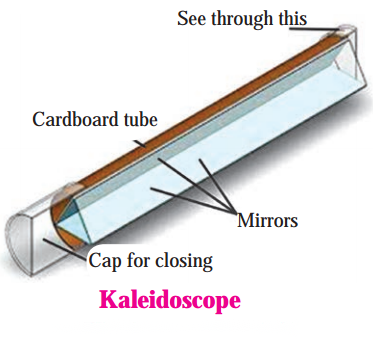
The working of a kaleidoscope is based on the properties of …………….
Answer:
The working of a kaleidoscope is based on the properties ofreflection of light.
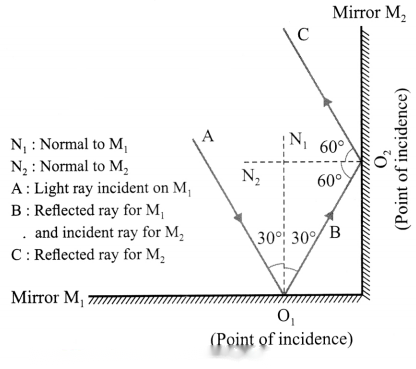
2. Draw a figure describing the following: The reflecting surfaces of two mirrors make an angle of 90° with each other. If a ray incident on one mirror has an angle of incidence of 30°, i draw the ray reflected from the second mirror. What will be its angle of reflection?
Question a.
Draw a figure describing the following: The reflecting surfaces of two mirrors make an angle of 90° with each other. If a ray incident on one mirror has an angle of incidence of 30°, draw the ray reflected from the second mirror. What will be its angle of reflection?
Answer:
For the ray C, the angle of reflection = 60°.
3. How will you explain the statement ‘We cannot see the objects in a dark room’?
Question a.
How will you explain the statement ‘We cannot see the objects in a dark room’?
Answer:
In a room that is completely dark, no light falls on objects. Hence, no light enters our eyes. Hence, there is no sensation of vision, i.e., we cannot see the objects.
4. Explain the difference between regular and irregular reflection of light.
Question a.
Explain the difference between regular and irregular reflection of light.
Answer:
For regular reflection of light, the angles of incidence as well as the angles of reflection are the same for all parallel rays of light incident on the plane and smooth surface. Hence, the reflected rays are also parallel to one another.
For irregular reflection of light, the angles of incidence for parallel rays of light incident on the rough surface are not equal, and hence the angles of reflection are also not equal. Here, the reflected rays are not parallel to one another and spread over a large surface.
5. Draw a figure showing the following:
(a) Incident ray,(b) Normal,(c) Angle of incidence,(d) Angle of reflection,(e) Point of incidence,(f) Reflected ray.
Question a.
Draw a figure showing the following:
(a) Incident ray
(b) Normal
(c) Angle of incidence
(d) Angle of reflection
(e) Point of incidence
(f) Reflected ray.
Answer:
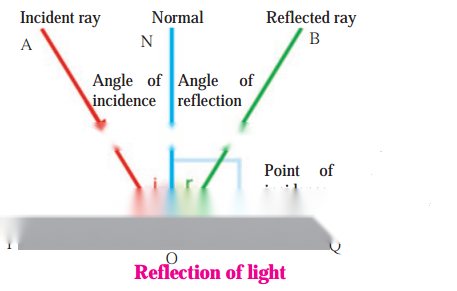
6. Study the following incident.
Swara and Yash were looking in a water-filled vessel. They could see their images clearly in the still water. At that instant, Yash threw a stone in the water. Now their images were blurred. Swara could not understand the reason for the blurring of the images.
Explain the reason for blurring of the images to Swara by answering the following questions:
Question i.
Is there a relation between the reflection of light and the blurring of the images?
Answer:
Yes.
Question ii.
Which types of reflection of light can you notice from this?
Answer:
Regular reflection of light when light is incident on the still water and irregular reflection of light when light is incident on the water as ripples are produced on its surface when a stone is thrown in the water.
Still water behaves as a plane and smooth surface while oscillating water behaves as a rough surface.
Question iii.
Are the laws of reflection followed in these types of reflection?
Answer:
Yes.
7. Solve the following examples.
Question a.
If the angle between the plane mirror and the incident ray is 40°, what are the angles of incidence and reflection?
Solution:
The angle between the plane mirror and the incident ray is 40°. Therefore, the angle of incidence (i) = the angle made by the incident ray with the normal to the plane mirror = 90° – 40° = 50°. The angle of reflection, r – i – 50°.
Question b.
If the angle between the mirror and reflected ray is 23°, what is the angle of incidence of the incident ray?
Solution:
The angle between the mirror and the reflected ray is 23°. Therefore, the angle of reflection (r) = the angle made by the reflected ray with the normal to the plane mirror = 90° – 23° = 67°.
∴ The angle of incidence, i = r = 67°.
Project:
Question a.
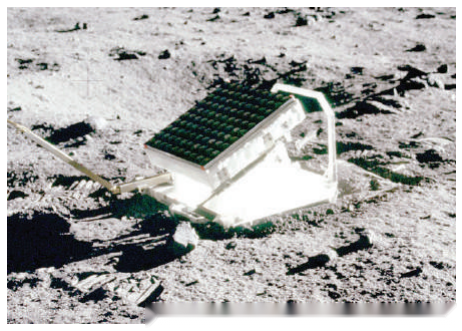
Apollo astronauts who stepped on the moon have kept some large mirrors there. Collect information about how the distance to the moon is measured using these.
Class 8 Science Chapter 16 Reflection of Light Important Questions and Answers
Rewrite the following statements by selecting the correct option:
Find the odd one out and give the reason:
State whether the following statements are True or False. (If a statement is false, correct it and rewrite it.)
Answer the following questions in one sentence each:
Try this:
Switch off the light in your room at night for some time and then turn it on again.
Question 2
Maharashtra Board Solution
What did you feel when it was turned on again?
Solution & Step-by-Step Answer:
block bg-white dark:bg-slate-900/80 border-l-4 border-emerald-500 rounded-r-xl p-5 my-3 shadow-xs border border-slate-200/60 dark:border-slate-800">
Solution & Step-by-Step Answer:
We could see the objects clearly. From the above activity you can notice that there is some connection between the sense of vision and light. When we switch off the light at night, the objects in the room cannot be seen and they can be seen as before when the light is switched on again. Thus, we can see objects when the light coming from these objects enters our eyes.
Answer the following questions:
Question 1
Maharashtra Board Solution
What is reflection of light?
Solution & Step-by-Step Answer:
When light rays fall on an object, their direction changes and they turn back. This is called the reflection of light.
Try this: Material:
Question 2
Maharashtra Board Solution
State the laws of reflection of light.
Solution & Step-by-Step Answer:
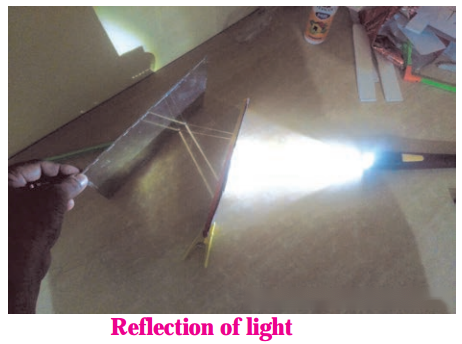
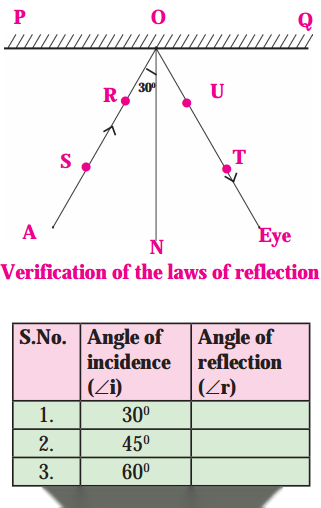
Try this: Verification of the laws of reflection of light.
What relation do you find between the angle of incidence and the angle of reflection? If you have done the experiment carefully, you will find that the angle of incidence is equal to the angle of reflection in all three cases. This verifies the laws of reflection. Question a.
Question 3
Maharashtra Board Solution
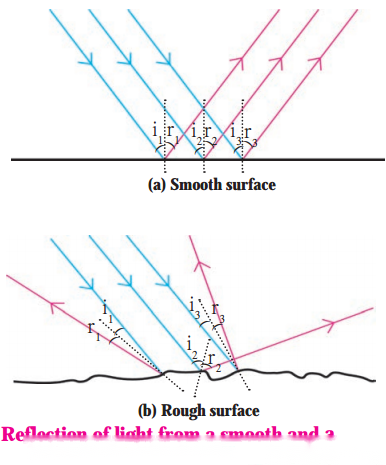
Figures (a) and (b) show three parallel rays, shown in grey, incident on smooth and rough surfaces. The reflected rays drawn using laws of reflection are shown in red. 1. Rays reflected from which surface are parallel to one another? 2. What conclusion can you draw from the figure?
Solution & Step-by-Step Answer:
1. Rays reflected from the smooth surface are parallel to one another.
2.When the reflecting surface is plane and smooth, the angles of incidence (i) as well as of reflection (r) are the same for all parallel rays incident on the surface. If i1, i2, i3, … are the angles of incidence for incident parallel rays, and r1, r2, r3, …, are the corresponding angles of reflection, then, i1= i2= i3= ……. = r1= r2= r3= ….. This is called regular reflection. Here, the reflected rays are parallel to one another. If the reflecting surface is rough and parallel rays are incident on it, then the angles of incidence are not equal and hence the angles of reflection are also not equal. Here, i1≠ i2≠ i3… and r1≠ r2≠ r3…, but r1= i1, r2= i2, r3= i3… as laws of reflection are obeyed. This is called irregular reflection. [Fig.(b)]. Here, the reflected rays are not parallel to one another and spread over a large surface.
Question 4
Maharashtra Board Solution
What is regular reflection of light?
Solution & Step-by-Step Answer:
The reflection of light from a plane and smooth surface is called regular reflection of light.
Question 5
Maharashtra Board Solution
What is irregular reflection of light?
Solution & Step-by-Step Answer:
The reflection of light from a rough surface is called irregular reflection of light.
Always remember: Can you recall? Reflection of reflected light :
Question 1
Maharashtra Board Solution
How do you see if the barber m a saloon has cut the hair on your neck properly or not?
Solution & Step-by-Step Answer:
In a saloon, there are mirrors in your front and at back. The image of the back of your head is formed in the mirror at the back. The image of this image is formed in the mirror in front of you. Thus you can see how the hair at the backside of your head is cut.
Question 2
Maharashtra Board Solution
What type of image do we see in a mirror? What happens to the left and right sides?
Solution & Step-by-Step Answer:
The image in a plane mirror is upright (erect) and of the same size as the object, but the left and right sides are interchanged. Our right hand appears to be the left hand in the image and the left hand appears to be the right hand in the image. (This is called lateral inversion.)
Question 3
Maharashtra Board Solution
How do we see the image of the moon in water?
Solution & Step-by-Step Answer:
The moon is not self luminous. The sunlight falling on the surface of the moon is reflected. This reflected light is again reflected by water to give us the image of the moon.
Try this: Kaleidoscope:
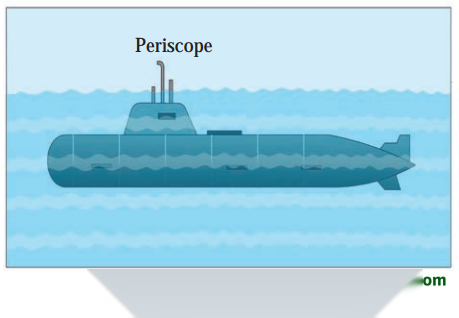
Activity: You can see different designs in the kaleidoscope. The speciality of a kaleidoscope is that the designs do not easily repeat themselves. Every time the design is different. People making wall papers which are used to decorate walls and cloth designers use a kaleidoscope for making new designs. Periscope:
Example questions for practice:
Question 1
Maharashtra Board Solution
If the angle between the plane mirror and the incident ray is 20°, what is the angle between the reflected ray and the plane mirror?
Solution & Step-by-Step Answer:
20°.
Question 2
Maharashtra Board Solution
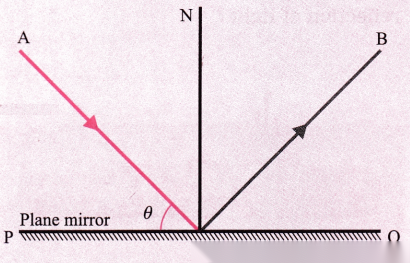
See Fig. In terms of O, what are the angles (i) AON (ii) BON (iii) AOB (iv) BOQ?
Solution & Step-by-Step Answer:
(i) 90° – θ (ii) 90° – θ (iii) 180° – 2θ
|