Maharashtra State Board Class 8 Science Solutions Chapter 14 Measurement and Effects of Heat
Class 8 Science Chapter 14 Measurement and Effects of Heat Textbook Questions and Answers
1. A. Whom should I pair with?
Question a.
Group ‘A’ | Group ‘B’ |
1. Temperature of a healthy human body | a. 296 K |
2. Boiling point of water | b. 98.6 °F |
3. Room temperature | c. 0°C |
4. Freezing point of water | d. 212 °F |
Answer:
Group ‘A’ | Group ‘B’ |
1. Temperature of a healthy human body | b. 98.6 °F |
2. Boiling point of water | d. 212 °F |
3. Room temperature | a. 296 K |
4. Freezing point of water | c. 0°C |
B. Who is telling the truth?
Question a.
The temperature of a substance is measured in joule.
Answer:
False. (The temperature of a substance is measured in °C or °F or K.)
Question b.
Heat flows from an object at higher temperature to an object at lower temperature.
Answer:
True.
Question c.
The joule is the unit of heat.
Answer:
True.
Question d.
Objects contract on heating.
Answer:
False. (In general, objects expand on heating. There are some exceptions to this, you will learn about them in Standard X.)
Question e.
Atoms of a solid are free.
Answer:
False. (Atoms of a solid are bound to each other due to the forces acting between them.)
Question f.
The average kinetic energy of atoms in a hot object is less than the average kinetic energy of atoms in a cold object.
Answer:
False. (The average kinetic energy of atoms in a hot object is more than the average kinetic energy of atoms in a cold object.)
C. You will find if you search.
Question a.
A thermometer is used to measure ……………..
Answer:
A thermometer is used to measuretemperature.
Question b.
The apparatus used to measure heat is called a ………….
Answer:
The apparatus used to measure heat is called acalorimeter.
Question c.
Temperature is the measure of the …………. kinetic energy of the atoms in a substance.
Answer:
Temperature is the measure of theaveragekinetic energy of the atoms in a substance.
Question d.
The heat contained in a substance is the measure of the ………….. kinetic energy of the atoms in the substance.
Answer:
The heat contained in a substance is the measure of thetotalkinetic energy of the atoms in the substance.
2. Nishigandha kept a vessel containing all the ingredients for making tea in a solar cooker. Shivani kept a similar vessel on a stove. Whose tea will be ready first and why?
Question a.
Nishigandha kept a vessel containing all the ingredients for making tea in a solar cooker. Shivani kept a similar vessel on a stove. Whose tea will be ready first and why?
Answer:
Shivani’s tea will be ready first.
Reason: In a given time, the amount of heat received by the vessel on a stove is far greater than that received by the vessel kept in a solar cooker.
3. Write brief answers.
Question a.
Describe a clinical thermometer. How does it differ from the thermometer used in a laboratory?
Answer:
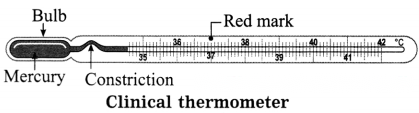
A clinical thermometer has a narrow stem and a long bulb filled with mercury (or alcohol). There is a small constriction in the stem above the bulb. When the bulb of the thermometer is held in the armpit or the mouth of a patient, the mercury (or alcohol) in the bulb rises in the stem.
When it is taken out of the patient’s body, the small constriction does not allow the mercury (or alcohol) from the stem to retreat into the bulb. Thus, this arrangement enables us to read the temperature of the patient’s body at ease after the removal of the thermometer from his body.
The clinical thermometer is graduated from 35 °C to 42 °C (or from 95 °F to 108 °F). At 37 °C (98.6 °F), there is a red arrow mark which indicates the temperature of a healthy person.
The thermometer used in a laboratory has wider range and does not have constriction like a clinical thermometer.
Question b.
What is the difference between heat and temperature?
Answer:
Heat is related to the total kinetic energy of the atoms in a substance while temperature is related to the average kinetic energy of the atoms in the substance. Heat flows from a body at higher temperature to a body at lower temperature. Thus, temperature is a quantity that determines the direction of flow of heat. It is a quantitative measure of the degree of hotness or coldness of a body.
Higher temperature does not mean higher heat content. Suppose a vessel A contains 2 litres of water at 90 °C and a vessel B contains 100 ml of water at 91 °C. Then the heat content of water in A is greater than that of water in B, but the temperature of water in B is higher than that of water in A.
Units of heat:
Heat is usually expressed in calorie, kilocalorie and joule. It can also be expressed in erg as heat is a form of energy.
Question c.
Explain the construction of a calorimeter. Draw the necessary figure.
Answer:
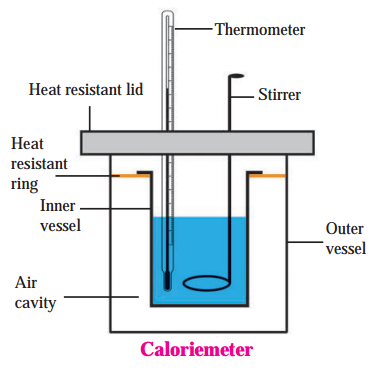
Figure shows the construction of a calorimeter. Like a thermo flask, a calorimeter has two vessels. The inner vessel, made of copper, is (practically) thermally isolated from the surroundings. The outer vessel is made of wood and is covered with a heat resistant lid. The lid has two holes, one for the thermometer and the other for the stirrer. The inner and outer surfaces of the inner vessel are polished for minimizing exchange of heat with the surroundings by radiation. A heat resistant ring covers the inner vessel.
Question d.
Explain why rails have gaps at specific distances.
Answer:
The rails expand in summer due to increase in the temperature of the atmosphere. Also, they expand due to rise in temperature caused by the friction between the rails and the wheels of the running train. If there is no gap between successive rails of a railway line, the rails would bend due to expansion. This bending and twisting of the rails would cause accidents. Hence, a gap is kept between successive rails of a railway line to make provision for their expansion in summer.
Do you know:
Have you seen rails? They are not continuous. A small gap is kept between them at regular intervals. This is shown in the figure. This is kept to accommodate the change in the length of the rails with change in temperature. If this gap is not kept, then the rail will get distorted due to expansion in summer which may lead to accidents.
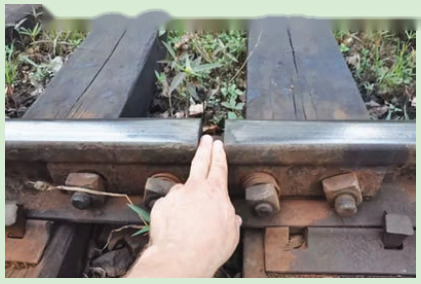
Similar to rails, the length of bridges can also increase due to expansion in summer. The length of the 18 km long great belt bridge in Denmark increases by 4.7 m in summer. Therefore, provision in made in the construction of the bridges to accommodate this expansion.
Question e.
Explain with the help of formulae the expansion coefficients of liquid and gas.
Answer:
1. A liquid is held in a container. When it is heated, both the container and the liquid expand. The expansion of the container is usually very small compared to that of the liquid in it. Often, it can be ignored.
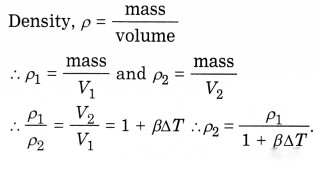
Suppose a liquid is heated so that its temperature rises by ΔT (very small) and its volume increases from V1to V2. Experimentally, it is found that the increase in volume, V2– V1, is proportional to V1and ΔT.
Hence, (V2– V1) α V1ΔT.
∴ V2– V1= β V1ΔT, where β is a constant of proportionality called the volumetric expansion coefficient of the liquid.
β = .
It is expressed in per °C.
We have V2= V1+ βV1ΔT = V1(1 + β ΔT).
β is the increase in the volume of a liquid per unit original volume per unit rise in its temperature.
2. A gas is enclosed in a container. When it is heated at constant pressure, both the container and the gas expand. Suppose a gas is heated at constant pressure so that its temperature rises by ΔT (very small) and its volume increases from V1to V2. Experimentally, it is found that the increase in volume, V2– V1is proportional to V1and ΔT. Hence, (V2– V1) a V1ΔT.
∴ V2– V1= β V1ΔT, where β is a constant of proportionality, the volumetric expansion coefficient, called the constant pressure expansion coefficient.
β = .
It is expressed in per °C.
We have V2= V1+ βV1T = V1(1 + β ΔT).
β is the increase in the volume of a gas per unit original volume per unit rise in its temperature when the pressure is kept constant.
4. Solve the following examples.
Question a.
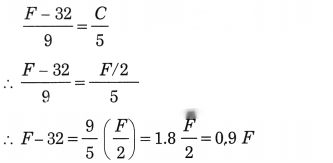
What must be the temperature in Fahrenheit so that it will be twice its value in Celsius?
Solution:
Data: F = 2 C ∴ C = F/2, F = ?
∴ F – 0.9 F = 32
∴ 0.1 F = 32
∴ F = = 320 °F.
Question b.
A bridge is made from 20 m long iron rods. At temperature 18 °C, the distance between two rods is 0.4 cm. Up to what temperature will the bridge be in good shape?
Solution:
Data: l1= 20 m, l2– l1= 0.4 cm
= 4 × 10⁻³m, Ti= 18 °C, λ for iron = 11.5 × 10⁻⁶/°C
l2– l1= λl1Δt
= °C = about 17.39 °C
Now, ΔT= Tf– Ti∴ Tf= Ti+ ΔT
∴ Tf= 18 °C + 17.39 °C = 35.39 °C.
The bridge will be in good shape up to 35.39 °C.

Question c.
At 15 °C the height of Eiffel Tower is 324 m. If it is made of iron, what will be the increase in length in cm, at 30 °C?
Solution:
Data: ΔT = 30 °C – 15 °C = 15 °C, l1= 324 m, λ for iron = 11.5 × 10⁻⁶/°C l2– l1= λl1ΔT
= 11.5 × 10⁻⁶/°C × 324 m × 15 °C
= 55890 × 10-6m
= 55890 × 10-6× 102cm
= 55890 × 10-4cm
= 5.589 cm (nearly 5.6 cm)
This is the increase in the length, i.e., the increase in the height of Eiffel Tower.
Question d.
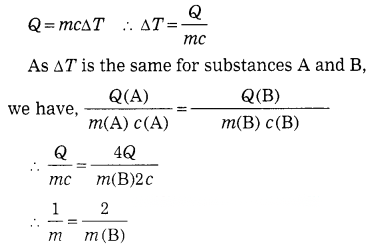
Two substances A and B have specific heats c and 2 c respectively. If A and B are given Q and 4Q amounts of heat respectively, the change in their temperatures is the same. If the mass of A is m, what is the mass of B?
Solution:
Data: c (A) = c, c (B) = 2c,
Q (A) = Q, Q (B) = 4Q, ΔT same,
m (A) = m, m (B) = ?
∴ m(B) = 2m.
This is the mass of B.
Question e.
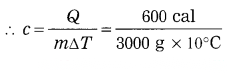
When a substance having mass 3 kg receives 600 cal of heat, its temperature increases by 10 °C. What is the specific heat of the substance?
Solution:
Data: m = 3 kg = 3000 g,
Q = 600 cal, ΔT = 10 °C, c = ?
Q = mcΔT
= 0.02 cal/(g.°C)
This is the specific heat of the substance.
Can you recall?
Question a.
Which sources do we get heat from?
Answer:
Question b.
How is heat transferred?
Answer:
Heat is transferred by conduction, convection and radiation.
Question c.
Which effects of heat do you know?
Answer:
Expansion, change of state, rise in temperature, emission of light, burning.
Question d.
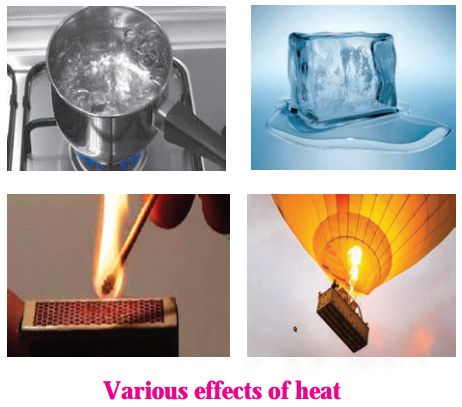
Some effects of heat are shown in Fig. What are they?
Answer:
Rise in temperature/boiling, melting, burning, expansion.
Question e.
What are potential and kinetic energies?
Answer:
The energy stored in a body because of its specific state or position is called its potential energy. The energy possessed by a body because of its motion is called it’s kinetic energy.
Project:
Question a.
Collect information about bimetallic strips and discuss in your class how a fire alarm is made using it.
Class 8 Science Chapter 14 Measurement and Effects of Heat Important Questions and Answers
Rewrite the following statements by selecting the correct options:
Find the odd one out and give the reason:
Answer the following questions in one sentence each:
Answer the following questions:
Try this:
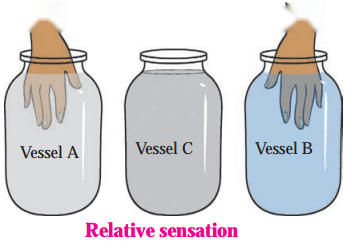
Even though, both the hands are dipped in water in the same vessel, i.e., water at the same temperature, your right hand will find the water to be cold while the left hand will find it to be hot. What is the reason for this? Think about it.
Answer:
The right hand finds the water cold because it loses heat to water in C. The left-hand feels the water hot because it gains heat from water in C. (This shows that we cannot determine the temperature of an object accurately by simply touching it)
Try this:
1. Take two steel vessels A and B of the same size.
2. Fill some water in A and double that amount in B. Make sure that the water in both vessels is at the same temperature.
3. Raise the temperatures of water in both vessels by 10 CC using a spirit lamp. Did it take the same time to increase the temperature in the two vessels?
Answer:
No.
You must have required more time to raise the temperature of water in B. This means that for the same increase in temperature, you had to give more amount of heat to B. Thus, even though the water in A and in B have the same temperature, the amount of heat in B is more than that in A.
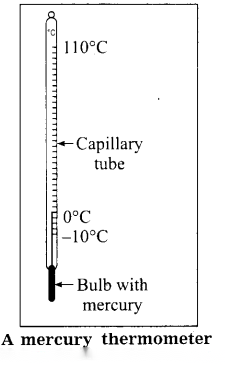
[Note: The range of an alcohol thermometer is different from that of a mercury thermometer.]
2. The mercury expands or contracts depending upon whether it gains heat or loses heat. Accordingly there is a rise or fall of the level of mercury in the tube of the thermometer indicating the temperature of the substance when the mercury and the substance are in thermal equilibrium.
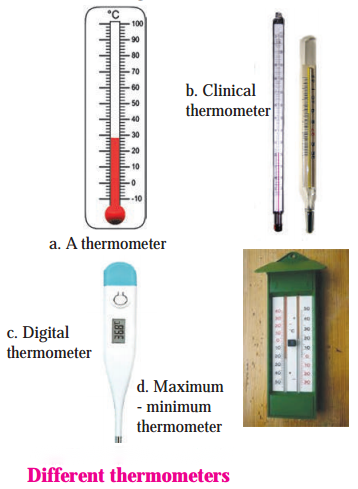
[Note: (1) A digital thermometer has a sensor that detects the heat coming out from the body directly and displays the temperature.
(2) The maximum-minimum temperature has two scales, one against each arm of the thermometer. One scale indicates the maximum temperature reached (generally during the day) and the other scale indicates the minimum temperature reached (generally during the night).]

Use your brain power!
3. Fill the calorimeter to two-thirds of its capacity with water and find its mass (m’c) along with the stirrer. Hence, find the mass (mw) of the water in the calorimeter (mw= m’c– mc).
4. Keep the calorimeter in the wooden box and note the temperature (T1) of the water in the calorimeter with the thermometer.
5. Suspend the iron ball in water in a beaker. Heat the beaker so that the water starts boiling. Note the temperature (T2) of the boiling water.
6. Transfer the iron ball quickly to the calorimeter and cover the calorimeter with the lid immediately.
7. Stir the water in the calorimeter gently and continuously for uniformity of temperature and note the maximum temperature (T3) attained by the mixture.
8. Find the specific heat capacity of iron using the following formula:
heat lost by the iron ball = heat gained by the calorimeter, stirrer and water
[assuming that there is no exchange of heat between the system (calorimeter, stirrer, water and iron ball) and the surroundings].
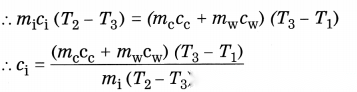
where cc = specific heat of the material of the calorimeter and stirrer and cw= specific heat of water.
Hence, the specific heat of iron (ci) can be determined when other quantities are known.
As a calorimeter ensures that there is hardly any exchange of heat between the contents of the calorimeter and the surroundings, the calorimeter is used in the study of the exchange of heat between a solid and liquid or between two liquids.
Use your brain power!
Can you recall?
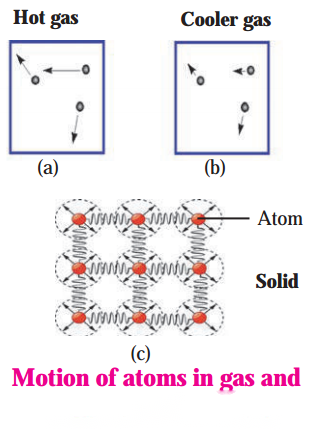
Expansion of gases:
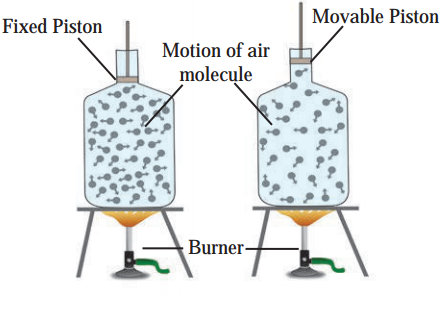
A gas does not even have a fixed volume. Gas expands on heating but if the gas is kept in a closed box, its volume cannot increase but its pressure increases. This is shown in Fig. Observe Fig. and find out answers to the questions.
Use your brain power!
Write short notes on the following:
Give scientific reasons:
Solve the following examples:
Find the heat needed to raise the temperature of 2.5 kg of water from 30 °C to 40 °C. Write the answer in calorie as well as joule.
Data: m = 2.5 kg = 2500 g,
ΔT = 40 °C-30 °C, Q = ?
Heat needed to raise the temperature of 1 g of water through 1°C is 1 calorie.
∴ Q = 2500 × 10 = 25000 calories
Now, 1 calorie = 4.18 joules
∴ Q = 25000 × 4.18 joules = 104500 joules
Heat needed, Q = 25000 calories = 104500 joules.
Question 3
Maharashtra Board Solution
If the temperature of water rises by 5 °C when 500 cal of heat is supplied to it, what is the mass of water?
Solution & Step-by-Step Answer:
Mass of water = = 100 g.
Question 4
Maharashtra Board Solution
How much heat is required to raise the temperature of 500 g of mercury from 20 °C to 100 °C? [Specific heat of mercury = 0.033 kcal/(kg °C)]
Solution & Step-by-Step Answer:
Data: m = 500 g = 0.5 kg, T1 = 20 °C, T2 = 100 °C, c = 0.033 kcal/(kg. °C), Q = ? Q = mc (T2 – T1) = 0.5 kg × 0.033 kcal/(kg. °C) × (100 °C – 20 °C) = 0.5 × 0.033 × 80 kcal = 0.033 × 40 kcal ∴ Q = 1.32 kcal Heat required = 1.32 kcal. [Note: 1kcal/(kg-°C) = 1 cal/(g.°C)]
Question 5
Maharashtra Board Solution
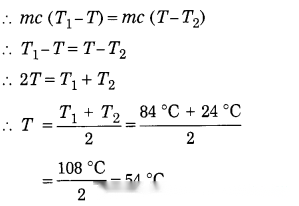
A certain mass of water at 84 °C is poured into an equal mass of water at 24 °C. What will be the resulting temperature of the mixture ?
Solution & Step-by-Step Answer:
Data: mx = m2 = m (say), T1 = 84 °C, T2 = 24 °C, T = ? Heat lost by the hot water = heat gained by the cold water Resulting temperature of the mixture = 54 °C.
Question 6
Maharashtra Board Solution
A bucket contains 8 kg of water at 20 °C. When 4 kg of hot water is mixed with it, the temperature of the mixture becomes 40 °C. Calculate the temperature of the hot water. (Ignore the heat absorbed by the bucket.)
Solution & Step-by-Step Answer:
Data: m1 = 8 kg, T1 = 20 °C, m2 = 4 kg, T = 40 °C, T2= ? Heat lost by the hot water = heat gained by the cold water (ignoring the heat absorbed by the bucket) ∴ m2c (T2 – T) = m1c (T – T1) ∴ 4 kg × c × (T2 – 40°C) = 8 kg × c × (40°C – 20°C) ∴ T2 – 40°C = 2 × 20°C = 40°C ∴ T2 = 40 °C + 40 °C = 80 °C Temperature of the hot water = 80 °C.
Question 7
Maharashtra Board Solution
A blacksmith plunges a 2 kg horseshoe at 400 °C into 1 kg of water at 20 °C. Find the maximum temperature of the water. [Specific heat of iron = 0.11 kcal/(kg-°C)]
Solution & Step-by-Step Answer:
Data: mx = 2 kg, c1 = 0.11 kcal/(kg.°C), T2 = 400 °C, m2 = 1 kg, c2 = 1 kcal/(kg.°C), T2 = 20 °C, T = ? Heat lost by the horseshoe = heat gained by the water ∴ m1c1 (T1 – T) = m2c2(T – T2) ∴ 2 kg × 0.11 kcal/(kg.°C) × (400 °C – T) = 1 kg × 1 kcal/(kg.°C) × (T – 20 °C) ∴ 0.22 × (400 °C – T) = T – 20 °C ∴ 1.22 T= 108 °C ∴ T = °C = 88.52 °C Maximum temperature of the water = 88.52 °C.
Question 8
Maharashtra Board Solution
A copper sphere of mass 500 g is heated to 100 °C and then introduced into a copper calorimeter containing 100 g of water at 20 °C. Find the maximum temperature of the mixture, if the mass of the calorimeter is 100 g and the specific heat of the calorimeter is 0.1 cal/(g.°C).
Solution & Step-by-Step Answer:
Data: m = 500 g, c = 0.1 cal/(g.°C), T’= 100 °C, m1 = 100 g, c1 = 1 cal/(g.°C), T1 = 20°C, m2 = 100 g, c2 = 0.1 cal/(g.°C), T2 = 20 °C, T= ? Heat lost by the sphere = heat gained by the water and the calorimeter. ∴ mc (T’ – T) = m1c1 (T – T1) + m2c2 (T – T2) ∴ 500 g × o.l cal/(g.°C) × (100 °C – T) = 100 g × 1 cal/(g.°C) × (T – 20 °C) + 100 g × 0.1 cal/(g.°C) × (T – 20 °C) ∴ 50 (100 °C – T) = 100 × (T – 20 °C) + 10 × (T – 20 °C) ∴ 50 (100 °C – T) = 110 × (T – 20 °C) ∴ 500 °C – 5T = 11T – 220 °C ∴ 16T = 720 °C ∴ T = = 45 °C Maximum temperature of the mixture = 45 °C.
Question 9
Maharashtra Board Solution
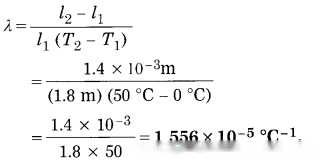
A metal rod 1.8 m long, increases ( in length by 1.4 mm, when heated from 0 °C to 50 °C. Find the coefficient of linear expansion of the metal.
Solution & Step-by-Step Answer:
Data: l1 = 1.8 m, l2 – l1 = 1.4 mm = 1.4 × 10⁻³ m. T1 = 0 °C, T2 = 50 °C. l2 – l1 = l1 λ (T2 – T1) ∴ The coefficient of linear expansion of the metal is
Question 10
Maharashtra Board Solution
A thin metal disc of surface area 500 cm2 at 0 °C is heated to 40 °C. Find the increase in the surface area of the disc. (σ = 4 × 10⁻⁵ °C -1)
Solution & Step-by-Step Answer:
Data: A1 = 500 cm2, T1 = 0 °C, T2 = 40 °C, σ = 4 × 10⁻⁵ °C-1, A2 – A1 = ? The increase in the surface area of the disc is A2 – A1 = A1σ(T2 – T1) = (500 cm2) (4 × 10⁻⁵ °C-1) (40 °C – 0 °C) = 500 × 4 × 10-5 × 40 = 0.8 cm2.
Question 11
Maharashtra Board Solution
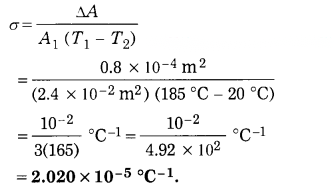
The surface area of a metal plate is 2.4 × 10⁻²m2 at 20 °C. When the plate is heated to 185 °C, its area increases by 0.8 cm2. Find the coefficient of areal expansion of the metal.
Solution & Step-by-Step Answer:
Data: A1 = 2.4 × 10⁻² m2, T1 = 20 °C, T2 = 185 °C, ΔA = 0.8 cm2 = 0.8 × 10⁻⁴ m2, σ = ? ΔA = A2 – A1 = A1 σ(T2 – T1) ∴ The coefficient of areal expansion of the metal is
Question 12
Maharashtra Board Solution
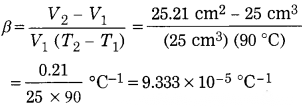
A lead bullet has a volume of 25 cm3 at 0 °C, and 25.21 cm3 at 90 °C. Find the volumetric expansion coefficient of lead.
Solution & Step-by-Step Answer:
Data: V1 = 25 cm3, T1 = 0 °C, V2 = 25.21 cm3, T2 = 90 °C T2 – T1 = 90 °C – 0 °C = 90 °C β = ? The volumetric expansion coefficient of lead is 9.333 × 10⁻⁵ °C-1.
Example Questions for practice:
Question 1
Maharashtra Board Solution
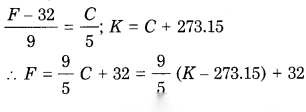
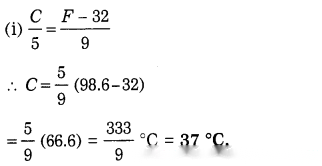
The temperature of a body is 30 °C. Express it in (i) degree Fahrenheit (ii) kelvin.
Solution & Step-by-Step Answer:
86 °F, 303.15 K
Question 2
Maharashtra Board Solution
The temperature of a body is 283.15 K. Express it in °C and °F.
Solution & Step-by-Step Answer:
10 °C, 50 °F
Question 3
Maharashtra Board Solution
The temperature of a body is 68 °F. Express it in °C and K.
Solution & Step-by-Step Answer:
20 °C, 293.15 K
Question 4
Maharashtra Board Solution
Find the heat needed to raise the temperature of 5 kg of water from 20 °C to 25 °C. Write the answer in calorie as well as joule.
Solution & Step-by-Step Answer:
25 × 103 cal, 1.045 × 10⁵ J
Question 5
Maharashtra Board Solution
When a substance having mass 2 kg absorbs 2000 cal of heat, its temperature increases by 10 °C. Find the specific heat of the substance.
Solution & Step-by-Step Answer:
0.1 cal/(g.°C)
Question 6
Maharashtra Board Solution
Find the heat needed to raise the temperature of 100 g of a metal through 10 °C if the specific heat of the metal is 0.1 cal/g. °C.
Solution & Step-by-Step Answer:
100 cal
Question 7
Maharashtra Board Solution
If water of mass 80 g and temperature 40 °C is mixed with water of mass 20 g and temperature 25 °C, what will be the maximum temperature of the mixture?
Solution & Step-by-Step Answer:
37 °C
Question 8
Maharashtra Board Solution
A metal rod 2.5 m long, increases in length by 1.25 mm when it is heated from 10 °C to 60 °C. Find the coefficient of linear expansion of the metal.
Solution & Step-by-Step Answer:
1 × 10⁻⁵ °C-1
Question 9
Maharashtra Board Solution
The surface area of a metal plate is 2 × 10⁻² m2 at 10 °C. When the plate is heated to 60 °C, its area increases by 0.2 m2. Find the coefficient of areal expansion of the metal.
Solution & Step-by-Step Answer:
2 × 10⁻⁵ °C-1
Question 10
Maharashtra Board Solution
A metal ball has volume 50 cm3 at 0 °C and 50.4 cm3 at 100 °C. Find the volumetric expansion coefficient of the metal.
Solution & Step-by-Step Answer:
8 × 10⁻⁵ °C-1
Project: Ref. Project. Useful information:
Question 1
Maharashtra Board Solution
The principle on which a bimetallic strip works:
Solution & Step-by-Step Answer:
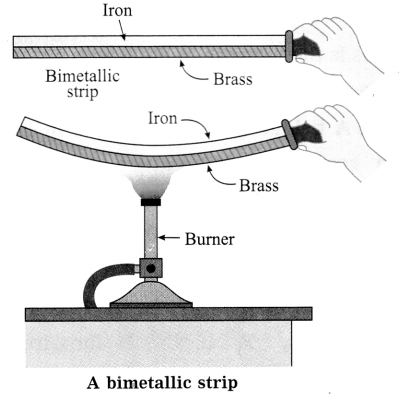
When two different metal strips of the same length at a given temperature are heated to the same higher temperature, they expand in different proportion. A bimetallic strip of brass and iron is straight at room temperature. The expansion of brass is nearly 1.5 times that of iron. Hence, when this bimetallic strip is heated, it bends, making the iron side concave.
Question 2
Maharashtra Board Solution
How a bimetallic strip is used in fire alarm:
Solution & Step-by-Step Answer:
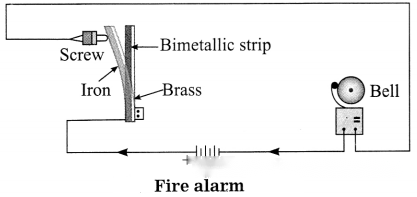
A bimetallic strip of brass and iron is connected to a battery and an electric bell as shown in the diagram. One terminal of the bell is connected to a screw which is at a very small distance from the iron side of the strip. In case, there is an accidental fire, the bimetallic strip bends towards iron and touches the screw. Thus, the circuit is completed and the bell rings, thereby warning the people of the accidental fire.
|