Latest Maharashtra State Board (SSC & HSC) 2026-27 Syllabus Digest & Solutions Updated!
Class 8English (Kumarbharati / Balbharati)2026-27 Syllabus

Chapter 4.4 Ramanujan Solutions

Complete Maharashtra State Board Balbharati & Yuvakbharati textbook solutions for Chapter 4.4 Ramanujan. Step-by-step solved exercises, numerical problems, and digest answers.

45 Solved Questions1 Diagrams3233 words

Maharashtra State Board Class 8 English Solutions Chapter 4.4 Ramanujan

Class 8 English Chapter 4.4 RamanujanTextbook Questions and Answers

Warming Up:

1. Discuss orally in your class:

In what subjects is knowledge of mathematics used, at school level and college university level. Name them.
Did you know maths is used in music and poetry also? Can you tell me how?
Answer:
(Points: knowledge of maths is used in science, physics, chemistry, economics, accountancy, etc. Poetry-rhymes, rhythm; music-beat, rhythm, etc.)

2. Use the letters in the word MATHEMATICIAN to make 4 letters 5 letter and 6 or more letter words, within a time limit fixed by your teacher.
Answer:
Mathematician: cinema, anthem, thematic, machine, attach, match, meant, mice, item, mime, hate, heat, them, team, etc.

3. Sentences can be classified into three types – Simple, Complex and Compound.

A Simple Sentence is one that has only one Subject and one Predicate.
It has only one Finite verb.
For example, She went home.
In the morning, near my school, I saw a snake.

A Complex Sentence consists of one Main Clause and one or more
Dependent or Subordinate Clauses.
For example, She went home, after school was over.
The boys found the book which had been lost.

A Compound Sentence consists of two or more Independent or
Co-ordinate Clauses. They are joined by Co-ordinators.
For example: and, but, so, or, for etc.

a. He finished his work and he left his office.
b. He is poor but he is honest.
From lesson 4.2 pick out one example of each of the following.

(i) Simple Sentence: ……………
Answer:
Modern techniques are used nowadays for anaesthesia.

(ii) Complex Sentence: …………..
Answer:
Today, if you need to have heart surgery, you can choose from many fine doctors.

(iii) Compound Sentence: ……………
Answer:
Over the years now, revolutionary steps have been taken in different types of complicated surgery and these have made such operations successful.

1. A. Use the following words/phrases to make sentences of your own:

Question 1 Maharashtra Board Solution
enthusiasm
Solution & Step-by-Step Answer:
The hikers set off on the hike with great enthusiasm.
Question 2 Maharashtra Board Solution
loped off
Solution & Step-by-Step Answer:
The deer loped off easily after being freed from the trap.
Question 3 Maharashtra Board Solution
fraud
Solution & Step-by-Step Answer:
The doctor was arrested by the police for being a fraud.
Question 4 Maharashtra Board Solution
clarity
Solution & Step-by-Step Answer:
The teacher told the student that there was no clarity in her answers.
Question 5 Maharashtra Board Solution
to come
Solution & Step-by-Step Answer:
The minister refused to come to the party unless he was provided conveyance.
Question 6 Maharashtra Board Solution
amiable
Solution & Step-by-Step Answer:
The Principal was happy that the new teacher was an amiable person.
Question 7 Maharashtra Board Solution
to terms with
Solution & Step-by-Step Answer:
The doctor advised the woman to come to terms with her illness,
Question 8 Maharashtra Board Solution
conveyance
Solution & Step-by-Step Answer:
The minister refused to come to the party unless he was provided conveyance.

1. B. The following words can be used us Nouns us well us Verbs:
(visit / honour / report / watch / form / surprise)

Make pairs of sentences of your own using them us u Noun in one and as a Verb in the other.
For example:
(i) She gave a smile – Noun.
(ii) Babies smile when they see their mother – Verb.
Answer:
(1) visit:
(i) My grandmother came over for avisityesterday, (noun)
(ii) “We mustvisitthe zoo when we go to Hyderabad,” said Meera. (verb)

(2) honour:
(i) It was anhonourto have such a great scientist visit our college, (noun)
(ii) “Let ushonourthose who have laid down their lives for the country,” said the minister, (verb)

(3) report:
The class had to hand in their projectreportsby the end of the week. (noun)
(ii) The witnessreportedall that he had seen to the lawyer, (verb)

(4) Watch:
(i) Suman lost her newwatchwhile travelling by train, (noun)
(ii) “Watchthe house to see if the thief returns,” ordered the inspector, (verb)

(5) form:
(i) The boy’s admissionformwas rejected by the college as it was incomplete. (noun)
(ii) Weformedour own impression of the new corporator, (verb)

(6) surprise:
(i) “There is asurprisefor you outside your door,” said my friend. (noun)
(ii) The villagerssurprisedthief 1 when he was sleeping and caught him. (verb)

2. Say why:

Question 1 Maharashtra Board Solution
Ramanujan’s letter bored and irritated Hardy at first.
Solution & Step-by-Step Answer:
Ramanujan’s letter was written in halting English and signed by a person unknown to Hardy. The script appeared to consist of theorems, most of them wild or fantastic-looking. Some of them though well-known were laid out as though they were original. There were no proofs of any kind. It seemed to be a kind of fraud, and hence bored and irritated Hardy.
Question 2 Maharashtra Board Solution
Hardy invited Littlewood for a discussion.
Solution & Step-by-Step Answer:
Hardy could not get the Indian manuscript out of his mind. It had wild theorems he had never seen before or imagined. He wondered if it was an unknown mathematician of genius. He had another look at the script and then invited Littlewood for a discussion to clarify his doubts.
Question 3 Maharashtra Board Solution
mother agreed to send Ramanujan to England.
Solution & Step-by-Step Answer:
Ramanujan’s mother had a dream in which she saw her son seated in a big hall among a group of Europeans and the goddess of Namakkal had commanded her not to stand in the way of her son fulfilling his life’s purpose. Hence, obeying the command of the goddess of Namakkal, mother agreed to send Ramanujan to England.
Question 4 Maharashtra Board Solution
Hardy and Ramanujan could not talk freely with each other.
Solution & Step-by-Step Answer:
Ramanujan was an untrained genius. There was a big difference between Ramanujan’s and Hardy’s education. Ramanujan knew nothing of modern rigour; he did not know what proof was and Hardy was obliged to teach him some formal mathematics. He was sometimes confused with Hardy’s conversation when it was outside mathematics. Due to all these reasons, Hardy and Ramanujan could not; talk freely with each other.
Question 5 Maharashtra Board Solution
Ramanujan had to be hospitalized.
Solution & Step-by-Step Answer:
Ramanujan had to be hospitalized because he was ill. He later died of tuberculosis.
Question 6 Maharashtra Board Solution
Ramanujan found the number 1729 very interesting.
Solution & Step-by-Step Answer:
Ramanujan found the number 1729 very interesting because it is the smallest number expressible as the sum of two cubes in two different ways.

3. Read the text and enlist the achievements and honours of Ramanujan, received in England.
Answer:
Ramanujan’s achievements and honour, received in England:

4. Voice – Active and Passive
The form of a verb shows whether the doer of an action is in the Subject (Active voice) or the Subject has an action done to it (Passive voice).
For example, The thief stole the jewels. (Active voice).
The jewels were stolen by the thief. (Passive voice)
Note: While changing from Active to Passive voice, the verb form includes be + past participle.
In a sentence, when the doer of an action is significant, we use Active voice. In Passive voice, the doer of an action may not be mentioned.
For example, The thief was caught. (by the police)

(A) Underline the verbs in the following sentences and state whether the sentences are in Active or Passive voice:

Question a.
England gave Ramanujan great honours.
Answer:
EnglandgaveRamanujan great honours. (Active)

Question b.
A large untidy envelope was decorated with Indian stumps.
Answer:
A large untidy envelopewas decoratedwith Indian stumps. (Passive)

Question c.
The timetable was not altered.
Answer:
The timetablewas not altered. (Passive)

Question d.
She saw her son in a big hail.
Answer:
Shesawher son in a big hail. (Active)

Question e.
Hardy corrected his statement.
Answer:
Hardycorrectedhis statement. (Active)

Question f.
Ramanujan was brought to England.
Answer:
Ramanujanwas broughtto England. (Passive)

(B) Change the voice in the following sentences:

Question a.
Hardy taught Ramanujan.
Answer:
Ramanujan was taught by Hardy.

Question b.
He knew nothing of the modern rigour.
Answer:
Nothing of the modern rigour was known by him.

Question c.
Sheets of paper were found in it, by Hardy.
Answer:
Hardy found sheets of paper in it.

Question d.
Hardy was bored by that manuscript.
Answer:
That manuscript bored Hardy.

Question e.
Trinity supported unorthodox talent.
Answer:
The unorthodox talent was supported by Trinity.

Question f.
He could not break the ban.
Answer:
The ban could not be broken by him.

5. Identify whether the following are Simple, Complex and Compound sentences:

Question a.
When he opened it, he found sheets of paper.
Answer:
Complex

Question b.
He glanced at a letter.
Answer:
Simple

Question c.
Hardy was not only bored but he was also irritated.
Answer:
Compound

Question d.
Ramanujan turned out to be a poor clerk.
Answer:
Simple

Question e.
If Ramanujan had been better educated, he would hove been even more wonderful than he was.
Answer:
Complex

Question f.
Ramanujan was self-taught: he knew nothing of the modern rigour.
Answer:
Compound

6. Interview Question:

A brilliant student from your school has on a Mathematics Quiz at the National Level.
Frame questions to ¡ntervie him / her when the school felicitates him / her. Follow the steps given below.

Answer:
(1) Good morning, Rachana. First of all, let me offer you my Congratulations on winning the Mathematics Quiz, and that too, at the National Level. May I ask you a few questions about your achievement?
(2) Did you have great interest in mathematics in the early years of your childhood?
(3) How did you develop this interest?
(4) How long did you prepare yourself before participating in this Quiz?
(5) Who helped you and guided you?
(6) Who encouraged you or motivated you at that stage?
(7) How did you feel when you were actually answering the questions?
(8) What is the next step from here?
(9) Do you plan to make a career in mathematics?
(10) Any message to others interested in mathematics?
(11) Thank you, and all the best for your future. Goodbye.

7. Summary:

Answer:

The Manuscript

One morning in 1913, Hardy received an envelope from India. It contained many lines of symbols, written in non- English script. The letter with it, written in halting English and signed by an unknown Indian, wanted Hardy’s opinion on the mathematical discoveries enclosed. These were only some known and unknown theorems, without any proofs. Hardy, bored and irritated, put the manuscript aside and went to play tennis. However, his pleasure in his game was interrupted by; the thought of the Indian manuscript with the wild theorems he had left behind. He
wondered if the man was a genius. When he returned to his room, he took another look at the script. Then he sent word to Littlewood that they must have a discussion after hall.

Class 8 English Chapter 4.4 Ramanujan Additional Important Questions and Answers

Complete the following:

Question 1 Maharashtra Board Solution
Hardy could not enjoy his game because ________.
Solution & Step-by-Step Answer:
he kept thinking of the Indian manuscript that he had received that morning.
Question 2 Maharashtra Board Solution
The manuscript contained _______.
Solution & Step-by-Step Answer:
wild and fantastic-looking theorems and lines and lines of symbols in a non-English script.
Question 3 Maharashtra Board Solution
The famous mathematicians mentioned in this extract are ______.
Solution & Step-by-Step Answer:
Hardy and Littlewood.
Question 4 Maharashtra Board Solution
The two English mathematicians realized by midnight _______.
Solution & Step-by-Step Answer:
that the writer of the manuscripts was a man of genius
Question 5 Maharashtra Board Solution
The famous mathematicians mentioned in this extract are _______.
Solution & Step-by-Step Answer:
Hardy, Ramanujan, Gauss, Euler and Kapitsa
Question 6 Maharashtra Board Solution
The number 1729 is exceptional because _________.
Solution & Step-by-Step Answer:
it is the smallest number expressible as the sum of two cubes in two different ways
Question 7 Maharashtra Board Solution
The famous mathematicians mentioned in this extract are ______.
Solution & Step-by-Step Answer:
Galois, Abel, and Riemann, in addition to Hardy and Ramanujan

Answer the following:

Question 1 Maharashtra Board Solution
Hardy invited Littlewood for a discussion.
Solution & Step-by-Step Answer:
Hardy could not get the Indian manuscript out of his mind. It had wild theorems he had never seen before or imagined. He wondered if it was an unknown mathematician of genius. He had another look at the script and then invited Littlewood for a discussion to clarify his doubts.
Question 2 Maharashtra Board Solution
What qualities of Ramanujan does this extract bring out?
Solution & Step-by-Step Answer:
This extract brings out Ramanujan’s passion for mathematics, his courage, and perseverance in sending his manuscript to a strange person across the seas, his efforts to put forward his ideas in spite of a lack of education, and his intelligence.
Question 3 Maharashtra Board Solution
What were the two drawbacks of Ramanujan’s career?
Solution & Step-by-Step Answer:
The two drawbacks in Ramanujan’s career were the defects in his education and that he had come on the scene too late in the line of mathematical history.
Question 4 Maharashtra Board Solution
What superstition did Ramanujan’s mother believe in?
Solution & Step-by-Step Answer:
Ramanujan’s mother believed in the superstition that she had to obey the commands given to her in her dream by the goddess of Namakkal and that whatever is seen in dreams comes true.
Question 5 Maharashtra Board Solution
What surprised everyone one morning?
Solution & Step-by-Step Answer:
One morning, Ramanujan’s mother said that she had a dream the previous night, in which she saw her son seated in a big hall among a group of Europeans. The goddess of Namakkal had commanded her not to stand in the way of her son fulfilling his life’s purpose. This statement, coming from a woman who was very strict about her religious observances, surprised everyone.
Question 6 Maharashtra Board Solution
Say why mother agreed to send Ramanujan to England.
Solution & Step-by-Step Answer:
Ramanujan’s mother had a dream in which she saw her son seated in a big hall among a group of Europeans and the goddess of Namakkal had commanded her not to stand in the way of her son fulfilling his life’s purpose. Hence, obeying the command of the goddess of Namakkal, mother agreed to send Ramanujan to England.
Question 7 Maharashtra Board Solution
Hardy calls teaching Ramanujan an unusual experience.
Solution & Step-by-Step Answer:
Ramanujan was an untrained genius. Yet, because of the defects in his education, Hardy had to teach him some formal mathematics as though Ramanuja was a scholarship candidate at Winchester. Hardy found it strange teaching modern mathematics to someone who had the deepest insight but who had literally never heard most of it. Hence he says that teaching Ramanujan was an unusual experience.

Underline the finite verbs in the following sentence:

She had a dream the previous night, in which she saw her son seated in a big hall among a group of Europeans and the goddess of Namakkal had commanded her not to stand in the way of her son fulfilling his life’s purpose.
Answer:
Shehada dream the previous night, in which shesawher son seated in a big hall among a group of Europeans and the goddess of Namakkal hadcommandedher not to stand in the way of her son fulfilling his life’s purpose.

Personal Response:

Question 1 Maharashtra Board Solution
Do you believe in superstitions?
Solution & Step-by-Step Answer:
I don’t believe in silly superstitions: like black cats crossing the path, walking under a ladder, etc. But I believe in God and that good things happen to good people. I also believe that ‘God helps those who help themselves’. We must work hard if we want something, and not just sit back and expect God and ‘luck’ to do things for us.
Question 2 Maharashtra Board Solution
Ramanujan did not have a proper formal education. Yet he became a famous mathematician. Does this mean that proper education is not necessary?
Solution & Step-by-Step Answer:
I think Ramanujan’s case was a very rare case, where he became famous even though there were so many defects in his education. This was because he was very highly talented. However, if he had received a proper education, he would probably have done much, much more, and contributed more in the field of maths. A proper education always helps, and one must always go for it.
Question 3 Maharashtra Board Solution
In the earlier days, people used to die of illnesses like tuberculosis and pneumonia. Do you think that is still the case?
Solution & Step-by-Step Answer:
Though these diseases are still prevalent, the rate of cure is high, and the percentage of people dying from them has gone down. Different medicines have – been found for them. Today people die of cardiac problems, cancer, etc.

Write if the following statements are True or False:

Question 1 Maharashtra Board Solution
Ramanujan was a bad-tempered person.
Solution & Step-by-Step Answer:
False
Question 2 Maharashtra Board Solution
Hardy thought that Ramanujan was an untrained genius.
Solution & Step-by-Step Answer:
True
Question 3 Maharashtra Board Solution
Ramanujan did not get admission to Madras University.
Solution & Step-by-Step Answer:
True
Question 4 Maharashtra Board Solution
Ramanujan was sometimes confused with Hardy’s conversation.
Solution & Step-by-Step Answer:
True

Do as directed:

Question 1 Maharashtra Board Solution
Pick out two compound words from the lesson.
Solution & Step-by-Step Answer:
timetable, superhuman
Question 2 Maharashtra Board Solution
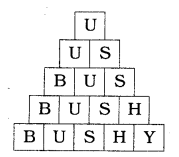
Make a word pyramid of at least four words beginning with U.
Solution & Step-by-Step Answer:

Question 3 Maharashtra Board Solution
Give the noun forms of: amiable, fulfilling
Solution & Step-by-Step Answer:
amiability, fulfillment
Question 4 Maharashtra Board Solution
Find out four hidden words from the given word: miserably (Each word should have at least 4 letters.)
Solution & Step-by-Step Answer:
miserably: miser, able, miserly, bleary
Question 5 Maharashtra Board Solution
Use the following word and its homophone in two separate sentences: sent
Solution & Step-by-Step Answer:
(i) Harsha sent the little boy home immediately. (ii) The scent of the jasmine flowers was simply wonderful.
Question 6 Maharashtra Board Solution
Rewrite as a negative sentence: It seemed impossible that he could break the ban and cross the water.
Solution & Step-by-Step Answer:
It did not seem possible that he could break the ban and cross the water.
Question 7 Maharashtra Board Solution
Underline the adjectives in the following sentence: He seems to have listened with a patient smile on his good, friendly, homely face.
Solution & Step-by-Step Answer:
He seems to have listened with a patient smile on his good, friendly, homely, face.
Question 8 Maharashtra Board Solution
Say whether the sentence is Simple, Compound, or Complex: If it had been summer, he would have walked down to Fenner’s to watch cricket.
Solution & Step-by-Step Answer:
Complex
Question 9 Maharashtra Board Solution
Change the voice: They needed a certain amount of help from a superhuman agency.
Solution & Step-by-Step Answer:
A certain amount of help was needed from a superhuman agency (by them).
Question 10 Maharashtra Board Solution
Rewrite using the underlined word as a verb: He sent word to Littlewood that they must have a discussion.
Solution & Step-by-Step Answer:
He sent word to Littlewood that they must discuss.