Maharashtra State Board Class 8 English Solutions Chapter 4.1 The Vet
Class 8 English Chapter 4.1 The Vet Textbook Questions and Answers
Warming Up:
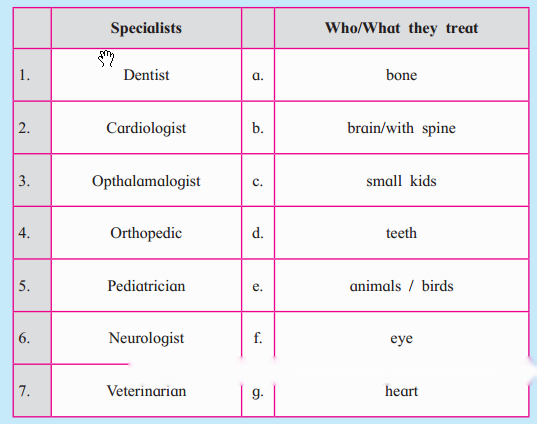
1. Doctor who does the special advanced study of specific parts of the body have special terms.
In your group try to match the specialist doctors with who I what they treat.
Answer:
2. Discuss in your group and write down the most important reason, why Pediatrician and Veterinarians have, a tougher job to diagnose their patients’ illnesses.
Answer:
Pediatricians and veterinarians have a tougher job to diagnose their patients’ Illnesses as their patients cannot communicate their problems clearly.
1. What is the Rhyme scheme of stanzas I to 3 and the last ho stanzas? How does it differ in the remaining stanzas 4 to 7?
Answer:
The rhyme scheme of:
(i) stanza 1: abab
(ii) stanza 2: abab
(iii) stanza 3: abab
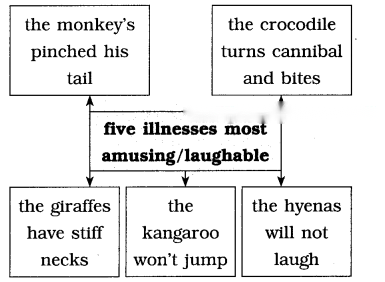
2. Write any five illnesses of the animals in the poem, that you find most amusing/laughable.
Answer:
3. A. Out of all names of birds and animals given in the poem, pick out 4 names that are similar in English as well as in Hindi / Marathi or your Mother tongue.
3. B. Write four reasons why animals in u zoo suffer more than those who live free in the wild.
Answer:
Animals in a zoo suffer more than those who live free in the wild because of:
4. Think deeply and write. Is the poet really discouraging the youth from becoming sets? Explain your response.
Answer:
No, the poet is not really discouraging the youth. The poem is a light-hearted one. However, the poet wants the reader to know how difficult the work of a vet is, and what a wide variety of patients he has to cure. They have different types of illnesses and different types of organs. They cannot even discuss their problems with him. We must acknowledge all this and respect the vet.
5. Find out from a vet or from a website, what precaution a vet has to take, when he/she is culled to treat wild, dangerous animals? Make point-wise flutes of the same.
Answer:
Points: must be aware of the signals they give – their body language – must not be distracted – protect against being attacked – precautions against allergies and transmission of diseases – wear protective gear, etc.
6. Select any four zoo – animals mentioned in the poem. Imagine they are able to talk in English. Compose a dialogue among the four animals discussing their discomfort and illnesses.
Answer:
Answer:
Animals: giraffe, tortoise, bear, kangaroo
Giraffe: Ouch, my neck hurts! The whole length of it! How lucky you are, tortoise to have such a short neck!
Tortoise: Lucky! Do you know what it means to take ages to move afoot? How difficult it is to permanently carry your home on your back?
Kangaroo: Oh, you find it difficult to move your feet. What about me? My legs are of unequal length; I cannot walk comfortably. I’m expected to jump around. I’m sick and tired of jumping. I want to walk regally like you, madam hippo.
Hippo: Regally, my foot! I’m walking so slowly because I’m feeling ill, and I do not know which part of this huge body is actually painting. You, tortoise, have such a small body. Not much searching is needed to find out the cause of the problem.
Tortoise: Problem! I only want to be able to move quickly, so that I can escape my enemies, and exercise my limbs.
Giraffe: I agree with madam hippo. The bigger the body, the more the area that has to be investigated to find out the problem. My doctor is never able to find out which part of my neck actually aches.
Kangaroo: Try balancing yourself on legs of unequal length and having to jump all the time, keeping your baby in your pouch.
Hippo: Ok, we all have our own problems. Let’s hope that the doctor who looks after us has enough knowledge and experience to cure us. He cannot even understand what we say!
All the others: How true!
Class 8 English Chapter 4.1 The Vet Additional Important Questions and Answers
Complete the following:
Answer the following:
Question 5. What is the poet’s advice to you? Do you think he means it? Answer: The poet advises the reader not to become a vet but to earn his/her living in an easier way. He advises the reader to become a doctor and treat the illnesses of human beings. No, I don’t think he means it. It is just said in a light-hearted way.
Question 6
Maharashtra Board Solution
Is the poet really discouraging the youth from becoming vets? Explain your response.
Solution & Step-by-Step Answer:
No, the poet is not really discouraging the youth. The poem is a light-hearted one. However, the poet wants: the reader to know how difficult the work of a vet is, and what a wide variety of patients he has to cure. They have different types of illnesses and different types of organs. They cannot even discuss their problems with him. We must acknowledge all this and respect the vet.
Question 7
Maharashtra Board Solution
What is the rhyme scheme of stanzas 6 and 7?
Solution & Step-by-Step Answer:
Rhyme scheme of: (i) stanza 6: aabccb (Note: the last line of the 6’ stanza is ‘If the elephant eats….’.) (ii) stanza 7: aabccb (Note: thefirst line of the 7th stanza is ‘If the camel hurts….’.)
Question 8
Maharashtra Board Solution
What is the rhyme scheme of the last two stanzas :
Solution & Step-by-Step Answer:
(i) stanza 8: abab (Note: the last line of the 81h stanza Is ‘Your livtng in….’.) (ii) stanza 9: abab (Note: the first line of the 9th stanza is ‘Don’t attempt to….’.)
Question 9
Maharashtra Board Solution
PIck out an example of Alliteration from the extract.
Solution & Step-by-Step Answer:
‘If the camel hurts his hump’.Repetition of the sound of the letter ‘h’.
Question 10
Maharashtra Board Solution
Pick out an eximple of Onomatopoeia from the extract.
Solution & Step-by-Step Answer:
‘If the elephant eats paper-bags and chokes’. The word ‘chokes’ indicates the sound.
Question 11
Maharashtra Board Solution
What is the rhyme scheme of stanzas 1 to 3 and the last two stanzas? How does it differ In the remaining stanzas 4 to 7?
Solution & Step-by-Step Answer:
In stanzas 1 to 3 and the last two stanzas, the alternate lines rhyme i.e. the rhyme scheme Is abab, cdcd, and so on. However, In the stanzas 4 to 7, the rhyme scheme is aab ccb I.e. the first two lines rhyme, then the third and sixth lines rhyme, and the fourth and fifth lines rhyme.
Question 12
Maharashtra Board Solution
Analysis/Appreciation Of A Poem
Solution & Step-by-Step Answer:
|