Maharashtra State Board Class 8 English Solutions Chapter 2.4 Three Visions for India
Class 8 English Chapter 2.4 Three Visions for India Textbook Questions and Answers
1. Read the Preamble of the Constitution of India given in your textbook. Pick out words that refer to the following.
Answer:
2. Finite and Non- finite Verbs:
Verbs are action words. They can be Finite or Non-finite.
Read the sentences below, focusing on the verbs.
(a) I play football.
(b) He plays football.
(c) They play football.
(d) Manish plays football.
We notice that the verb ‘play’ as we change the person (First I Second /Third) or Number (Singular/Plural) of the Subject.
When the use of a verb is limited by the Person or Number of the Noun/Pronoun in the Subject, we call it a Finite Verb.
Now read the sentences below.
(a) I like to play football.
(b) He likes to play football.
(c) They like playing football.
(d) Manish likes to play football.
In the sentences above the verb ‘to play’ or ‘playing’ does not change or take ‘-s’ or ‘-es’ after them, even when we change the Person or Number of the Subject.
to + verb, I verb + ing/verb + en I ed/having + verb + en I ed are not limited by their Subject. Such verbs are called Non-finite Verbs.
1. Complete Dr APJ Abdul Kolum’s profile with information picked from the lesson:
Profile – Dr. APJ Abdul Kalam
a. Title: …….
b. Profession: ………
c. Branch of science: ……..
d. Important position in Government held: ………..
e. His three visions for India: ……..
Answer:
a. Title: Dr. APJ Abdul Kalam
b. Profession: Missile scientist.
c. Branch of Science: Physics and Aerospace Engineering.
d. An important position in government-held: 11th President of India.
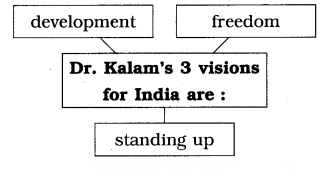
e. His three visions for India: Freedom, Development, and Standing Up to the rest of the World.
2. Using a dictionary/internet note down the main differences between:
Question a.
a developing nation and a developed nation
Answer:
(i) a developing nation: a country that is poor and whose citizens are mostly agricultural workers, and the average income is very low.
(ii) a developed nation: a country with a lot of industrial activity, high economic growth and where people have high incomes.
Question b.
self-reliant and self-assured
Answer:
(i) self-reliant: not needing help or support from other peoples
(ii) self-assured-having confidence in yourself.
Question c.
our strengths and our achievements
Answer:
(i) our strengths – the qualities and abilities that we have which are an advantage to us, or which make us successful.
(ii) our achievements – our successes or accomplishments.
Question d.
farm and granary
Answer:
(i) farm – a large area used for growing crops/flowers, etc.
(ii) granary – a storehouse for grain
Question e.
a remote-sensing satellite and a natural satellite
Answer:
(i) a remote-sensing satellite – artificial (man-made) satellites with remote sensors which have been launched into space to measure various things.
(ii) a natural satellite – any celestial body in space that orbits around a larger body.
3. Find evidence from the lesson and write in your own words:
Question a.
Indians respect the freedom of others.
Answer:
India has not tried to conquer anyone, or grab their land, culture and history. We have not tried to force our way of life on anyone. This is because Indians respect the freedom of others.
Question b.
It is time to see ourselves as a developed nation.
Answer:
We have been a developing nation ‘ for 50 years. Now we are among the top five nations of the world in terms of GDP we have ten percent growth rate in most areas. Our poverty levels are falling and our achievements are being recognized globally. It is time to see ourselves as a developed nation.
Question c.
We Indians are obsessed with foreign things.
Answer:
We Indians are obsessed with foreign things and we want to have things like foreign TVs, foreign shirts and foreign l technology.
Question d.
In Israel, the media have a positive outlook and self-respect.
Answer:
In Israel, it was the day after Hamas had struck and a lot of attacks, bombardments and deaths had taken place. However, the front page of the newspaper had an inspiring picture of a Jewish gentleman who in five years had transformed his desert land into an orchid farm and granary. The gory details of the killings, bombardments, deaths, etc. were inside the newspaper, buried among other news. This showed that in Israel the media have a positive outlook and self-respect.
Question e.
India has many amazing success stories.
Answer:
India has many amazing success stories. We are not only the second largest producer of wheat in the world, but also the second largest producer of rice. We are the first in milk production and are number one in remote sensing satellites. We have great personalities like Dr. Sudarshan, who has transformed a tribal village into a self-sustaining, self-driving unit.
4. Pick out some sentences from (he Iesson that coney u general truth.
(i) If we are not free, no one will respect us.
(ii) …………
Answer:
(i) If we are not free, no one will respect us.
(ii) We must stand up to the world or no one will respect us.
(iii) Only strength respects strength.
(iv) Military power and economic power-both must go hand in hand.
5. Find out from the Internet the poem Song of Youth’ by Dr APJ Abdul Kulam.
(A) Copy it down in your notebook and write its theme in your own words.
(B) Using information from our school library or the Internet, prepare a
Profile of any great Indian Scientist. (Refer to Activity 1 for points.)
6. Say whether each of the verbs, underlined below, is Finite or Non-finite.
Question a.
Welackthe confidenceto seeourselves as adevelopednation.
Answer:
lack – Finite
to see – Non-finite
developed – Non-finite
Question b.
Westandfirst inproducingmilk.
Answer:
stand – Finite
producing – Non-finite
Question c.
Iwantto livein a developed India.
Answer:
want – Finite
to live – Non-finite
Question d.
Wepreferbuyingimported things.
Answer:
prefer – Finite
buying – Non-finite
Question e.
Indians never tryto forcetheir way of life on others.
Answer:
to force – Non-finite
Question f.
Having invaded India, theycapturedour land.
Answer:
captured – Finite
7. Phrases and Clauses:
Study the underlined groups of words.
(i)
(a) He wore a shirtmade of cotton.
(b)He wore a shirtwhich was made of cotton.
(ii)
(a) Are you sure of your innocence?
(b) Are you sure that you are innocent?
(iii)
(a) This is the exact reasonfor his failure.
(b)This is exactlywhy he has failed.
(iv)
(a) Pay careful attention tomy words.
(b)Pay careful attention towhat I say.
(v)
(a)After finishing his work, he went home.
(b)He finished his workandhe went home.
You will notice that all underlined groups of words in sentences marked (a) merely
refer to a concept or expression. They do not contain a Subject or a Main or Principal
Verb. Such a group of words or unit of a sentence is called a PHRASE
Each of the underlined groups of words in sentences marked (bi convey a thought/concept and have a Subject and a Principal or Main Verb.
This unit /part of a sentence is called a CLAUSE.
Say whether the underlined parts of the following sentences are Phrases or Clauses:
(i)
Peoplefrom all over the worldhave invaded us.
Answer:
Phrase
(ii)
I believethat Indio had its first vision of freedom in 1857.
Answer:
Clauses
(iii)
It is this freedomthat we must respect.
Answer:
Clauses
(iv)
We area great nation.
Answer:
Phrase
(v)
I want to livein a developed India.
Answer:
Phrase
(vi)
We have so many amazing success stories butwe refuse to acknowledge them.
Answer:
Clauses
(vii)
We have a 10 percent growth ratein most areas.
Answer:
Phrase
Replace the underlined Phrases with Clauses:
Question a.
Do you know hisplace of birth?
Answer:
Do you know where he was born?
Question b.
In his absence, the thieves looted his house.
Answer:
When he was absent, the thieves looted his house.
Question c.
I am a citizenof India. I am a citizen.
Answer:
I am a citizen who belongs to India.
Class 8 English Chapter 2.4 Three Visions for India Additional Important Questions and Answers
Complete the webs:


Simple Factual Activities:
Write the past tense forms of the following words:
Answer:
Rewrite the following sentences as affirmative sentences:
Personal Response:
Complete the following:
Write the antonyms of the following words using prefixes:
Answer:
Pick out the relative pronouns from the following sentences:
Personal Response:
Do as directed: