Maharashtra State Board Class 8 English Solutions Chapter 1.4 Revathi’s Musical Plants
Class 8 English Chapter 1.4 Revathi’s Musical Plants Textbook Questions and Answers
Warming Up
1. Discuss in groups and share your answers with the class:
2. Affirmative and Negative sentences:
Read the sentences below and spot the difference in their framing:
1. (a) I could not complete the work.
(b) I failed to complete the work.
2. (a) There is no sense in what you say.
(b) There is hardly any sense in what you say.
3. (a) He said he wouldn’t go.
(b) He refused to go.
You will observe that sentences marked (a) and (b) convey the same meaning. But in all sentences marked (a) there are negative words (no, not, wouldn’t) whereas the ones marked (b) do not have them.
Negative words are those that convey a negative meaning.
For example: never, no, neither, nor, not, cannot, don’t, isn’t, nothing etc.
If a sentence contains Negative words, it is called a Negative Sentence.
If a sentence does not contain any Negative word, it is called Affirmative sentence.
Note: While interchanging Negative and Affirmative sentence, the meaning and tense must not change.
You must use Negative words in the sentence, while transforming from Affirmative to Negative.
You may use words like hardly I fail to I refuse / reject / avoid / prohibit / without / ban etc., while changing Negative sentences to Affirmative.
Say whether the following sentences are Affirmative or Negative ones:
1. Read the story and complete the following:
Question a.
At first, Revathi’s plants did not look normal and healthy because of _______.
Answer:
they had pale green leaves and their growth was stunted due to insufficient sunlight.
Question b.
When Revathi played her favourite raga, the plants began to move because _____.
Answer:
they liked the music she was playing.
Question c.
Revathi’s grief knew no bounds because _________.
Answer:
she could not find her pot of balsam plants.
Question d.
Revathi was confident of proving her ownership of her pot of plants because________.
Answer:
she knew that her plants loved music and would respond to her favorite raga. They would bend their stems towards her, proving that they were hers.
Question e.
Revathi won the prize for the ‘Best Plant’ because of ______.
Answer:
her plants were the best looking and the healthiest.
2. Answer in your own words:
Question a.
What did Revathi discover about her balsam plants?
Answer:
Revathi discovered that her balsam plants were not only taller and healthier than the other balsam plants, but they had started flowering earlier too. The flowers were big and brightly coloured, and one of the plants had an unusual kind of flower. She also discovered that while the plants liked her favourite tune, they did not like the tune with a quick rhythm.
Question b.
Why did Revathi decide to keep her new knowledge ‘a secret’?
Answer:
Revathi decided to keep her new knowledge a secret perhaps because she felt that it was something only between her and her beloved plants, whom she considered her friends. or perhaps she felt that nobody would believe her if she mentioned that her plants were music lovers.
Question c.
How did the plants respond when Revathi played her favourite tune?
Answer:
When Revathi played her favourite tune on her violin, the plants all bent their stems towards her even though there was no breeze.
Question d.
How did the plants react to the fast rhythmic music?
Answer:
When Revathi played a tune with a quick rhythm, the plants turned away from her as though they did not like what she was playing.
Question e.
How did Revathi prove to the organisers of the competition that the plants truly belonged to her?
Answer:
When Revathi played her favourite tune, the plants bent their stems towards her as though they wanted to touch her in their happiness. This convinced the organisers that the plants were hers.
Question f.
What helped Revathi to claim her plants her belief in magic or the belief in her convictions? Explain your choice.
Answer:
Her belief in her convictions helped Revathi to claim her plants. She was sure that her plants were music lovers and would respond to her favourite raga as they had done before. There was no magic involved. It was a fact.
3. A. An ord chain consists of words of a certain category that begin with the letter, that the previous word has ended with.
Complete the word chain adding Four Nouns from the text.
Music → courtyard → ………
Answer:
music → courtyard → days → surprise → evening → grief.
3. B. Add the appropriate Prefix to make the following words opposite in meaning.
Answer:
3. C. Use the following expressions to make sentences of your own:
4. Imagine there is a ‘Best Plant’ Competition in the locality /colony where you live. Frame a Notice about the same, in the form of an attracti’e poster.
Cover the following points.
Name of the organisation.
Name of the Contest.
Day, Date, Venue.
Who can participate.
Prizes.
Contact details for further enquiry.
Answer:
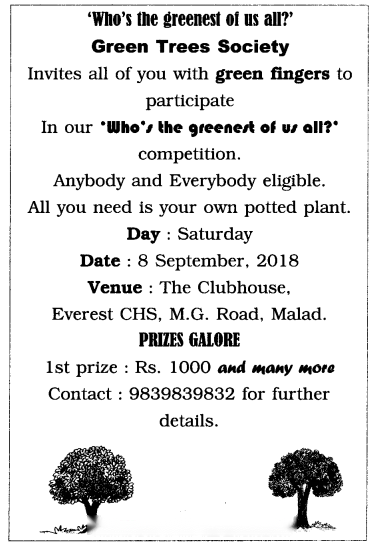
5. Types of sentences:
Study the following sentences.
Set (A)
Revathi was a student of music.
The flowers were big and brightly coloured; indeed.
They were requested to believe her.
All the above sentences are statements or assertions, and called Assertie or Declarative sentences.
Set (B)
Wasn’t Revathi a student of music?
How can we doubt her?
Do plants have ears?
The above sentences in Set (B) are Questions. They are called Interrogatie sentences.
Set (C)
Please believe me.
Let us rutch the fun.
Sit straight.
Excuse me.
In Set (C) the sentences are either requests, appeals, commands, suggestions etc. Such sentences are called Imperative Sentences.
Set (D)
How big and bright the flowers were!
What a surprise!
Ah, what beautiful music that is!
Set (D) has sentences that express strong feelings. They are called Exclamatory Sentences
State the kinds of the following sentences:
6. Make the following Negative using the negative words given:
7. Make the following Affirmutie using the words given:
8. Imagine that Revathi’s father is abroad on business and she wishes to convey the news of her prize-winning plants. Draft un email for the above subject.
Answer:
Hi Dad,
How are you? How is your trip? Have you done a lot of sightseeing the past weekend? Please don’t forget to send some pics. I wish we could all have been in Paris with you.

I have some excellent news for you. Do you know those potted balsam plants in the corner of our courtyard? Well, I took one pot and gave it a lot of love and care. And guess what! It won the first prize in the ‘Best Plant’ contest in our colony!
But more important than that, Dad, is the fact that I have discovered that my plants love music, especially my favourite raga, Mohanam. They bend towards me when
I play that raga on my violin, and move I away when I play some music with a quick rhythm. No, it is not my imagination; I proved it to the organisers of the contest, and they have praised me for my discovery.I They will certainly talk to you about it when you come back.
Dad, I want to prove my discovery to you too. Please come back soon. Rest everything is fine. Lots of hugs and kisses from all of us.
Revathi.
Class 8 English Chapter 1.4 Revathi’s Musical Plants Additional ImportantQuestions and Answers
Simple Factual Activity:
Fill in the blanks:
Pick out the conjunctions in the following sentences:
Complete the table and write who said the given words and to whom:
Answer:
The Words | Who said | To whom |
(1) Do plants have ears? | The organisers | Revathi |
(2) I know my plants. | Revathi | The organisers |
Give reasons:
Punctuate the sentence:
they asked her do plants have ears like ours to enjoy your music
Answer:
They asked her, “Do plants have ears like ours to enjoy your music?”
Underline the nouns in the following sentence :
There was her pot of plants on a bench, with the name of a distant neighbour written on a small piece of cardboard and placed in the soil.
Answer:
There was herpotofplantson abench, with thenameof a distantneighbourwritten on a smallpieceofcardboardand placed in thesoil.
Personal Response:
Rewrite the following sentences in the correct order of occurrence in the passage:
Answer:
Complex Factual Activities :
Give reasons :
Activities based on Vocabulary :
Write the noun forms of the following words :
Answer:
Write the adjective forms of the following words:
Answer:
Activities based on Contextual Grammar:
Underline the adverbs in the following sentence:
She felt very dejected but was determined to win her plants back.
Answer:
She feltverydejected but was I determined to win her plantsback.
Underline the conjunctions in the following sentence :
The authorities decided that Revathi’s plants deserved the first prize as they were the best-looking and healthy.
Answer:
The authorities decidedthatRevathi’s plants deserved the first prizeasthey were the best-lookingandhealthy.
Personal Response:
What helped Revathi to claim her plants-her belief in magic or her belief in her convictions? Explain your choice.
Answer:
Her belief in her convictions helped Revathi to claim her plants. She was sure that her plants were music lovers and would respond to her favourite raga as they had done before. There was no magic involved. It was a fact.
Grammar
Say whether the following sentences are Assertive, Interrogative, Imperative or Exclamatory:
Do as directed: