Maharashtra State Board Class 7 Science Solutions Chapter 4 Nutrition in Living Organisms
Class 7 Science Chapter 4 Nutrition in Living Organisms Textbook Questions and Answers
1. Classify according to food-type.
Tiger, cow, vulture, bacteria, deer, goat, human, fungus, lion, sparrow, buffalo, frog, cockroach, tick.
Answer:
2. Nutrition In Living Organisms Class 7 Exercise Match the pairs.
Class 7 Science Chapter 4 Nutrition In Living Organisms Question Answer Question 1.
Column ‘A’ | Column ‘B’ |
1. Parasitic plant | a. Mushroom |
2. Parasitic plant | b. Lichen |
3. Saprophytic plant | c. Drosera |
4. Symbiotic plant | d. Cuscuta |
Answer:
Column ‘A’ | Column ‘B’ |
1. Parasitic plant | d. Cuscuta |
2. Parasitic plant | c. Drosera |
3. Saprophytic plant | a. Mushroom |
4. Symbiotic plant | b. Lichen |
3. Answer the following questions in your words.
Question a.
Why do living organisms need nutrition?
Answer:
Living organisms need nutrition due to the following: (a) To supply the energy required for doing work, (b) For growth and development of the body, (c) To replace the damaged cells and repair tissues, (d) To fight diseases.
Question b.
Explain the process of production of food in plants.
Answer:
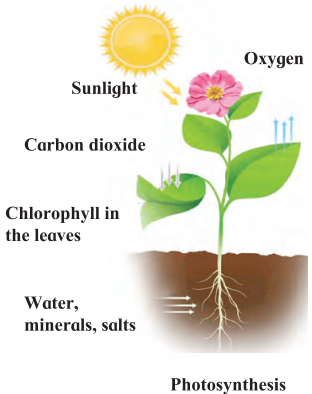
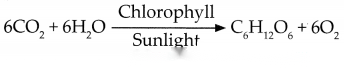
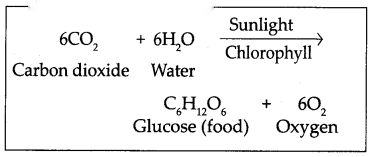
1. Green plants can produce their own food. With the help of sunlight and chlorophyll, plants make their own food in their leaves, using water and nutrients from the soil and carbon dioxide from the air.
2. This process is called as photosynthesis. In this process plants give out oxygen and take in carbon dioxide.
Question c.
What is meant by parasitic plants? Name their different types with examples of each.
Answer:
The plants that grow on the body of other plants to obtain food are called as parasitic plants.
There are two types of parasitic plants:
Question d.
Explain the various steps of nutrition in animals.
Answer:
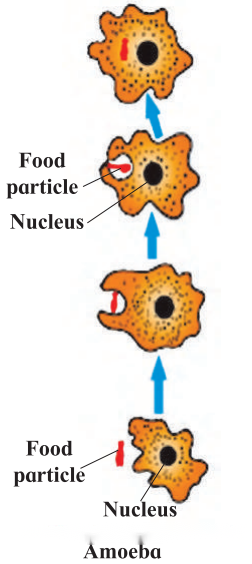
Steps of nutrition in animals are as follows:
Question e.
Name some unicellular organisms in which all life processes take place within their unicellular body.
Answer:
Unicellular organisms like amoeba, euglena, paramoecium in which all life processes take place within their unicellular body.
4. Give reasons.
Question a.
Insectivorous plants are attractively coloured.
Answer:
Question b.
Butterflies have a long tube-like proboscis.
Answer:
Holozoic mode of nutrition means the feeding of solid and liquid food by animals. Butterflies live on nectar from flowers. Therefore to suck the nectar from flowers, they have a long tube-like structure called proboscis.
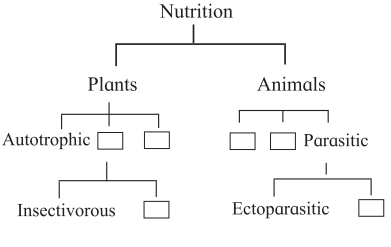
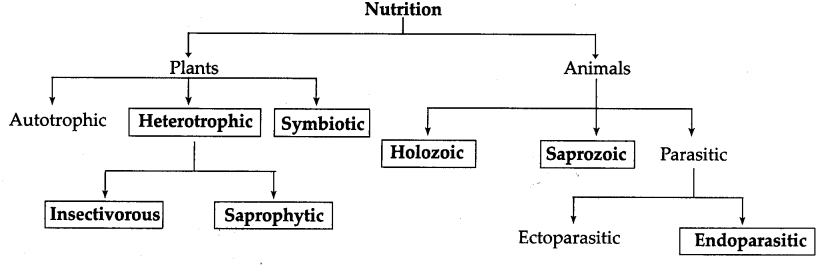
5. Prepare and complete the flowchart according to type of nutrition.
Question a.
Prepare and complete the flowchart according to type of nutrition.
Answer:
6. Think and answer.
Question a.
We prepare a variety of foodstuffs and dishes at home. Are we then autotrophic organisms?
Answer:
Question b.
Which organisms are greater in number – autotrophs or heterotrophs? Why?
Answer:
Question c.
The number of heterotrophs found in desert regions is smaller. However, they are found in greater numbers in the sea. Why is this so?
Answer:
Question d.
What damage or harm do ectoparasitic and endoparasitic animals cause?
Answer:
Question e.
Why is plant food not produced in any other parts of the plant except the green ones?
Answer:
Plant food is not produced in any other parts of the plant except the green ones because only green part contains chlorophyll and chlorophyll is very necessary for the production of food.
Class 7 Science Chapter 4 Nutrition In Living Organisms Project:
Question 2
Maharashtra Board Solution
Prepare a Power point presentation on the topic ‘Nutrition in Living Organisms’. |
Class 7 Science Chapter 4 Nutrition in Living Organisms Important Questions and
Nutrition In Living Organisms Class 7 Exercise Fill in the blanks.
Nutrition In Living Organisms Class 7 Exercise Question 1.
Leaves have microscopic openings called ……………..