Maharashtra State Board Class 7 Science Solutions Chapter 14 Elements, Compounds and Mixtures
Class 7 Science Chapter 14 Elements, Compounds and Mixtures Textbook Questions and Answers
1. Who are my companions?
Question a.
Column ‘A’ | Column B’ |
1. Stainless steel | a. Non-metal |
2. Silver | b. Compound |
3. Bhajani mixture for milling | c. Mixture |
4. Salt | d. Element |
5. Coal | e. Alloy |
6. Hydrogen | f. Metal |
Answer:
Column ‘A’ | Column B’ |
1. Stainless steel | e. Alloy |
2. Silver | f. Metal |
3. Bhajani mixture for milling | c. Mixture |
4. Salt | b. Compound |
5. Coal | a. Non-metal |
6. Hydrogen | d. Element |
2. Write the names of elements from the following symbols:
Zn, Cd, Xe, Br, Ti, Cu, Fe, Si, Ir, Pt.
Question a.
Write the names of elements from the following symbols:
Zn, Cd, Xe, Br, Ti, Cu, Fe, Si, Ir, Pt.
Answer:
Symbol | Element |
Zn | Zinc |
Cd | Cadmium |
Xe | Xenon |
Br | Bromine |
Ti | Titanium |
Cu | Copper |
Fe | Iron |
Si | Silicon |
Ir | Iridium |
Pt | Platinum |
3. What are the molecular formulae of the following compounds?
(Hydrochloric acid, Sulphuric acid, Sodium chloride, Glucose, Methane)
Question a.
What are the molecular formulae of the following compounds?
(Hydrochloric acid, Sulphuric acid, Sodium chloride, Glucose, Methane)
Answer:
4. Give scientific reasons:
Question a.
Buttermilk is churned to get butter.
Answer:
Question b.
In Chromatography the ingredients of a mixture rise up to a limited height when water rises up to the upper end of the paper.
Answer:
In Chromatography two properties of substances are used, (a) They are the stability of the substances in the solvent that moves up. The ability of the substance to stick to the stationary filter paper, (b) So all the components of the mixture do not rise all the way to the upper end of the filter paper but remain behind at limited heights.
Question c.
A wet cloth is wrapped around a water storage container in summer.
Answer:
A wet cloth will absorb the heat from the surroundings and it will keep the water in the container, cool for a longer time.
5. Explain the difference.
Question a.
Metals and Non-metals
Answer:
Metals | Non-metals |
1. Metals are good conductors of heat and electricity. | 1. Non-metals are poor conductors of heat and electricity. |
2. Metals are solids at room temperature except for mercury. | 2. Non-metals exists in all three states. |
3. Metals are lustrous, (shiny) | 3. Non-metals are not lustrous, (dull appearance) except graphite. |
4. Metals are malleable (can be hammered into sheets) | 4. Non-metals are brittle, not malleable. |
5. Metals are ductile, can be drawn into wire. | 5. Non-metals are not ductile. |
6. Metals are very hard and strong. | 6. Non-metals are brittle, will break down into pieces except diamond. |
Question b.
Mixture and Compound
Answer:
Mixture | Compound |
1. The different substances are not chemically joined together to form a mixture but mixed physically. | 1. A compound is formed when two or more elements chemically combine together e.g. H2O → chemical formula of water. |
2. Each substance in the mixture retains its own properties | 2. Compound has fixed properties. |
3. Mixtures are impure substances. | 3. Compounds are pure substances. |
4. Substances from the mixture can easily be separated by physical methods. | 4. The constituents of a compound can be separated only by chemical methods. |
5. The constituents of a mixture are present in varying proportions. | 5. The constituents of a compound are present in fixed proportion. |
Question c.
Atoms and Molecules
Answer:
Atoms | Molecules |
1. An atom is the fundamental part of matter. | 1. A molecule is a group of chemically bonded atoms. |
2. Atoms are basic building blocks of matter. | 2. Molecule is the smallest unit of a chemical compound |
3. It is foundation of molecules. | 3. It is foundation of chemical compound. |
Question d.
Separation by distillation and Separation by separating funnel
Answer:
Separation by distillation | Separation by separating funnel |
1. Distillation is used for purification of impure liquids, for separating liquid and solids (Separation of mixture containing two miscible liquids) e.g. to separate salt and water from saltwater. | 1. This procedure is used for separating two liquids e.g. separating oil and water, (two immiscible liquids) |
6. Write answers to the following questions in your own words.
Question a.
How are the components of mixture separated by simple methods?
Answer:
1. Component of mixtures are separated by straining, filtering, sifting, picking, sorting, winnowing, combing with a magnet and sublimation.
2. In a mixture, the constituent substances do not lose their identity, they can be separated easily by physical methods.
a. Sedimentation: (i) It is a process of separating an insoluble solid from a liquid in which it is suspended, by allowing it to settle to the bottom of the container, e.g. Muddy water contains heavier particles like sand and soil, (ii) Leave this muddy water undisturbed for some time, (iii) The heavier soil and sand particles settle down and the clear upper water is poured out by decantation.
b. Filtration: It is used for separating insoluble solids from a liquid, e.g. mixture of chalk and water is poured through a filter paper in a funnel while the water gets
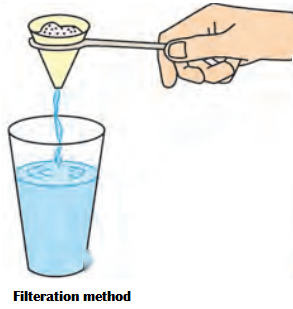
collected in the beaker below, chalk is retained in the filter paper.
c. Evaporation: It is used for recovering dissolved solid substances from solutions by evaporation e.g. sugar can be recovered from sugar-water.
d. Distillation: It is a process of heating a solution containing soluble solids to form vapours of the liquid and then cooling the vapours to get the liquid back. e.g. A mixture of common salt and water is taken in distillation flask and heated. Steam rises up and comes out into condenser.
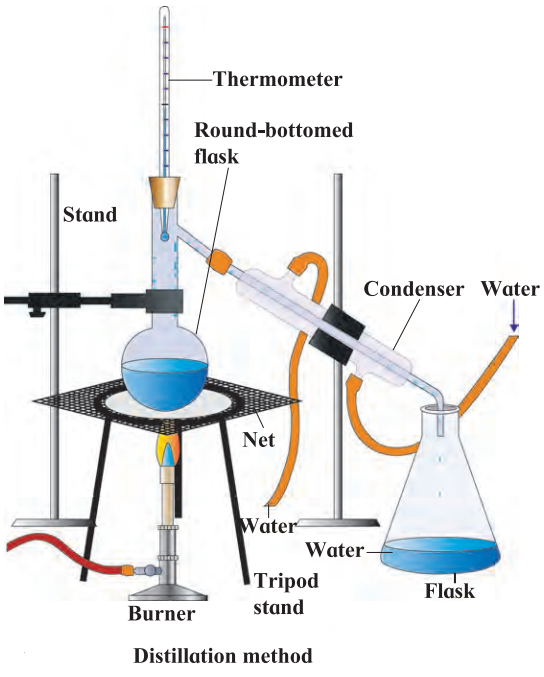
e. Sublimation: It is a process in which some solids on heating are transformed directly to vapour without passing through the liquid state, (i) It is used to separate a mixture of solids. The vapours are cooled separately, (ii) Used to separate ammonium chloride, iodine, camphor and sulphur from any mixture.
f. Magnetic separation: A mixture with iron fillings as one of the components can be separated using magnet to attract the iron particles away from the mixture.
Question b.
Which elements (metals, non-metals) compounds and mixtures do we use in our day to day life?
Answer:
Elements – non-metal
Elements – metals
Compounds:
Mixtures:
Question c.
In everyday life, where and for what purpose do we use centrifugation?
Answer:
Centrifugation: It is a process which involves application of centrifugal force.
1. It is used in industrial and laboratory settings. It is used for separation of fluids, gas or liquid based on density. In centrifugation mixture is separated through spinning and the solid settles to the bottom and the solution is clear.
2. Best example of centrifugal force is working of washing machine when it dries the clothes. The wet clothes are moving in circular path and a force acts on water particles in clothes and this force pulls water all outer side. Force involved is centrifugal force which removes the water from the clothes and clothes are dried in this way.
3. Cream separation: When the machine moves, the rod set inside milk moves and milk is pressurised and solid part from this milk goes outside due to centrifugal force and this solid part is cream. In this way the cream is separated from the milk.
Question d.
Where are methods of separation by distillation and by separating funnel used?
Answer:
1. Distillation: It is the process of separating the components or substances from a compound. It is a process of heating a solution containing soluble solids to form vapours of the liquid and then cooling the vapours to get the liquid back.
Distillation method is used in the following:
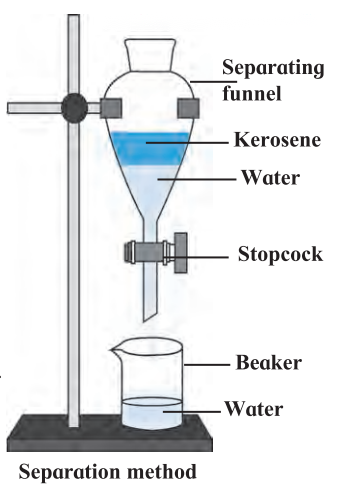
2. Separating funnel: When a mixture of two immiscible liquids is left undisturbed, two layers are clearly seen to have formed, (a) The heavier of the liquids remain below and the lighter liquid floats on it. (b) So two liquids in a mixture can be separated by making use of this property, e.g.
Question e.
Which precaution will you take while using the methods of distillation and separation by separating funnel?
Answer:
In using distillation:
In using separating funnel:
Project:
Question a.
Visit a jaggery or a sugar factory. Obtain information about the methods that are used to separate the components of the mixture while making jaggery or sugar. Present it in the class.
Class 7 Science Chapter 14 Elements, Compounds and Mixtures Important Questions and Answers
Fill in the blanks and rewrite the sentences:
Give scientific reason.
Metals | Mixtures | Compounds |
Copper, Iron | Soil, Thermocol | Paper, Coir, Plastic, Rubber, Water |
Can you tell?
Answer the following questions:
Use your brainpower!
Answer the following questions:
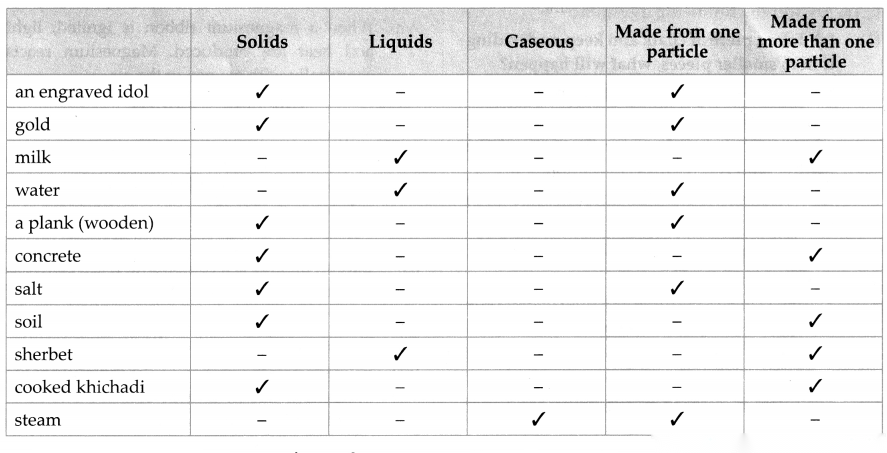
Answer the following questions:
Question b.
Wipe a drop of ink with a handkerchief what effect does it have on the cloth of the handkerchief?
Answer:
The cloth will absorb the ink drop and cloth will have a stain mark on it.
Question c.
What happens when the lid of a bottle of perfume is opened?
Answer:
The molecules of perfume move out of the bottle and collide with other molecules in the air and eventually perfume spreads throughout the room.

Question b.
Using tongs hold a magnesium ribbon in a flame and observe what changes took place?
Answer:
When a magnesium ribbon is ignited, light and heat are produced. Magnesium reacts chemically with oxygen in the air
2Mg(s)+ O2(g)→ 2MgO(s)
Magnesium oxide is produced.
Question c.
What does the name carbon dioxide imply – how many and which elements is this substance made of?
Answer:
[A molecule of the compound carbon dioxide contains one atom of the element carbon and two atoms of the element oxygen.]
Question d.
Which of these are compound, which are elements?
Answer:
Question e.
What is the smallest particle of a compound called?
Answer:
The smallest particle of a compound is called molecule.
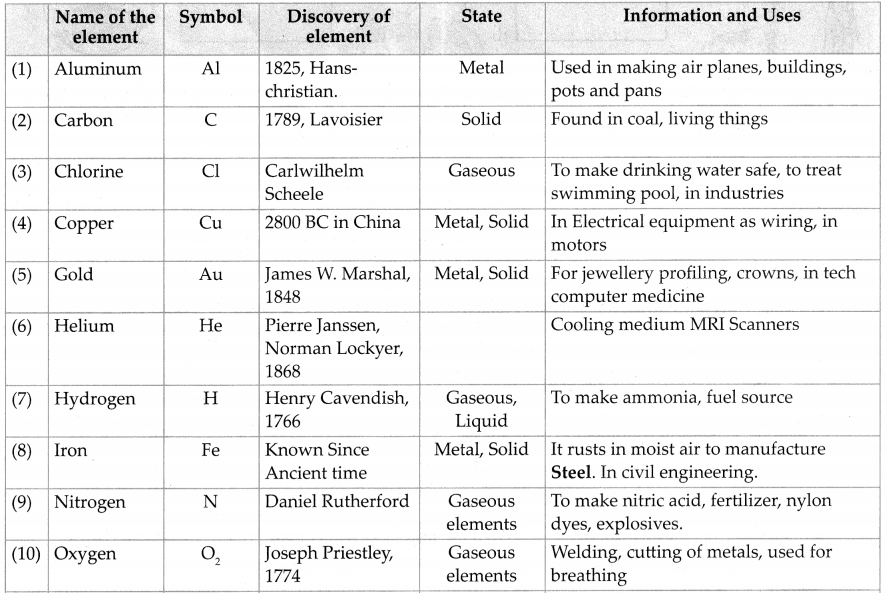
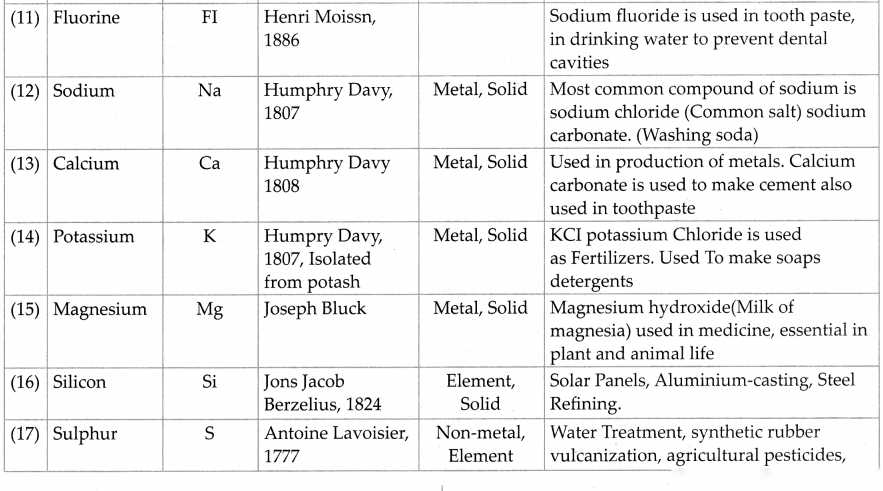
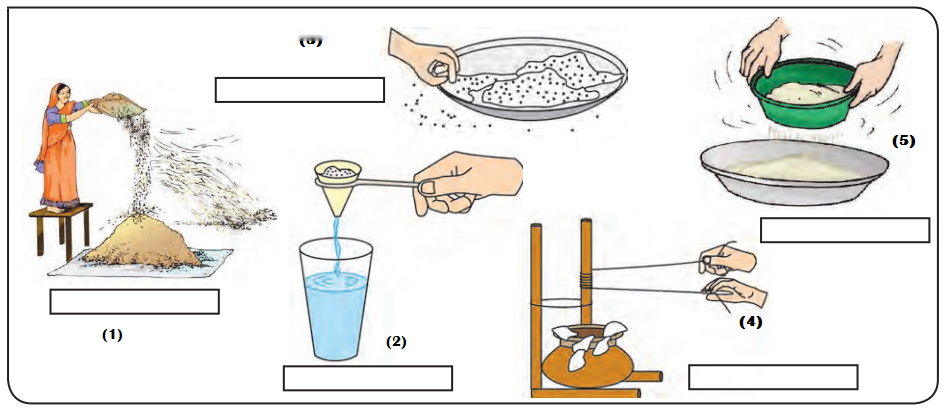
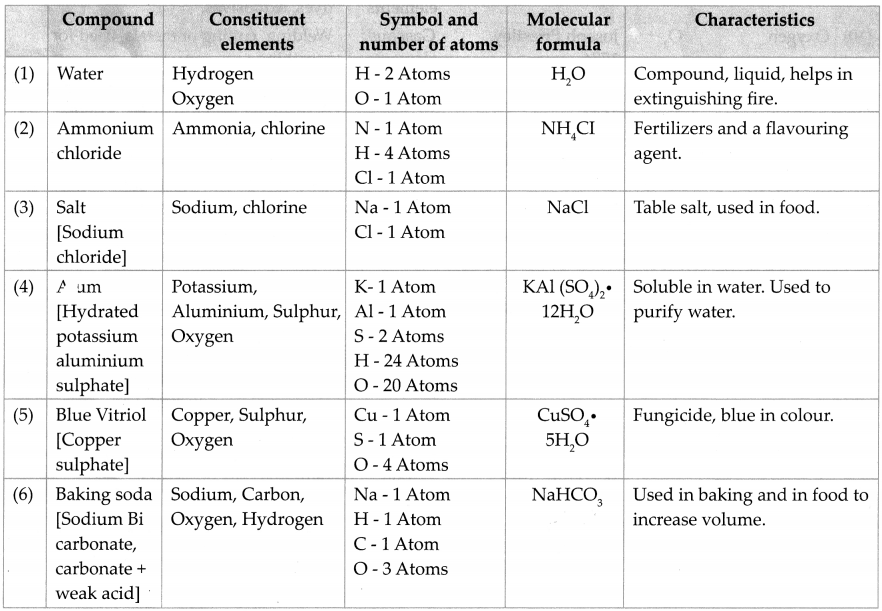
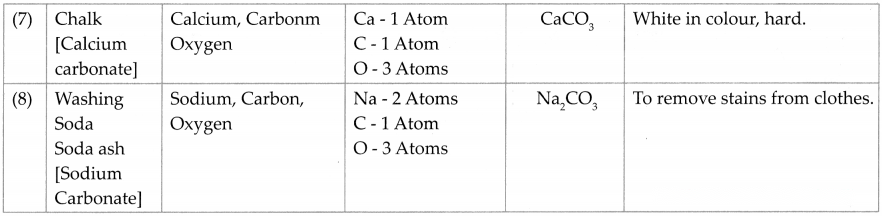
Write short notes on:
Question a.
Atoms
Atoms are basic building blocks of matter. Desk, chair, air are made up of atoms.
Question b.
Compounds
Answer:
1. A compound is a pure substance that contains two or more elements. Compounds are chemical combination of elements with properties that are different from the elements that formed them.
2. Substance is a compound only if its molecules are made up of atoms of different types e.g. Water, one molecule of water is made of two atoms of hydrogen and one atom of oxygen.
Question c.
Mixtures
Answer:
Question 9
Maharashtra Board Solution
Write short notes on: (1) Distillation (2) Sublimation (3) Magnetic separation (4) Sedimentation (5) Filtration (6) Evaporation
Solution & Step-by-Step Answer:
1. Distillation: It is a process of heating a solution containing soluble solids to form vapours of the liquid and then cooling the vapours to get the liquid back. e.g. A mixture of common salt and water is taken in distillation flask and heated. Steam rises up and comes out into condenser.
2. Sublimation: It is a process in which some solids on heating are transformed directly to vapour without passing through the liquid state, (i) It is used to separate a mixture of solids. The vapours are cooled separately, (ii) Used to separate ammonium chloride, iodine, camphor and sulphur from any mixture. 3. Magnetic separation: A mixture with iron fillings as one of the components can be separated using magnet to attract the iron particles away from the mixture. 4. Sedimentation: (i) It is a process of separating an insoluble solid from a liquid in which it is suspended, by allowing it to settle to the bottom of the container, e.g. Muddy water contains heavier particles like sand and soil, (ii) Leave this muddy water undisturbed for some time, (iii) The heavier soil and sand particles settle down and the clear upper water is poured out by decantation. 5. Filtration: It is used for separating insoluble solids from a liquid, e.g. mixture of chalk and water is poured through a filter paper in a funnel while the water gets collected in the beaker below, chalk is retained in the filter paper. 6. Evaporation: It is used for recovering dissolved solid substances from solutions by evaporation e.g. sugar can be recovered from sugar-water.
Question 10
Maharashtra Board Solution
Name the method you will use to separate the following mixtures: |
Question 11
Maharashtra Board Solution
Draw the experimental setup of weperation using separating funnel:
Solution & Step-by-Step Answer:
|