Maharashtra State Board Class 7 Science Solutions Chapter 1 The Living World: Adaptations and Classification
Class 7 Science Chapter 1 The Living World: Adaptations and Classification Textbook Questions and Answers
1. Find my match!
Question a.
Column ‘A’ | Column ‘B’ |
1. Lotus | a. Flower and leaves attract insects |
2. Aloe | b. Haustorial roots for absoption of food |
3. Cuscuta | c. Adapted to live in deserts |
4. Venus fly trap | d. Adapted to live in water |
Answer:
Column ‘A’ | Column ‘B’ |
1. Lotus | d. Adapted to live in water |
2. Aloe | c. Adapted to live in deserts |
3. Cuscuta | b. Haustorial roots for absoption of food |
4. Venus fly trap | a. Flower and leaves attract insects |
2. Read the paragraph and answer the following questions:
I am a penguin. I live in polar region covered by snow. My abdomen is white. My skin is thick with a layer of fat underneath. My body is spindle-shaped. My wings are small. My toes are webbed. We live in flocks.
Question a.
Why is my skin white and thick and why is there a thick layer of fat underneath?
Answer:
Question b.
Why do we live in flocks sticking close to each other?
Answer:
Penguins live in flocks sticking close to each other because sticking close to each other reduce the relative area so there is least loss of heat and they get protection from cold.
Question c.
Which geographical region do I inhabit? Why?
Answer:
Question d.
Which adaptations should you have to enable you to live permanently in the polar region? Why?
Answer:
3. Who is lying?
Question a.
Cockroach – I have five legs.
Answer:
Cockroach is lying. It has six legs.
Question b.
Hen – My toes are webbed.
Answer:
Hen is lying because hen’s toes are not webbed. Duck has webbed toes.
Question c.
Cactus – My fleshy, green part is a leaf.
Answer:
Cactus is lying. It’s fleshy, green part is a stem not a leaf.
4. Read each of the following statements. Write a paragraph about adaptation with reference to each statement.
Question a.
There is extreme heat in deserts.
Answer:
Question b.
Grasslands are lush green.
Answer:
Insects like grasshoppers have green colour so they can be camouflaged amidst grasses.
Question c.
We hide.
Answer:
In equatorial region grasses are very tall, so to protect themselves animals like tiger, elephants and deer remain hidden in these tall grasses.
Question d.
We have long ears.
Answer:
It helps the animals to receive sounds from long distance, and they can protect themselves from predators.
5. Answer the following:
Question a.
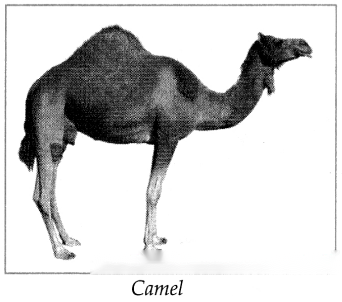
Why is the camel called the ‘ship of the desert’?
Answer:
Due to above adaptations camel is used to carry people and transport goods from one place to another place in the desert. Therefore, camel is called the ship of the desert.
Question b.
How can the plants like cactus and acacia live in deserts with scarce water?
Answer:
The plants like cactus and acacia live in deserts with scarce water due to the following adaptations.
Question c.
What is the inter-relationship between adaptations of organisms and their surroundings?
Answer:
1. Adaptations of organisms depend on the changes in the surroundings.
2. To adjust with those changes in the surroundings adaptation takes place gradually and continuously in organisms.
3. Changes that take place in the various organs and life processes of organisms, enable them to live, feed, reproduce to perpetuate themselves and to protect themselves from their enemies in specific surroundings, depending upon the habitat and its geographical conditions, are called adaptations.
Question d.
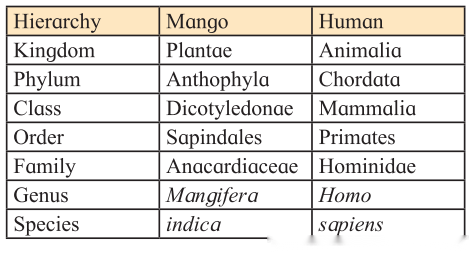
How are organisms classified?
Answer:
Genus | Species | |
Mango | Mangifera | Indica |
Human | Homo | Sapiens |
Activity:
Class 7 Science Chapter1 The Living World: Adaptations and ClassificationImportant Questions and Answers
Fill in the blanks.
Question 1
Maharashtra Board Solution
Leaves of some aquatic plants are …………. and …………. ike a ribbon.
Solution & Step-by-Step Answer:
block bg-white dark:bg-slate-900/80 border-l-4 border-emerald-500 rounded-r-xl p-5 my-3 shadow-xs border border-slate-200/60 dark:border-slate-800">
Solution & Step-by-Step Answer:
thin, slender
Question 2
Maharashtra Board Solution
…………. in stems and …………. of aquatic plants are useful for floating in water.
Solution & Step-by-Step Answer:
Air spaces, petioles
Question 3
Maharashtra Board Solution
Leaves of desert plants are modified into …………..
Solution & Step-by-Step Answer:
thorns
Question 4
Maharashtra Board Solution
The stems of desert plants are green as they perform …………. in the absence of leaves.
Solution & Step-by-Step Answer:
photosynthesis
Question 5
Maharashtra Board Solution
…………. roots of grasses prevent soil erosion.
Solution & Step-by-Step Answer:
Fibrous
Question 6
Maharashtra Board Solution
Grasses in the …………. region are very tall.
Solution & Step-by-Step Answer:
equatorial
Question 7
Maharashtra Board Solution
…………. are found in hilly areas as well as plains.
Solution & Step-by-Step Answer:
Vast meadows
Question 8
Maharashtra Board Solution
Plants need …………., …………. and …………. for growth.
Solution & Step-by-Step Answer:
nitrogen, phosphorus, potassium
Question 9
Maharashtra Board Solution
Dodder has …………. roots for absorbing nutrients from the host plant.
Solution & Step-by-Step Answer:
haustorial (sucking)
Question 10
Maharashtra Board Solution
Fungi do not have …………. so cannot perform photosynthesis.
Solution & Step-by-Step Answer:
chlorophyll
Question 11
Maharashtra Board Solution
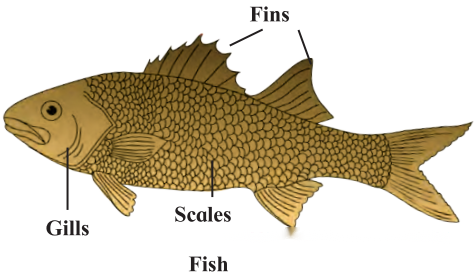
Fish breathe with …………. instead of a nose.
Solution & Step-by-Step Answer:
gills
Question 12
Maharashtra Board Solution
Fish have …………. within the body to help them to float.
Solution & Step-by-Step Answer:
air bladders
Question 13
Maharashtra Board Solution
Frog and duck have …………. toes.
Solution & Step-by-Step Answer:
webbed
Question 14
Maharashtra Board Solution
Tigers have …………. paws.
Solution & Step-by-Step Answer:
padded
Question 15
Maharashtra Board Solution
Bats can fly with the help of …………..
Solution & Step-by-Step Answer:
patagium.
Question 16
Maharashtra Board Solution
Desert plants are either leafless or their leaves are like …………. or modified into …………..
Solution & Step-by-Step Answer:
needles, thorns
Question 17
Maharashtra Board Solution
Spring like …………. on the stems of some climbers are examples of their adaptation.
Solution & Step-by-Step Answer:
Tendrils
Question 18
Maharashtra Board Solution
…………. is not a sudden process, it is gradual and continuous.
Solution & Step-by-Step Answer:
Adaptation
Question 19
Maharashtra Board Solution
…………. proposed the theory of the survival of the fittest.
Solution & Step-by-Step Answer:
Charles Darwin
Match the columns:
Question 1
Maharashtra Board Solution
|
Column ‘A’ | Column ‘B’ |
1. Cactus | a. Herbivorous animal |
2. Pine | b. Carnivorous animal |
3. Tiger | c. Snowy region plant |
4. Blackbuck | d. Desert plant |
Column ‘A’ | Column ‘B’ |
1. Cactus | d. Desert plant |
2. Pine | c. Snowy region plant |
3. Tiger | b. Carnivorous animal |
4. Blackbuck | a. Herbivorous animal
Question 2
Maharashtra Board Solution
|
Column ‘A’ | Column B’ |
1. Dog | a. Hibiscus roso sinensis |
2. Cow | b. Sorghum bicolor |
3. Hibiscus | c. Bos taurus |
4. Jowar | d. Canis lupus familiarise |
Column ‘A’ | Column B’ |
1. Dog | d. Canis lupus familiarise |
2. Cow | c. Bos taurus |
3. Hibiscus | a. Hibiscus roso sinensis |
4. Jowar | b. Sorghum bicolor Name the following:
Question 1
Maharashtra Board Solution
Animals which live in desert in deep burrows.
Solution & Step-by-Step Answer:
Rats, snakes, spiders, lizards
Question 2
Maharashtra Board Solution
Animals which have webbed feet.
Solution & Step-by-Step Answer:
Frog, duck
Question 3
Maharashtra Board Solution
Plants of snowy regions.
Solution & Step-by-Step Answer:
Deodar, pine
Question 4
Maharashtra Board Solution
Plants that eat insects.
Solution & Step-by-Step Answer:
Drosera, venus flytrap, pitcher plant
Question 5
Maharashtra Board Solution
World Frog Protection Day.
Solution & Step-by-Step Answer:
29th April
Question 6
Maharashtra Board Solution
2 parts of bionomial nomenclature.
Solution & Step-by-Step Answer:
genus and species.
Who am I?
Question 1
Maharashtra Board Solution
My leaves trap insects.
Solution & Step-by-Step Answer:
Venus fly trap or pitcher plant.
Question 2
Maharashtra Board Solution
I have waxy feathers and webbed feet.
Solution & Step-by-Step Answer:
Duck
Question 3
Maharashtra Board Solution
I breath through skin in water and through lungs on land.
Solution & Step-by-Step Answer:
Frog
Question 4
Maharashtra Board Solution
I have sucking roots through which I take nutrition from my host plant.
Solution & Step-by-Step Answer:
Dodder (cuscuta)
Question 5
Maharashtra Board Solution
I have silvery white body with thick long hair
Solution & Step-by-Step Answer:
Snow animals like polar bear.
Question 6
Maharashtra Board Solution
I have waxy broad leaves and air spaces in my stem.
Solution & Step-by-Step Answer:
Lotus (or aquatic plants)
Question 7
Maharashtra Board Solution
My Scientific name is Bos taurus.
Solution & Step-by-Step Answer:
Cow
Question 8
Maharashtra Board Solution
I discovered Binomial nomenclature.
Solution & Step-by-Step Answer:
Carl Linnaeus
Question 9
Maharashtra Board Solution
I have special thin folds in between my forelegs and hind legs called patagium.
Solution & Step-by-Step Answer:
Bat
Question 10
Maharashtra Board Solution
I am mango, my genus is?
Solution & Step-by-Step Answer:
Mangifera
Say whether true or false, correct and rewrite the false statements:
Question 1
Maharashtra Board Solution
Killing or harming frogs is prohibited by the Wild Life Protection Act.
Solution & Step-by-Step Answer:
True
Question 2
Maharashtra Board Solution
Scientific name of jowar is Bos taurus.
Solution & Step-by-Step Answer:
False. Scientific name of jowar is Sorghum bicolor
Question 3
Maharashtra Board Solution
Theory of natural selection was found by Charles Darwin.
Solution & Step-by-Step Answer:
True
Question 4
Maharashtra Board Solution
T.V. Channels like National Geographic, Wild and Discovery show about the feeding habits of animals.
Solution & Step-by-Step Answer:
True
Question 5
Maharashtra Board Solution
The spindle shaped body of birds maximizes the resistance of air while flying.
Solution & Step-by-Step Answer:
False. The spindle shaped body of birds minimises the resistance of air while flying.
Question 6
Maharashtra Board Solution
House lizard and monitor lizards have webbed toes.
Solution & Step-by-Step Answer:
False. House lizard and monitor lizards have clawed toes.
Question 7
Maharashtra Board Solution
Crocodiles use their muscles for creeping.
Solution & Step-by-Step Answer:
True
Question 8
Maharashtra Board Solution
The eyes of predatory carnivores are located on either side of the head.
Solution & Step-by-Step Answer:
False. The eyes of predatory carnivores are located in the front of their head.
Question 9
Maharashtra Board Solution
A frog is an amphibian.
Solution & Step-by-Step Answer:
True
Question 10
Maharashtra Board Solution
Diverse types of bushes and grasses are found in the grasslands.
Solution & Step-by-Step Answer:
True.
Complete the given table:
Question 1
Maharashtra Board Solution
|
Question 2
Maharashtra Board Solution
Give one special adaptation or features of the following plant or animal to suit its habitat surrounding
Solution & Step-by-Step Answer:
block bg-white dark:bg-slate-900/80 border-l-4 border-emerald-500 rounded-r-xl p-5 my-3 shadow-xs border border-slate-200/60 dark:border-slate-800">
Solution & Step-by-Step Answer:
Who is lying?
Question 1
Maharashtra Board Solution
Camel has thin skin and short eyelashes.
Solution & Step-by-Step Answer:
Camel is lying – It has thick skin and long and thick eyelashes.
Answer in one or two sentences:
Question 1
Maharashtra Board Solution
What is called ‘hierarchy of classification’?
Solution & Step-by-Step Answer:
Question 2
Maharashtra Board Solution
What theories were proprosed by Charles Darwin
Solution & Step-by-Step Answer:
The theories of Charles Darwin are Theory of natural selection and theory of survival of the fittest.
Question 3
Maharashtra Board Solution
Explain the terms Autotrophic and Parasitic
Solution & Step-by-Step Answer:
1. Plants which are able to produce their own food with the help of the process of photosynthesis are called autotrophic plants eg. All green plants.
2. Plants which are not able to produce their own food but depend upon other plants for their nutrition are called parasitic plants They are leafless and non green in colour eg. Dodder (cuscuta). They have haustorial (sucking) roots for absorbing nutrients from the host plant. Give scientific reasons:
Question 1
Maharashtra Board Solution
Leaves of some aquatic plants are thin and slender like a ribbon.
Solution & Step-by-Step Answer:
Leaves of some aquatic plants are thin and slender like a ribbon because this shape helps them to withstand fast currents of water.
Question 2
Maharashtra Board Solution
Some aquatic plants have air spaces in stems.
Solution & Step-by-Step Answer:
Some aquatic plants have air spaces in stems because air spaces help the plants to float on water.
Question 3
Maharashtra Board Solution
Desert plants have thorns.
Solution & Step-by-Step Answer:
Question 4
Maharashtra Board Solution
Desert plants have green stem.
Solution & Step-by-Step Answer:
Desert plants have green stem because green stem performs photosynthesis in the absence of leaves.
Question 5
Maharashtra Board Solution
Desert plants have strong roots.
Solution & Step-by-Step Answer:
Desert plants have strong roots so they can penetrate deep into the soil in search of water.
Question 6
Maharashtra Board Solution
Deodar tree is conical in shape.
Solution & Step-by-Step Answer:
Deodar tree grows in snowy region and conical shape of the tree doesn’t allow snow to accumulate on the tree and thus protect the tree from snow.
Question 7
Maharashtra Board Solution
Pine tree has thick bark.
Solution & Step-by-Step Answer:
Pine tree grows in snowy region where it is extremely cold and its thick bark helps the tree to withstand the cold.
Question 8
Maharashtra Board Solution
Plants in forest grow tall.
Solution & Step-by-Step Answer:
In forest region variety of trees, shrubs and herbs are found. These plants compete amongst themselves for sunlight. Hence trees grow tall to get sunlight.
Question 9
Maharashtra Board Solution
Cuscuta has haustorial roots.
Solution & Step-by-Step Answer:
Question 10
Maharashtra Board Solution
Fungi have root-like fibers.
Solution & Step-by-Step Answer:
Question 11
Maharashtra Board Solution
Pitcher plant eats insects.
Solution & Step-by-Step Answer:
Question 12
Maharashtra Board Solution
Duck and frog have webbed feet.
Solution & Step-by-Step Answer:
When duck and frog are in water at that time the webbed feet act as oars and help them to swim in water.
Question 13
Maharashtra Board Solution
Frogs can swim easily in water.
Solution & Step-by-Step Answer:
Frogs have webbed toes, slippery, smooth skin and triangular head. This helps the frog to swim easily through water.
Question 14
Maharashtra Board Solution
Tiger has sharp and pointed canine teeth.
Solution & Step-by-Step Answer:
Tiger is a carnivorous animal. So the sharp and pointed canine teeth help the tiger to tear the prey and eat.
Question 15
Maharashtra Board Solution
Blackbuck has eyes on either side of the head.
Solution & Step-by-Step Answer:
Blackbuck is a herbivore animal and eyes on either side of the head gives them wide angle vision which helps to protect themselves from predators.
Question 16
Maharashtra Board Solution
Tigers have padded paws.
Solution & Step-by-Step Answer:
Tigers are carnivorous animals. So these padded paws enable them to silently stalk their prey and capture it easily.
Question 17
Maharashtra Board Solution
The eyes of predatory carnivores are located in the front of their head.
Solution & Step-by-Step Answer:
The eyes of predatory carnivores are located in the front of their head because it helps them to spot their prey from a long distance.
Question 18
Maharashtra Board Solution
Camel can live in desert.
Solution & Step-by-Step Answer:
Question 19
Maharashtra Board Solution
White fox has white body colour.
Solution & Step-by-Step Answer:
Question 20
Maharashtra Board Solution
Birds can fly in the air.
Solution & Step-by-Step Answer:
Can you tell? Answer the following questions:
Question 1
Maharashtra Board Solution
Arc the plants and animals from Kashmir and Rajasthan of the same type? Can you elaborate on any differences between the two?
Solution & Step-by-Step Answer:
Plants and animals from Kashmir and Rajasthan are of different types. Differences in plants:
Differences in animals:
Question 2
Maharashtra Board Solution
In what way are sloping branches useful to plants in a snowy region?
Solution & Step-by-Step Answer:
In a snowy region sloping branches of a plant gives conical shape to the tree and it doesn’t allow snow to accumulate on tree inspite of heavy snowfall and thus protect the tree from severe cold and snow.
Question 3
Maharashtra Board Solution
What is the main difference between vehicles on the road and aeroplanes?
Solution & Step-by-Step Answer:
The two main differences between vehicles on the road and aeroplanes are:
Use your brain power! Answer the following questions:
Question 1
Maharashtra Board Solution
Why does water trickle off lotus leaves?
Solution & Step-by-Step Answer:
Question 2
Maharashtra Board Solution
Why don’t the leaves of lotus plants rotinwatei?
Solution & Step-by-Step Answer:
leaves of these plants do not rot in water because it is covered with waxy coating on it so that they do not get wet.
Question 3
Maharashtra Board Solution
Why are roots of lotus plants short and fibrous?
Solution & Step-by-Step Answer:
–
Question 4
Maharashtra Board Solution
The lotus stalk has holes or air spaces?
Solution & Step-by-Step Answer:
Answer in detail:
Question 1
Maharashtra Board Solution
Explain the Darwin’s theory of evolution.
Solution & Step-by-Step Answer:
Charles Darwin, a biologist suggested two principles in his theory of evolution.
Diagram based questions: Draw a neat labelled diagram of fish and answer the following questions.
Question a. Question b. Question c. Observe the diagram and answer the questions.
Question a. Question b. Question c. Paragraph based questions: Compare and contrast:
Question 1
Maharashtra Board Solution
Compare the lotus plant to the Acacia plant and Hibiscus plant.
Solution & Step-by-Step Answer:
Question 2
Maharashtra Board Solution
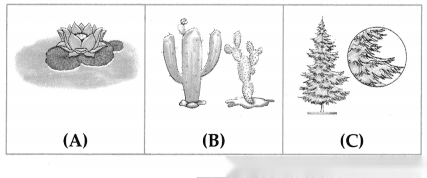
What is the difference between the plants given in the pictures. Give 2 points of difference taking into consideration their adaptations with their surroundings.
Solution & Step-by-Step Answer:
|