Maharashtra State Board Class 6 Science Solutions Chapter 9 Motion and Types of Motion
Class 6 Science Chapter 9 Motion and Types of Motion Textbook Questions and Answers
1. Identify the types of motion.
Question a.
Movement of the earth around the sun: …………….
Answer:
periodic, drcular
Question b.
Movement of ceiling fan: …………….
Answer:
circular
Question c.
A rocket launched from the ground: ………...
Answer:
linear
Question d.
A fish swimming in water: ……….
Answer:
random
Question e.
The plucked string of a sitar:…………...
Answer:
oscillatory motion
2. Fill in the blanks.
(linear, non-linear, uniform linear, non-uniform linear, uniform circular, random, circular, non-uniform circular)
Question a.
If a ball is released from the terrace of a building, it comes down in ………… motion. On the other hand, it reaches the ground in ………… motion if it is thrown with a force away from the terrace in a direction parallel to the terrace.
Answer:
uniform linear, non-uniform linear
Question b.
The motion of an aeroplane on the runway before take off is …………..
Answer:
linear
Question c.
The kite looking for its prey flies with …………. motion in the sky.
Answer:
circular
Question d.
Children sitting in a rotating giant wheel have ………. motion, while those sitting in a merry-go-round have a ………. motion.
Answer:
uniform circular, non-uniform circular
3. How are we different?.
Question a.
Oscillatory motion and Linear motion.
Answer:
Oscillatory motion | Linear motion |
1. In oscillatory motion, body swings back and forth. | 1. In linear motion, an object shows displacement in a straight line, e.g. A train in motion, motion of marching soldiers. |
Question b.
Linear motion and Random motion
Answer:
Linear motion | Random motion |
1. Motion in a straight line is called linear motion. | 1. The motion that changes its direction and speed continuously is called random motion, e.g. Motion of a bird. |
Question c.
Random motion and Oscillatory motion
Answer:
Random motion | Oscillatory motion |
1 The motion that changes its direction and speed continuously is called random motion, e.g. Motion of a butterfly | 1. The motion of a body that is swinging back and forth is called oscillatory motion, e.g. Pendulum of a clock, the wing of a bird. |
4. Explain in your own words, giving one example each.
Question a.
Linear motion
Answer:
An object that shows displacement along a straight line is called linear motion, e.g. A vehicle moving on a road.
Question b.
Oscillatory motion
Answer:
The motion of a body swinging back and forth is called oscillatory motion, e.g. Motion of a pendulum of a clock.
Question c.
Circular motion
Answer:
The motion of an object along a circular path is called circular motion, e.g. Motion of a ceiling fan.
Question d.
Random motion
Answer:
The motion that changes its direction and speed continuously is called random motion, e.g. Motion of a butterfly.
Question e.
Periodic motion
Answer:
The repetitive motion in which the moving object passes through a certain point again and again after a fixed period is called as periodic motion, e.g. The minute hand of a clock.
5. Answer the following questions in your own words.
Question a.
Which types of motion are seen in birds flying in the sky?
Answer:
Question b.
Write in detail about your experience of various types of motion while riding a bicycle on a road.
Answer:
6. Complete the puzzle using words for types of motion:
Question a.
Complete the puzzle using the words for types of motion.
1. A spring is stretched and one end is released.
2. A minute hand.
3. A see-saw.
4-5. Children in a march past.
6. A stone rolling down a hillside.
Answer:
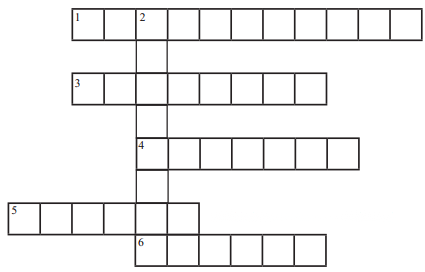
Activity:
Class 6 Science Chapter9 Motion and Types of MotionImportant Questions and Answers
Identify the types of motion.
Question 1
Maharashtra Board Solution
The movement of a see-saw.
Solution & Step-by-Step Answer:
block bg-white dark:bg-slate-900/80 border-l-4 border-emerald-500 rounded-r-xl p-5 my-3 shadow-xs border border-slate-200/60 dark:border-slate-800">
Solution & Step-by-Step Answer:
oscillatory motion
Question 2
Maharashtra Board Solution
The motion of a moving ant.
Solution & Step-by-Step Answer:
random
Question 3
Maharashtra Board Solution
The marching army soldiers.
Solution & Step-by-Step Answer:
linear
Question 4
Maharashtra Board Solution
A train approaching a station.
Solution & Step-by-Step Answer:
non-uniform linear
Question 5
Maharashtra Board Solution
A meteor falling from the sky.
Solution & Step-by-Step Answer:
linear
Fill in the blanks with suitable words from those given in the bracket:
Question 1
Maharashtra Board Solution
The motion that changes its speed and direction continuously is called ………..
Solution & Step-by-Step Answer:
random
Choose the correct alternative:
Question 1
Maharashtra Board Solution
A baby is crawling. The motion is said to be ……………... (a) linear (b) periodic (c) circular (d) random
Solution & Step-by-Step Answer:
(d) random
Question 2
Maharashtra Board Solution
The children are having a 50m running race. The motion exhibited is ………….. motion. (a) linear (b) periodic (c) random (d) circular
Solution & Step-by-Step Answer:
(a) linear
Question 3
Maharashtra Board Solution
The motions of the hands of a clock are ………….. and ………….. (a) periodic, linear (b) periodic, circular (c) non-linear, non-uniform (d) circular, non-uniform
Solution & Step-by-Step Answer:
(b) periodic, circular
Question 4
Maharashtra Board Solution
The motion of a pendulum of a clock is …………….. (a) linear (b) oscillatory (c) circular (d) random
Solution & Step-by-Step Answer:
(b) oscillatory
Question 5
Maharashtra Board Solution
The motion of a butterfly from one flower to another flower is an example of …………… motion. (a) circular (b) periodic (c) linear (d) random
Solution & Step-by-Step Answer:
(d) random
Question 6
Maharashtra Board Solution
The distance traversed by an object in a unit time is called ……….. of that object. (a) length (b) motion (c) speed (d) displacement
Solution & Step-by-Step Answer:
(c) speed
Explain it in your own words, giving one example of each.
Question 1
Maharashtra Board Solution
Uniform linear motion
Solution & Step-by-Step Answer:
When the distance traversed by an object along a straight line in unit time is the same, the motion is called as uniform linear motion, e.g. Motion of soldiers on parade.
Question 2
Maharashtra Board Solution
Non-uniform linear motion
Solution & Step-by-Step Answer:
When the distance traversed by an object along a straight line in unit time keeps on changing, the motion is called non-uniform linear motion. e.g. A girl coming down a slide.
Question 3
Maharashtra Board Solution
Non-linear motion
Solution & Step-by-Step Answer:
The motion of an object that does not move in a straight line is called non-linear motion. e.g. Motion of a swing,
Question 4
Maharashtra Board Solution
Speed
Solution & Step-by-Step Answer:
The distance traversed by an object in unit time is called the speed of that object. e.g. A boy riding on a bicycle covers a distance of 15 kilometres in 3 hours. Hence Speed = = 5 kilometres/hour
Answer the following:
Question 1
Maharashtra Board Solution
In which muscial instruments can you see oscillatory motion?
Solution & Step-by-Step Answer:
Vibrating diaphragm of tabla, drum, dhol and strings of sitar, guitar show oscillatory motions.
Question 2
Maharashtra Board Solution
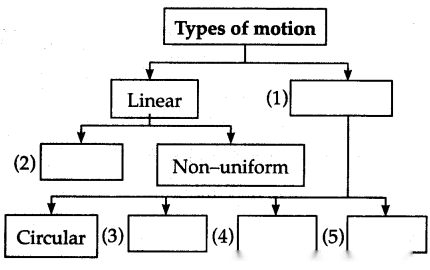
With reference to types of motion, complete the table below.
Solution & Step-by-Step Answer:
Read the following stories and answer the questions. Rita and Geetha are friends travelling from Mumbai to Pune. Seetha had come to the station to see her friends off. After 15 minutes train starts moving. Rita and Geetha feel that Seetha and the vendors on platform are moving backwards. Whereas, Seetha feels that Rita and Geetha are moving forward. Rita feels Geetha is not in motion and Geetha also feels Rita is not in motion. Can you say why? Question a. Question b. Question c. Observe and discuss:
Question 1
Maharashtra Board Solution
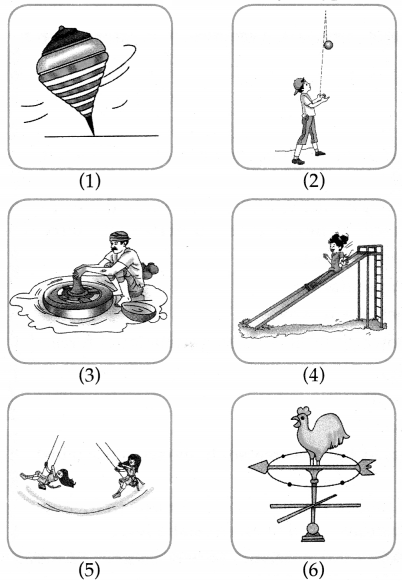
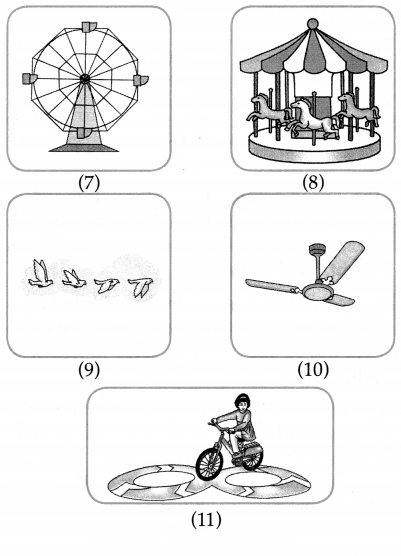
Observe the figure and classify the type of motion.
Solution & Step-by-Step Answer:
Can you tell?
Question 1
Maharashtra Board Solution
While chasing a butterfly in a garden, do you run along a definite path or in the same direction all the time?
Solution & Step-by-Step Answer:
No, we move in random motion.
|