Maharashtra Board Class 6 Geography Solutions Chapter 7 Rocks and Rock Types
Class 6 Geography Chapter 7 Rocks and Rock Types Textbook Questions and Answers
B. Which of the following monuments are built in igneous rock?
(1) The Taj Mahal
(2) Fort Raigad
(3) The Red Fort
(4) Ellora Sculpture
Answer:
Ellora Sculpture
C. Find the differences between:
Igneous rocks | Sedimentary rocks |
(i) Igneous rocks are rocks formed by cooling and solidifying of molten materials.(ii) Igneous rocks are hard and homogeneous.(iii) Examples: Basalt, pumice | (i) Rocks that are formed through deposition and compaction of sediments, especially rock particles transported by rivers, glaciers, wind, etc., are called sedimentary rocks. |
Sedimentary rocks | Metamorphic rocks |
(i) Rocks that are formed through deposition and compaction of sediments, especially rock particles transported by rivers, glaciers, wind, etc., are called sedimentary rocks. | (i) Rocks are formed due to the process of metamorphosis are called metamorphic rocks. |
(ii) One may find fossils in sedimentary rocks.(iii) Sedimentary rocks are brittle and light weight. Examples: Shale, corals | (ii) Metamorphic rocks do not contain fossils.(iii) Metamorphic rocks are heavy and hard. Examples: Marble, slate |
igneous rocks | Metamorphic rocks |
(i) Igneous rocks are rocks formed by cooling and solidifying of molten material. | (i) Rocks formed due to the process of metamorphosis are called metamorphic rocks. |
D. Which types of rocks are predominantly found at the following locations?
(1) Central Maharashtra
(2) South Konkan
(3) Vidarbha
Answer:
Locations | Types of rocks |
(1) Central Maharashtra | (a) Basalt |
(2) South Konkan | (b) Laterite and granite |
(3) Vidharbha | (c) Basalt, granite and sedimentary rocks |
Activity:
Collect rock specimens from your surroundings and also during your travels. Classify them with the help of your teacher. Make a small museum of rocks for your school and place your specimens there. Keep a note of the place from where you have collected them. (See a specimen
display on page 65.)
Visit the historical sites in your surroundings, e.g., hill forts, masonry dams, land forts, bastions, wadas, temples, mosques, etc. and observe with the help of your teacher, the rock used for their construction.
Class 6 Geography Chapter 7 Rocks and Rock Types InText Questions and Answers
Do it yourself!
From the hills, river-beds or the land in your vicinity, collect rock specimens of different types, shapes, colours, etc. Observe the rock specimens and note down the following.
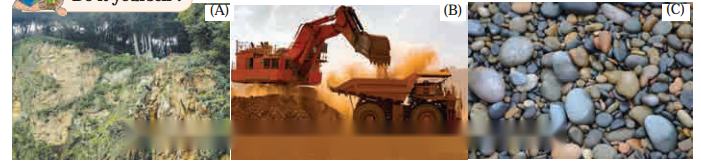
Observe the pictures given below and answer the questions:
Question 1.
What is the hill in ‘A’ made up of?
Answer:
Hill in ‘A’ is made up of soils and rocks.
Use your brain power!
Similarly like our terrains which are strong, the people of our country are also strong and invincible, incapable of being conquered.
We have imbibed the value of resilience and courage and the ability to withstand all challenges from our terrain.
What will you do?
Ajit is interested in sculpting. He wants to prepare a sculpture of Dr. APJ Abdul Kalam.
He cannot decide which rock he should use for this, igneous, sedimentary or metamorphic? What will be your advice?
Answer:
I would advise him to use a metamorphic rock like marble. Due to the translucent nature of the marble, it will give the sculpture a glow. Properties like softness and easy availability makes the metamorphic rock, marble an ideal choice. These rocks are heavy and hard. Hence, they are ideal for making sculptures.
Class 6 Geography Chapter 7 Rocks and Rock Types Additional Important Questions and Answers
Fill in the blanks choosing the correct options from the bracket:
Match the pairs correctly:
Column A | Column B |
(1) Igneous rocks | (a) brittle and light weight |
(2) Sedimentary rocks | (b) heavy and hard |
(3) Metamorphic rocks | (c) hard and homogeneous |
1 – c
2 – a
3 – b
Complete the tabular form:
Original Rock | Metamorphosed Rock | ||||||||||||||
Granite | _________ | ||||||||||||||
Basalt | __________ | ||||||||||||||
_________ | Marble | ||||||||||||||
Coal | ___________ | ||||||||||||||
Sand Stone | __________ | ||||||||||||||
_________ | Slate Answer:
Name the following:
Question 1
Maharashtra Board Solution
Two major rock-forming minerals:
Solution & Step-by-Step Answer:
Silica, aluminium.
Question 2
Maharashtra Board Solution
Hard and homogeneous rocks:
Solution & Step-by-Step Answer:
Igneous rocks.
Question 3
Maharashtra Board Solution
Two sedimentary rocks:
Solution & Step-by-Step Answer:
Shale, corals.
Question 4
Maharashtra Board Solution
Rocks which does not contain fossils:
Solution & Step-by-Step Answer:
Metamorphic and Igneous rock
Question 5
Maharashtra Board Solution
One use of diamonds:
Solution & Step-by-Step Answer:
Ornament making.
Question 6
Maharashtra Board Solution
One activity which leads to increased pressure and heat in that region:
Solution & Step-by-Step Answer:
Volcanic eruption.
Question 7
Maharashtra Board Solution
Rock found in South Konkan:
Solution & Step-by-Step Answer:
Laterite.
Question 8
Maharashtra Board Solution
Rocks that formed by metamorphosis:
Solution & Step-by-Step Answer:
Metamorphic rocks.
Question 9
Maharashtra Board Solution
Two metamorphosised rocks:
Solution & Step-by-Step Answer:
Marble, Slate.
Question 10
Maharashtra Board Solution
Two igneous rocks:
Solution & Step-by-Step Answer:
Granite and Basalt.
State whether the following statements are true or false:
Question 1
Maharashtra Board Solution
The properties of rocks depend on their constituent minerals and their proportion alone.
Solution & Step-by-Step Answer:
False.
Question 2
Maharashtra Board Solution
Silica is a rock forming mineral.
Solution & Step-by-Step Answer:
True
Question 3
Maharashtra Board Solution
One may find fossils in Igneous rocks.
Solution & Step-by-Step Answer:
False
Question 4
Maharashtra Board Solution
Weathering of rocks leads to its disintegration or decomposition.
Solution & Step-by-Step Answer:
True
Question 5
Maharashtra Board Solution
Sedimentary rocks are hard and homogeneous.
Solution & Step-by-Step Answer:
False
Question 6
Maharashtra Board Solution
Maharashtra has large reserves of mineral wealth.
Solution & Step-by-Step Answer:
False
Question 7
Maharashtra Board Solution
The Maharashtra plateau and the Sahyadris are formed out of igneous rocks.
Solution & Step-by-Step Answer:
True
Question 8
Maharashtra Board Solution
Most of the hill forts in Maharashtra do not have lakes or elephant yards.
Solution & Step-by-Step Answer:
False
Question 9
Maharashtra Board Solution
One can easily see layers in the sedimentary rocks.
Solution & Step-by-Step Answer:
True
Question 10
Maharashtra Board Solution
Sedimentary rocks are generally heavy weight.
Solution & Step-by-Step Answer:
False
Question 11
Maharashtra Board Solution
Metamorphic rocks do not contain fossils.
Solution & Step-by-Step Answer:
True
Question 12
Maharashtra Board Solution
Metamorphic rocks are brittle and lightweight.
Solution & Step-by-Step Answer:
false
Answer the following questions in short:
Question 1
Maharashtra Board Solution
What are rocks?
Solution & Step-by-Step Answer:
Rocks are a mixture of different minerals formed by natural processes in the lithosphere. Rocks are found on land surface and also below it.
Question 2
Maharashtra Board Solution
What do the properties of rocks depend on?
Solution & Step-by-Step Answer:
The properties of rocks depend on the constituent minerals and their proportion as well as on the formation process. Silica, aluminium, magnesium and iron are the major rock-forming minerals.
Question 3
Maharashtra Board Solution
What are the three types of rocks?
Solution & Step-by-Step Answer:
Igneous rocks, Sedimentary rocks and Metamorphic rocks are the three types of rocks.
Question 4
Maharashtra Board Solution
What are Igneous Rocks?
Solution & Step-by-Step Answer:
When the molten material, known as magma within the crust and lava on the surface cools down, it solidifies giving rise to igneous rocks.
Question 5
Maharashtra Board Solution
What information does the study of fossils provide?
Solution & Step-by-Step Answer:
Study of fossils provide information about the life in the olden period.
Question 6
Maharashtra Board Solution
Write any two characteristics of metamorphic rocks.
Solution & Step-by-Step Answer:
Metamorphic rocks are heavy and hard.
Question 7
Maharashtra Board Solution
When does coal get metamorphosed?
Solution & Step-by-Step Answer:
When coal undergoes heavy pressure and intense heat it gets metamorphosed.
Question 8
Maharashtra Board Solution
When does the price of coal increase?
Solution & Step-by-Step Answer:
The price of coal increases when it gets metamorphosed into diamonds.
Question 9
Maharashtra Board Solution
What is referred to as primary rocks?
Solution & Step-by-Step Answer:
Rocks are formed out of the material from the interior of the earth, these are referred to as primary rocks.
Question 10
Maharashtra Board Solution
What is called fossils?
Solution & Step-by-Step Answer:
The buried remains of dead animals or plants embedded in the rocks and preserved petrified form are called fossils.
Give geographical reasons for the following statements:
Question 1
Maharashtra Board Solution
Igneous rocks are also referred to as primary rocks.
Solution & Step-by-Step Answer:
As Igneous rocks are formed out of the material from the interior of the earth, these rocks are also referred to as primary rocks.
Question 2
Maharashtra Board Solution
Most of the hill forts in Maharashtra have lakes or elephant yards.
Solution & Step-by-Step Answer:
(i) Hillforts in Maharashtra are old quarry sites from which stone or other materials have been extracted for the construction of the fort and other buildings.
(ii) In the pits and dugouts left behind after rock extraction, water was allowed to accumulate and these lakes, banks, etc., were created. (iii) Therefore, most of the hill forts in Maharashtra have lakes or elephant yards.
Question 3
Maharashtra Board Solution
Weathering of rocks occurs.
Solution & Step-by-Step Answer:
Question 4
Maharashtra Board Solution
One may find fossils in sedimentary rocks.
Solution & Step-by-Step Answer:
Question 5
Maharashtra Board Solution
Changes in nature, as well as the chemical composition of the original rocks, is witnessed.
Solution & Step-by-Step Answer:
Question 6
Maharashtra Board Solution
Maharashtra does not have a large reserve of mineral wealth.
Solution & Step-by-Step Answer:
Maharashtra does not have a large reserve of mineral wealth due to the thick and extensive layers of basalt rocks.
Answer the following questions in detail:
Question 1
Maharashtra Board Solution
What leads to the development of sedimentary rocks?
Solution & Step-by-Step Answer:
Question 2
Maharashtra Board Solution
How are Metamorphic rocks formed?
Solution & Step-by-Step Answer:
Question 3
Maharashtra Board Solution
How is sand that flows in a river formed? Collect some information about where the sand comes from.
Solution & Step-by-Step Answer:
|