Maharashtra Board Class 6 Geography Solutions Chapter 5 Temperature
Class 6 Geography Chapter 5 Temperature Textbook Questions and Answers
A. Where am I?
B. Who am I?
C. Answer the following:
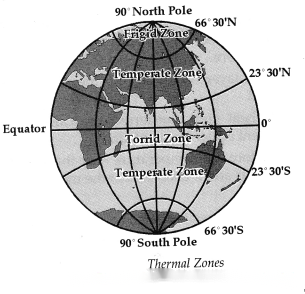
Activity:
Class 6 Geography Chapter 5 Temperature InText Questions and Answers
Can you tell?
Region | Min. temperature | Max. temperature |
Mumbai | 20.5 | 32 |
Nagpur | 22 | 44 |
Srinagar | 2.5 | 24 |
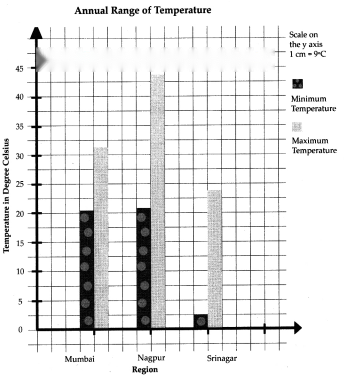
Answer the following questions with the help of figure:
Question 1.
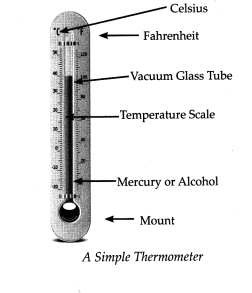
What is the tube of the thermometer fixed on ?
Answer:
The tube of the thermometer is fixed on a mount.
How will the rays fall between:
What will you do?
You stay at ‘Man’ in Satara district. Your Grandma stays at Vengurla in Sindhudurg district. During Diwali, you often visit Vengurla. You like the sea coast there. The warm air of that region attracts you because you are freed from the dry air and scratching cold of your place. This time Grandma is suffering from asthma. Doctors have advised her to stay at a place which has a drier climate. What should you do?
Answer:
Think a little!
Use your brain power!
Observe the map. Name the coastal areas that will experience changes in temperature. Give the reason for this.
Answer:
(i) West coast of North America : The California current moving from the Northern frigid zone to the torrid zone will reduce the temperature at this coast.
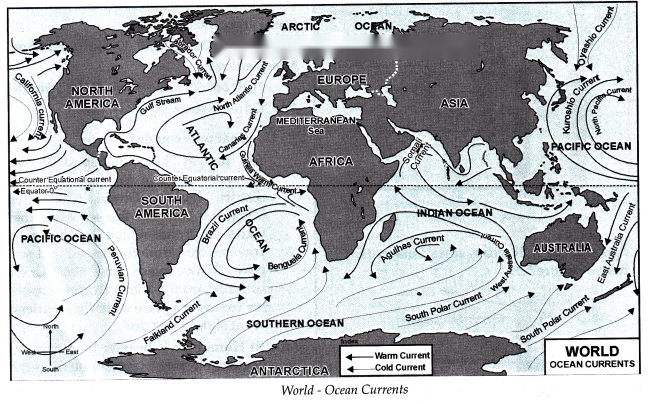
(ii) East coast of North America : The Gulf stream current flowing towards the northern frigid zone will increase the temperature at this coast.
(iii) West coast of Europe : The North Atlantic current flowing towards the Northern frigid zone will increase the temperature at this coast
Class 6 Geography Chapter 5 Temperature Additional Important Questions and Answers
Fill in the blanks wish the right alternative given in the bracket:
Match the pairs correctly:
Factor | Isoline |
(1) Height | (a) Isotherm |
(2) Temperature | (b) Isohyet |
(3) Pressure | (c) Contour |
(4) Rainfall | (d) Isobar |
(5) Planktons | (e) Food for fishes |
(f) Ocean current |
1 – c
2 – a
3 – d
4 – b
5 – e
Give one word for the following sentences:
Question 1
Maharashtra Board Solution
The sunrays which occupy less area.
Solution & Step-by-Step Answer:
Perpendicular.
Question 2
Maharashtra Board Solution
The sunrays which occupy larger area.
Solution & Step-by-Step Answer:
Slant.
Question 3
Maharashtra Board Solution
The climate in coastal areas.
Solution & Step-by-Step Answer:
Equable.
Question 4
Maharashtra Board Solution
The climate in continental areas.
Solution & Step-by-Step Answer:
Extreme.
Question 5
Maharashtra Board Solution
Food for fishes.
Solution & Step-by-Step Answer:
Plankton.
Question 6
Maharashtra Board Solution
Main factor responsible for influenceing the distribution of temperature.
Solution & Step-by-Step Answer:
Latitude.
Question 7
Maharashtra Board Solution
Measuring daily temperature.
Solution & Step-by-Step Answer:
Thermometer.
Name the following:
Question 1
Maharashtra Board Solution
Temperature zones on the earth:
Solution & Step-by-Step Answer:
Torrid zone, temperate zone and frigid zone.
Question 2
Maharashtra Board Solution
Lines drawn on a map by joining all the points having the same value:
Solution & Step-by-Step Answer:
Isolines.
Question 3
Maharashtra Board Solution
Two cold currents:
Solution & Step-by-Step Answer:
Canaries and Peruvian current.
Question 4
Maharashtra Board Solution
Two warm currents.:
Solution & Step-by-Step Answer:
Equatorial and Brazil current.
Answer the following questions in one sentence each:
Question 1
Maharashtra Board Solution
What is diurnal range of temperature?
Solution & Step-by-Step Answer:
The difference in maximum and minimum temperature of a day is called diurnal range of temperature.
Question 2
Maharashtra Board Solution
What factors leads to horizontal currents in the ocean?
Solution & Step-by-Step Answer:
Horizontal currents develop in the ocean due
difference in temperature
Question 3
Maharashtra Board Solution
What is the advantage of the convergence of warm and cold current?
Solution & Step-by-Step Answer:
The convergence of warm and cold current favours the growth of plankton.
Question 4
Maharashtra Board Solution
What are isolines?
Solution & Step-by-Step Answer:
Lines drawn on a map by joining all the points having the same value are called isolines.
Question 5
Maharashtra Board Solution
Where is the distance between the isotherms parallel?
Solution & Step-by-Step Answer:
The distance between the isotherms are parallel from South Pole to the Tropic of Capricorn.
Question 6
Maharashtra Board Solution
Which factors lead to diversity in the climate of different regions?
Solution & Step-by-Step Answer:
The factors which lead to diversity in the climate of different regions are nearness to the sea, continentality, height above the mean sea level and physical level.
Question 7
Maharashtra Board Solution
What is an annual range of temperature?
Solution & Step-by-Step Answer:
The difference in the mean temperatures of summer and winter is called an annual range of temperature.
Give geographical reasons for the following statements:
Question 1
Maharashtra Board Solution
There is unequal distribution of heat received from the Sun.
Solution & Step-by-Step Answer:
The unequal distribution of heat received from the Sun is because:
Question 2
Maharashtra Board Solution
The temperature near the sea level is higher and it decreases in the mountainous region.
Solution & Step-by-Step Answer:
Question 3
Maharashtra Board Solution
In the coastal areas, as compared to continental areas, the temperature of air is lower during the day but warmer at night.
Solution & Step-by-Step Answer:
Question 4
Maharashtra Board Solution
Greenhouse gases lead to increasing temperature of the earth.
Solution & Step-by-Step Answer:
Question 5
Maharashtra Board Solution
Regions, where warm and cold currents converge, are favourable for the growth of fisheries.
Solution & Step-by-Step Answer:
Answer the following questions in short:
Question 1
Maharashtra Board Solution
Explain the movement of ocean currents from equator to the polar region.
Solution & Step-by-Step Answer:
Due to temperature differences, both upward and horizontal currents develop in the ocean. Besides temperature differences, factors like winds and differences in the density of water also give rise to horizontal currents. These ocean currents flow from the equator to the polar region and from the polar region to the equator.
Question 2
Maharashtra Board Solution
Explain the effect of the ocean current flows from the frigid to the torrid zone.
Solution & Step-by-Step Answer:
When an ocean current flows from the frigid to the torrid zone, it reduces the temperature of the coasts in the torrid zone. When a current flows from the torrid to the frigid zone, it increases the temperature of the coasts in the frigid zone.
I can do this!
Question 1
Maharashtra Board Solution
Identify the temperature zones.
Solution & Step-by-Step Answer:
There are three temperature zones namely torrid, temperate and frigid zones.
Question 2
Maharashtra Board Solution
Tell the factors influencing temperature.
Solution & Step-by-Step Answer:
Factors influencing temperature are latitude, winds, nearness to the sea, continentality, vegetation cover, cloud cover, physical set up, height above sea level and industrialisation.
Question 3
Maharashtra Board Solution
Describe the global distribution of temperature with its characteristics.
Solution & Step-by-Step Answer:
The isotherms in the southern hemisphere are fairly parallel to the latitudinal lines. From South Pole to the Tropic of Capricorn the distance between these lines is almost equal. As the proportion of land in the southern hemisphere is limited, temperatures in these parts are largely influenced by latitude.
In the northern hemisphere, the distance between these lines varies. In this hemisphere, the proportion of land is comparatively greater. This affects the distribution of temperature. These effects are seen in the form of variations in the distance between the isotherms and curved nature of these lines.
Question 4
Maharashtra Board Solution
Describe the structure of a thermometer.
Solution & Step-by-Step Answer:
A vacuum glass tube is filled with mercury or alcohol is mounted on a wooden board. There are two temperature scales showing Celsius and Fahrenheit.
|