Latest Maharashtra State Board (SSC & HSC) 2026-27 Syllabus Digest & Solutions Updated!
Class 6Geography2026-27 Syllabus

Chapter 10 Human Occupations Solutions

Complete Maharashtra State Board Balbharati & Yuvakbharati textbook solutions for Chapter 10 Human Occupations. Step-by-step solved exercises, numerical problems, and digest answers.

70 Solved Questions9 Diagrams2892 words

Maharashtra Board Class 6 Geography Solutions Chapter 10 Human Occupations

Class 6 Geography Chapter 10 Human Occupations Textbook Questions and Answers

A. Select the correct option:

Question 1 Maharashtra Board Solution
Serving as a ______ is a tertiary type of occupation.(bus conductor, veterinary doctor, brick kiln worker)
Solution & Step-by-Step Answer:
bus conductor
Question 2 Maharashtra Board Solution
In the tropical areas, we mainly see ________ occupations. (primary; secondary, tertiary)
Solution & Step-by-Step Answer:
primary
Question 3 Maharashtra Board Solution
Amol’s Granny sells papads and pickles. This is a _______ occupation. (primary, secondary, tertiary)
Solution & Step-by-Step Answer:
secondary

B. Give reasons:

Question 1 Maharashtra Board Solution
The type of occupation determines a person’s income.
Solution & Step-by-Step Answer:
(i) Occupation is a job, a person’s role in society wherein a regular activity is carried out for income.

(ii) Certain occupations bring greater economic benefits to the society and the nation at large while certain occupations bring relatively less economic benefits.

(iii) Similarly some occupations require higher level of knowledge and skill while some can be carried out with little or no skill or expertise. Person’s income is proportionate to the economic benefit his occupation brings with it and the land of his knowledge and skill. So the type of occupation determines a person’s income.

Question 2 Maharashtra Board Solution
Primary occupations are associated with developing countries while tertiary, with developed countries.
Solution & Step-by-Step Answer:
(i) Countries which are developing have low income as they are in a state of development and their main source of income comes from production carried out in primary sector.

(ii) Developed countries are rich with high income and so they practice tertiary occupation. They have enough money to invest in business which creates tertiary occupations which requires huge investment.

Question 3 Maharashtra Board Solution
Quaternary occupations are not commonly seen.
Solution & Step-by-Step Answer:
Quaternary occupations are occupations which require special knowledge, skills and expertise. This sectorevolves in well-developed countries and requires skilled workforce apart from sufficient money to invest in fields like IT, research and development, quality testing, etc.

Activity:

Class 6 Geography Chapter 10 Human Occupations InText Questions and Answers

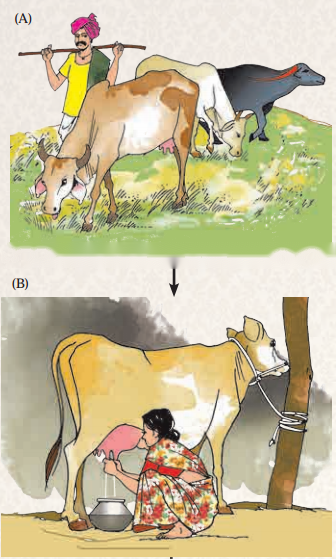
Look at the figure and answer the following questions:


Question 1.
What are the cows and buffaloes in picture A doing?
Answer:
The animals, cows and buffaloes are grazing in the pasture, i.e. land covered with grass and other low plants.
Question 2 Maharashtra Board Solution
What is being obtained in picture B?
Solution & Step-by-Step Answer:
Milk is being obtained in picture B.
Question 3 Maharashtra Board Solution
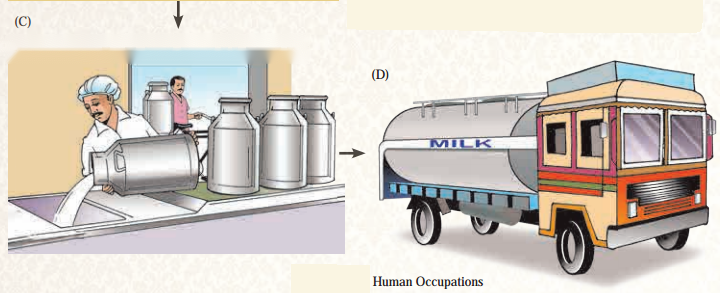
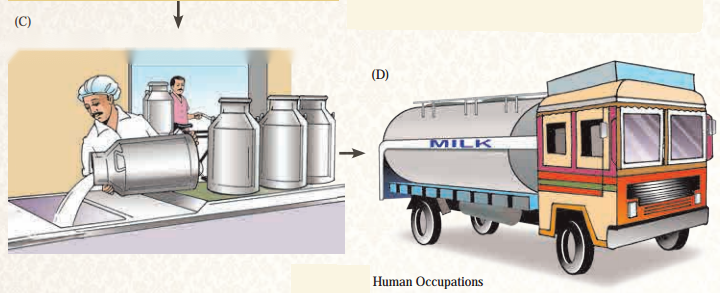
What is happening at the Milk Collection Centre in picture C?
Solution & Step-by-Step Answer:
Milk is being filled for storage and sold at the milk collection centre.
Question 4 Maharashtra Board Solution
In picture D, what is being transported? Where could the tanker be going?
Solution & Step-by-Step Answer:
Milk is being transported to the milk processing centre. The tanker is on the truck
Question 5 Maharashtra Board Solution
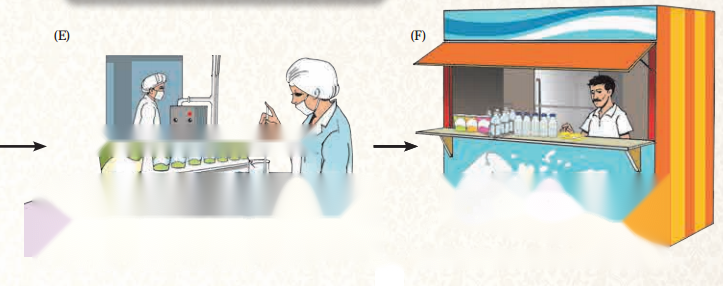
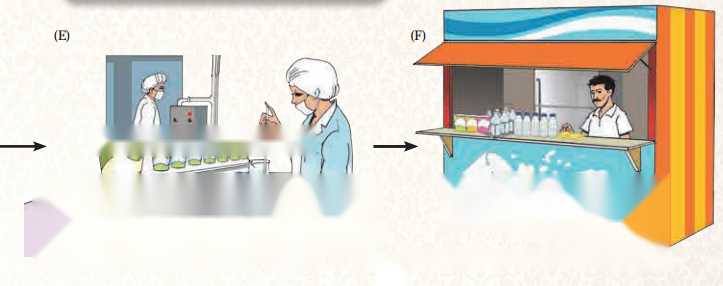
Which products are seen in picture E? From what have these products been made?
Solution & Step-by-Step Answer:
Curd, ghee, butter, cheese and shrikhand are the products seen in picture E and these products have been made from milk.
Question 6 Maharashtra Board Solution
What else is happening in picture E?
Solution & Step-by-Step Answer:
In picture E, person is testing the quality of the prepared milk products.
Question 7 Maharashtra Board Solution
Out of the products shown in picture F, which products do you use?
Solution & Step-by-Step Answer:
I use all the products shown in picture F as milk products are high on nutrients and good for health.
Question 8 Maharashtra Board Solution
What would be main difference between milk and milk products?
Solution & Step-by-Step Answer:
Milk is a beverage obtained from nature, directly from different animals. While milk products are obtained by processing milk into different products.
Question 9 Maharashtra Board Solution
Do these products perish quickly like milk?
Solution & Step-by-Step Answer:
No, they have a longer life unlike milk.

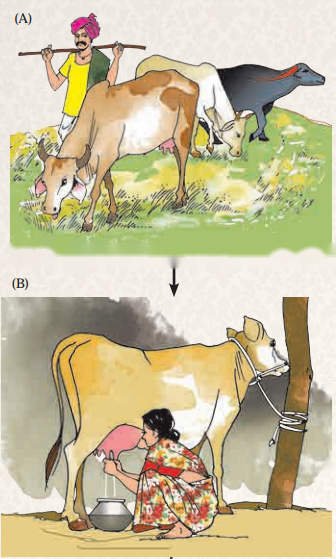
Look at the figure and answer the following questions:
Question 1 Maharashtra Board Solution
Which of these activities is undertaken to obtain a product from nature?
Solution & Step-by-Step Answer:
Obtaining milk from the cow is the activity undertaken to obtain a product from nature.

Question 2 Maharashtra Board Solution
How long does this product last?
Solution & Step-by-Step Answer:
If refrigerated it will last for about five days to one week.
Question 3 Maharashtra Board Solution
In which picture is the product obtained from nature being collected?
Solution & Step-by-Step Answer:
In picture C, the product obtained from nature is being collected.
Question 4 Maharashtra Board Solution
Which service did the milk producer get through this activity?
Solution & Step-by-Step Answer:
Transport and unloading of milk, a tertiary service is the service which the milk producer received.
Question 5 Maharashtra Board Solution
Where is milk being taken? What happens to the milk thereafter?
Solution & Step-by-Step Answer:
The milk is being taken to the milk processing centre for processing milk to make milk products.
Question 6 Maharashtra Board Solution
What milk products are seen in the picture?
Solution & Step-by-Step Answer:
Ghee, butter, cheese, shrikhand are the products seen in the picture.
Question 7 Maharashtra Board Solution
Who inspects these products?
Solution & Step-by-Step Answer:
A food inspector, a person with special skill and expertise inspects these products.
Question 8 Maharashtra Board Solution
What does the shopkeeper do with these products?
Solution & Step-by-Step Answer:
The shopkeeper sells these products to the consumer.
Question 9 Maharashtra Board Solution
Which of these products are perishable and which are non- perishable?
Solution & Step-by-Step Answer:
All are the products, even after proper storage will deteriorate and perish over a period of time.
Question 10 Maharashtra Board Solution
Will the price and weight of these products be same as that of the milk?
Solution & Step-by-Step Answer:
The price and weight of these products will be higher after processing. These products will be more durable and its quality too will be enhanced and so their price will be also higher.

Use your brainpower!

Question 1 Maharashtra Board Solution
Milk is available at ₹ 40 per litre while dahi at ₹ 60 per kg and paneer at ₹ 200 per kg. If both are obtained from milk, why is there so much difference in their prices?
Solution & Step-by-Step Answer:
Milk is being processed, obtained from nature and made it into different products. These products are more durable. Their quality its enhanced and therefore their price is higher.

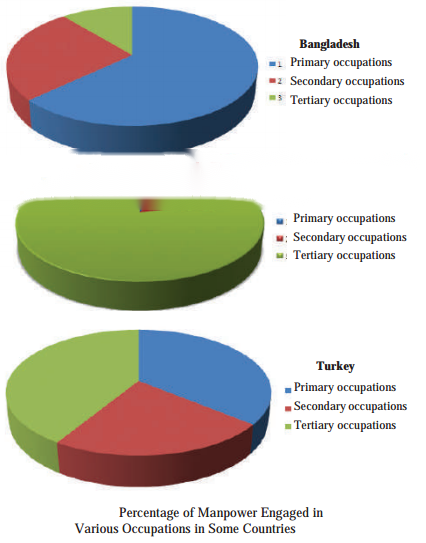
Answer the following questions based on the pie charts:
Question 1 Maharashtra Board Solution
Which country has more manpower engaged in primary occupation?
Solution & Step-by-Step Answer:
Bangladesh.

Question 2 Maharashtra Board Solution
Which country has more manpower engaged in secondary occupation?
Solution & Step-by-Step Answer:
Turkey.
Question 3 Maharashtra Board Solution
Which country has more manpower engaged in tertiary occupations?
Solution & Step-by-Step Answer:
United Arab Emirates.
Question 4 Maharashtra Board Solution
Which country has almost equal manpower engaged in all the occupations?
Solution & Step-by-Step Answer:
Turkey.

Think a little!

Who am I?

Question 1 Maharashtra Board Solution
Who examines us when we fall ill?
Solution & Step-by-Step Answer:
Doctor
Question 2 Maharashtra Board Solution
Who checks our examination papers?
Solution & Step-by-Step Answer:
Teacher
Question 3 Maharashtra Board Solution
Who prepares the designs of buildings?
Solution & Step-by-Step Answer:
Architect
Question 4 Maharashtra Board Solution
Who produces machines and looks after their maintenance and repairs?
Solution & Step-by-Step Answer:
Engineer

Observe figure and answer the questions related to sugar production:


Question 1.
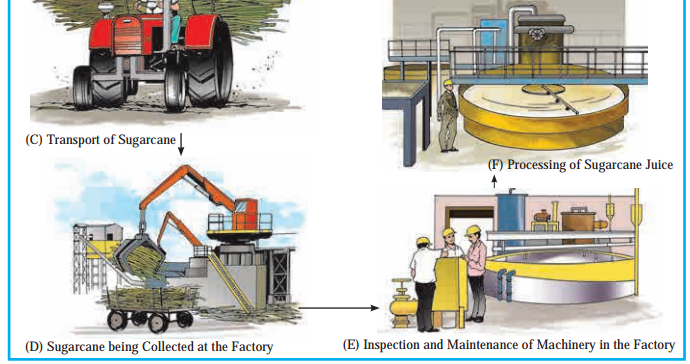
Classify the occupations from primary to quaternary
Answer:
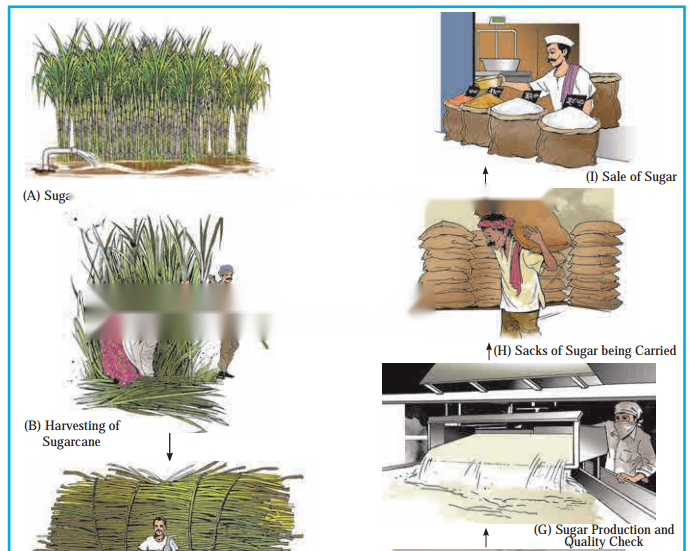
Primary

Secondary

Tertiary

Quaternary

Harvesting of sugarcane

Sugarcane being collected at factory

Transport of sugarcane

Quality check

Processing of sugarcane juice

Sacks of sugar being canned

Inspection and
maintenance of
machinery in the factory

Sugar production

Sale of goods

Question 2 Maharashtra Board Solution
Which raw material is used in the secondary occupation?
Solution & Step-by-Step Answer:
Sugarcane is the raw material used in the secondary occupation.
Question 3 Maharashtra Board Solution
Which is the finished product obtained in the secondary occupation?
Solution & Step-by-Step Answer:
Sugar is the finished product obtained in the secondary occupation.
Question 4 Maharashtra Board Solution
What are the services in tertiary occupations?
Solution & Step-by-Step Answer:
Transport of sugarcane, sacks of sugar being carried and sales of goods are the services in tertiary occupations.
Question 5 Maharashtra Board Solution
Which picture is related to a quaternary occupation? Can you name the occupation?
Solution & Step-by-Step Answer:
Picture G is related to a quaternary occupation. The occupation is quality testing.

Think and discuss:

What effect does nature have on our occupations? Think a little. Give a thought to the following issues. Discuss them in the class. Write two paragraphs about it.

Answer:
Primary occupations like agriculture can be totally disrupted if there are no rains or excessive rains while good rains will usher with good agricultural output. When we receive good agricultural yield it will have a positive input on all secondary occupations which rely on agriculture. It will bring about all-round growth in both agricultural and industrial sector.

Natural calamities like storms, earthquake, volcanoes and tsunami can have adverse impact on various occupations. It can bring all the primary, secondary, tertiary and quaternary occupations to a standstill. Occupations related to production, storage, distribution, etc. will be greatly affected as rescue and rehabilitation of the people and reconstruction of the damaged caused, becomes a priority.

Do it yourself!

Question 1 Maharashtra Board Solution
Which occupations are found in your area?
Solution & Step-by-Step Answer:
I live in Maharashtra and occupations like textile manufacture, manufacture of sugar, pharmaceutical, petrochemicals, electronics, automobiles, engineering services, food processing, etc. are practised here.
Question 2 Maharashtra Board Solution
Which occupation is practised on a large scale?
Solution & Step-by-Step Answer:
Sugar manufacturing is an occupation which is practised on a large scale.
Question 3 Maharashtra Board Solution
Find the reason behind it.
Solution & Step-by-Step Answer:
Advantageous location of Maharashtra, progressive government policies, availability of raw material, i.e. sugarcane, good infrastructure and above all the ownership given to farmers in sugar factories are the reasons why this occupation is practised on a large scale.
Question 4 Maharashtra Board Solution
Both human and natural factors affect occupations. Can you find those factors?
Solution & Step-by-Step Answer:
Development of industries, availability of technical know-how and skilled manpower, existing labour laws and government policies pertaining to occupations development of infrastructure are the human factors that affect occupations. Climate, terrain of a region, fertility of soil, susceptibility to natural calamities, availability of raw materials, etc. are the natural factors which affect occupations.
Question 5 Maharashtra Board Solution
Obtain information about the damage caused to the environment through different occupations.
Solution & Step-by-Step Answer:
Pollution of the environment in all its form – air, water, soil and land, deforestation, soil erosion, depletion of the ozone layer, etc. are some of the damages caused due to different occupations practised.

While practising occupations we should be careful not be cause of hazardous air emissions, land contamination leading to soil pollution, marine and coastal pollution caused due to untreated waste water, etc. Sustainable development, let us remember should be the need of the hour.

Visit a secondary occupation in your area gather information related to that occupation using the following points and note it down:
Answer:

Name of the occupation

Pharmaceutical manufacturing.

Raw material used

Animal extracts, herbal extracts, additives like glaze, talc, etc. and chemical substances.

Sources of raw material

From different parts of India, some raw materials are imported from other countries.

Finished products

Medicine and other pharma products.

Market of finished products

National and international markets including US, UK, Australia, Russia, Germany, etc.

Tertiary occupations

Transport of goods, loading and unloading of goods and sale of goods.

Class 6 Geography Chapter 10 Human Occupations Additional Important Questions and Answers

Complete the following statements by choosing the correct options:

Question 1 Maharashtra Board Solution
Occupations which are dependent on nature are called _______ occupations. (secondary, primary, tertiary)
Solution & Step-by-Step Answer:
primary
Question 2 Maharashtra Board Solution
Processed products are ________.(non-perishable, more durable, less durable)
Solution & Step-by-Step Answer:
more durable
Question 3 Maharashtra Board Solution
Occupations dependent on primary occupations are called ______ occupations. (primary, secondary, quaternary)
Solution & Step-by-Step Answer:
secondary
Question 4 Maharashtra Board Solution
The occupations which provide complimentary services to the other two occupations are called _________ occupations. (tertiary, secondary, primary)
Solution & Step-by-Step Answer:
tertiary
Question 5 Maharashtra Board Solution
Countries which have more manpower engaged in _______ activities are considered to be developed countries. (primary, secondary, tertiary)
Solution & Step-by-Step Answer:
tertiary
Question 6 Maharashtra Board Solution
Countries which have more manpower engaged in primary activities are considered to be _____ countries. (developed, developing, under developed)
Solution & Step-by-Step Answer:
developing
Question 7 Maharashtra Board Solution
transactions decide the country’s ______.(production, occupation, manpower)
Solution & Step-by-Step Answer:
primary

Arrange the following in proper order:

Answer:

Match the pairs correctly:

Question 1 Maharashtra Board Solution

Column A

Column B

(1) Animal husbandry and fishing

(a) secondary occupation

(2) Processing of milk

(b) tertiary occupation

(3) Transport of goods

(c) quaternary occupation

(4) Quality testing of product

(d) primary occupation

(5) Transaction of the country

(e) economic transactions

(f) production

Solution & Step-by-Step Answer:

1 – d
2 – a
3 – b
4 – c
5 – f

Name the following:

Question 1 Maharashtra Board Solution
Any two products obtained after processing milk at milk processing centre:
Solution & Step-by-Step Answer:
Question 2 Maharashtra Board Solution
Any two animals domesticated by man:
Solution & Step-by-Step Answer:
Question 3 Maharashtra Board Solution
Occupation which is directly dependent on nature:
Solution & Step-by-Step Answer:
Primary occupations.
Question 4 Maharashtra Board Solution
Occupations dependent on primary occupations:
Solution & Step-by-Step Answer:
Secondary occupations.
Question 5 Maharashtra Board Solution
Occupations which provide complementary services to primary and secondary occupations:
Solution & Step-by-Step Answer:
Tertiary occupations.
Question 6 Maharashtra Board Solution
Occupations like sale of goods
Solution & Step-by-Step Answer:
Tertiary occupations or service occupations
Question 7 Maharashtra Board Solution
Occupations which requires special expertise:
Solution & Step-by-Step Answer:
Quaternary occupations.
Question 8 Maharashtra Board Solution
Countries which have more manpower engaged in tertiary activities:
Solution & Step-by-Step Answer:
Developed countries.
Question 9 Maharashtra Board Solution
Countries which have more manpower engaged in primary activities:
Solution & Step-by-Step Answer:
Developing countries.

Complete the table:

Occupations

Definition

Examples

Primary

Secondary

Tertiary

Quaternary

Answer:

Occupations

Definition

Examples

Primary

Occupation which directly depend on nature are called primary occupations.

Farming, animal husbandry, mining, foresting, fishing.

Secondary

Occupations dependent on primary occupations are called secondary occupations.

Food processing, manufacturing, construction.

Tertiary

Occupations which provide complementary services to primary and secondary occupations are called tertiary occupations.

Transport of goods, commercial services, loading and unloading goods, sale of goods.

Quaternary

The occupations which requires special expertise and special skills are called quaternary occupations.

Quality testing of food products, inspection and maintenance., IT.

Answer the following questions in one sentence each:

Question 1 Maharashtra Board Solution
Why does man undertake various activities?
Solution & Step-by-Step Answer:
Man undertakes various activities to satisfy his need.
Question 2 Maharashtra Board Solution
How are activities undertaken by man classified?
Solution & Step-by-Step Answer:
Activities undertaken by man are classified on the basis of their nature and the products they yield.
Question 3 Maharashtra Board Solution
Where are raw materials supplied to the industries often obtained from?
Solution & Step-by-Step Answer:
Raw materials supplied to the industries are often obtained from nature.
Question 4 Maharashtra Board Solution
Which occupations require special skills and expertise?
Solution & Step-by-Step Answer:
Quaternary occupations requires special skills and expertise.

Answer the following questions in short:

Question 1 Maharashtra Board Solution
Why are the prices of processed milk products higher?
Solution & Step-by-Step Answer:
Question 2 Maharashtra Board Solution
Explain the term “Service occupation”.
Solution & Step-by-Step Answer:
Question 3 Maharashtra Board Solution
A person testing the quality of a product is practising a quaternary occupation. Elaborate.
Solution & Step-by-Step Answer:
Question 4 Maharashtra Board Solution
How can we decide the extent of the country’s development?
Solution & Step-by-Step Answer:
Question 5 Maharashtra Board Solution
What decides the country’s annual income?
Solution & Step-by-Step Answer:
Different occupations are practised in different countries of the world through which economic transactions occur within country and various countries which decide the country’s production of various goods and their annual income.

I can do this!

Question 1 Maharashtra Board Solution
Solution & Step-by-Step Answer:

Name different occupations

Primary occupationSecondary occupationTertiary occupationQuaternary occupation

Differences

Primary occupations are those occupations which are dependent on nature,e.g. Agriculture.Occupations dependent on primary occupations are called secondary occupations,e.g. Food processing.Those occupations which provide complementary services to primary and secondary occupation are called tertiary occupations,e.g.Sale of goods.While occupation which requires special skills and expertise are called quaternary occupation,e.g.Quality assurance.

Question 2 Maharashtra Board Solution
Classify the occupations from primary to quaternary.
Solution & Step-by-Step Answer:

Primary occupations

Secondary occupations

Tertiary occupations

Quaternary occupations

Farming, mining, forestry, animal husbandry, fishing

Manufacturing, construction, food processing

Commercial services, transport of goods, loading and unloading of goods, sale of goods

Research and development, IT, quality assurance, inspection and maintenance