Maharashtra State Board Class 6 English Solutions Chapter 3.4 Sushruta
Class 6 English Chapter 3.4 Sushruta Textbook Questions and Answers
1. Answer the following questions:
Question a.
Who was Sushruta?
Answer:
Sushruta was a bright student of veterinary medicine.
Question b.
Who was Shalihotra?
Answer:
Shalihotra was Sushruta’s teacher.
Question c.
What question did Shalihotra ask to test Sushruta?
Answer:
The question Shalihotra asked to test Sushruta was, ‘What all would be needed to perform a surgery on a wonderful horse?’
Question d.
How long a period did Shalihotra allow to find the missing things?
Answer:
Shalihotra gave Sushruta a week to find the missing things.
Question e.
How did Sushruta find the missing things? (Select appropriate answer)
1. By reading several books
2. By consulting his friends
3. By observing his teacher carefully and thinking about what he did
4. By meditating
Answer:
By observing his teacher carefully and thinking about what he did.
Question f.
Who erected the first known veterinary hospitals of the world?
Answer:
The great Emperor Ashoka erected the first known veterinary hospital of the world.
2. What were the three things that Sushruta discovered?
3. Explain the meaning of the following phrases:
(a) An eagle’s eye, (b) A lion’s heart, (c) A mother’s touch.
4. Narrate the story of Susharuta in your own words.
5. Write short notes on the following:
Question a.
Veterinary Science in ancient India
Answer:
Veterinary therapy developed very early in India. Based on the Ayurveda, Indian veterinary medicine is known for its specialised literature, which provides information on ancient methods of preventing and treating diseases of animals. Shalihotra, the founder of veterinary medicine, has been attributed the oldest existing veterinary texta treatise entitled ‘Asvayurveda Siddhanta’.
Question b.
Care of animals in the regime of Emperor Ashoka.
Answer:
The great Emperor Ashoka erected the first known veterinary hospitals of the world. Giving the animals general tonics and stimulants was practiced in order to ensure good mental and physical health. Prevention of the occurrence of diseases was also given importance. Cleanliness of animals, maintenance of stalls and stables, quality of food, disadvantages of overfeeding were also looked after during the regime of Emperor Ashoka.
Question c.
Utilization of animal by-products in the ancient world.
Answer:
Utilization of animal by-products was also done wisely by our ancestors. Conversion of milk into butter, ghee, curd, khoa, etc., was practiced. Chicken for its meat and sheep for its wool were also utilized in the ancient world.
6. Form pairs. Complete the following table through discussions.
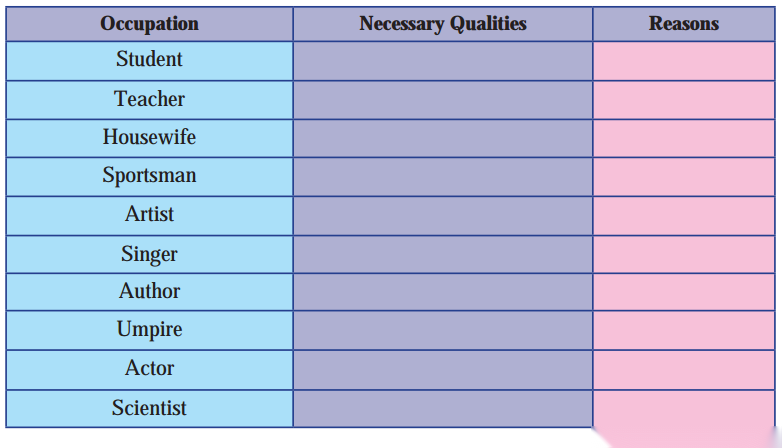
Quality | Reasons | |
Housewife | Loving, caring, organised, cheerful | Should be proud for the well-being and warmth of the family |
Sportsman | Sporting, team spirit, confident, accept defeat with a smile | Should not be proud, accept defeat in the right spirit |
Artist | Should have an aesthetic mind | Should be able to express his feelings through art |
Singer | Have a good voice modulation | Should be able to enthrall the audience |
Author | Good writer, convey messages through writings | Young and old should be able to learn and love reading |
Umpire | Should be knowledgeable, observant and impartial | Should take the right decision to be fearless |
Actor | Should know the art of acting naturally | Should be a good entertainer |
Scientist | Discover science which is useful to mankind | Should be an asset to the society |
7. Note these pairs of words: care-carefully, equal-equally.
Here we see that the letters ‘-ly’ are added at the end of the word to make another word. A letter or group of letters added at the end of a word to make another word is called a suffix.
(a) Use the suffix ‘-ly’ to make other words from the following:
subsequent, frequent, wise, immense, beautiful
(b) Find two examples each, of the words made by using the following suffixes.
-ness, -er, -let, -ful, -tion/sion, -y
Question a.
Use the suffix ‘-ly’ to make other words from the following:
subsequent, frequent, wise, immense, beautiful
Answer:
Question b.
Find two examples each, of the words made by using the following suffixes.
-ness, -er, -let, -ful, -tion/sion, -y
Answer:
8. Frame questions beginning with the following words, based on the above passage.
Who, What, Where, When, How, Why (One question each)
9. Visit a library: Find more information/stories about scholars of the ancient world – Aryabhatta, Bhaskaracharya, Varah Mihir, Charak, Nagarjuna, Jeevak.
Class 6 English Chapter 3.4 Sushruta Important Questions and Answers
Reading Skills, Vocabulary and Grammar
Read the extract and do the given activities.
Question 1
Maharashtra Board Solution
State whether the following statements are true or false. a. Veterinary Sciences is a chosen career nowadays. b. Utilisation of animal by-products was practiced in the ancient world.
Solution & Step-by-Step Answer:
block bg-white dark:bg-slate-900/80 border-l-4 border-emerald-500 rounded-r-xl p-5 my-3 shadow-xs border border-slate-200/60 dark:border-slate-800">
Solution & Step-by-Step Answer:
a. False b. True
Question 2
Maharashtra Board Solution
Why is veterinary sciences not a chosen career?
Solution & Step-by-Step Answer:
Veterinary sciences is not a chosen career because of lack of awareness.
Question 3
Maharashtra Board Solution
What kind of veterinarians does India need?
Solution & Step-by-Step Answer:
India needs veterinarians who empathize with animals and give their cent percent to the profession.
Question 4
Maharashtra Board Solution
Pick out two Indian words from the extract.
Solution & Step-by-Step Answer:
Ghee, khoa
Question 5
Maharashtra Board Solution
Give verb forms of:
|
Question 6
Maharashtra Board Solution
Write the antonyms of by using a prefix.
Solution & Step-by-Step Answer:
Personal response:
Question 1
Maharashtra Board Solution
What would you like to take up as a profession when you grow up?
Solution & Step-by-Step Answer:
I would like to become a veterinarian when I grow up basically because I love animals. I would like to do something in this field which is necessary because animals are dumb creatures and cannot vocalise their problems. I would love to make life easy for animals.
Language Study Vocabulary and Wordplay
Question 1
Maharashtra Board Solution
List all the words related to surgery from the passage.
Solution & Step-by-Step Answer:
Instruments, medicine, dressing of wounds bandaging of fractures, specialist. Now you add more to the list.
Question 2
Maharashtra Board Solution
List words related to milk from the lesson.
Solution & Step-by-Step Answer:
Milk – ghee, butter, curds, khoa
(b) Find two examples of each of the words made by using the following suffixes. Sushruta Summary in English Part 1 of Sushruta talks about Sushruta, a bright veterinary student and his teacher Shalihotra, who decided to test him. Shalihotra asked Sushruta to list down the equipments which are needed to perform a surgery. Sushruta had everything right but missed on three things, which he found out through careful observation of his teacher. Part 2 acquaints us with veterinary therapy which developed very early in India and how it was used by great kings like Chandra Gupta Maurya and Emperor Ashoka to treat their animals accompanying their armies and cattle as well. Animal by-products were used by our ancestors. Indians need to be made more aware of veterinary sciences as a career which is the need of the hour. Introduction: Sushruta was an ancient Indian physician known as the main author of Sushruta Samhita, a text on medicine and surgery. He is known as the ‘Founding Father of Surgery’. His teacher Shalihotra, was the founder of veterinary medicine (around 2350 BCE). A treatise entitled ‘Asvayurveda Siddhanta’ (complete Ayurvedic system for horses) is attributed to Shalihotra. Nakula, one of the Pandavas has written ‘Asva chikitsita.’ Glossary: |