Latest Maharashtra State Board (SSC & HSC) 2026-27 Syllabus Digest & Solutions Updated!
Class 5Environmental Studies (EVS)2026-27 Syllabus

Chapter 3 The Earth and its Living World Solutions

Complete Maharashtra State Board Balbharati & Yuvakbharati textbook solutions for Chapter 3 The Earth and its Living World. Step-by-step solved exercises, numerical problems, and digest answers.

90 Solved Questions3 Diagrams2812 words

Maharashtra State Board Class 5 EVS Solutions Part 1 Chapter 3 The Earth and its Living World

5th Std EVS 1 Digest Chapter 3 The Earth and its Living World Textbook Questions and Answers

1. What is the solution?

Question 1 Maharashtra Board Solution
Dark patches appear on the skin after exposure to the sun.
Solution & Step-by-Step Answer:
Dark patches due to sun’s rays are called sunspots which can be taken care in a natural way by applying slices of fresh lemon on it for 10-15 minutes or by applying aloe vera gel twice a day.

2. Use your brainpower!

Question (a)
Why are microorganisms important?
Answer:
Microorganisms live in the soil and do the work of decomposing the dead plants and animals. If there were no microorganisms then the dead plants and animals would not get decomposed, they would have got accumulated and the soil would not become fertile.

Question (b)
Think about all the foodstuffs obtained from the sea. Find more information and write ten lines about them.
Answer:
Question Personal response.

3. Answer the following in one sentence:

Question (a)
What are clouds made of?
Answer:
Clouds are made up of very fine droplets of water which are small and light.

Question (b)
What is meant by biosphere?
Answer:
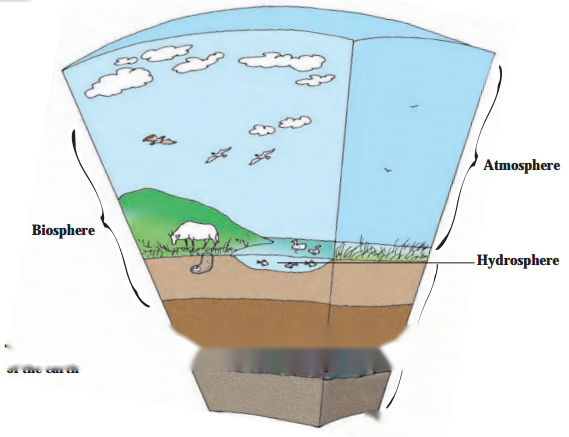
Living things occupy parts of the lithosphere, hydrosphere, and atmosphere. Living things and all the parts they occupy are together called the biosphere.

Question (c)
Make a list of the land forms you see in your surroundings and give a description of any two of them.
Answer:
(Personal response) Landforms e.g. mountain, hill, hillock, valley, plains, plateaus, river etc. (Students are supposed to write their own answers)

4. In the following sentences, underline the words that refer to landforms.

Question 1 Maharashtra Board Solution
In the following sentences, underline the words that refer to landforms.
Solution & Step-by-Step Answer:
(a) Anil lives at the foot of a hill. (b) Ria lives in the plateau region.

5. Write a note about the following:

Question (a)
Evaporation:
Answer:
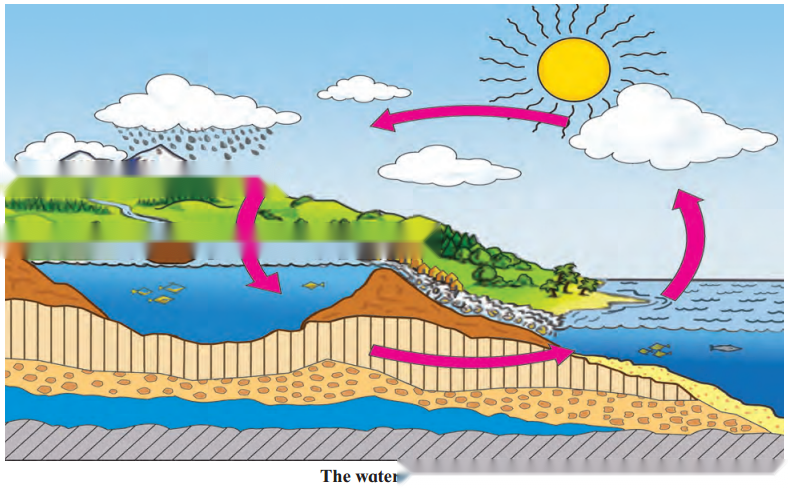
Due to the heat of the sun, the water from the earth’s surface goes into vapour state forming fine droplets of water which are small and light. This process is called evaporation.

Question (b)
Condensation:
Answer:
The process when vapour turns into water on cooling to form drops of water it is called as condensation.

Question (c)
The water cycle:
Answer:

6. Give two examples of each:

Question (a)
Weather-related events
Answer:
Clouds, rain

Question (b)
Sources of water
Answer:
River, lake

7. Draw a labelled diagram showing the:

Question 1 Maharashtra Board Solution
Water cycle
Solution & Step-by-Step Answer:

Question 2 Maharashtra Board Solution
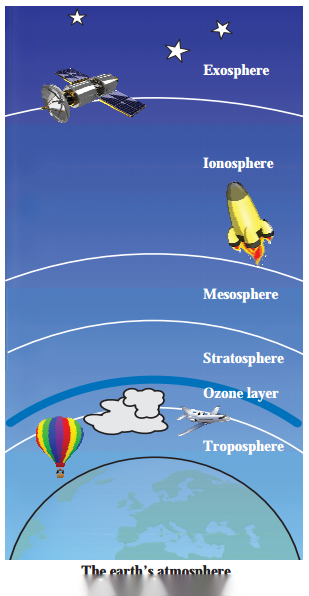
The earth’s atmosphere
Solution & Step-by-Step Answer:

Question 3 Maharashtra Board Solution
The spheres of the earth
Solution & Step-by-Step Answer:

Environmental Studies Part 1 Standard 5th Solutions Chapter 3 The Earth and its Living World Additional Important Questions and Answers

Fill in the blanks with the correct answers from the options given below:

Question 1 Maharashtra Board Solution
The earth’s crust is mainly made up of ……………... (a) soil (b) rock (c) animals
Solution & Step-by-Step Answer:
(b) rock
Question 2 Maharashtra Board Solution
The earth’s crust and a small hard portion of the layer under it is called the ……………….. (a) hydrosphere (b) atmosphere (c) lithosphere
Solution & Step-by-Step Answer:
(c) lithosphere
Question 3 Maharashtra Board Solution
About ……………….. of the earth’s surface is covered by land while about ………………… is covered with water. (a) one third (b) one fourth, two third (c) three fourth
Solution & Step-by-Step Answer:
(b) one fourth, two third
Question 4 Maharashtra Board Solution
The envelope of air around the earth is called the ………………. (a) lithosphere (b) atmosphere (c) biosphere
Solution & Step-by-Step Answer:
(b) atmosphere
Question 5 Maharashtra Board Solution
There are huge blocks of ice floating in the sea called ………………... (a) glacier (b) blockice (c) iceberg
Solution & Step-by-Step Answer:
(c) iceberg
Question 6 Maharashtra Board Solution
The earth is surrounded by the ………………….. (a) atmosphere (b) lithosphere (c) hydrosphere
Solution & Step-by-Step Answer:
(a) atmosphere
Question 7 Maharashtra Board Solution
There are ………………. things on land, air and water. (a) non-living (b) living (c) rocks
Solution & Step-by-Step Answer:
(b) living
Question 8 Maharashtra Board Solution
The ……………….. is the cause of many natural processes on the earth. (a) moon (b) planets (c) sun
Solution & Step-by-Step Answer:
(c) sun
Question 9 Maharashtra Board Solution
The ……………… spreads in all the other three spheres. (a) biosphere (b) atmosphere (c) lithosphere
Solution & Step-by-Step Answer:
(a) biosphere
Question 10 Maharashtra Board Solution
The earth’s crust is …………………... (a) soft (b) marshy (c) hard
Solution & Step-by-Step Answer:
(c) hard
Question 11 Maharashtra Board Solution
A vast continuous stretch of land is called a …………………. (a) sea (b) ocean (c) continent
Solution & Step-by-Step Answer:
(c) continent
Question 12 Maharashtra Board Solution
The land on earth is divided into ………………… continents. (a) one (b) two (c) seven
Solution & Step-by-Step Answer:
(c) seven
Question 13 Maharashtra Board Solution
………………….. is the largest continent. (a) Africa (b) Asia (c) Australia
Solution & Step-by-Step Answer:
(b) Asia
Question 14 Maharashtra Board Solution
…………….. is the smallest continent. (a) Africa (b) Asia (c) Australia
Solution & Step-by-Step Answer:
(c) Australia
Question 15 Maharashtra Board Solution
Ocean water is ………………….. (a) salty (b) sweet (c) bitter
Solution & Step-by-Step Answer:
(a) salty
Question 16 Maharashtra Board Solution
There are ……………….. oceans. (a) one (b) five (c) seven
Solution & Step-by-Step Answer:
(b) five
Question 17 Maharashtra Board Solution
The land along the margins of an ocean is called the ……………….. region. (a) coastal (b) rainy (c) mountainous
Solution & Step-by-Step Answer:
(a) coastal
Question 18 Maharashtra Board Solution
Stream water is ……………….. and not salty. (a) bitter (b) fresh (c) salty
Solution & Step-by-Step Answer:
(b) fresh
Question 19 Maharashtra Board Solution
……………….. are smallest forms of water streams. (a) Rills (b) Brooks (c) Rivers
Solution & Step-by-Step Answer:
(a) Rills
Question 20 Maharashtra Board Solution
……………… are biggest forms of water streams. (a) Rills (b) Brooks (c) Rivers
Solution & Step-by-Step Answer:
(c) Rivers
Question 21 Maharashtra Board Solution
A river cascades down a sudden drop to form a ………………... (a) lake (b) waterfall (c) glacier
Solution & Step-by-Step Answer:
(b) waterfall
Question 22 Maharashtra Board Solution
All rivers eventually flow into the ………………….. (a) lake (b) waterfall (c) ocean
Solution & Step-by-Step Answer:
(c) ocean
Question 23 Maharashtra Board Solution
A water body formed by water collecting naturally in a low-lying area of land is called a ……………. (a) ocean (b) lake (c) river
Solution & Step-by-Step Answer:
(b) lake
Question 24 Maharashtra Board Solution
Many lakes and wells get water from underground ………………….. (a) lakes (b) springs (c) mines
Solution & Step-by-Step Answer:
(b) springs
Question 25 Maharashtra Board Solution
As we go higher from the earth’s surface, the air in the atmosphere becomes ……………….. (a) rarer (b) thicker (c) solid
Solution & Step-by-Step Answer:
(a) rarer
Question 26 Maharashtra Board Solution
The atmosphere consists of a mixture of ………………... (a) liquid (b) solid (c) gases
Solution & Step-by-Step Answer:
(c) gases
Question 27 Maharashtra Board Solution
As we go higher in the troposphere, it becomes ………………... (a) hotter (b) humid (c) cooler
Solution & Step-by-Step Answer:
(c) cooler
Question 28 Maharashtra Board Solution
Almost all the water vapour in the atmosphere is contained in the ……………….. (a) troposphere (b) stratosphere (c) mesosphere
Solution & Step-by-Step Answer:
(a) troposphere
Question 29 Maharashtra Board Solution
In the lower part of the stratosphere, there is a layer of a gas called ………………... (a) oxygen (b) ozone (c) nitrogen
Solution & Step-by-Step Answer:
(b) ozone
Question 30 Maharashtra Board Solution
…………………….. rays coming from the sun are harmful for living things. (a) Ultraviolet (b) Infrared (c) Electric bulb
Solution & Step-by-Step Answer:
(a) Ultraviolet
Question 31 Maharashtra Board Solution
Water on the earth ……………………….. continuously due to the heat of the sun. (a) condenses (b) evaporates (c) melts
Solution & Step-by-Step Answer:
(b) evaporates
Question 32 Maharashtra Board Solution
Water vapour is ………………. than air, it rises up into the atmosphere. (a) lighter (b) heavier (c) bigger
Solution & Step-by-Step Answer:
(a) lighter
Question 33 Maharashtra Board Solution
The polar bear is seen only in the …………………. polar regions. (a) rain bound (b) windblown (c) snowbound
Solution & Step-by-Step Answer:
(c) snowbound
Question 34 Maharashtra Board Solution
Zebras are found in …………………... (a) Africa (b) India (c) Australia
Solution & Step-by-Step Answer:
(a) Africa
Question 35 Maharashtra Board Solution
Kangaroos are found only in ……………………. (a) Africa (b) India (c) Australia
Solution & Step-by-Step Answer:
(c) Australia
Question 36 Maharashtra Board Solution
This ………………… world constitutes the biosphere. (a) living (b) non-living (c) material
Solution & Step-by-Step Answer:
(a) living

Give two examples of each:

Question 1 Maharashtra Board Solution
Continents
Solution & Step-by-Step Answer:
Asia, Africa
Question 2 Maharashtra Board Solution
Oceans
Solution & Step-by-Step Answer:
The Atlantic, Pacific Ocean
Question 3 Maharashtra Board Solution
Part of the ocean
Solution & Step-by-Step Answer:
Sea, Gulf
Question 4 Maharashtra Board Solution
Animals found in regions of hot climates
Solution & Step-by-Step Answer:
Elephant, Lions
Question 5 Maharashtra Board Solution
Answer in one word:
Solution & Step-by-Step Answer:

Answer:

Question 4 Maharashtra Board Solution
In the following sentences, underline the words that refer to landforms.
Solution & Step-by-Step Answer:

Answer the following in one sentence:

Question 1 Maharashtra Board Solution
What is a coastal region?
Solution & Step-by-Step Answer:
The land along the margins of an ocean is called a coastal region.
Question 2 Maharashtra Board Solution
What is a lake?
Solution & Step-by-Step Answer:
A water body formed by water collecting naturally in a low lying area of land is called a lake.
Question 3 Maharashtra Board Solution
What is meant by hydrosphere?
Solution & Step-by-Step Answer:
The water or ice that occupies the earth’s surface, groundwater and the water vapour in the atmosphere together form the earth’s hydrosphere.
Question 4 Maharashtra Board Solution
Name the layers of the atmosphere.
Solution & Step-by-Step Answer:
The layers of the atmosphere are troposphere, stratosphere, mesosphere, ionosphere and exosphere.
Question 5 Maharashtra Board Solution
What is the atmosphere made up of?
Solution & Step-by-Step Answer:
The atmosphere mainly consists of a mixture of gases, namely nitrogen, oxygen, water vapour and carbon dioxide.
Question 6 Maharashtra Board Solution
Which three spheres envelope the earth?
Solution & Step-by-Step Answer:
The hydrosphere, lithosphere and atmosphere envelope the earth.
Question 7 Maharashtra Board Solution
Which sphere is present in all the three spheres?
Solution & Step-by-Step Answer:
The biosphere spreads in all the three spheres.
Question 8 Maharashtra Board Solution
What portion of the earth is land?
Solution & Step-by-Step Answer:
About a third of the surface of the earth consists of land.
Question 9 Maharashtra Board Solution
What is a continent?
Solution & Step-by-Step Answer:
A vast continuous stretch of land is called a continent.
Question 10 Maharashtra Board Solution
Into how many continents is the land on earth divided?
Solution & Step-by-Step Answer:
Land on earth is divided into seven continents.
Question 11 Maharashtra Board Solution
Name the seven continents of the earth?
Solution & Step-by-Step Answer:
The seven continents are Asia, Europe, Africa, North America, South America, Antarctica and Australia.
Question 12 Maharashtra Board Solution
Which is the largest and the smallest continent?
Solution & Step-by-Step Answer:
Asia is the largest continent and Australia is the smallest continent.
Question 13 Maharashtra Board Solution
Name the five oceans of the earth.
Solution & Step-by-Step Answer:
The five oceans are the Atlantic, Pacific, Artie, the Southern Ocean and the Indian Ocean.
Question 14 Maharashtra Board Solution
Name some water bodies that form along the coastal region.
Solution & Step-by-Step Answer:
Sea, bay, gulf, strait7, creek8 etc. are some water bodies formed along the coastal region.
Question 15 Maharashtra Board Solution
How are rivers formed?
Solution & Step-by-Step Answer:
Rills, brooks9, streams join each other to form rivers.
Question 16 Maharashtra Board Solution
What is a waterfall?
Solution & Step-by-Step Answer:
In some places, a river cascades down a sudden drop. This forms a waterfall.
Question 17 Maharashtra Board Solution
Where do rivers end?
Solution & Step-by-Step Answer:
All rivers eventually flow into the ocean.
Question 18 Maharashtra Board Solution
What is snow?
Solution & Step-by-Step Answer:
Water particles in the cloud freeze and in the cold regions, they come down in the form of snow.
Question 19 Maharashtra Board Solution
What are icebergs?
Solution & Step-by-Step Answer:
Huge blocks or mass of ice floating in the sea are called icebergs.
Question 20 Maharashtra Board Solution
What is ground water?
Solution & Step-by-Step Answer:
There is a lot of water stored in the underground layers of rock. This water is called ground water.
Question 21 Maharashtra Board Solution
What is hydrosphere?
Solution & Step-by-Step Answer:
The water or ice that occupies the earth’s surface, ground water and the water vapour in the atmosphere together form the earth’s hydrosphere.
Question 22 Maharashtra Board Solution
What is atmosphere?
Solution & Step-by-Step Answer:
The envelope of air around the earth is called the atmosphere.
Question 23 Maharashtra Board Solution
Which layer of the atmosphere is closest to the surface of the earth?
Solution & Step-by-Step Answer:
The troposphere is closest to the surface of the earth.
Question 24 Maharashtra Board Solution
What happens to the air as we go higher in the troposphere?
Solution & Step-by-Step Answer:
As we go higher in the troposphere the air becomes rarer and cooler.
Question 25 Maharashtra Board Solution
What is the ozone layer?
Solution & Step-by-Step Answer:
In the lower part of the stratosphere, there is a layer of a gas called ozone.
Question 26 Maharashtra Board Solution
How is ozone layer useful for the living things on earth?
Solution & Step-by-Step Answer:
Ultraviolet rays coming from the sun are harmful for living things, but the ozone layer absorbs them and protects the living world from those rays.
Question 27 Maharashtra Board Solution
In which region are elephants and lions found?
Solution & Step-by-Step Answer:
Elephants and lions are found in regions of hot climate.
Question 28 Maharashtra Board Solution
Where are kangaroos found?
Solution & Step-by-Step Answer:
Kangaroos are found only in Australia.
Question 29 Maharashtra Board Solution
Where are polar bears found?
Solution & Step-by-Step Answer:
Polar bears are seen only in the snowbound polar regions.

Give geographical reasons:

Question 1 Maharashtra Board Solution
As we go higher in the troposphere it becomes cooler.
Solution & Step-by-Step Answer:
1. The surface of the earth gets heated due to the heat of the sun. 2. So, the air near the surface is the hottest. 3. Therefore as we go higher in the troposphere it becomes cooler.
Question 2 Maharashtra Board Solution
All weather-related phenomena take place in the troposphere.
Solution & Step-by-Step Answer:
1. Almost all water vapour in the atmosphere is present in the troposphere. 2. Therefore, all weather related phenomena take place in the troposphere.
Question 3 Maharashtra Board Solution
Mountaineers carry oxygen in cylinders when they climb mountains that are more than 5000 m high.
Solution & Step-by-Step Answer:
1. As we go higher from the surface of the earth, the air in the atmosphere becomes rarer. 2. Therefore, mountaineers carry oxygen in cylinders when they climb mountains that are more than 5000 m high to get sufficient supply of oxygen.

Answer briefly:

Question 1 Maharashtra Board Solution
What is a glacier?
Solution & Step-by-Step Answer:
Question 2 Maharashtra Board Solution
What is groundwater? How can we obtain it?
Solution & Step-by-Step Answer:
Question 3 Maharashtra Board Solution
Explain ‘troposphere’.
Solution & Step-by-Step Answer:
Question 4 Maharashtra Board Solution
How do we get rain?
Solution & Step-by-Step Answer:

Write a note about the following:

Question 4 Maharashtra Board Solution
Stratosphere:
Solution & Step-by-Step Answer:

Use your brain power!

Question 1 Maharashtra Board Solution
In which layer of the atmosphere do we see the rainbow?
Solution & Step-by-Step Answer:
We see the rainbow in the troposphere.

Can you tell?

Question 1 Maharashtra Board Solution
Where do you get water from?
Solution & Step-by-Step Answer:
Rain
Question 2 Maharashtra Board Solution
Where do we lay the foundation of buildings?
Solution & Step-by-Step Answer:
Lithosphere
Question 3 Maharashtra Board Solution
Which need is met through breathing?
Solution & Step-by-Step Answer:
Breathing helps us to keep us alive. We take in oxygen from the air and give out carbon dioxide.
Question 4 Maharashtra Board Solution
From where does the earth get light and heat?
Solution & Step-by-Step Answer:
Sun
Question 5 Maharashtra Board Solution
Make as long a list as you can of all the living things you see in the lithosphere, hydrosphere and atmosphere.
Solution & Step-by-Step Answer:

Lithosphere

Hydrosphere

Atmosphere

1. Trees

1. Fishes

1. Birds

2. Rabbit

2. Whales

2. Butterflies

Glossary: