Maharashtra State Board Class 5 EVS Solutions Part 2 Chapter 10 Historic Period
5th Std EVS 2 Digest Chapter 10 Historic Period Textbook Questions and Answers
1. Answer the following question in one sentence.
Question a.
Where did the people in the New Stone Age establish their village settlements?
Answer:
The people in the New Stone Age established their village-settlements on the banks of rivers.
Question b.
What articles were the Harappan craftsmen skilled at making?
Answer:
The Harappan craftsmen were highly skilled in making bronze objects and beads from semi-precious stones of different colours.
2. Answer the following question in brief.
Question a.
What are some of the well-known characteristics of Harappan cities?
Answer:
The well-known characteristics of Harappan cities are :
Question b.
What made the soil on the banks of the Nile fertile?
Answer:
3. Complete the following chart.
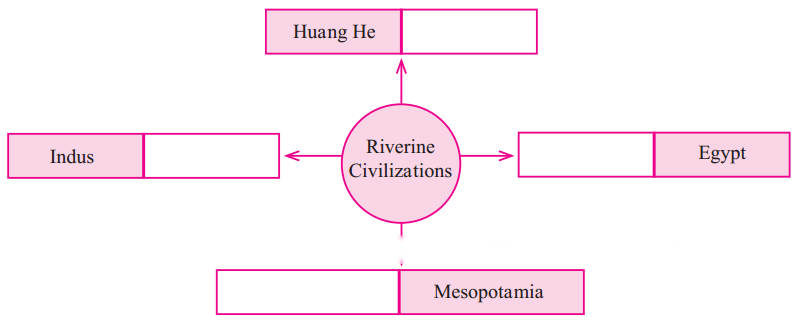
Activities :
Question a.
Show the sites of Harappan Culture in an outline map of india.
Question b.
Visit various artistes in your locality who play musical instruments. Collect information a bout their instruments.
Question c.
Visit some senior citizens in your locality and collect information about the traditional sports and games of their times.
Environmental Studies Part 2 Standard 5th Solutions Chapter 10 Historic Period Additional Important Questions and Answers
Fill in the blanks :
Question 1
Maharashtra Board Solution
|
Answer each of the following questions in one sentence :
Question 1
Maharashtra Board Solution
How are written records available?
Solution & Step-by-Step Answer:
Written records are available in the form of inscriptions, manuscripts, books etc.
Question 2
Maharashtra Board Solution
What brought an end to the New Stone Age?
Solution & Step-by-Step Answer:
With the rise of ancient civilization, the New Stone Age came to an end and the Historic Period began.
Question 3
Maharashtra Board Solution
What is a significant difference between humans and animals?
Solution & Step-by-Step Answer:
Animals do not bring about change in their environment, whereas humans change the character of their surroundings, they process substances from nature to suit their needs. This is the significant difference between humans and animals.
Question 4
Maharashtra Board Solution
Where did the people in the New Stone Age establish their village-settlements?
Solution & Step-by-Step Answer:
The people in the New Stone Age established their village settlements on the banks of various rivers.
Question 5
Maharashtra Board Solution
Why did the people in the New Stone Age establish their village-settlements on the banks of various rivers?
Solution & Step-by-Step Answer:
Fertile soil and constant water supply are essential to grow good crops. Since the people in the New Stone Age followed the agricultural way of life, they established their village settlements on the banks of various rivers.
Question 6
Maharashtra Board Solution
What gave rise to the early civilizations?
Solution & Step-by-Step Answer:
Increased production because of industrial skills, the use of the wheel, flourishing of trade, use of well-developed scripts etc. gave rise to the early civilization.
Question 7
Maharashtra Board Solution
In which four regions of the world did the ancient civilization come into existence?
Solution & Step-by-Step Answer:
Mesopotamia, Egypt, the Indian subcontinent and China are the four regions of the world where ancient civilization came into existence.
Question 8
Maharashtra Board Solution
What are these four civilizations called? Why?
Solution & Step-by-Step Answer:
The ancient civilizations in these four regions developed in river valleys and hence they are called ‘Riverine Civilizations!
Question 9
Maharashtra Board Solution
What does Mesopotamia mean?
Solution & Step-by-Step Answer:
Mesopotamia means ‘Land between two rivers’
Question 10
Maharashtra Board Solution
Between which two rivers did Mesopotamia bloom?
Solution & Step-by-Step Answer:
Mesopotamia bloomed between the two rivers Tigris and Euphrates.
Question 11
Maharashtra Board Solution
Which were the ancient cities in Mesopotamia?
Solution & Step-by-Step Answer:
Cities like Ur, Uruk, Nippur blossomed in ancient Mesopotamia.
Question 12
Maharashtra Board Solution
Where did the Egyptian Civilization flourish?
Solution & Step-by-Step Answer:
The Egyptian Civilization flourished along the banks of river Nile in the north of Africa.
Question 13
Maharashtra Board Solution
Where did the ancient civilization at China flourish?
Solution & Step-by-Step Answer:
The ancient civilization of China flourished in the valley of the Huang He River.
Question 14
Maharashtra Board Solution
What did the Chinese King introduce to the civilization?
Solution & Step-by-Step Answer:
A Chinese king Huangdi introduced agriculture, animal husbandry, wheeled carts and chariots, boats and clothing in China.
Question 15
Maharashtra Board Solution
What was the ancient Chinese belief?
Solution & Step-by-Step Answer:
The ancient Chinese believed that their queen invented the technique of silk production and silk dyeing
Question 16
Maharashtra Board Solution
Which were the important cities of ancient China?
Solution & Step-by-Step Answer:
Luoyang, Beijing and Chang were the important cities of ancient China.
Question 17
Maharashtra Board Solution
Which was the earliest civilization on the Indian subcontinent?
Solution & Step-by-Step Answer:
The Harappan Civilization was the earliest civilization on the Indian subcontinent.
Question 18
Maharashtra Board Solution
Where did the Harappan Civilization develop?
Solution & Step-by-Step Answer:
The Harappan Civilization developed in the Indus Valley.
Question 19
Maharashtra Board Solution
‘Indus’ is the English word for which name?
Solution & Step-by-Step Answer:
‘Indus is the English word for the name ‘Sindhu’.
Question 20
Maharashtra Board Solution
Which two sites of Harappan Civilization was unearthed first?
Solution & Step-by-Step Answer:
Harappa in Punjab and Mohenjo-daro in Sind were the two sites of Harappan Civilization.
Question 21
Maharashtra Board Solution
Which are the famous sites of the Harappan Civilization in India?
Solution & Step-by-Step Answer:
Lothal and Dhola Vira in Gujarat and Kalibangan in Rajasthan are among the famous sites of the Harappan Civilization in India.
Question 22
Maharashtra Board Solution
What articles were the Harappan craftsmen skilled at making?
Solution & Step-by-Step Answer:
The Harappan craftsmen were highly skilled in making bronze objects and beads from precious stones of various colours.
Question 23
Maharashtra Board Solution
Which things had great demand in Mesopotamia?
Solution & Step-by-Step Answer:
The bronze objects and beads made of colourful precious stones made by the Harappan craftsman were in great demand in Mesopotamia.
Question 24
Maharashtra Board Solution
Which were the main deities of the Harappan civilization?
Solution & Step-by-Step Answer:
Pashuapati and a mother goddess were the main deities of the Harappan civilization.
Question 25
Maharashtra Board Solution
Which were the important sports of the Harappans?
Solution & Step-by-Step Answer:
Hunting and wrestling were the important sports of the Harappans.
Question 26
Maharashtra Board Solution
Which were the popular indoor games of the Harappans?
Solution & Step-by-Step Answer:
Games played with the help of game boards and gamesmen were popular indoor games of the Harappans.
Question 27
Maharashtra Board Solution
Which indoor game similar to chess was played in ancient Egypt?
Solution & Step-by-Step Answer:
Senat’ a game similar to chess was played in ancient Egypt
Question 28
Maharashtra Board Solution
List some toys found in the excavations of Harappan sites.
Solution & Step-by-Step Answer:
Whirls, whistles, rattles, bullock carts, animals and birds on wheels etc were some of the ‘toy’ found in the excavations of Harappan sites.
Question 29
Maharashtra Board Solution
What was important in celebrating any festival in early civilizations?
Solution & Step-by-Step Answer:
Music and dance were very essential in elebrating any festival in early civilizations.
Question 30
Maharashtra Board Solution
What is ‘Balag’?
Solution & Step-by-Step Answer:
In Mesopotamia, a stringed instrument known as ‘Balag’ was very popular.
Question 31
Maharashtra Board Solution
Name some musical instruments in early civilization.
Solution & Step-by-Step Answer:
Cymbals, rattles, flutes, drums etc. were some of the musical instrumentof the early civilization
Question 32
Maharashtra Board Solution
What were the Egyptian kings known as?
Solution & Step-by-Step Answer:
The Egyptian kings were known as ‘Pharaohs’?
Question 33
Maharashtra Board Solution
What did the Pharaoh do on the occasion of certain festivals?
Solution & Step-by-Step Answer:
On the occasion of certain festivals, the Pharaoh himself used to participate in the celebrations and dance.
Question 34
Maharashtra Board Solution
What shows that dance was important in the Harappan Civilization?
Solution & Step-by-Step Answer:
The bronze image of a dancer found in the excavation’ at Mohen-jo-daro is evidence that dance was important in the Harappan Civilization.
Question 35
Maharashtra Board Solution
On what did humans and all other animals depend for satisfying their needs?
Solution & Step-by-Step Answer:
Humans and all other animals depend on their environment and nature for satisfying their needs.
Question 36
Maharashtra Board Solution
What are the characteristics of the earthen pots of the Harappan?
Solution & Step-by-Step Answer:
The characteristics of the earthen ports are that they are well-baked, red in colour with beautiful designs.
Answer the following questions in brief.
Question 1
Maharashtra Board Solution
What is ‘culture’?
Solution & Step-by-Step Answer:
Question 2
Maharashtra Board Solution
What made the soil fertile on the banks of Nile?
Solution & Step-by-Step Answer:
i. River Nile gets flooded every year. The land along her banks becomes very fertile because of the flood deposits. ii. Ancient Egyptians used to build small embankments on the river to store the flood water. After the soil in the flood water settles at the bottom, the water is then used for irrigation
Question 3
Maharashtra Board Solution
What are the characteristics of the earthen pots made by the Harappans?
Solution & Step-by-Step Answer:
The characteristics of the earthen pots made by the Harappans are
Question 4
Maharashtra Board Solution
Explain how music and dance were very important in early civilizations.
Solution & Step-by-Step Answer:
Question 5
Maharashtra Board Solution
Which were the games and sports of the ancient civilizations?
Solution & Step-by-Step Answer:
Glossary : |