Maharashtra State Board Class 5 EVS Solutions Part 1 Chapter 1 Our Earth and Our Solar System
5th Std EVS 1 Digest Chapter 1 Our Earth and Our Solar System Textbook Questions and Answers
1. What’s the solution?
2. Use your Brain Power:
3. Look at the picture of the solar system and answer the following questions:
Question (a)
Which planet is nearest to the Sun?
Mercury
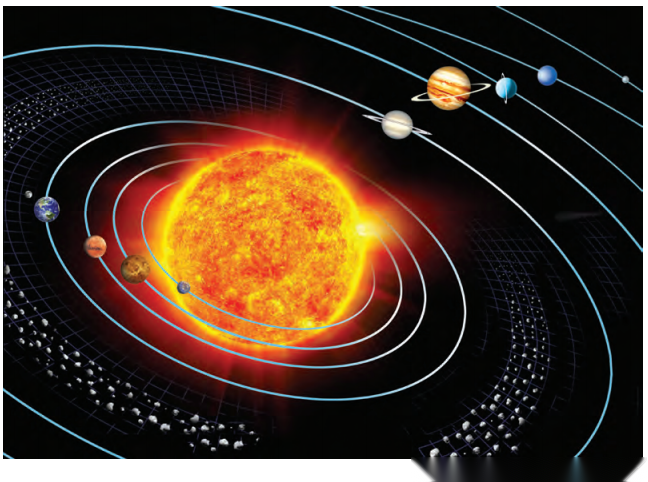
Question (b)
At what position is the earth from the Sun?
Answer:
Third
Question (c)
Which planet is placed between the earth and mercury?
Answer:
Venus
Question (d)
Name the planets beyond the orbit of Mars in serial order.
Answer:
Jupiter, Saturn, Uranus and Neptune.
Question (e)
Which planet in the Solar System is furthest from the sun?
Answer:
Neptune
4. Who am I?
Question (a)
You can see me from the earth but the lighted part of me that you see changes every day.
Answer:
The moon.
Question (b)
I have my own light. It is only from me that the planets get light and heat.
Answer:
The sun.
Question (c)
I turn around myself, around a planet and also around a star.
Answer:
Satellite.
Question (d)
I turn around myself and revolve around the Sun.
Answer:
Planet.
Question (e)
No other planet has a living world like mine.
Answer:
Earth.
Question (f)
I am the nearest star to the earth.
Answer:
The sun.
5.
Question (a)
For what purpose are rockets used in space travel?
Answer:
1. Very powerful rockets are used to send a spacecraft into space.
2. A tremendous quantity of fuel is burnt in rockets so that spacecraft weighing thousands of tons may be launched into space.
Question (b)
What information do man-made satellites provide?
Answer:
1. Man made satellites provide useful information on agriculture, environment, weather, forecasting, making maps and searching for water and mineral wealth on the earth.
2. It is also used for telecommunication.
Environmental Studies Part 1 Standard 5th Solutions Chapter 1 Our Earth and Our Solar System Additional Important Questions and Answers
Fill in the blanks with the correct answers from the options given below:
Question 1
Maharashtra Board Solution
The heavenly bodies that twinkle are called …………………….. (a) earth (b) moon (c) stars
Solution & Step-by-Step Answer:
(c) Stars
Question 2
Maharashtra Board Solution
Satellites and planets get their light from the ………………... (a) asteroids (b) pluto (c) sun
Solution & Step-by-Step Answer:
(c) sun
Question 3
Maharashtra Board Solution
The heavenly body closest to the earth is ……………….. (a) sun (b) moon (c) mercury
Solution & Step-by-Step Answer:
(b) moon
Question 4
Maharashtra Board Solution
…………………….. is an important Indian space mission on Mars. (a) Chandrayaan -1 (b) Mangalyaan (c) Marsyaan
Solution & Step-by-Step Answer:
(b) Mangalyaan
Question 5
Maharashtra Board Solution
Scientists who travel in the spacecraft are called ………………... (a) astronauts (b) researchers (c) engineers
Solution & Step-by-Step Answer:
(a) astronauts
Question 6
Maharashtra Board Solution
…………………. became the first Indian astonaut to go in space. (a) Kalpana Chaivla (b) Rakesh Sharma (c) Sunita Williams
Solution & Step-by-Step Answer:
(b) Rakesh Sharma
Question 7
Maharashtra Board Solution
………………….. have their own light. (a) Stars (b) Planets (c) Asteroids
Solution & Step-by-Step Answer:
(a) Stars
Question 8
Maharashtra Board Solution
The Sun is a ………………….. (a) planet (b) star (c) satellite
Solution & Step-by-Step Answer:
(b) star
Question 9
Maharashtra Board Solution
The heavenly bodies that do not twinkle are called ……………….. (a) planets (b) stars (c) rockets
Solution & Step-by-Step Answer:
(a) planets
Question 10
Maharashtra Board Solution
………………… do not have their own light. (a) stars (b) planets (c) bulbs
Solution & Step-by-Step Answer:
(b) planets
Question 11
Maharashtra Board Solution
Plants get their light from the ……………………. (a) rockets (b) asteroids (c) stars (d) sun
Solution & Step-by-Step Answer:
(c) stars
Question 12
Maharashtra Board Solution
Our earth is a …………………... (a) satellite (b) moon (c) planet
Solution & Step-by-Step Answer:
(c) planet
Question 13
Maharashtra Board Solution
The earth’s movement around the sun is called the ………………. of the earth. (a) revolution (b) rotation (c) motion
Solution & Step-by-Step Answer:
(a) revolution
Question 14
Maharashtra Board Solution
Besides earth, there are ……………. other planets which revolves around the sun. (a) two (b) one (c) seven
Solution & Step-by-Step Answer:
(c) seven
Question 15
Maharashtra Board Solution
The pathway along which the planets move around the sun is known as the planet’s (a) track (b) orbit (c) asteroid
Solution & Step-by-Step Answer:
(b) orbit
Question 16
Maharashtra Board Solution
The sun and the planets that revolve around it are together called the ………………. system. (a) satellite (b) solar (c) universal
Solution & Step-by-Step Answer:
(b) solar
Question 17
Maharashtra Board Solution
Some heavenly bodies that revolve around the planets are called ………………... (a) sun (b) moon (c) satellites
Solution & Step-by-Step Answer:
(c) satellites
Question 18
Maharashtra Board Solution
The ………………….. revolves around the earth. (a) sun (b) moon (c) planets
Solution & Step-by-Step Answer:
(b) moon
Question 19
Maharashtra Board Solution
The moon is the satellite of the …………………... (a) Mars (b) Saturn (c) Earth
Solution & Step-by-Step Answer:
(c) Earth
Question 20
Maharashtra Board Solution
The planets revolve around the …………….. along with its satellites. (a) earth (b) sun (c) solar system
Solution & Step-by-Step Answer:
(b) sun
Question 21
Maharashtra Board Solution
……………….. is a well-known dwarf planet. (a) Pluto (b) Jupiter (c) Saturn
Solution & Step-by-Step Answer:
(a) Pluto
Question 22
Maharashtra Board Solution
Asteroids also ………………. around the sun. (a) rotate (b) move (c) revolve
Solution & Step-by-Step Answer:
(c) revolve
Question 23
Maharashtra Board Solution
Due to the earth’s ………………….. all things on the earth remain on it. (a) gravity (b) rotation (c) revolution
Solution & Step-by-Step Answer:
(a) gravity
Question 24
Maharashtra Board Solution
Very powerful rockets are used to send a spacecraft into ……………….. (a) planets (b) asteroids (c) space
Solution & Step-by-Step Answer:
(c) space
Question 25
Maharashtra Board Solution
Our country is well-known for the development of its ……………… launch technology. (a) Space (b) Astronaut (c) Asteroids
Solution & Step-by-Step Answer:
(a) Space
Question 26
Maharashtra Board Solution
Scientists who travel in spacecraft are called (a) astronauts (b) asteroids (c) rockets
Solution & Step-by-Step Answer:
(a) astronauts
What is the full form of:
Question 1
Maharashtra Board Solution
M. O. M.
Solution & Step-by-Step Answer:
Mars Orbit Mission
Question 2
Maharashtra Board Solution
ISRO
Solution & Step-by-Step Answer:
Indian Space Research Organisation
Question 3
Maharashtra Board Solution
Match the following: |
‘A’ | ‘B’ |
(1) Rakesh Sharma went to space | (a) 2008 |
(2) Chandrayaan I launched | (b) 2014 |
(3) MOM launched in space | (c) 1984 |
(4) MOM established in an orbit | (d) 2013 |
‘A’ | ‘B’ | ||||||||
(1) Rakesh Sharma went to space | (c) 1984 | ||||||||
(2) Chandrayaan I launched | (a) 2008 | ||||||||
(3) MOM launched in space | (b) 2014 | ||||||||
(4) MOM established in an orbit | (d) 2013 Name the following:
Question 1
Maharashtra Board Solution
Two heavenly bodies.
Solution & Step-by-Step Answer:
The sun and the moon.
Question 2
Maharashtra Board Solution
Planets in the solar system.
Solution & Step-by-Step Answer:
Mercury Venus, Earth, Mars, Jupiter/Saturn, Uranus and Neptune.
Question 3
Maharashtra Board Solution
Heavenly bodies between Mars and Jupiter.
Solution & Step-by-Step Answer:
Asteroids.
Question 4
Maharashtra Board Solution
A dwarf planet.
Solution & Step-by-Step Answer:
Pluto.
Question 5
Maharashtra Board Solution
Technology that helps us to travel in space.
Solution & Step-by-Step Answer:
Rocket technology or space launch technology.
Answer the following in one sentence:
Question 1
Maharashtra Board Solution
What is the solar system?
Solution & Step-by-Step Answer:
The sun and their planets, their satellites, dwarf planets and asteroids that revolve around the sun are together called the solar system.
Question 2
Maharashtra Board Solution
What is known as planet’s orbit?
Solution & Step-by-Step Answer:
Every planet in the solar system revolves around the sun along a specific path which is known as planet’s orbit.
Question 3
Maharashtra Board Solution
What are satellites?
Solution & Step-by-Step Answer:
Some heavenly bodies which revolves around the planets are called satellites.
Question 4
Maharashtra Board Solution
What do you mean by the force of gravity?
Solution & Step-by-Step Answer:
All heavenly bodies exert a force of attraction or a pull on one another, this is called the force of gravity.
Question 5
Maharashtra Board Solution
What are heavenly bodies?
Solution & Step-by-Step Answer:
The sun, the moon, the stars, the planets, etc. are all heavenly bodies.
Question 6
Maharashtra Board Solution
What are stars?
Solution & Step-by-Step Answer:
Heavenly bodies that twinkle are called stars.
Question 7
Maharashtra Board Solution
Which star is closer than any other star?
Solution & Step-by-Step Answer:
The sun is the star that is closest to us.
Question 8
Maharashtra Board Solution
What are planets?
Solution & Step-by-Step Answer:
Heavenly bodies that do not twinkle are called planets.
Question 9
Maharashtra Board Solution
What are the two movements of a planet?
Solution & Step-by-Step Answer:
Planets revolve around a star, even as they rotate around themselves.
Question 10
Maharashtra Board Solution
What is the revolution of the earth?
Solution & Step-by-Step Answer:
The movement of the earth around the sun is called the revolution of the earth.
Question 11
Maharashtra Board Solution
How many planets are there in our solar system?
Solution & Step-by-Step Answer:
Our solar system has eight planets.
Question 12
Maharashtra Board Solution
Name the planets of our solar system.
Solution & Step-by-Step Answer:
The planets of our solar system are Mercury, Venus, Earth, Mars, Jupiter, Saturn, Uranus and Neptune.
Question 13
Maharashtra Board Solution
Which is the satellite of the Earth?
Solution & Step-by-Step Answer:
The moon is the satellite of the earth.
Question 14
Maharashtra Board Solution
What are dwarf planets?
Solution & Step-by-Step Answer:
Some smaller heavenly bodies that revolve around the sun are called dwarf planets.
Question 15
Maharashtra Board Solution
Which dwarf planet is well-known?
Solution & Step-by-Step Answer:
Pluto is a well known dwarf planet.
Question 16
Maharashtra Board Solution
What are Asteroids?
Solution & Step-by-Step Answer:
A band of numerous small heavenly bodies are called Asteroids.
Question 17
Maharashtra Board Solution
Where are the Asteroids situated?
Solution & Step-by-Step Answer:
The Asteroids are situated between the planets Mars and Jupiter.
Question 18
Maharashtra Board Solution
Why do all the things on the earth remain on it?
Solution & Step-by-Step Answer:
All things on earth remain on it, due to the earth’s gravity.
Question 19
Maharashtra Board Solution
How do we send some object to space?
Solution & Step-by-Step Answer:
To send some object from earth to space, it must be given power against the force of gravity.
Question 20
Maharashtra Board Solution
Which technology is used to send objects into space?
Solution & Step-by-Step Answer:
Rocket technology or space launch technology is used to send objects into space.
Question 21
Maharashtra Board Solution
What are used to send a spacecraft into space?
Solution & Step-by-Step Answer:
Very powerful rockets are used to send a spacecraft into space.
Question 22
Maharashtra Board Solution
What is our country well-known for?
Solution & Step-by-Step Answer:
Our country is well-known for the development of its space launch technology.
Question 23
Maharashtra Board Solution
Who are astronauts?
Solution & Step-by-Step Answer:
Some scientists who travel in spacecraft are known as astronauts.
Question 24
Maharashtra Board Solution
Who was the first Indian astronaut to go into space?
Solution & Step-by-Step Answer:
Rakesh Sharma was the first Indian astronaut to go into space in 1984.
Question 25
Maharashtra Board Solution
Name two astronauts of Indian origin.
Solution & Step-by-Step Answer:
Kalpana Chawla and Sunita Williams are two astronauts with Indian origin.
Give geographical reasons:
Question 1
Maharashtra Board Solution
During the day we cannot see other stars, besides the Sun.
Solution & Step-by-Step Answer:
1. The sun is a star. 2. It is closer to us than any other star. 3. It appears big and brilliant. 4. Therefore, due to its bright light during the day, we cannot see other stars.
Question 2
Maharashtra Board Solution
The moon is called a satellite of the earth.
Solution & Step-by-Step Answer:
1. We see the moon at night. 2. It revolves around the earth. 3. Therefore, it is called a satellite of the earth.
Question 3
Maharashtra Board Solution
Our Earth is an invaluable planet.
Solution & Step-by-Step Answer:
1. Space scientists have not yet been able to find a single other planet which has life on it. 2. Therefore, our planet is an invaluable planet.
Question 4
Maharashtra Board Solution
Though the sun is a star it does not twinkle.
Solution & Step-by-Step Answer:
1. The sun is a star and it is closer to us than any of the stars. 2. Hence, it appears big and brilliant and does not twinkle like the distant stars.
Question 5
Maharashtra Board Solution
The moon appears to be very big.
Solution & Step-by-Step Answer:
1. Compared to the sun, the other heavenly bodies in the solar system are much smaller. 2. As the moon is closest to the earth, it appears to be very big although it is actually very much smaller than the sun.
Question 6
Maharashtra Board Solution
Satellites revolve around their planets.
Solution & Step-by-Step Answer:
1. The sun exerts a gravitational pull on all planets whereas the tendency of the planets is to move away from the sun. 2. As a result of these two forces, a planet keeps revolving around the sun at fixed distance, in a fixed orbit. 3. In this way the satellites revolve around their planets.
Question 7
Maharashtra Board Solution
Even if we throw something upward with a great force, it finally falls to the ground.
Solution & Step-by-Step Answer:
1. All things on the earth remain on it due to the earth’s gravity. 2. So, even if we throw something upward with a great force, it finally falls back to the ground.
Answer briefly:
Question 1
Maharashtra Board Solution
What happens to the spacecrafts after the mission is over?
Solution & Step-by-Step Answer:
1. Some spacecraft remain in space. 2. Others are brought back to earth. 3. Some land on other planets or satellites after the mission is complete.
Question 2
Maharashtra Board Solution
Describe Rakesh Sharma’s mission to space.
Solution & Step-by-Step Answer:
1. Rakesh Sharma became the first Indian astronaut to go into space in 1984. 2. He spent eight days. 3. It was a joint mission of the ISRO and the Soviet Intercosmos. 4. Seeing India from space, he said it looked: ‘Saare jahan se achha’.
Question 3
Maharashtra Board Solution
How are spacecraft launched into space?
Solution & Step-by-Step Answer:
1. Very powerful rockets are used to send a spacecraft into space. 2. A tremendous quantity of fuel is burnt in these rockets so that the spacecraft weighing thousands of tons may be launched into space.
Question 4
Maharashtra Board Solution
What are the uses of man-made satellites?
Solution & Step-by-Step Answer:
1. Man-made satellites provide useful information for agriculture, environment, weather forecasting, map making and searching for water and mineral wealth on the earth. 2. They are also used for telecommunication.
Write short note on:
Question 1
Maharashtra Board Solution
Dwarf planets
Solution & Step-by-Step Answer:
1. Dwarf planets are smaller heavenly bodies that revolve around the sun. 2. The most well known is Pluto. 3. They revolve around the sun independently. 4. They have their own orbit.
Question 2
Maharashtra Board Solution
Asteriods
Solution & Step-by-Step Answer:
1. Small heavenly bodies between the planets Mars and Jupiter are called asteroids. 2. They move in a form of a band and are numerous. 3. They revolve around the sun.
Question 3
Maharashtra Board Solution
Distinguish between stars and planets:
Solution & Step-by-Step Answer:
Question 4
Maharashtra Board Solution
Give details of Mangalyaan on the basis of the following points: (a) Another name of Mangalyaan, (b) Date of launch, (c) Date of orbiting, (d) Attempts made to achieve success, (e) Type of mission, (f) Objective of the mission.
Solution & Step-by-Step Answer:
(a) Mass Orbit Mission (b) 5 November 2013 (c) 24 September 2014 (d) one (e) unmanned (f) Deeper study of the moon and mass.
Question 5
Maharashtra Board Solution
Through your observation: In which direction do leaves from a tree, rocks from a hillside or rain from the sky fall?
Solution & Step-by-Step Answer:
Due to earth’s gravity all things fall down to the ground.
Glossary: |