Latest Maharashtra State Board (SSC & HSC) 2026-27 Syllabus Digest & Solutions Updated!
Class 12 (HSC Board)Secretarial Practice (SP)2026-27 Syllabus

Chapter 3 Issue of Shares Solutions

Complete Maharashtra State Board Balbharati & Yuvakbharati textbook solutions for Chapter 3 Issue of Shares. Step-by-step solved exercises, numerical problems, and digest answers.

134 Solved Questions5 Diagrams6528 words

Maharashtra State Board Class 12 Secretarial Practice Solutions Chapter 3 Issue of Shares

1A. Select the correct answer from the options given below and rewrite the statements.

Question 1 Maharashtra Board Solution
___________ refers to capital made up of Equity and preference shares. (a) Share capital (b) Debt capital (c) Reserve fund
Solution & Step-by-Step Answer:
(a) Share capital
Question 2 Maharashtra Board Solution
___________ capital refers to maximum capital a company can raise by issuing shares. (a) Issued (b) Authorised (c) Paid up
Solution & Step-by-Step Answer:
(b) Authorised
Question 3 Maharashtra Board Solution
___________ means shares are offered to the public. (a) Rights Issue (b) Private Placement (c) Public Issue
Solution & Step-by-Step Answer:
(c) Public Issue
Question 4 Maharashtra Board Solution
Under ___________ method, issue price of shares is based on bidding. (a) Book Building (b) Fixed Price (c) Bonus Issue
Solution & Step-by-Step Answer:
(a) Book Building
Question 5 Maharashtra Board Solution
In ___________, shares of a company are offered to the public for the first time. (a) Further Public Offer (b) Initial Public Offer (c) Public Offer
Solution & Step-by-Step Answer:
(b) Initial Public Offer
Question 6 Maharashtra Board Solution
___________ is offered to existing equity shareholders. (a) IPO (b) ESOS (c) Rights Issue
Solution & Step-by-Step Answer:
(c) Rights Issue
Question 7 Maharashtra Board Solution
Bonus shares are issued free of cost to ___________ (a) existing Equity shareholders (b) existing employees (c) Directors
Solution & Step-by-Step Answer:
(a) existing Equity shareholders
Question 8 Maharashtra Board Solution
___________ are offered to permanent employees Directors and Officers of a company. (a) Bonus Shares (b) Rights Issue (c) ESOS
Solution & Step-by-Step Answer:
(c) ESOS
Question 9 Maharashtra Board Solution
Under ___________, a company offers its securities to a select group of persons not exceeding 200. (a) Private Placement (b) IPO (c) Public Offer
Solution & Step-by-Step Answer:
(a) Private Placement
Question 10 Maharashtra Board Solution
The ___________ have the power to allot shares. (a) Director (b) Board of Directors (c) Company Secretary
Solution & Step-by-Step Answer:
(b) Board of Directors
Question 11 Maharashtra Board Solution
Letter of ___________ is sent to applicants who have been given shares by the company. (a) Regret (b) Renunciation (c) Allotment
Solution & Step-by-Step Answer:
(c) Allotment
Question 12 Maharashtra Board Solution
___________ is a proof of title to Shares. (a) Share Certificate (b) Register of Member (c) Letter of Allotment
Solution & Step-by-Step Answer:
(a) Share Certificate
Question 13 Maharashtra Board Solution
The gap between two calls should not be less than ___________ (a) 14 days (b) One month (c) 21 days
Solution & Step-by-Step Answer:
(b) One month
Question 14 Maharashtra Board Solution
Company can ___________ shares on non-payment of calls. (a) forfeit (b) surrender (c) allot
Solution & Step-by-Step Answer:
(a) forfeit
Question 15 Maharashtra Board Solution
Voluntarily giving away one’s share to another person is called as ___________ of shares. (a) Transfer (b) Transmission (c) Surrender
Solution & Step-by-Step Answer:
(a) Transfer
Question 16 Maharashtra Board Solution
___________ of shares takes place due to operation of law. (a) Forfeiture (b) Allotment (c) Transmission
Solution & Step-by-Step Answer:
(c) Transmission

1B. Match the Pairs.

Question (I).

Answer:
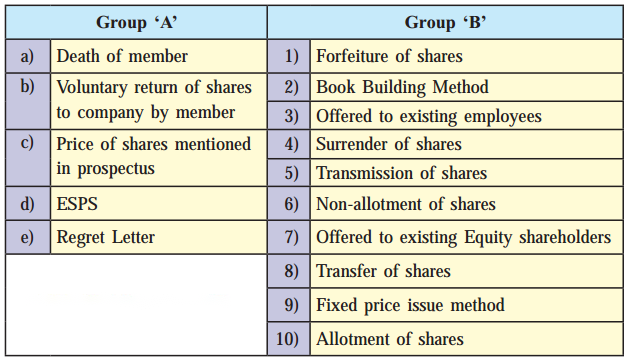
Group ‘A’

Group ‘B’

(a) Death of member

(5) Transmission of shares

(b) Voluntary return of shares to company by member

(4) Surrender of shares

(c) Price of shares mentioned in prospectus

(7) Offered to existing Equity Shareholders

(d) ESPS

(3) Offered to existing employees

(e) Regret Letter

(6) Non-allotment of shares

Question (II).

Answer:

Group ‘A’

Group ‘B’

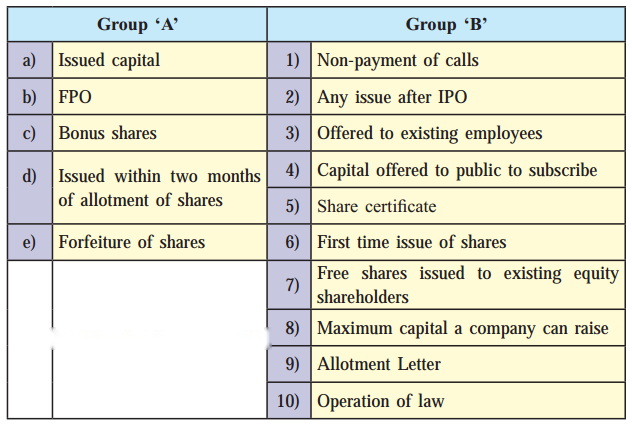
(a) Issued capital

(4) Capital offered to public to subscribe

(b) FPO

(8) Maximum capital a company can raise

(c) Bonus shares

(7) Free shares issued to existing equity shareholder

(d) Issued within two months of allotment of shares

(5) Share Certificate

(e) Forfeiture of shares

(1) Non-payment of calls

1C. Write a word or a term or a phrase which can substitute each of the following statements.

Question 1 Maharashtra Board Solution
Capital collected by way of issue of Equity and Preference shares.
Solution & Step-by-Step Answer:
Share Capital
Question 2 Maharashtra Board Solution
Part of issued capital subscribed by investors.
Solution & Step-by-Step Answer:
Subscribed capital
Question 3 Maharashtra Board Solution
Capital that will be collected only at the time of winding up of a company.
Solution & Step-by-Step Answer:
Reserve capital
Question 4 Maharashtra Board Solution
Highest bid price in Book Building method.
Solution & Step-by-Step Answer:
Cap price
Question 5 Maharashtra Board Solution
Offering of shares by a company to the public for the first time.
Solution & Step-by-Step Answer:
IPO
Question 6 Maharashtra Board Solution
Subsequent issue of shares after an IPO.
Solution & Step-by-Step Answer:
FPO
Question 7 Maharashtra Board Solution
Pre-emptive right given to existing Equity shareholders to subscribe to new issue of shares by company.
Solution & Step-by-Step Answer:
Rights issue/shares
Question 8 Maharashtra Board Solution
It is also called as ‘Capitalization of Profits’.
Solution & Step-by-Step Answer:
Bonus shares
Question 9 Maharashtra Board Solution
Appropriation of shares to an applicant.
Solution & Step-by-Step Answer:
Allotment of shares
Question 10 Maharashtra Board Solution
Committee set up to decide the formula for allotment of shares in case of over-subscription.
Solution & Step-by-Step Answer:
Allotment committee
Question 11 Maharashtra Board Solution
Minimum amount to be collected from subscribers within thirty days of issue of prospectus.
Solution & Step-by-Step Answer:
Minimum subscription
Question 12 Maharashtra Board Solution
Document which is a prima facie evidence of ownership of certain shares of a company.
Solution & Step-by-Step Answer:
Share certificate
Question 13 Maharashtra Board Solution
Penal action taken by company on non-payment of calls.
Solution & Step-by-Step Answer:
Forfeiture of shares
Question 14 Maharashtra Board Solution
Person to whom transferor is transferring the shares.
Solution & Step-by-Step Answer:
Transferee
Question 15 Maharashtra Board Solution
Transfer of shares due to operation of law.
Solution & Step-by-Step Answer:
Transmission of shares

1D. State whether the following statements are true or false.

Question 1 Maharashtra Board Solution
Only fully paid-up shares can be forfeited.
Solution & Step-by-Step Answer:
False
Question 2 Maharashtra Board Solution
The member transferring shares is called a transferor.
Solution & Step-by-Step Answer:
True
Question 3 Maharashtra Board Solution
A share certificate is issued for partly or fully paid up shares.
Solution & Step-by-Step Answer:
True
Question 4 Maharashtra Board Solution
Allotment of shares must be done within one month of receipt of application money.
Solution & Step-by-Step Answer:
False
Question 5 Maharashtra Board Solution
Sweat Equity shares are offered to Directors or employees of a company.
Solution & Step-by-Step Answer:
True
Question 6 Maharashtra Board Solution
Bonus Shares are issued at a discounted price to the Equity Shareholder.
Solution & Step-by-Step Answer:
False
Question 7 Maharashtra Board Solution
The floor price is the highest bid price under the Book Building method.
Solution & Step-by-Step Answer:
False
Question 8 Maharashtra Board Solution
Calls not paid by shareholders are called calls in arrears.
Solution & Step-by-Step Answer:
True
Question 9 Maharashtra Board Solution
Shares not offered to the public for subscription are called subscribed capital.
Solution & Step-by-Step Answer:
False
Question 10 Maharashtra Board Solution
Authorized capital is mentioned in the capital clause of the Memorandum of Association.
Solution & Step-by-Step Answer:
True

1E. Find the odd one.

Question 1 Maharashtra Board Solution
Authorized capital, Equity share capital, Issued capital, Paid-up Capital.
Solution & Step-by-Step Answer:
Equity share capital
Question 2 Maharashtra Board Solution
ESOS, ESPS, Rights Shares, Sweat Equity.
Solution & Step-by-Step Answer:
Rights Shares
Question 3 Maharashtra Board Solution
Floor Price, Cap Price, Cut-off price, Face Value.
Solution & Step-by-Step Answer:
Face Value
Question 4 Maharashtra Board Solution
Bonus Shares, Rights Shares, ESOS.
Solution & Step-by-Step Answer:
ESOS
Question 5 Maharashtra Board Solution
Allotment of Shares, Forfeiture of shares, Surrender of shares.
Solution & Step-by-Step Answer:
Allotment of shares

1F. Complete the sentences.

Question 1 Maharashtra Board Solution
Share Capital refers to capital made up of Equity shares and ___________
Solution & Step-by-Step Answer:
Preference Share
Question 2 Maharashtra Board Solution
Reserve capital is part of ___________
Solution & Step-by-Step Answer:
Uncalled Capital
Question 3 Maharashtra Board Solution
Transfer of shares due to death, insolvency, or insanity of the member is called ___________
Solution & Step-by-Step Answer:
Transmission Shares
Question 4 Maharashtra Board Solution
The two parties involved in transfer of shares are transferor and ___________
Solution & Step-by-Step Answer:
transferee
Question 5 Maharashtra Board Solution
Voluntarily giving up of shares by a member due to inability to pay calls is called as ___________
Solution & Step-by-Step Answer:
surrender of shares
Question 6 Maharashtra Board Solution
Company can forfeit only ___________ paid shares.
Solution & Step-by-Step Answer:
partly
Question 7 Maharashtra Board Solution
In case the original Share Certificate is torn or mutilated, company can issue ___________
Solution & Step-by-Step Answer:
Duplicate Share Certificate
Question 8 Maharashtra Board Solution
In case of transfer of shares, the company has to issue to the transferee a new share certificate within ___________
Solution & Step-by-Step Answer:
one month
Question 9 Maharashtra Board Solution
Letter sent to applicants for informing them shares are allotted is called as ___________
Solution & Step-by-Step Answer:
Letter of Allotment
Question 10 Maharashtra Board Solution
When applications received is more than the number of shares offered, it is called as ___________
Solution & Step-by-Step Answer:
Over Subscription
Question 11 Maharashtra Board Solution
In Book Building Method, the final price at which shares are offered to investors is called as ___________
Solution & Step-by-Step Answer:
Cut-off price
Question 12 Maharashtra Board Solution
Shares issued free of cost to existing Equity shareholders is called as ___________
Solution & Step-by-Step Answer:
Bonus Shares

1G. Select the correct option from the bracket.
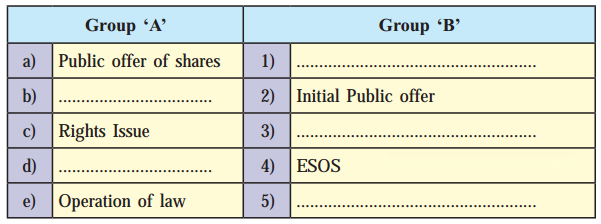
Question 1 Maharashtra Board Solution
(The first-time offer of shares, Shares offered to the public, Shares offered to exist, Equity shareholders, Shares offered to exist, employees, Transmission of shares)
Solution & Step-by-Step Answer:

Group ‘A’

Group ‘B’

(a) Public offer of shares

(1) Shares offered to Public

(b) First time offer of shares

(2) Initial public offer

(c) Rights Issue

(3) Shares offered to existing equity share holders

(d) Shares offered to existing employees

(4) ESOS

(e) Operation of law

(5) Transmission of Shares

1H. Answer in one sentence.

Question 1 Maharashtra Board Solution
When does the transmission of shares take place?
Solution & Step-by-Step Answer:
Transmission of Shares takes place on death, insolvency, or insanity of the members.
Question 2 Maharashtra Board Solution
Name the two parties involved in the transfer of shares.
Solution & Step-by-Step Answer:
The transferor and Transferee are the two parties involved in the transfer of shares.
Question 3 Maharashtra Board Solution
What is the time limit to issue a share certificate on allotment of shares?
Solution & Step-by-Step Answer:
Secretary should issue share certificate within two months of allotment of shares.
Question 4 Maharashtra Board Solution
What is the time limit for Filing a Return of Allotment with the Registrar on the allotment of shares?
Solution & Step-by-Step Answer:
Secretary has to file a ‘Return of Allotment’ with the Registrar of Companies within 30 days of allotment of shares.
Question 5 Maharashtra Board Solution
When can a company forfeit shares?
Solution & Step-by-Step Answer:
If a shareholder fails to pay calls on shares within a certain period company can forfeit shares.
Question 6 Maharashtra Board Solution
What is a share certificate?
Solution & Step-by-Step Answer:
Share Certificate is a registered document issued by a company that is evidence of ownership of a specified number of shares of the company.
Question 7 Maharashtra Board Solution
What is the minimum application money to be collected by Company as per the Companies Act?
Solution & Step-by-Step Answer:
As per the companies act, the company should collect a minimum of 25% of the nominal value of shares.
Question 8 Maharashtra Board Solution
To whom should the prospectus be filed before issuing it to the public?
Solution & Step-by-Step Answer:
The prospectus should be filed with the Registrar of Companies before issuing it to the public.
Question 9 Maharashtra Board Solution
What is meant by private placement?
Solution & Step-by-Step Answer:
When a company offers its securities to a select group of persons not exceeding 200, it is called Private Placement.
Question 10 Maharashtra Board Solution
To whom is Sweat Equity shares offered by a company?
Solution & Step-by-Step Answer:
Sweat equity shares are issued to directors or employees of the company.
Question 11 Maharashtra Board Solution
To whom can a company issue Bonus Shares?
Solution & Step-by-Step Answer:
The company can issue Bonus Shares to its existing equity shares.
Question 12 Maharashtra Board Solution
What is the subsequent issue after IPO called as?
Solution & Step-by-Step Answer:
The subsequent issue after IPO is called FPO.
Question 13 Maharashtra Board Solution
Name the method under which the issue price of shares is fixed through a bidding process.
Solution & Step-by-Step Answer:
Under the Book Building method, the issue price of shares is fixed through a bidding process.
Question 14 Maharashtra Board Solution
What is Public Issue?
Solution & Step-by-Step Answer:
Public issue or offer means offering the shares to the public. The company invites the public to subscribe to its shares by issuing a prospectus.
Question 15 Maharashtra Board Solution
Name the capital which is mentioned in the capital clause of the Memorandum of Association.
Solution & Step-by-Step Answer:
Authorized Capital is mentioned in the capital clause of the Memorandum of Association.

1I. Correct the underlined words/and rewrite the following sentences.

Question 1 Maharashtra Board Solution
Issued capital is the maximum capital that a company can raise by issuing shares.
Solution & Step-by-Step Answer:
Authorized capital is the maximum capital that a company can raise by issuing shares.
Question 2 Maharashtra Board Solution
Under the Fixed-Price issue method, the price of shares is fixed through a bidding process.
Solution & Step-by-Step Answer:
Under Book Building Method the price of shares is fixed through a bidding process.
Question 3 Maharashtra Board Solution
FPO refers to offering shares to the public for the first time.
Solution & Step-by-Step Answer:
IPO refers to the offering of shares to the public for the first time.
Question 4 Maharashtra Board Solution
Only Fully paid up shares can be forfeited.
Solution & Step-by-Step Answer:
Only Partly paid-up shares can be forfeited.
Question 5 Maharashtra Board Solution
Bonus shares are offered to existing employees of a company.
Solution & Step-by-Step Answer:
Bonus shares are offered to existing shareholders of a company.
Question 6 Maharashtra Board Solution
The company enters into an underwriting agreement with the shareholders.
Solution & Step-by-Step Answer:
The company enters into an underwriting agreement with the underwriters.
Question 7 Maharashtra Board Solution
Letter of Allotment is sent to applicants when no shares are allotted to them.
Solution & Step-by-Step Answer:
Letter of Regret is sent to applicants when no shares are allotted to them.
Question 7 Maharashtra Board Solution
IPO refers to the offering of shares to the public for the second time.
Solution & Step-by-Step Answer:
FPO refers to offering shares to the public for the second time.
Question 8 Maharashtra Board Solution
A duplicate share certificate must be issued within one month from the date of application.
Solution & Step-by-Step Answer:
A duplicate share certificate must be issued within three months from the date of application.
Question 9 Maharashtra Board Solution
Call money can not exceed 5% of the nominal value of shares.
Solution & Step-by-Step Answer:
Call money can not exceed 25% of the nominal value of shares.

1J. Arrange in proper order.

Question 1 Maharashtra Board Solution
(a) Forfeiture of shares (b) Calls on shares (c) Allotment of shares
Solution & Step-by-Step Answer:
(a) Allotment of shares (b) Calls on shares (c) forfeiture of shares
Question 2 Maharashtra Board Solution
(a) Share certificate (b) Allotment letter (c) Application from
Solution & Step-by-Step Answer:
(a) Application form (b) Allotment letter (c) share certificate
Question 3 Maharashtra Board Solution
(a) Return of allotment (b) Application form (c) Minimum Subscription
Solution & Step-by-Step Answer:
(a) Minimum subscription (b) Application form (c) Return of allocation

2. Explain the following terms/concepts.

Question 1 Maharashtra Board Solution
Transmission of shares.
Solution & Step-by-Step Answer:
Question 2 Maharashtra Board Solution
Bonus shares
Solution & Step-by-Step Answer:
Question 3 Maharashtra Board Solution
Allotment of Shares
Solution & Step-by-Step Answer:
Question 4 Maharashtra Board Solution
Employees Stock Option Scheme
Solution & Step-by-Step Answer:
An employee stock option plan is an employee benefits scheme under which the company encourages its employees to acquire ownership in the form of shares. Under this scheme, permanent employees, Directors or Officers of the Company or its holding company or subsidiary company are offered the benefit or right to purchase the equity shares of the company at a future date at a predetermined price.
Question 5 Maharashtra Board Solution
Surrender of Shares
Solution & Step-by-Step Answer:
Question 6 Maharashtra Board Solution
Sweat equity shares
Solution & Step-by-Step Answer:
These are shares issued by a company to its directors or employees at a discount or for consideration other than cash. It is one of the modes of making share-based payments to employees. It is issued in recognition of their valuable contribution to the prosperity of the company.
Question 7 Maharashtra Board Solution
Share Certificate
Solution & Step-by-Step Answer:
A Share certificate refers to documents that are issued by a company evidencing that a person named in such certificate is the owner of the shares of the company stated in the share certificate. Share certificate has to be issued under the common seal of the company. It should be issued within 2 months from the date of allotment against the allotment letter.
Question 8 Maharashtra Board Solution
Authorized Capital
Solution & Step-by-Step Answer:
Question 9 Maharashtra Board Solution
Forfeiture of shares
Solution & Step-by-Step Answer:
If a shareholder, who is called upon to pay any call fails to pay the amount, even after sending many reminders the company may forfeit its shares. Thus forfeiture of shares means cancellation of shares.
Question 10 Maharashtra Board Solution
Paid-up capital
Solution & Step-by-Step Answer:
Question 11 Maharashtra Board Solution
Calls on Shares
Solution & Step-by-Step Answer:
Question 12 Maharashtra Board Solution
Subscribed Capital.
Solution & Step-by-Step Answer:
Question 13 Maharashtra Board Solution
Minimum Subscription
Solution & Step-by-Step Answer:
Minimum subscription means a minimum amount decided by the ROC which should be build-up by the company by issuing securities to the general public. If the company failed in minimum subscription then it has to return the entire amount back to the applicants.
Question 14 Maharashtra Board Solution
Transfer of shares
Solution & Step-by-Step Answer:
Question 15 Maharashtra Board Solution
Initial Public Offer (IPO)
Solution & Step-by-Step Answer:
The initial public offering is the sale of equity shares to the public first time in order to raise capital. This is the most popular and common method used by companies. The company invites the public to subscribe to its shares by issuing prospects.
Question 16 Maharashtra Board Solution
Blank Transfer
Solution & Step-by-Step Answer:
Question 17 Maharashtra Board Solution
Further Public Offer (FPO)
Solution & Step-by-Step Answer:
It is also called a follow-on public offer. When the company issue shares to the public after IPO, it is called a further public offer. Thus every issue of shares by a listed company after its IPO is called an FPO. FPO leads to an increase in the subscribed capital of the company.
Question 18 Maharashtra Board Solution
Forged Transfer
Solution & Step-by-Step Answer:
Question 19 Maharashtra Board Solution
Rights issue
Solution & Step-by-Step Answer:
A rights issue is an invitation to existing shareholders to purchase additional new shares in the company. A rights issue is a way by which a listed company can raise additional capital.
Question 20 Maharashtra Board Solution
Private Placement
Solution & Step-by-Step Answer:
When a company offers its securities to a selected group of persons not exceeding 200, it is called private placement. Here securities are not offered to the general public.

5. Study the following cases and express your opinion.

1. Eva Ltd. Company’s capital structure is made up of 1,00,000 equity shares having a face value of ₹ 10/- each. The company has offered to the public 40,000 equity shares and out of this, the public has subscribed for 30,000 equity shares. State the following in rupees-

Question (a).
Authorized capital
Answer:
The authorized capital is ₹ 10,00,000 (1,00,000 equity shares × ₹ 10/- each)

Question (b).
Subscribed capital
Ans. The subscribed capital is ₹ 3,00,000 (30,000 equity shares × ₹ 10/- each)

Question (c).
Issued capital
Answer:
The issued capital is ₹ 4,00,000 (40,000 equity shares × ₹ 10/- each)

2. TRI. Ltd company is a newly incorporated public company and wants to raise share capital by issuing equity shares in the market. The board of directors is considering various options for this. Advise the board on the following matters:

Question (a).
What should the company offer – IPO or FPO?
Answer:
The Company should offer IPO.

Question (b).
Can the company offer Bonus shares to raise its capital?
Answer:
The company cannot offer Bonus Shares. Bonus Shares are given out of only accumulated capital or reserves only.

Question (c).
Can the company enter into an underwriting Agreement?
Answer:
Yes. The company can enter into an Underwriting Agreement. The underwriters assure the company to take up the unsold shares so that company can be able to raise the minimum subscription.

3. Silver ltd. The company has recently come out with its public offer through FPO. Their issue was over-subscribed. The board of directors now wants to start the allotment process.

Question (a).
Should the company set up an allotment committee?
Answer:
Yes. The company should set up an allotment committee as the issue is over-subscribed so the Board has to set up an allotment committee.

Question (b).
How should the company information to whom the company is allotting shares?
Answer:
The company should inform the applicants through a letter of allotment for allotting shares.

Question (c).
Within what period should the company issue a share certificate?
Answer:
The company should issue share certificates within two months from the date of allotment.

4. Red Tubes Ltd. has made a demand on its shareholders to pay the balance unpaid amount of ₹ 20/- per share (having a face value of ₹ 100) held by them. The company has sent letters asking the shareholders to pay the money to its Bankers within the specified time.

Question (a).
Are the shareholders liable to pay ₹ 20/- for the shares held by them?
Answer:
Yes. The shareholders are liable to pay ₹ 20 for the shares held by them. When a company demands the shareholder to pay a part or full amount of the balance amount unpaid on shares it is called ‘calls on shares’.

Question (b).
Name the letter sent by the company to its shareholders asking them to pay ₹ 20/-
Answer:
The company will send a ‘Call Letter’ to its shareholders for asking them to pay ₹ 20.

Question (c).
What happens if the shareholders fail to pay the money within a specific time?
Answer:
If a shareholder fails to pay call money within the specified time, the company can forfeit the shares.

5. X owns 100 shares and Y owns 500 shares of RED tubes. The company has asked all its shareholders to pay the balance unpaid amount of rupees 20. X pays full money demanded by the company and Y failed to pay the money due to poor financial condition.

Question (a).
Can the company forfeit the shares of Y?
Answer:
Yes. The company can forfeit the shares of ‘Y’ as he failed to pay calls on shares within a certain period.

Question (b).
Can the company forfeit the shares of X?
Answer:
The company cannot forfeit the shares of ‘X’ as he paid the full amount of shares. Only partly paid-up shares can be forfeited.

Question (c).
Can X transfer his shares?
Answer:
Yes. X can transfer his shares by filling Instrument of transfer.

4. Distinguish between the following.

Question 1 Maharashtra Board Solution
Initial Public Offer and Further Public Offer
Solution & Step-by-Step Answer:

Points

Initial Public offer

Further Public offer

1. Meaning

IPO refers to an offer of Securities by an unlisted public company to the public for the first time.

FPO means an offer of securities by a listed public company to the public to raise subsequent capital.

2. Raising Money

Raising Money for the first time from the public.

Before FPO Company has already raised money through an IPO.

3. When Issued

It is usually issued by an existing company that wants to raise capital from the public for the first time.

It is usually issued by a listed public company when it wants to raise further capital from the public.

4. Order of Issue

IPO precedes FPO. IPO is the first time sale of shares to the public.

FPO is always done after IPO. FPO is the second or subsequent sale of shares to the public.

5. Listing

The company has to get itself listed for the first time before issuing IPO.

A company making an FPO is already a listed company.

6. Risk

It is very risky for the investor as he cannot predict the company’s performance.

It is less risky for the investor as he has an idea of the company’s past performance and can judge its future performance.

Question 2 Maharashtra Board Solution
Fixed Price Issue Method and Book Building Method
Solution & Step-by-Step Answer:

Points

Fixed Price Issue Method

Book Building Method

1. Meaning

Under this method, the issue price of shares is mentioned in the prospectus and investors have to buy shares at that price only.

Under this method, the issue price is determined by a bidding process.

2. Price of Shares

The exact price of shares is known in advance and it is mentioned in the prospectus.

The price of shares is not known in advance only the minimum price and maximum price at which the company is willing to sell the shares is known in advance.

3. Prospectus

The company has to issue a prospectus and it contains the details of the price at which shares are offered and the total number of shares offered by the company.

The company issues a Red Herring Prospectus. It contains only the price band and the total size of the issue.

4. Determination of Demand

The company comes to know the public demand for its shares only after the closure of the issue.

The company comes to know the public demand for its shares every day. The bids are registered in the book.everyday till the closure of the issue.

5. Payment of Application Money

Application money or entire money has to be paid by the investor at the time of submitting the application for shares.

Only application money has to be paid at the time of bidding. Money will be collected only after the issue price has been fixed.

6. When Used

It can be used for any issue i.e., Public issues, Rights Issues, FSOS, etc.

It is usually used in public issues i.e., IPO and FPO

Question 3 Maharashtra Board Solution
Right shares and Bonus shares
Solution & Step-by-Step Answer:

Points

Rights Shares

Bonus Shares

1. Meaning

In the rights issues, shares are offered to the existing equity shareholders.

Bonus shares are issued to the existing equity shareholders free of cost.

2. Payment

Subscribers have to pay for the Right Shares.

Bonus Shares are issued free of cost to the shareholders.

3. Partly/Fully paid-up shares

Shareholders have to pay for these shares as Application Money, Allotment, Call money, etc.

Bonus Shares are fully paid up shares so no money has to be paid by shareholders to the company.

4. Minimum Subscription

The company has to obtain a minimum subscription for Rights shares.

There is no minimum Subscription to be collected for Bonus shares.

5. Right to Renounce

The shareholders can renounce their shares.

Shareholders cannot renounce their bonus share.

6. Purpose of Issue

The main purpose to issue rights shares is to raise fresh funds and along with it to give a chance to their existing members to increase their shareholding.

The main purpose of issuing bonus shares, is to give rewards to its existing equity shareholders out of its accumulated huge profits or Reserves.

Question 4 Maharashtra Board Solution
Transfer of shares and Transmission of shares
Solution & Step-by-Step Answer:

Points

Transfer of shares

Transmission of shares

1. Meaning

Transfer of shares means the transfer of ownership of shares from one person to another by entering into a contract.

It means the transfer of ownership of a member’s shares to his legal representative due to the operation of law. It takes place on the death of insolvency or insanity of the members.

2. When Done

It is done when the member wants to sell his shares or give his shares as a gift.

It is done when the member dies or becomes insolvent or suffering from insanity.

3. Nature of Action

It is a voluntary action taken by the member.

It is an involuntary action. It is performed by operation of law.

4. Parties Involved

In the transfer of shares, there are two parties involved – the member who is called as transferor and the buyer who is called as transferee.

There is only one party e.g., the nominee of the members in case of death of the member or the legal representative.

5. Instrument of transfer

Transfer requires an Instrument of transfer.

No instrument of transfer is needed.

6. Initiated by

The transferor initiates the transfer process.

Legal representative or official receiver initiates the process of transmission.

7. Consideration

Transfer of shares is done often by the member to receiving some consideration e.g., money.

In the transmission of shares, no consideration is involved.

8. Liability

The liability of the transferor ends after the shares are transferred.

Original liability of the member continues in case of transmission of shares.

9. Stamp duty

Stamp duty as per the market value of shares has to be paid.

No stamp duty is to be paid.

5. Answer in brief.

Question 1 Maharashtra Board Solution
What is Book Building Method?
Solution & Step-by-Step Answer:
Question 2 Maharashtra Board Solution
State the provisions for the Rights issue.
Solution & Step-by-Step Answer:
Question 3 Maharashtra Board Solution
State the provisions related to Bonus Shares.
Solution & Step-by-Step Answer:

Following are the provisions related to Bonus Issue-

Question 4 Maharashtra Board Solution
State the general principles/rules for allotment of shares.
Solution & Step-by-Step Answer:
Every company issuing shares has to follow rules or general principles given by the Companies Act 2013 as follows:
Question 5 Maharashtra Board Solution
State the contents of the Share Certificate.
Solution & Step-by-Step Answer:
A Share certificate refers to a document which is issued by a company evidencing that a person named in such certificate is the owner of the shares of the company stated in the share certificate. Share certificate has to be issued under the common seal of the company. It should be issued within 2 months from the date of allotment against the allotment letter.

Contents of Share Certificate:
Share Certificate should be in Form SH – 1 as prescribed under Companies (Share Capital and Debenture) Rules 2014.

Question 6 Maharashtra Board Solution
What are the effects of forfeiture of shares?
Solution & Step-by-Step Answer:
If a shareholder, who is called upon to pay any call fails to pay the amount, even after sending many reminders the company may forfeit his shares. Thus forfeiture of shares means cancellation of shares.

Effects of Forfeiture

Question 7 Maharashtra Board Solution
When can the Board of Directors refuse the transfer of shares?
Solution & Step-by-Step Answer:
Question 8 Maharashtra Board Solution
Explain Employee Stock Option Scheme.
Solution & Step-by-Step Answer:
An employee stock option plan is an employee benefits scheme under which the company encourages its employees to acquire ownership in the form of shares. Under this scheme, permanent employees, Directors or Officers of the Company or its holding company or subsidiary company are offered the benefit or right to purchase the equity shares of the company at a future date at a predetermined price. Generally these shares are issued at discount. The shares are offered at a price lesser than their market price.

Following are the provisions related to ESOS:

Question 9 Maharashtra Board Solution
What are Calls on shares?
Solution & Step-by-Step Answer:
Question 10 Maharashtra Board Solution
Explain private placement method for the issue of shares.
Solution & Step-by-Step Answer:

6. Justify the following statements.

Question 1 Maharashtra Board Solution
Company has to fulfill certain provisions while making Right Issue.
Solution & Step-by-Step Answer:
Question 2 Maharashtra Board Solution
To issue Bonus shares a company has to fulfil certain provisions.
Solution & Step-by-Step Answer:

Following are the provisions related to Bonus Issue-

Question 3 Maharashtra Board Solution
ESOS is offered by a company to its permanent employees, Directors, and officers.
Solution & Step-by-Step Answer:
Question 4 Maharashtra Board Solution
The company has to fulfill general principles/rules for allotment of shares.
Solution & Step-by-Step Answer:
Every company issuing shares has to follow rules or general principles given by the Companies Act, 2013 as follows:
Question 5 Maharashtra Board Solution
A Company can issue a duplicate share certificate.
Solution & Step-by-Step Answer:
A Company can issue a duplicate share certificate in the following circumstances:
Question 6 Maharashtra Board Solution
Board of directors has the authority to forfeit shares.
Solution & Step-by-Step Answer:
Question 7 Maharashtra Board Solution
A member of a public company can transfer shares.
Solution & Step-by-Step Answer:
Question 8 Maharashtra Board Solution
The Board of Directors can refuse the transfer of shares.
Solution & Step-by-Step Answer:

7. Answer the following questions.

Question 1 Maharashtra Board Solution
Explain the classification of Share Capital. OR Explain types of Share Capital.
Solution & Step-by-Step Answer:
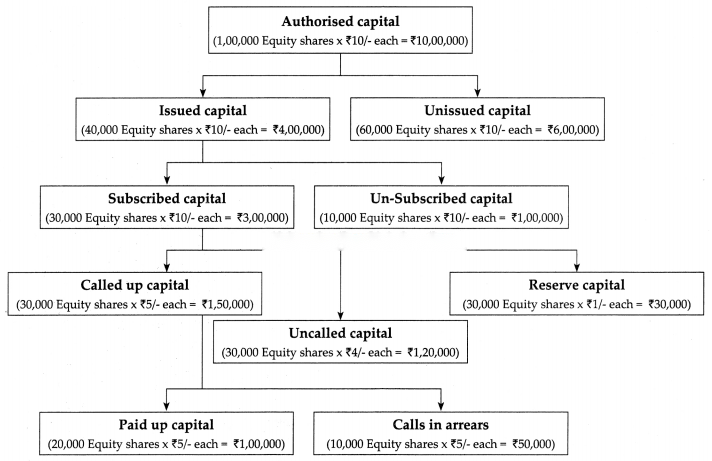
Share capital is the capital that is built up by the company by issuing shares in the market. Share capital consist of capital that is made up of Equity shares and Preference shares. Share capital can be classified as-

(i) Authorised or Nominal or Registered Capital

(ii) Issued and Unissued capital:

(iii) Subscribed and Unsubscribed Capital:

(iv) Called up and Uncalled capital and Reserve capital:

Example of call up, uncalled and Reserve Capital.
If XYZ Ltd company is to subscribed capital is ₹ 3,00,000 i.e., 30,000 equity shares of face value of ₹ 10/- each. Out of which company made first call of ₹ 5/- per share, so company called up capital will be ₹ 1,50,000 (30,000 Equity shares × ₹ 5/- each = ₹ 1,50,000)

If the company decides to keep ₹ 1/- per share as capital to be collected at the time of the winding-up, the Reserve Capital will be 30,000 (30,000 equity shares of ₹ 10 each.)
Uncalled Capital will be ₹ 1,20,000 (30,000 equity shares were 4 per share which will be called up in the future.)

(v) Paid-up capital and calls in Arrears:

Example of paid up capital and calls in Arrears.
‘XYZ’ Ltd Company has made a call of ₹ 5/- per share on 30,000 equity shares, so if all the shareholder have paid the calls, then paid-up capital will be ₹ 1,50,000 (30,000 equity shares of ₹ 5/- per share). But if 10,000 Equity Shareholders have not paid calls then the paid-up capital will be ₹ 1,00,000 (20,000 Equity Shares × ₹ 5/- per share) and calls in Arrears will be ₹ 50,000 (10,000 Equity Shares × ₹ 5/- per share).

Question 2 Maharashtra Board Solution
What are the methods of issue of shares to the public through public offer?
Solution & Step-by-Step Answer:
Issue of shares is the process in which companies offer new shares to shareholders. The company follows different methods prescribed by the Companies Act 2013 while issuing the shares. There are two methods of issue of shares to the public through public offer, they are – Public issue or Public offer of shares.

A public offering is the sale of equity shares to the public in order to raise capital. This is the most popular and common method used by companies. The company invites the public to subscribe to its shares by issuing prospects. A company can use two pricing methods to offer shares to the public.

(i) Fixed Price Issue method:

(ii) Book Building Method:

Further public offer:
It is also called a follow on public offer. When the company issue shares to the public after IPO, it is called a a further public offer. Thus every issue of shares by a listed company after its IPO is called as FPO. FPO leads to an increase in the subscribed capital of the company.
Question 3 Maharashtra Board Solution
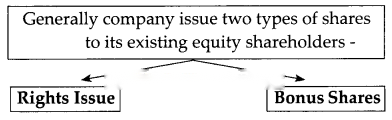
Explain briefly the different types of shares offered by a company to its existing equity shareholders.
Solution & Step-by-Step Answer:
The company issues equity shares in the market. The equity shareholders are the real owner of the company. A company can raise funds by offering shares to its existing equity shareholders as follows.

(i) Right Issue:
A right issue is an invitation to existing shareholders to purchase additional new shares in the company. A right issue is a way by which a listed company can raise additional capital. Instead of going for the public issue of shares, the company gives its existing shareholders, the right to subscribe to newly issued shares in proportion to their existing equity shareholding.

Whenever a company makes the further issue of shares the existing equity shareholders have preemptive rights means the first option to buy shares.

Company making rights issue has to fulfil the following provision:

(ii) Bonus Issue/Bonus Shares:
Bonus Shares are shares distributed by a company to its current shareholders as fully paid shares free of charge. The Bonus shares are given to the existing equity shareholders according to their existing proportion of equity shareholdings.

Like for example, a company declaring one for two bonus share proportion means that an existing shareholder would get one bonus share of the company for every two shares held. Financially sound companies issue Bonus shares out of their accumulated distributable profits or reserves. Hence as the profits or reserves are capitalized, it is called “Capitalisation of Profits or Reserves.”

Following are the provisions related to Bonus Issue-

Question 4 Maharashtra Board Solution
Explain the statutory provisions for the allotment of shares.
Solution & Step-by-Step Answer:

(i) Registration of Prospectus:

(ii) Application Money:

(iii) Minimum Subscription:

(iv) Closing of Subscription list:

(v) Basic of allotment:

(vi) Over Subscription:

(vii) Permission to deal on Stock Exchanges:

(viii) Appointment of Managers to the issue and various other agencies.

Question 5 Maharashtra Board Solution
Explain briefly the procedure for allotment of shares.
Solution & Step-by-Step Answer:
Allotment of Shares:

Procedure for Allotment of Shares
(i) Appointment of Allotment Committee

(ii) Hold Board Meeting to Decide Basis of Allotment

(iii) Pass Board Resolution for allotment:

(iv) Collection of Allotment Money:

(v) Arrangement Relating to Letters of Renunciation:

(vi) Arrangement Relating to Splitting of Allotment letters:

(vii) File Return of Allotment:

(viii) Prepare Register of Members and Issue of Share Certificate