Maharashtra State Board Class 12 Political Science Solutions Chapter 5 Contemporary India: Good Governance
1. (A) Complete the following statements by selecting the appropriate option.
(B) State the appropriate concept for the given statements.
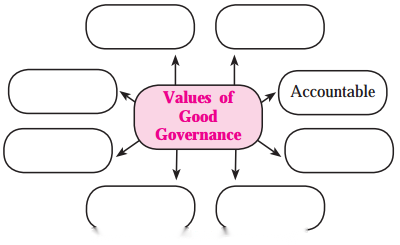
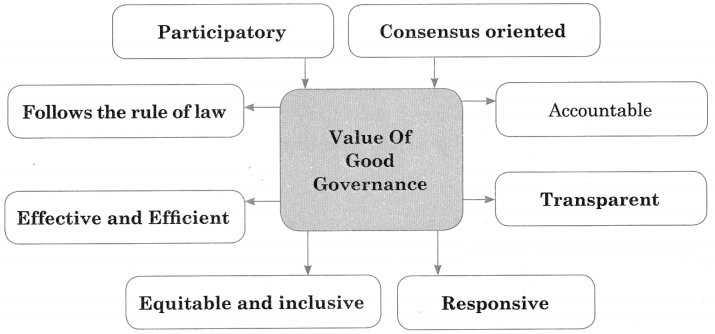
2. (A) Complete the concept map.
(B) State whether the following statements are true or false with reason.
3. Explain the correlation between the following.
E-Governance is one of the most important aspects of good governance. It involves the employment of Information and Communications Technology (I.C.T) to facilitate efficient and instant transmission and processing of information as well as storing and retrieval of data. Thus, e-governance helps to implement core values of good governance such as transparency, effectiveness, accountability and participation of citizens.
4. Express your opinion of the following.
E-governance helps in increasing the geographical and demographical reach of the government. Efforts have been made at various levels to improve the delivery of public services and simplify the process of accessing them. The objective of National e-Governance Plan is to bring public services closer to the people i.e., make them citizen centric.
5. Answer the following question in 80 to 100 words.
The benefits of good governance must be available to all the sections of the society. The constitution provides for socio-economic and political safeguards to certain disadvantaged sections of the society. Besides the safeguards, provided for them the government has created several commissions to safeguard the rights of different sections of the society. These include the following:
1. National Commission for Scheduled Castes – Deals with matters related to the safeguards provided in the constitution for the Scheduled Castes and inquire into specific complaints relating to deprivation of rights of the Schedule Castes.
2. National Commission for Scheduled Tribes – Deals with matters related to the safeguards provided in the constitution for the Scheduled Tribes and inquire into specific complaints relating to deprivation of rights of the Schedule Tribes.
3. National Human Rights Commission – It deals with protection of rights relating to life, liberty, equality and dignity guaranteed by the constitution.
4. National Commission for Women – This was created to facilitate the redressal of grievances and accelerate socio-economic development of women.
5. National Commission for the Protection of Child Rights – It seeks to protect, promote and defend child rights in the country. The Commission defines a child as a person in the 0 to 18 years of age group.
6. National Commission for Backward Classes – The focus is welfare of socially and economically backward classes.
7. National Commission for Minorities – It monitors the working of the safeguards for minorities provided in the Constitution and by laws enacted by the Parliament and the State Legislatures. The National Commission for Minorities recognises the following religious communities as minority communities: Muslim, Sikh, Christian, Buddhist, Parsis and Jain.
8. National Consumer Disputes Redressal Commission – This provides for a consumer disputes redressal mechanism e.g.,consumer courts are set up.
6. Answer the following question with reference to the given points.
The Good Governance approach aims at the following-
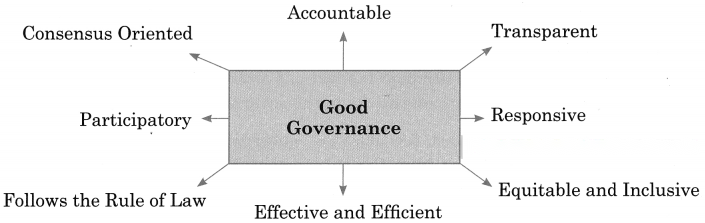
a. Participation – The effective functioning of any democratic system requires that people get an opportunity to participate in the process of decision making and its implementation.
b. Transparency – This value of good governance enables people to keep the government under scrutiny for e.g., Right to Information Act (2005) provides citizens access to information about public policies and actions.
c. Responsiveness – The government must be prompt and sensitive while designing policies to serve all stake holders within a reasonable time frame.
d. Accountability – This cannot be enforced without the rule of law and transparency. Any organization is accountable to those who will be affected by it’s decisions and actions, i.e. to stakeholders. Governmental institutions, private sector and civil society institutions must be accountable.
Activity
2. State Commission for Women was constituted on 25th January 1993. It consists of a chair person, 6 nonofficial members, a member secretary and a DGP as ex-officio member. It aims to investigate into practices derogatory to women and suggest remedial measures. It also advises the government on matters related to upliftment to the status of women.
3. State Commission for Scheduled Castes and Scheduled Tribes was established by the Social Justice and Special Assistance Department dated 1st March 2005. It’s role is to study existing socio-economic, political and educational situation of Scheduled Castes and Tribes and to suggest measures to improve the same. It also investigates grievances raised by members of Scheduled Castes and Schedules Tribes.
4. State Human Rights Commission (MSHRC) was established on 6th March 2001 to protect, promote and enforce human rights. It can inquire suo motu (of its own accord) or on petition presented to it, into complaints of violation of human rights.
5. State Commission for Protection of Child’s Rights was set up in July 2007 to protect and defend child rights in the State.
6. State Commission for Minorities – was set up to safeguard the interests of religious and linguistic minorities.
After the India Against Corruption Movement led by Anna Hazare, the Lokpal and Lokayuktas Bill, 2013 was passed in Parliament and came into force on 16th January 2014. The Lokpal is a multimember body, consisting of a chairperson and a maximum of 8 members. The Lokpal and Lokayuktas inquire into allegations of corruption / maladministration against public functionaries.
Class 12 Political Science Chapter 5 Contemporary India: Good Governance Intext Questions and Answers
ACTIVITY (Text Book Page No. 48)
2. For child welfare
3. For educational purposes
4. For women’s welfare
5. For the disabled/ill/aged
To ensure consumer rights, Consumer Disputes Redressal System included a three-tier level i.e.,
The redressal agencies (consumer courts) set up were. Central Consumer Protection Council and State Consumer Councils. Consumer courts are special purpose courts dealing with cases involving consumer disputes, conflicts and grievances.