Maharashtra State Board 12th Physics Solutions Chapter 3 Kinetic Theory of Gases and Radiation
1. Choose the correct option.
i) In an ideal gas, the molecules possess
(A) only kinetic energy
(B) both kinetic energy and potential energy
(C) only potential energy
(D) neither kinetic energy nor potential energy
Answer:
(A) only kinetic energy
ii) The mean free path λ of molecules is given by
(A)
(B)
(C)
(D)
where n is the number of molecules per unit volume and d is the diameter of the molecules.
Answer:
(C)
iii) If pressure of an ideal gas is decreased by 10% isothermally, then its volume will
(A) decrease by 9%
(B) increase by 9%
(C) decrease by 10%
(D) increase by 11.11%
Answer:
(D) increase by 11.11% [Use the formula P1V1= P2V2. It gives = = 1.111 ∴ = 0.1111, i.e., 11.11%
iv) If a = 0.72 and r = 0.24, then the value of tris
(A) 0.02
(B) 0.04
(C) 0.4
(D) 0.2
Answer:
(B) 0.04
v) The ratio of emissive power of a perfect blackbody at 1327°C and 527°C is
(A) 4 : 1
(B) 16 : 1
(C) 2 : 1
(D) 8 : 1
Answer:
(B) 16 : 1
2. Answer in brief.
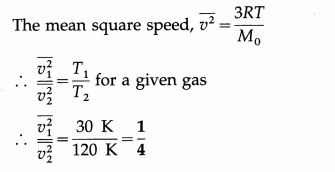
i) What will happen to the mean square speed of the molecules of a gas if the temperature of the gas increases?
Answer:
If the temperature of a gas increases, the mean square speed of the molecules of the gas will increase in the same proportion.
[Note: = ∴ ∝ T for a fixed mass of gas.]
ii) On what factors do the degrees of freedom depend?
Answer:
The degrees of freedom depend upon
(i) the number of atoms forming a molecule
(ii) the structure of the molecule
(iii) the temperature of the gas.
iii) Write ideal gas equation for a mass of 7 g of nitrogen gas.
Answer:
In the usual notation, PV = nRT.
Therefore, the corresponding ideal gas equation is
PV = RT.

iv) What is an ideal gas ? Does an ideal gas exist in practice ?.
Answer:
An ideal or perfect gas is a gas which obeys the gas laws (Boyle’s law, Charles’ law and Gay-Lussac’s law) at all pressures and temperatures. An ideal gas cannot be liquefied by application of pressure or lowering the temperature.
A molecule of an ideal gas is an ideal particle having only mass and velocity. Its structure and size are ignored. Also, intermolecular forces are zero except during collisions
v) Define athermanous substances and diathermanous substances.
Answer:
The energy of the molecules of a gas, in thermal equilibrium at a thermodynamic temperature T and containing large number of molecules, is equally divided among their available degrees of freedom, with the energy per molecule for each degree of freedom equal to kBT, where kBis the Boltzmann constant.
(a) Monatomic gas : For a monatomic gas, each atom has only three degrees of freedom as there can be only translational motion. Hence, the average energy per atom is kBT. The total internal energy per mole of the gas is E = NAkBT, where NAis the Avogadro
number.
Therefore, the molar specific heat of the gas at constant volume is
CV= = NAkB= R,
where R is the universal gas constant.
Now, by Mayer’s relation, Cp— Cv= R, where Cpis the specific heat of the gas at constant pressure.
∴ CP= CV+ R = R + R = R
(b) Diatomic gas : Treating the molecules of a diatomic gas as rigid rotators, each molecule has three translational degrees of freedom and two rotational degrees of freedom. Hence, the average energy per molecule is
3(kBT) + 2(kBT) = kBT
The total internal energy per mole of the gas is
E = NAkBT.
∴ CV= = NAkB= R and
CP= CV+ R = R + R = R
A soft or non-rigid diatomic molecule has, in addition, one frequency of vibration which contributes two quadratic terms to the energy.
Hence, the energy per molecule of a soft diatomic molecule is
Therefore, the energy per mole of a soft diatomic molecule is
E = kBT × NA= RT
In this case, CV= = R and
CP= CV+ R = R + R = R
[Note : For a monatomic gas, adiabatic constant,
γ = = . For a diatomic gas, γ = or .]

Fery designed a spherical blackbody which consists of a hollow double-walled, metallic sphere provided with a tiny hole or aperture on one side, in below figure. The inside wall of the sphere is blackened with lampblack while the outside is silver-plated. The space between the two walls is evacuated to minimize heat loss by conduction and convection.
Any radiation entering the sphere through the aperture suffers multiple reflections where about 97% of it is absorbed at each incidence by the coating of lampblack. The radiation is almost completely absorbed after a number of internal reflections. A conical projection on the inside wall opposite the hole minimizes probability of incident radiation escaping out.
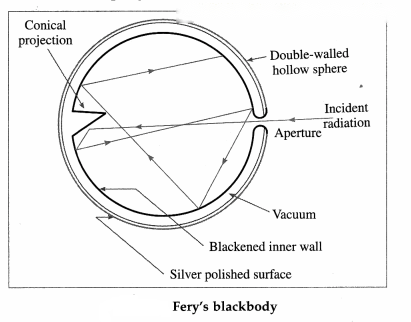
When the sphere is placed in a bath of suitable fused salts, so as to maintain it at the desired temperature, the hole serves as a source of black-body radiation. The intensity and the nature of the radiation depend only on the temperature of the walls.
A blackbody, by definition, has coefficient of absorption equal to 1. Hence, its coefficient of reflection and coefficient of transmission are both zero.
The radiation from a blackbody, called blackbody radiation, covers the entire range of the electromagnetic spectrum. Hence, a blackbody is called a full radiator.
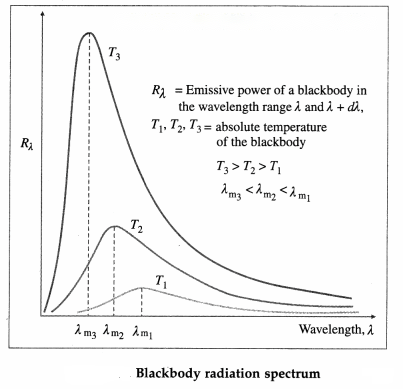
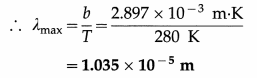
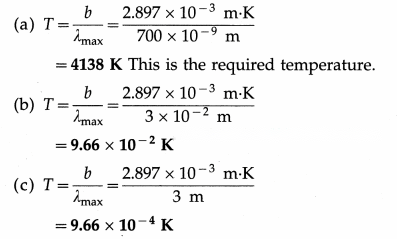
(ii) Wien’s displacement law : The wavelength for which the emissive power of a blackbody is maximum, is inversely proportional to the absolute temperature of the blackbody.
OR
For a blackbody at an absolute temperature T, the product of T and the wavelength λmcorresponding to the maximum radiation of energy is a constant.
λmT = b, a constant.
[Notes: (1) The law stated above was stated by Wilhelm Wien (1864-1928) German Physicist. (2) The value of the constant b in Wien’s displacement law is 2.898 × 10⁻³m.K.]
If Rλis the emissive power of a blackbody in the wavelength range λ and λ + dλ, the energy it emits per unit area per unit time in this wavelength range depends on its absolute temperature T, the wavelength λ and the size of the interval dλ.
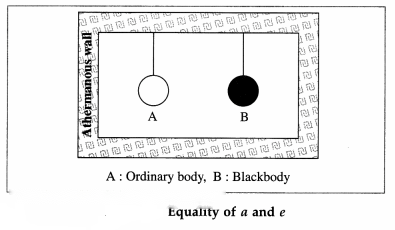
Theoretical proof: Consider the following thought experiment: An ordinary body A and a perfect black body B are enclosed in an athermanous enclosure as shown in below figure.
According to Prevost’s theory of heat exchanges, there will be a continuous exchange of radiant energy between each body and its surroundings. Hence, the two bodies, after some time, will attain the same temperature as that of the enclosure.
Let a and e be the coefficients of absorption and emission respectively, of body A. Let R and Rbbe the emissive powers of bodies A and B, respectively. ;
Suppose that Q is the quantity of radiant energy incident on each body per unit time per unit surface area of the body.
Body A will absorb the quantity aQ per unit time per unit surface area and radiate the quantity R per unit time per unit surface area. Since there is no change in its temperature, we must have,
aQ = R … (1)
As body B is a perfect blackbody, it will absorb the quantity Q per unit time per unit surface area and radiate the quantity Rbper unit time per unit surface area.
Since there is no change in its temperature, we must have,
Q = Rb….. (2)
From Eqs. (1) and (2), we get,
a = = ….. (3)
From Eq. (3), we get, = RbOR
By definition of coefficient of emission,
…(4)
From Eqs. (3) and (4), we get, a = e.
Hence, the proof of Kirchhoff ‘s law of radiation.
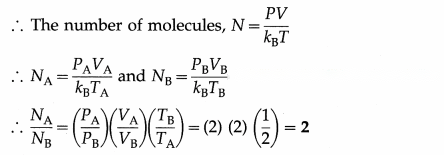
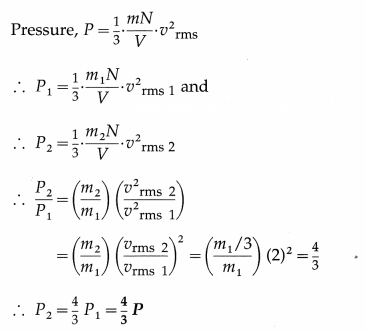
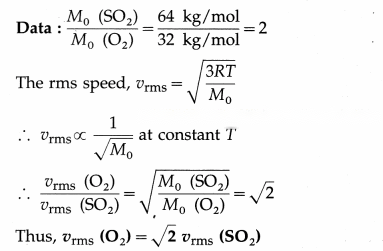
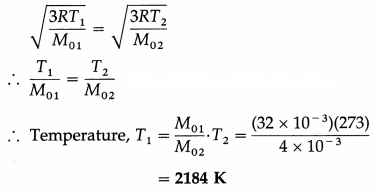
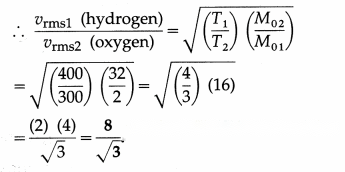
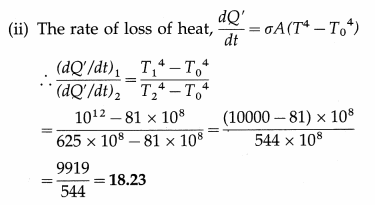
(i) The average molecular kinetic energy per kmol of oxygen = the average kinetic energy per mol of oxygen × 1000
= RT × 1000 = (8.31) (400) (103)
= (600)(8.31)(103) = 4.986 × 10⁶J/kmol
(ii) The average molecular kinetic energy per kg of
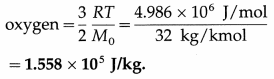
(iii) The average molecular kinetic energy per molecule of oxygen

12th Physics Digest Chapter 3Kinetic Theory of Gases and RadiationIntext Questions and Answers
Remember This (Textbook Page No. 60)
The root-mean-square speed vrmsgives us a general idea of molecular speeds in a gas at a given temperature. However, not all molecules have the same speed. At any instant, some molecules move slowly and some very rapidly. In classical physics, molecular speeds may be considered to cover the range from 0 to ∞. The molecules constantly collide with each other and with the walls of the container and their speeds change on collisions. Also the number of molecules under consideration is very large statistically. Hence, there is an equilibrium distribution of speeds.
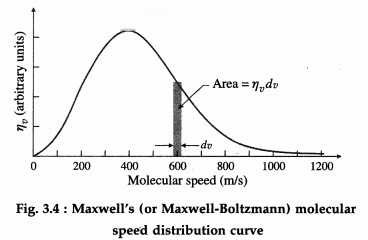
If dNvrepresents the number of molecules with speeds between v and v + dv, dNvremains fairly constant at equilibrium. We consider a gas of total N molecules. Let r\vdv be the probability that a molecule has its speed between v and v + dv. Then, dNv= Nηvdv
so that the fraction, i.e., the relative number of molecules with speeds between v and v + dv is dNv/N = ηvdv
Below figure shows the graph of ηvagainst v. The area of the strip with height ηvand width dv gives the fraction dNv/N.
Remember This (Textbook Page No. 64)
Remember This (Textbook Page No. 66)
Use your brain power (Textbook Page No. 68)
Can you tell? (Textbook Page No. 71)