Maharashtra State Board 12th Physics Solutions Chapter 14 Dual Nature of Radiation and Matter
1. Choose the correct answer.
i) A photocell is used to automatically switch on the street lights in the evening when the sunlight is low in intensity. Thus it has to work with visible light. The material of the cathode of the photocell is
(A) zinc
(B) aluminum
(C) nickel
(D) potassium
Answer:
(D) potassium
ii) Polychromatic (containing many different frequencies) radiation is used in an experiment on the photoelectric effect. The stopping potential
(A) will depend on the average wavelength
(B) will depend on the longest wavelength
(C) will depend on the shortest wavelength
(D) does not depend on the wavelength
Answer:
(C) will depend on the shortest wavelength
iii) An electron, a proton, an α-particle and a hydrogen atom are moving with the same kinetic energy. The associated de Broglie wavelength will be longest for
(A) electron
(B) proton
(C) α-particle
(D) hydrogen atom
Answer:
(A) electron
iv) If NRedand NBlueare the number of photons emitted by the respective sources of equal power and equal dimensions in unit time, then
(A) NRed< NBlue
(B) NRed= NBlue
(C) NRed> NBlue
(D) NRed≈ NBlue
Answer:
(C) NRed> NBlue
v) The equation E = pc is valid
(A) for all sub-atomic particles
(B) is valid for an electron but not for a photon
(C) is valid for a photon but not for an electron
(D) is valid for both an electron and a photon
Answer:
(C) is valid for a photon but not for an electron
2. Answer in brief.
i) What is photoelectric effect?
Answer:
The phenomenon of emission of electrons from a metal surface when electromagnetic radiation of appropriate frequency is incident on it is known as photoelectric effect.
ii) Can microwaves be used in the experiment on photoelectric effect?
Answer:
No
iii) Is it always possible to see photoelectric effect with red light?
Answer:
No
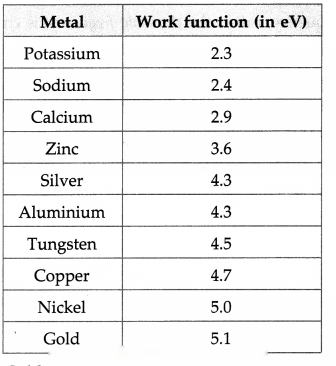
iv) Using the values of work function given in Table 14.1, tell which metal will require the highest frequency of incident radiation to generate photocurrent.
Answer:
Gold.
[ Note : W0= hv0, where h is Planck’s constant. The larger the work function (W0), the higher is the threshold frequency (v0). ]
v) What do you understand by the term wave-particle duality? Where does it apply?
Answer:
Depending upon experimental conditions or structure of matter, electromagnetic radiation and material particles exhibit wave nature or particle nature. This is known as wave-particle duality.
It applies to all phenomena. The wave nature and particle nature are liked by the de Broglie relation λ = h/p, where λ is the wavelength of matter waves, also called de Broglie waves / Schrodinger waves, p is the magnitude of the momentum of a particle or quantum of radiation and h is the universal constant called Planck’s constant.
[Note : It is the smallness of h (= 6.63 × 10⁻³⁴J∙s) that is very significant in wave-particle duality.]
If an electron is at rest, its momentum would be zero, and hence the corresponding de Broglie wavelength would be infinite indicating absence of a matter wave. However, according to quantum mechanics/wave mechanics, this is not possible.
[Note : The aim of the experiment was not to verify wave like properties of electrons. The realisation came only later, an example of serendipity.]
[Note : Like X-rays, electrons exhibit wave nature under suitable conditions. When the wavelength of matter waves associated with moving electrons is comparable to the inter-atomic spacing in a crystal, electrons show diffraction effects. In 1927, Sir George Thomson (1892 – 1975), British physicist, with his student Alex Reid, observed electron diffraction with a metal foil. It is found that neutrons, atoms, molecules, Œ-particles, etc. show wave nature under suitable conditions.]
(b) Maximum kinetic energy of electrons ejected
= hc
=(6.63 × 10⁻³⁴)(3 × 10⁸)J
= (6.63 × 10⁻¹⁹)(0.5555 – 0.3623)
= (6.63)(0.1932 × 10⁻¹⁹)J = 1.281 × 10⁻¹⁹J
= = 0.8006 eV
(c) Maximum kinetic energy of electrons ejected
= hv –
=(6.63 × 10⁻³⁴(4 × 10¹⁵) –
= 26.52 × 10⁻¹⁹– 7.207 × 10-19
= 19.313 × 10⁻¹⁹J
= = 12.07eV
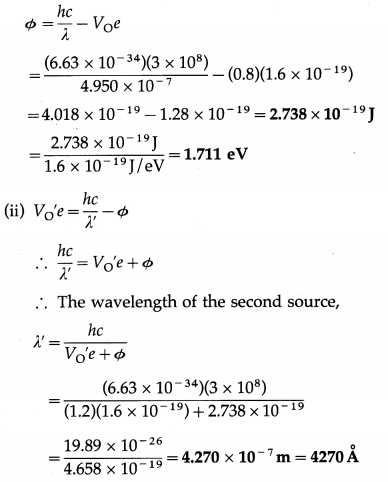
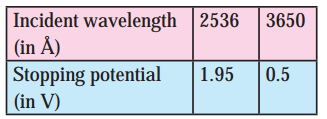
(i) V0e = – Φ and V0‘e = – Φ
∴ (V0– V0‘)e = hc
∴ (1.95 – 0.5(1.6 × 10⁻¹⁹)
= h (3 × 10⁸
∴ 2.32 × 10-19= h(3 × 10¹⁵)(0.3943 – 0.2740)
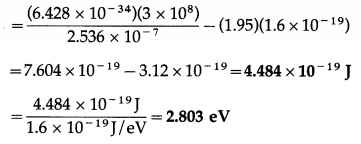
∴ h = = 6.428 × 10⁻³⁴J∙s
This is the value of Planck’s constant.
(ii) Φ = – V0e
This is the work function of the cathode material.
(iii) Φ = hv0
∴ The threshold frequency, v0=
= = 6.976 × 10¹⁴Hz
(iv) v0= ∴ The threshold frequency, λ0=
= = 4.300 × 10⁻⁷m = 4300 Å
(v) The most likely metal used for emitter : calcium
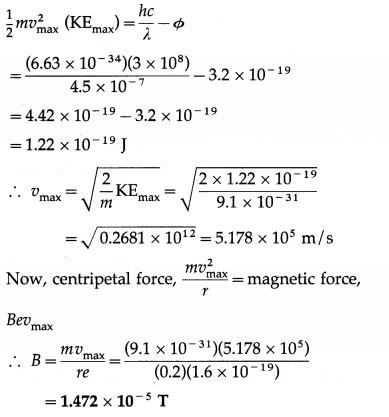
(b) when it is moving with kinetic energy of 150 eV.
Answer:
As KE ∝ , we get
= 1.666
∴ v’ = 1.666v = (1.666)(4.356 × 10⁶)
= 7.262 × 10⁶m/s
This is the speed of the electron.
p’ = mv’’=(9.1 × 10⁻³¹)(7.262 × 10⁶)
= 6.608 × 10⁻²⁴kg∙m/s
This is the momentum of the electron. The
wavelength associated with the electron,
λ = = 1.003 × 10⁻¹⁰m
= 1.003 Å = 0.1003 nm
(ii) Assuming v «c,
KE = mv2=
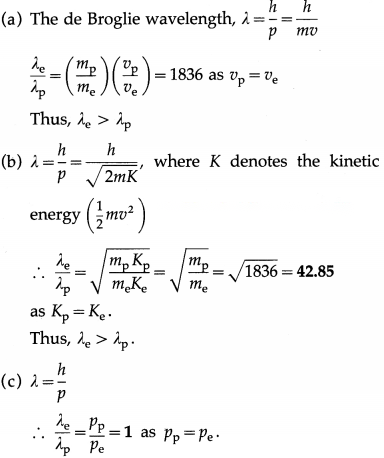
∴ = 1836 as p is the same for the electron and the proton.
12th Physics DigestChapter 14 Dual Nature of Radiation and Matter Intext Questions and Answers
Remember This (Textbook Page No. 316)
Remember This (Textbook Page No. 317)
Remember This (Textbook Page No. 319)
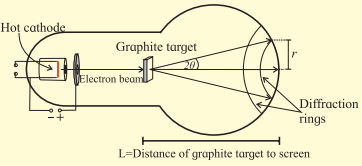
Diffraction results described above can be produced in the laboratory using an electron diffraction tube as shown in figure. It has a filament which on heating produces electrons. This filament acts as a cathode. Electrons are accelerated to quite high speeds by creating large potential difference between the cathode and a positive electrode. On its way, the beam of electrons comes across a thin sheet of
graphite. The electrons are diffracted by the atomic layers in the graphite and form diffraction rings on the phosphor screen. By changing the voltage between the cathode and anode, the energy, and therefore the speed, of the electrons can be changed. This will change the wavelength of the electrons and a change will be seen in the diffraction pattern. By increasing the voltage, the radius of the diffraction rings will decrease. Try to explain why?
Answer:
When the accelerating voltage is increased, the kinetic energy and hence the momentum of the electron increases. This decreases the de Brogue wavelength of the electron. Hence, the radius of the diffraction ring decreases.
Remember This (Textbook Page No. 320)