Maharashtra State Board 12th Organisation of Commerce and Management Solutions Chapter 1 Principles of Management
1. (A) Select the correct option and rewrite the sentence
1. (B) Match the pairs
Group A | Group B |
A) Henry Fayol | 1) Eight Foremen |
B) Principle of Unity of Direction | 2) F.W. Taylor |
C) Principles of Management | 3) Proper division of all activities |
D) Scientific Management Theory | 4) general guidelines |
E) Functional Organization | 5) A place for everything and everything in its place |
6) One head-one plan | |
7) Low wage rate | |
8) Harmony between the employees and management | |
9) German engineer | |
10) Modern Management |
Answer:
Group A | Group B |
A) Henry Fayol | 1) Modern Management |
B) Principle of Unity of Direction | 2) One head-one plan |
C) Principles of Management | 3) general guidelines |
D) Scientific Management Theory | 4) F.W. Taylor |
E) Functional Organization | 5) Eight Foremen |
1. (C) Give one word/phrase/term for the following statements:
1. (D) State whether the following statements are True or False
1. (E) Find the odd one.
1. (F) Answer in one sentence
1. (G) Correct the underlined word and rewrite the following sentences.
2. Explain the following terms/concepts
(2) This study is useful to manager to eliminate the unnecessary movements or their sequence for doing the job. It also helps the manager to combine some actions or movements in the process. It increases efficiency and productivity of the employees and helps in reducing the wastage of time, raw material and improving the usefulness of resources.
(2) In differential piece wage rate plan, the. standard is determined for production by the management. The workers who produce more them the standard are to be paid more in the form of incentives and those who produce less than the standard are to be paid less by way of penalty. This technique encourages those who perform well and motivates those who have performed less than the standard required to improve their performance.
(3) Taylor suggested the differential piece wage system and further stated that the discrimination should be made between the efficient and inefficient workers. This technique explains that, efficient workers should be paid more remuneration in comparison to inefficient workers.
(4) Thus, the differential piece-rate wage plan technique motivates the able employees to attain higher performance and earn wages at higher rate.
(2) Under this technique of scientific management, every part of the entire work is considered in detail and the time required to complete each element of job or task is ascertained. On the basis of the time study, the manager determines the standard time required to complete a particular job. This also facilitates the manager to decide the remuneration to be paid and efficiency of the worker and to control the cost of work.
3. Study the following case/situation and express your opinion.
4. Answer in brief
(2) Principle of Authority and Responsibility:
Authority implies right or freedom to take decisions. The manager should be given authority to get the work done systematically from the subordinates. Authority should always go with corresponding responsibility, e.g. if manager is given authority to complete a specific task within a given time, he would be held responsible for the same. Manager should have adequate authority to take managerial decisions on his own to achieve the goal.
(3) Principle of Discipline: Fayol insists that discipline is essential for smooth working of an organisation. It helps to achieve the goals set in the organisation. In relation to organisation, discipline means strictly obeying instructions of the superiors. There should be clear and utmost understanding between management and employees in respect to organisation’s rules. It is necessary to observe basic discipline at all levels of management.
(4) Principle of Unity of Command: According to this principle, every employee should receive orders and instructions from one boss only and he should be accountable to him only. If he receives orders from more them one boss at a time, he will not understand whose orders should be executed first. To avoid this, organisational hierarchy should be well defined and each employee in the organisation should know his immediate boss. He should receive orders and instructions from him only and should report to him only.
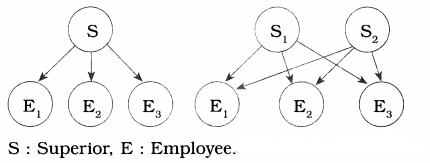
(5) Principle of Unity of Direction: Fayol advocates “One head for One plan”. It means that a group of employees working on similar activities should have common objectives and must work under one head (senior). All the objectives of the different groups should be in line with the objectives of the organisation. If this principle is followed there will be an effective co-ordination of the individual efforts and energies.
(6) Principle of Subordination of Individual Interest to Organisational Interest: According to this principle, the interest of the organisation must always be given greater importance than the interest of an employee or a group of employees. While taking decision, the manager should always consider the interest of whole group rather than the interest of an individual employee. Similarly, employees should surrender their personal goals or interests before that of an organisation e.g. while playing a game a team players should always play to win the game and not for his individual records.
(ii) Method Study : In order to get best quality with cost effectiveness, it is important and challenging for a manager to identify the best method from various available methods to complete the specific job. This method is useful to reduce the wastage of time, raw material and to improve usefulness of the resources to achieve defined objectives. It is also useful to determine the methods to handle the raw materials, storage, inspection and transportation.
(iii) Motion Study : Motion study refers to the close study of the movements of employees as well as machines in completing a particular task. This technique is useful to manager to eliminate the unnecessary movements and to find out the best method of completing a specific task. It improves efficiency and productivity of the employees. This method is also useful to understand and decide about the elimination of some elements of a job or changing their sequence for smooth flow of work.
(iv) Fatigue Study : The term ‘fatigue’ implies physical or mental exhaustion. Long working hours with insufficient breaks, heavy working tools, target pressure and poor working conditions lead to fatigue. It reduces efficiency of the employees and creates adverse effect on their health. To reduce fatigue it is very important to keep and maintain the operational efficiency of the workers.
(2) Standardisation of Tools and Equipment:
On the basis of experiments conducted at work place, Taylor insisted to provide standard tools and equipment, standard working environment and standard methods of production. It helps to reduce spoilage and wastage of materials, cost of production, fatigue among the employees on the one hand and improves quality of work on the other hand.
(3) Scientific Task Setting : Taylor laid stress on the need for fixing a fair day’s work. The technique of scientific task setting is useful to restrain the employees from performing the task much below their capacity. As a result, they will complete their task according to the standards given and management will be able to keep proper control on the optimum use of available workforce.
(4) Scientific Selection and Training: By using scientific selection procedures, management easily select right persons for the right jobs. According to this technique, job specifications required to be fixed and employees are selected as per predetermined standards in an impartial way. After their selection, the management should arrange proper training programmes to increase efficiency.
(5) Functional Organisation : Taylor suggested that planning of the work is to be done by different people and actual work is to be supervised by different set of people. Every worker in the factory is to be supervised by two different sets of supervisors. He further suggested total eight foremen to control the various parts of the production. They are categorised as follows:
(A) At planning level:
(B) At implementation level:
5. Justify the following statements
(2) Principles of management although fundamental, are not rigid. They are flexible in nature in the sense they can be changed or modified according to the situation and requirements of the organisation. Managers can change these principles to suit the requirements of the organisation.
(3) Principles of management are flexible guidelines providing ample scope for making changes according to the nature of enterprise, its size, competitive situation, etc. For instance, in the context of present business scenario, at many places the ‘family management has been substituted by professional management’.
(4) Modern business world is dynamic. The situations in a business enterprise keep on changing continuously. No two circumstances are identical. Principles of management can be changed, adjusted or modified and used in the enterprise as per its changing needs and requirements. By identifying problems of business changes will be accepted.
(2) The different types of resources are used in the organisation to manufacture or produce different types of goods and services. The resources are scarce in relation to their demand and therefore resources should not be wasted and misused. They should be used carefully and up to their optimum capacity.
(3) The basic aim and function of management are to make and maintain proper balance and allocate these resources by putting them to maximum possible use and control on wastage of resources. Through the use of different techniques and management principles, management maintains discipline and healthy working environment to establish cordial relationship with the employees.
(4) It helps to increase the efficiency level of employees and to manage the administration effectively, e.g. use of modern and standard tools and machineries. It also helps to increase quality, productivity and level of efficiency of human resources.
(2) The principle of equity further states that there should not be any discrimination between the employees while making the payment of wages. The employees working on the same level but in different departments should be paid same wages.
(3) The wages payable to employees should not depend on the departments but the level at which they are working, e.g. Foremen should be paid higher wages than that is paid to employees working under them.
(4) The principle of equity also states that there should not be any discrimination between the employees while distributing work between them. As far as possible, there should be equal distribution of work. Thus, equality in treatment of employees boosts the morale and develops a sense of belongingness among the employees. It helps to develop loyalty of employees towards organisation and avoid conflicts.
(2) Taylor had conducted many experiments at workplace and as a result of those experiments, he advocated standardisation of tools and equipment. Standard here, means a level of quality or achievement, especially a level that is acceptable.
(3) According to him, standardised working environment and standardised methods of production tools and equipment help to reduce spoilage and wastage of materials. This in turn reduces the overall cost of production.
(4) Similarly use of standardised tools and equipment increases efficiency of employees and also helps to reduce fatigue among the workers. This improves the quality of work.
(2) In differential piece wage rate plan, the. standard is determined for production by the management. The workers who produce more them the standard are to be paid more in the form of incentives and those who produce less than the standard are to be paid less by way of penalty. This technique encourages those who perform well and motivates those who have performed less than the standard required to improve their performance.
(3) Taylor suggested the differential piece wage system and further stated that the discrimination should be made between the efficient and inefficient workers. This technique explains that, efficient workers should be paid more remuneration in comparison to inefficient workers.
(4) Thus, the differential piece-rate wage plan technique motivates the able employees to attain higher performance and earn wages at higher rate.
6. Attempt the Following
(2) Principle of Authority and Responsibility:
Authority implies right or freedom to take decisions. The manager should be given authority to get the work done systematically from the subordinates. Authority should always go with corresponding responsibility, e.g. if manager is given authority to complete a specific task within a given time, he would be held responsible for the same. Manager should have adequate authority to take managerial decisions on his own to achieve the goal.
(3) Principle of Discipline: Fayol insists that discipline is essential for smooth working of an organisation. It helps to achieve the goals set in the organisation. In relation to organisation, discipline means strictly obeying instructions of the superiors. There should be clear and utmost understanding between management and employees in respect to organisation’s rules. It is necessary to observe basic discipline at all levels of management.
(4) Principle of Unity of Command: According to this principle, every employee should receive orders and instructions from one boss only and he should be accountable to him only. If he receives orders from more them one boss at a time, he will not understand whose orders should be executed first. To avoid this, organisational hierarchy should be well defined and each employee in the organisation should know his immediate boss. He should receive orders and instructions from him only and should report to him only.
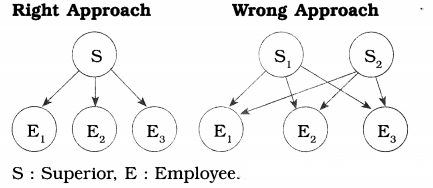
(5) Principle of Unity of Direction: Fayol advocates “One head for One plan”. It means that a group of employees working on similar activities should have common objectives and must work under one head (senior). All the objectives of the different groups should be in line with the objectives of the organisation. If this principle is followed there will be an effective co-ordination of the individual efforts and energies.
(6) Principle of Subordination of Individual Interest to Organisational Interest: According to this principle, the interest of the organisation must always be given greater importance than the interest of an employee or a group of employees. While taking decision, the manager should always consider the interest of whole group rather than the interest of an individual employee. Similarly, employees should surrender their personal goals or interests before that of an organisation e.g. while playing a game a team players should always play to win the game and not for his individual records.
(ii) Method Study : In order to get best quality with cost effectiveness, it is important and challenging for a manager to identify the best method from various available methods to complete the specific job. This method is useful to reduce the wastage of time, raw material and to improve usefulness of the resources to achieve defined objectives. It is also useful to determine the methods to handle the raw materials, storage, inspection and transportation.
(iii) Motion Study : Motion study refers to the close study of the movements of employees as well as machines in completing a particular task. This technique is useful to manager to eliminate the unnecessary movements and to find out the best method of completing a specific task. It improves efficiency and productivity of the employees. This method is also useful to understand and decide about the elimination of some elements of a job or changing their sequence for smooth flow of work.
(iv) Fatigue Study : The term ‘fatigue’ implies physical or mental exhaustion. Long working hours with insufficient breaks, heavy working tools, target pressure and poor working conditions lead to fatigue. It reduces efficiency of the employees and creates adverse effect on their health. To reduce fatigue it is very important to keep and maintain the operational efficiency of the workers.
(2) Standardisation of Tools and Equipment:
On the basis of experiments conducted at work place, Taylor insisted to provide standard tools and equipment, standard working environment and standard methods of production. It helps to reduce spoilage and wastage of materials, cost of production, fatigue among the employees on the one hand and improves quality of work on the other hand.
(3) Scientific Task Setting : Taylor laid stress on the need for fixing a fair day’s work. The technique of scientific task setting is useful to restrain the employees from performing the task much below their capacity. As a result, they will complete their task according to the standards given and management will be able to keep proper control on the optimum use of available workforce.
(4) Scientific Selection and Training: By using scientific selection procedures, management easily select right persons for the right jobs. According to this technique, job specifications required to be fixed and employees are selected as per predetermined standards in an impartial way. After their selection, the management should arrange proper training programmes to increase efficiency.
(5) Functional Organisation : Taylor suggested that planning of the work is to be done by different people and actual work is to be supervised by different set of people. Every worker in the factory is to be supervised by two different sets of supervisors. He further suggested total eight foremen to control the various parts of the production. They are categorised as follows:
(A) At planning level :
(B) At implementation level:
1. Science, Not Rule of Thumb : Rule of thumb method is based on personal judgements of the manager which should be substituted with the methods developed through scientific analysis of work. Taylor emphasised more on the use of scientific method for every small job. This principle related with selecting the best way of doing a work after scientific analysis. Under this method, standard required time and standard output are defined by the manager. This method is useful to save time and human energy, to get expected standard output and to increase organisational efficiency.
2. Harmony, Not Discord : This principle states that, in every organisation these should be proper co-ordination and harmonious relations between the management and employees. This will help in minimising conflicts between them and in achieving the goals of the organisation. The perfect understanding between employees and management is also helpful in creating healthy work environment. Organisation should also think about the maximum prosperity of the employees.
3. Mental Revolution : The concept of ‘mental revolution’ was introduced by Taylor. This principle highlights on the complete change in the attitude of the management and employees toward each other. Both should recognise their equal importance in the organisation. They should co-operate with each other to achieve goals or objectives of the organisation. This in turn will increase productivity and profits.
4. Co-operation, Not Individualism : This principle states that there should be mutual co-operation between employees and management. Co-operation, trust, team spirit, etc. are important to avoid internal competition and to create healthy working environment. Management should always appreciate and consider the suggestions given by the employees in decision-making process. The management should treat the employees as an integral part of the organisation in all respects. Employees should also resist themselves from going on strikes and making unacceptable or unnecessary demands from the management. Thus, they should see each other as two pillars of the organisation.
5. Division of Responsibility : This principle states that while dividing the work there should be’ corresponding division of responsibility between the managers and employees. Major planning should be done by the top and middle level management and employees should concentrate on its execution. The reporting of the jobs should be done by the subordinates as per the instructions given by their superiors. For the best performances, the management should always help, encourage and guide the employees.
6. Development of employer and employees for greater efficiency and maximum prosperity : Profitability and best performance of any organisation mostly depend on the skills, intelligence and capabilities of its employees. Arranging and providing training and development programmes for the employees at regular interval or whenever required are absolutely important. It helps to increase profitability of the organisation. Proper opportunity should be given to each ; employee to attain his highest efficiency and ; maximum prosperity.
(2) General guidelines : Management principles give general guidelines to tackle the organisational situations wisely and to solve the problems systematically. They are not rigid. Application of management principles depend upon the situation, size and nature of organisation, e.g., when we say according to principle of remuneration, the employees must be paid fair remuneration. The term ‘fair’ may vary as per nature, size and financial ability of the organisation.
(3) Principles are formed by practice and experiments : The management principles are developed gradually with thorough research work, experiments and systematic observations. The results of such observations and experiments are developed after their practice in different organisations.
(4) Flexibility : Management principles, although fundamental are not rigid statements. They have to be applied differently under various conditions. It is possible to make suitable changes in their application according to the requirement of the organisation. Thus, Management principles are flexible guidelines providing ample scope for making changes according to the nature of enterprise, its size, competitive situation, etc.
(5) Behavioural in nature : Management is a teamwork or a group activity. Management principles aim at influencing individual efforts and directing them to achieve various objectives of the organisation. They are directed towards regulating human behaviour so that people give their best to the organisation. Thus, principles of management are designed to influence human behaviour.
(6) Cause and effect relationship : Management principles indicate cause and effect relationship. Each principle has a definite effect on the efficiency or working of management. For example, payment of good remuneration and incentives increases output. Similarly, effective advertisement given by the organisation increases the sale of a product.
(7) All principles are of equal importance : All the principles of management have equal importance and they also carry equal weightage with reference to their applicability in the organisation. For example, it cannot be said that the principle of division of labour is more important than the principle of unity of command or vice versa. Management principles are not static in nature. They are not absolute like principles of pure sciences like Chemistry, Mathematics, etc. They are the principles of social science. They are to be modified and applied according to the size and nature of the organisation, keeping in mind the requirements.
7. Answer the following questions
(i) Time Study : Under this method, the manager observes and record the time an employee takes to complete a particular job or task. This technique is useful to fix standard time needed to complete a specific task under given conditions. It measures the efficiency of an employee and helps to control the cost of work.
(ii) Method Study : In order to get best quality with cost effectiveness, it is important and challenging for a manager to identify the best method from various available methods to complete the specific job. This method is useful to reduce the wastage of time, raw material and to improve usefulness of the resources to achieve defined objectives. It is also useful to determine the methods to handle the raw materials, storage, inspection and transportation.
(iii) Motion Study : Motion study refers to the close study of the movements of employees as well as machines in completing a particular task. This technique is useful to manager to eliminate the unnecessary movements and to find out the best method of completing a specific task. It improves efficiency and productivity of the employees. This method is also useful to understand and decide about the elimination of some elements of a job or changing their sequence for smooth flow of work.
(iv) Fatigue Study : The term ‘fatigue’ implies physical or mental exhaustion. Long working hours with insufficient breaks, heavy working tools, target pressure and poor working conditions lead to fatigue. It reduces efficiency of the employees and creates adverse effect on their health. To reduce fatigue it is very important to keep and maintain the operational efficiency of the workers.
(2) Standardisation of Tools and Equipment:
On the basis of experiments conducted at work place, Taylor insisted to provide standard tools and equipment, standard working environment and standard methods of production. It helps to reduce spoilage and wastage of materials, cost of production, fatigue among the employees on the one hand and improves quality of work on the other hand.
(3) Scientific Task Setting : Taylor laid stress on the need for fixing a fair day’s work. The technique of scientific task setting is useful to restrain the employees from performing the task much below their capacity. As a result, they will complete their task according to the standards given and management will be able to keep proper control on the optimum use of available workforce.
(4) Scientific Selection and Training: By using scientific selection procedures, management easily select right persons for the right jobs. According to this technique, job specifications required to be fixed and employees are selected as per predetermined standards in an impartial way. After their selection, the management should arrange proper training programmes to increase efficiency.
(5) Functional Organisation : Taylor suggested that planning of the work is to be done by different people and actual work is to be supervised by different set of people. Every worker in the factory is to be supervised by two different sets of supervisors. He further suggested total eight foremen to control the various parts of the production. They are categorised as follows:
(A) At planning level:
(B) At implementation level:
(6) Differential Piece – Rate Wage Plan : Taylor suggested that discrimination should be made between efficient and less efficient workers. In this technique, the standard is determined (fixed) for production. The workers who produce more than the standard output are to be paid remuneration at higher rates and those who produce less them the standard quantity are to be paid at lower rate of wages. This technique encourages the employees to attain higher standard performance to earn higher wages.
1. Principle of Division of Work: According to this principle, the entire work such as technical, financial, commercial, accounting, management and security operations should be assigned to different employees as per their qualification, qualities, capabilities and experience. It gives benefits of specialisation and improves efficiency and expertise of employees. This in turn helps to attain expected productivity level.
2. Principle of Authority and Responsibility: Authority implies right or freedom to take decisions. The manager should be given authority to get the work done systematically from the subordinates. Authority should always go with corresponding responsibility, e.g. if manager is given authority to complete a specific task w12. Principle of Stability of Tenure:ithin a given time, he would be held responsible for the same. Manager should have adequate authority to take managerial decisions on his own to achieve the goal.
3. Principle of Discipline: Fayol insists that discipline is essential for smooth working of an organisation. It helps to achieve the goals set in the organisation. In relation to organisation, discipline means strictly obeying instructions of the superiors. There should be clear and utmost understanding between management and employees in respect to organisation’s rules. It is necessary to observe basic discipline at all levels of management.
4. Principle of Unity of Command: According to this principle, every employee should receive orders and instructions from one boss only and he should be accountable to him only. If he receives orders from more them one boss at a time, he will not understand whose orders should be executed first. To avoid this, organisational hierarchy should be well defined and each employee in the organisation should know his immediate boss. He should receive orders and instructions from him only and should report to him only.
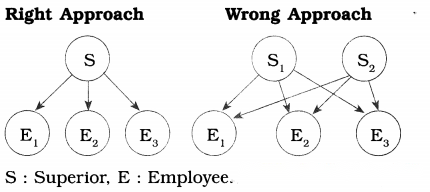
5. Principle of Unity of Direction: Fayol advocates “One head for One plan”. It means that a group of employees working on similar activities should have common objectives and must work under one head (senior). All the objectives of the different groups should be in line with the objectives of the organisation. If this principle is followed there will be an effective co-ordination of the individual efforts and energies.
6. Principle of Subordination of Individual Interest to Organisational Interest: According to this principle, the interest of the organisation must always be given greater importance than the interest of an employee or a group of employees. While taking decision, the manager should always consider the interest of whole group rather than the interest of an individual employee. Similarly, employees should surrender their personal goals or interests before that of an organisation e.g. while playing a game a team players should always play to win the game and not for his individual records.
7. Principle of Centralisation: Centralisation means concentration of authority or power in a few hands at the top level. As number of employees is less in a smaller organisation there is centralisation of authority. Decentralisation means even distribution of authority or power at every level of management. As number of employees and levels of management are more in a larger organisation, there must be decentralisation of some authorities for its smooth functioning. According to Fayol, there must be a proper balance between centralisation and decentralisation, depending upon the nature and size of an organisation.
8. Principle of Remuneration: According to this principle, the employees must be paid fair and appropriate remuneration to keep them satisfied financially and to retain them within the organisation for longer period of time. While fixing remuneration various factors such as the skill, knowledge, expertise, tenure, cost of living, market trend, profitability of organisation, etc. should be considered. It boosts the morale of employees and increases efficiency and productivity.
9. Principle of Scalar Chain: According to Fayol, in the organisation decisions, orders, instructions, messages, etc. must be passed through a chain, i.e. from the general manager to the respective functional manager, then to the supervisor, then to the foreman and then ultimately, to the workers. Similarly, suggestions, information, grievances, etc., must flow from the worker in the upward direction. This is called Scalar Chain. Sometimes, following a scalar chain becomes a lengthy process. In such cases, ‘Gang Plank’ is followed which permits speedy and direct communication between the employees working at the same level of authority. However, for this, permission of the proper authority is necessary.
10. Principle of Order: The principle of order is based on ‘a place for everything and everything in its place’. According to this principle, in every organisation there should be proper, systematic and orderly arrangement of men and materials. There should be a fixed place to keep every material and thing used in the organisation and a fixed place or a seat for every employee. The purpose of this principle is to reduce wastage of time and energy. This principle emphasises more I on the proper and optimum utilisation of physical and human resources.
11. Principle of Equity: This principle states that the management should be fair as well as friendly to the subordinate staff. There should be no discrimination of employees in regard to division of work, delegation of the authorities, deciding the monetary terms, etc. This principle also states that the remuneration should depend not on the department but at the level at which employees are working, It means the employees working on the same level but in separate departments must be paid equal wages. It will also help in avoiding conflicts in an organisation.
12. Principle of Stability of Tenure: According to this principle, at the time of recruitment of employees, the management should assure them about the stability of tenure (i.e. job security). This creates a sense of belonging among the employees. Job security increases efficiency of the employees and minimises employees turnover ratio.
13. Principle of Initiative: Initiative means to do the work in an innovative way in his or her personal capacity. According to this principle, managers should give freedom, opportunity or encourage the subordinates to take initiative while working on given job. Their suggestions and ideas should be invited before framing the plan. This can work as a morale booster for the employees and leads to timely achievement of organisational goals.
14. Principle of Esprit de corpse (Team Work): ‘Esprit de corpse’ means union is strength. This principle integrates and co-ordinates the individual and group efforts. It emphasizes the spirit of teamwork. The manager as a leader should create the feeling of team spirit and understanding among the various groups. When entire group of employees works as a team, their efforts get directed towards realising the goals of the organisation.