Balbharti12th Maharashtra State Board Maths Solutions BookPdf Chapter 7 Probability Distributions Miscellaneous Exercise 7 Questions and Answers.
Maharashtra State Board 12th Maths Solutions Chapter 7 Probability Distributions Miscellaneous Exercise 7
(I) Choose the correct option from the given alternatives:
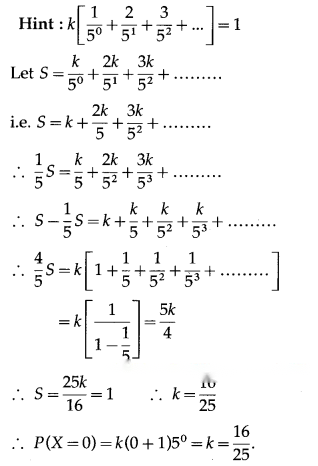



(II) Solve the following:
(ii) Let X = amount of syrup prescribed by a physician.
Then X takes uncountable infinite values.
∴ random variable X is continuous.
(iii) Let X = gain of weight in a week
Then X takes uncountable infinite values
∴ random variable X is continuous.
(iv) Let X = number of female rats selected on a specific day.
Since the total number of rats is 20 which includes 12 males and 8 females, X takes the finite values.
∴ random variable X is discrete.
Range = {0, 1, 2, 3, 4, 5}
(v) Let X = speed of.the car in km/hr.
Then X takes uncountable infinite values
∴ random variable X is continuous.

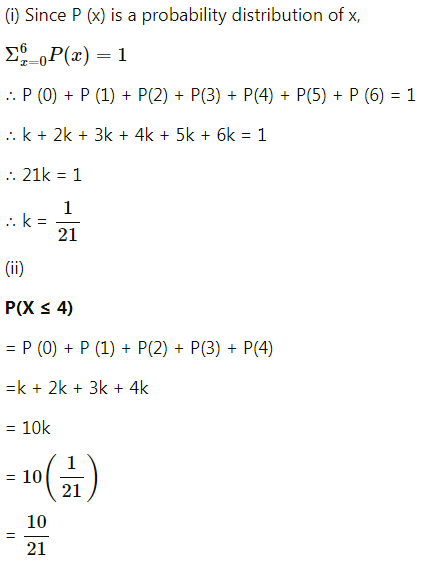
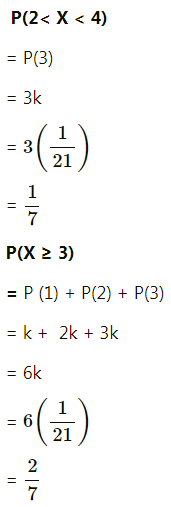

(ii) P(X is non-negative)
= P(X = 0) + P(X = 1) + P(X = 2) + P(X = 3)
= 0.20 + 0.25 + 0.15 + 0.1
= 0.70
(iii) P(X is odd)
= P(X = -3) + P(X = -1) + P(X = 1) + P(X = 3)
= 0.05 + 0.15 + 0.25 + 0.1
= 0.55
(iv) P(X is even)
= P(X = -2) + P(X = 0) + P(X = 2)
= 0.10 + 0.20 + 0.15
= 0.45.

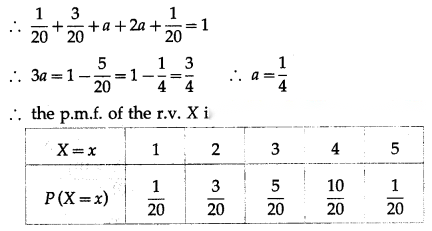

Question 9
Maharashtra Board Solution
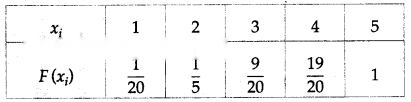
The following is the c.d.f. of a r.v. X: Find (i) p.m.f. of X (ii) P( -1 ≤ X ≤ 2) (iii) P(X ≤ X > 0).
Solution & Step-by-Step Answer:
block bg-white dark:bg-slate-900/80 border-l-4 border-emerald-500 rounded-r-xl p-5 my-3 shadow-xs border border-slate-200/60 dark:border-slate-800">
Solution & Step-by-Step Answer:
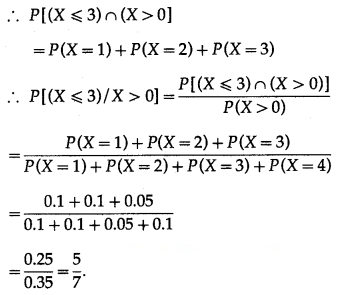
(i) From the given table F(-3) = 0.1, F(-2) = 0.3, F(-1) = 0.5 F(0) = 0.65, f(1) = 0.75, F(2) = 0.85 F(3) = 0.9, F(4) = 1 P(X = -3) = F(-3) = 0.1 P(X = -2) = F(-2) – F(-3) = 0.3 – 0.1 = 0.2 P(X = -1) = F(-1) – F(-2) = 0.5 – 0.3 = 0.2 P(X = 0) = F(0) – F(-1) = 0.65 – 0.5 = 0.15 P(X = 1) = F(1) – F(0) = 0.75 – 0.65 = 0.1 P(X = 2) = F(2) – F(1) = 0.85 – 0.75 = 0.1 P(X = 3) = F(3) – F(2) = 0.9 – 0.85 = 0.1 P(X = 4) = F(4) – F(3) = 1 – 0.9 = 0.1 ∴ the p.m.f of X is as follows: (ii) P(-1 ≤ X ≤ 2) = P(X = -1) + P(X = 0) + P(X = 1) + P(X = 2) = 0.2 + 0.15 + 0.1 + 0.1 = 0.55
(iii) (X ≤ 3) ∩ (X > 0)
Question 10
Maharashtra Board Solution
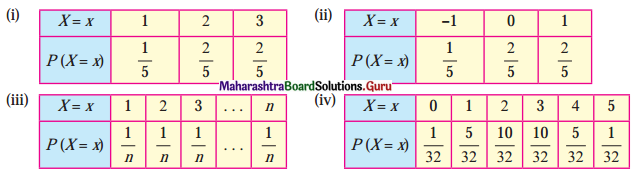
Find the expected value, variance, and standard deviation of the random variable whose p.m.f’s are given below:
Solution & Step-by-Step Answer:
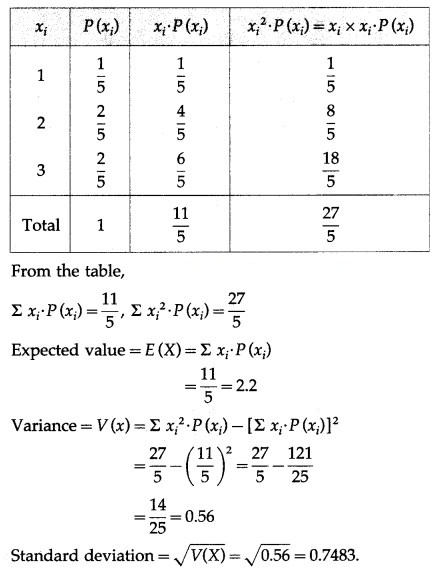
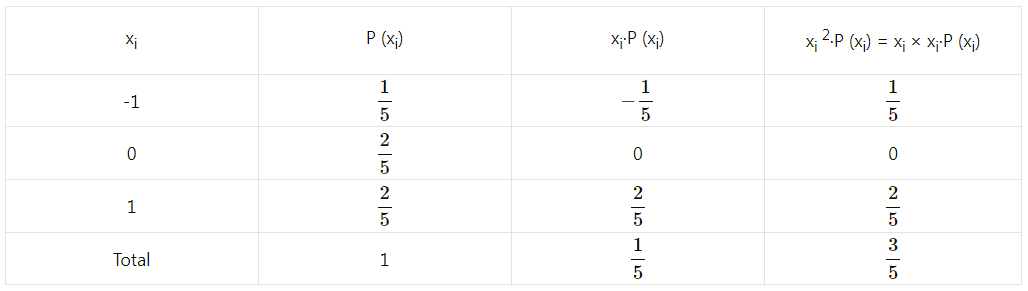
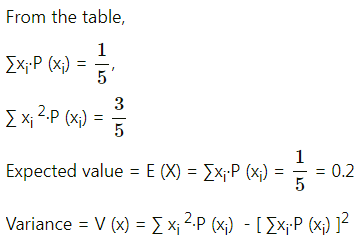
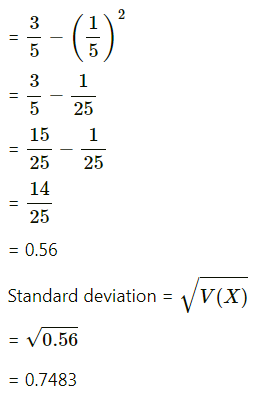
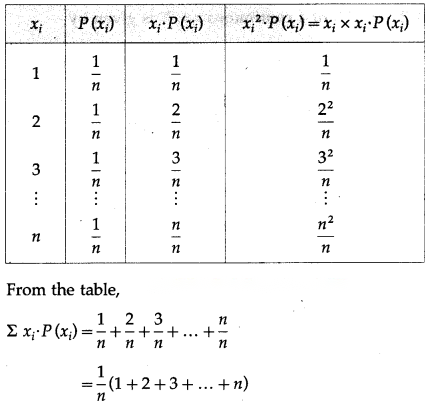
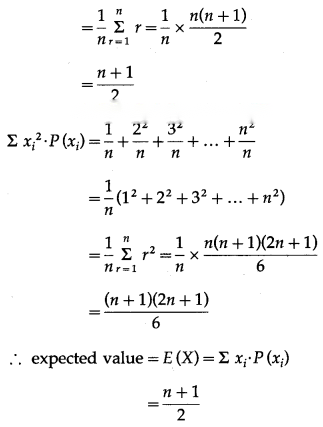
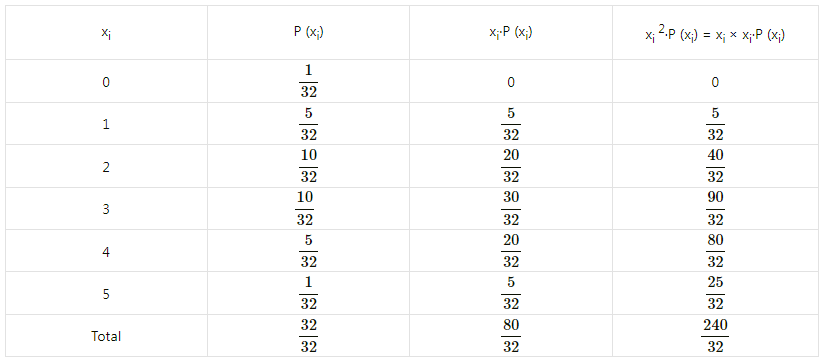
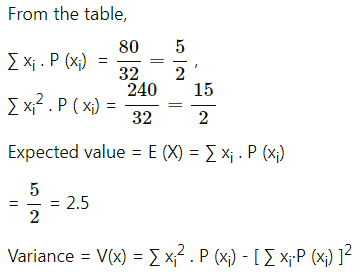
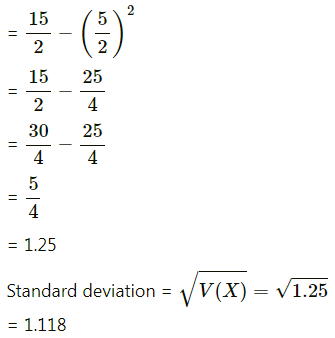
(i) We construct the following table to find the expected value, variance, and standard deviation: (ii) We construct the following table to find the expected value, variance, and standard deviation: (iii) We construct the following table to find the expected value, variance, and standard deviation: (iv) We construct the following table to find the expected value, variance, and standard deviation:
Question 11
Maharashtra Board Solution
A player tosses two wins. He wins ₹ 10 if 2 heads appear, ₹ 5 if 1 head appears and ₹ 2 if no head appears. Find the expected winning amount and variance of the winning amount.
Solution & Step-by-Step Answer:
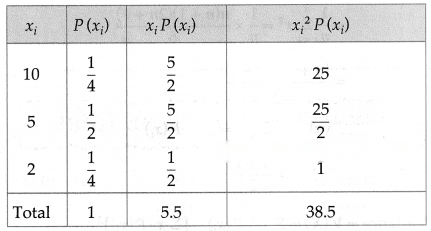
When a coin is tossed twice, the sample space is S = {HH, HT, TH, HH} Let X denote the amount he wins. Then X takes values 10, 5, 2. P(X = 10) = P(2 heads appear) = P(X = 5) = P(1 head appears) = = P(X = 2) = P(no head appears) = We construct the following table to calculate the mean and the variance of X: From the table Σxi. P(xi) = 5.5, = 38.5 E(X) = Σxi. P(xi) = 5.5 Var(X) = – [E(X)]2 = 38.5 – (5.5)2 = 38.5 – 30.25 = 8.25 ∴ Hence, expected winning amount = ₹ 5.5 and variance of winning amount = ₹ 8.25.
Question 12
Maharashtra Board Solution
Let the p.m.f. of r.v. X be P(x) = , for x = -1, 0, 1, 2 and = 0, otherwise. Calculate E(X) and Var(X).
Solution & Step-by-Step Answer:
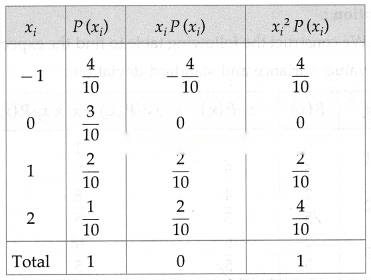
P(X) = X takes values -1, 0, 1, 2 P(X = -1) = P(-1) = P(X = 0) = P(0) = P(X = 1) = P(1) = P(X = 2) = P(2) = We construct the following table to calculate the mean and variance of X: From the table ΣxiP(xi) = 0 and = 1 E(X) = ΣxiP(xi) = 0 Var(X) = – [E(X)]2 = 1 – 0 = 1 Hence, E(X) = 0, Var (X) = 1.
Question 13
Maharashtra Board Solution
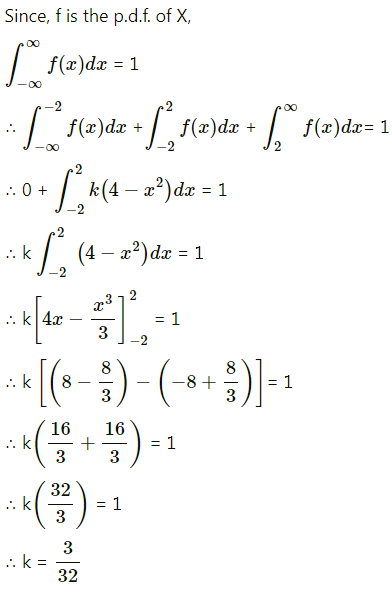
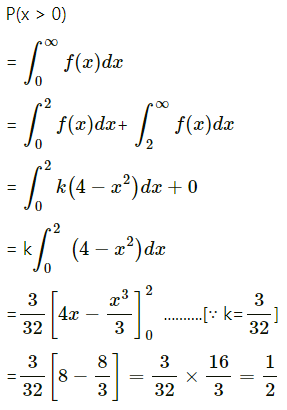
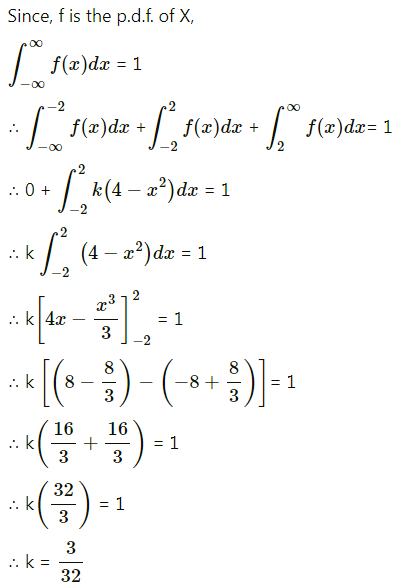
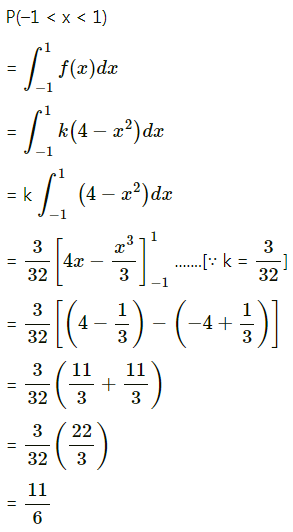
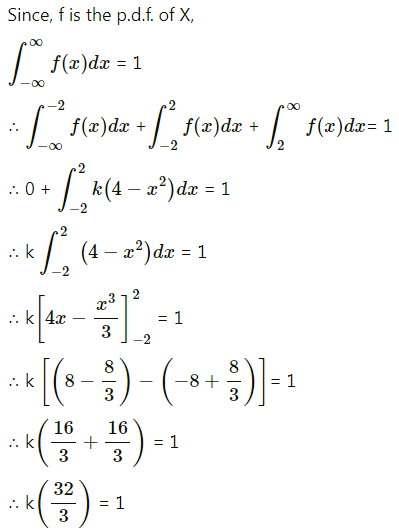
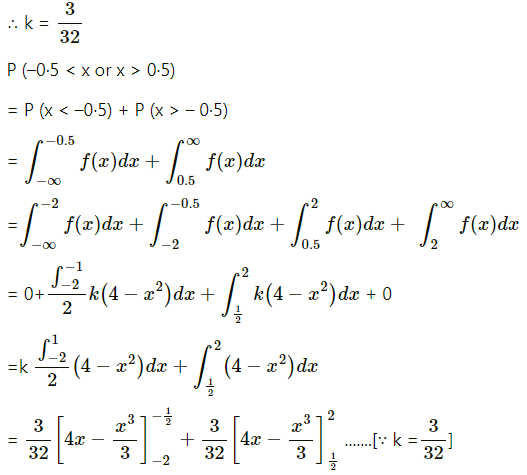
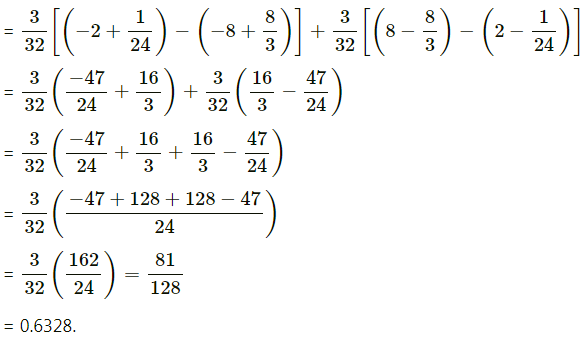
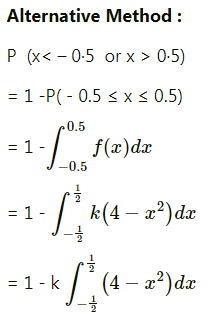
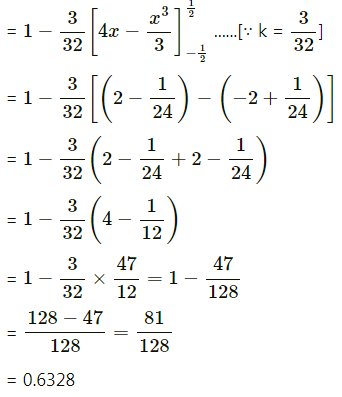
Suppose the error involved in making a certain measurement is a continuous r.v. X with p.d.f. f(x) = k(4 – x2), -2 ≤ x ≤ 2 and = 0 otherwise. Compute (i) P(X > 0) (ii) P(-1 < X < 1) (iii) P(X < -0.5 or X > 0.5).
Solution & Step-by-Step Answer:
(i) P(X > 0) (ii) P(-1 < X < 1) (iii) P(X < -0.5 or X > 0.5)
Question 14
Maharashtra Board Solution
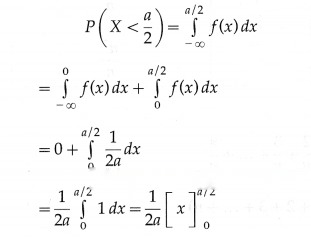
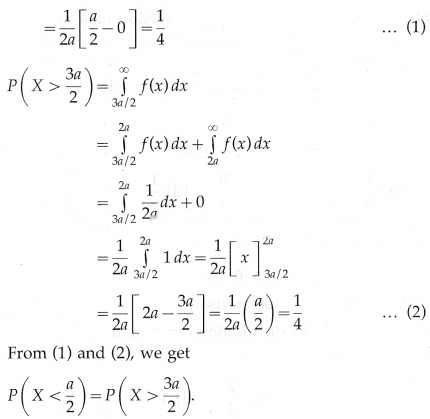
The p.d.f. of a continuous r.v. X is given by f(x) = , for 0 < x < 2a and = 0, otherwise. Show that P( X < ) = P(X > )
Solution & Step-by-Step Answer:
Question 15
Maharashtra Board Solution
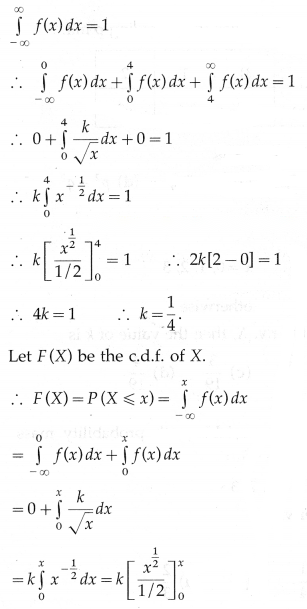
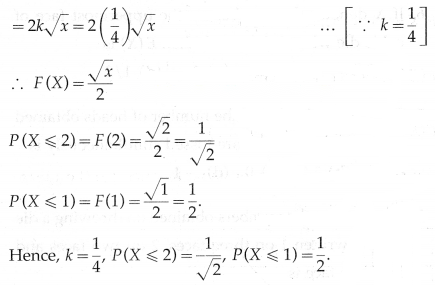
The p.d.f. of r.v. X is given by f(x) = , for 0 < x < 4 and = 0, otherwise. Determine k. Determine c.d.f. of X and hence find P(X ≤ 2) and P(X ≤ 1).
Solution & Step-by-Step Answer:
Since f is p.d.f. of the r.v. X,
|