Balbharti12th Maharashtra State Board Maths Solutions BookPdf Chapter 7 Probability Distributions Ex 7.1 Questions and Answers.
Maharashtra State Board 12th Maths Solutions Chapter 7 Probability Distributions Ex 7.1
Solution & Step-by-Step Answer:
When a coin is tossed 6 times, the number of heads can be 0, 1, 2, 3, 4, 5, 6. The corresponding number of tails will be 6, 5, 4, 3, 2, 1, 0. ∴ X can take values 0 – 6, 1 – 5, 2 – 4, 3 – 3, 4 – 2, 5 – 1, 6 – 0 i.e. -6, -4, -2, 0, 2, 4, 6. ∴ X = {-6, -4, -2, 0, 2, 4, 6}.
Solution & Step-by-Step Answer:
The urn contains 5 red and 2 black balls. If two balls are drawn from the urn, it contains either 0 or 1 or 2 black balls. X can take values 0, 1, 2. ∴ X = {0, 1, 2}.
Solution & Step-by-Step Answer:
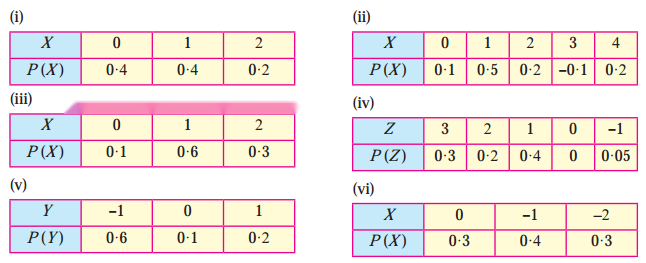
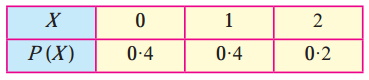
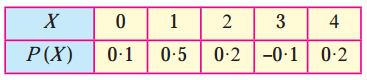
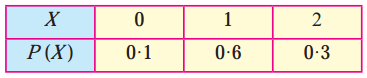
Solution: P.m.f. of random variable should satisfy the following conditions: (a) 0 ≤ pi ≤ 1 (b) Σpi = 1.
(i)
(a) Here 0 ≤ pi≤ 1
(b) Σpi= 0.4 + 0.4 + 0.2 = 1
Hence, P(X) can be regarded as p.m.f. of the random variable X.
(ii)
P(X = 3) = -0.1, i.e. Pi< 0 which does not satisfy 0 ≤ Pi≤ 1
Hence, P(X) cannot be regarded as p.m.f. of the random variable X.
(iii)
(a) Here 0 ≤ pi≤ 1
(b) ∑pi= 0.1 + 0.6 + 0.3 = 1
Hence, P(X) can be regarded as p.m.f. of the random variable X.
(iv)
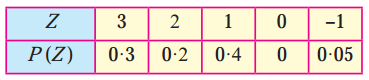
Here ∑pi= 0.3 + 0.2 + 0.4 + 0 + 0.05 = 0.95 ≠ 1
Hence, P(Z) cannot be regarded as p.m.f. of the random variable Z.
(v)
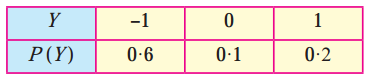
Here ∑pi= 0.6 + 0.1 + 0.2 = 0.9 ≠ 1
Hence, P(Y) cannot be regarded as p.m.f. of the random variable Y.
(vi)
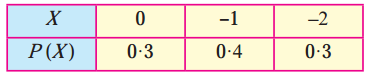
(a) Here 0 ≤ pi≤ 1
(b) ∑pi= 0.3 + 0.4 + 0.3 = 1
Hence, P(X) can be regarded as p.m.f. of the random variable X.
Solution & Step-by-Step Answer:
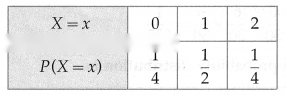
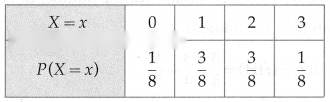
(i) For two tosses of a coin the sample space is {HH, HT, TH, TT} Let X denote the number of heads in two tosses of a coin. Then X can take values 0, 1, 2. ∴ P[X = 0] = P(0) = P[X = 1] = P(1) = = P[X = 2] = P(2) = ∴ the required probability distribution is
(ii) When three coins are tossed simultaneously, then the sample space is
{HHH, HHT, HTH, THH, HTT, THT, TTH, TTT}
Let X denotes the number of tails.
Then X can take the value 0, 1, 2, 3.
∴ P[X = 0] = P(0) =
P[X = 1] = P(1) =
P[X = 2] = P(2) =
P[X = 3] = P(3) =
∴ the required probability distribution is
(iii) When a fair coin is tossed 4 times, then the sample space is
S = {HHHH, HHHT, HHTH, HTHH, THHH, HHTT, HTHT, HTTH, THHT, THTH, TTHH, HTTT, THTT, TTHT, TTTH, TTTT}
∴ n(S) = 16
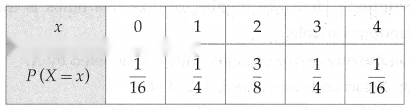
Let X denotes the number of heads.
Then X can take the value 0, 1, 2, 3, 4
When X = 0, then X = {TTTT}
∴ n(X) = 1
∴ P(X = 0) =
When X = 1, then
X = {HTTT, THTT, TTHT, TTTH}
∴ n(X) = 4
∴ P(X = 1) =
When X = 2, then
X = {HHTT, HTHT, HTTH, THHT, THTH, TTHH}
∴ n(X) = 6
∴ P(X = 2) =
When X = 3, then
X = {HHHT, HHTH, HTHH, THHH}
∴ n(X) = 4
∴ P(X = 3) =
When X = 4, then X = {HHHH}
∴ n(X) = 1
∴ P(X = 4) =
∴ the probability distribution of X is as follows:
Solution & Step-by-Step Answer:
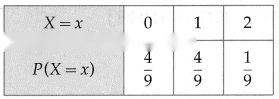
When a die is tossed twice, the sample space s has 6 × 6 = 36 sample points. ∴ n(S) = 36 The trial will be a success if the number on at least one die is 5 or 6. Let X denote the number of dice on which 5 or 6 appears. Then X can take values 0, 1, 2. When X = 0 i.e., 5 or 6 do not appear on any of the dice, then X = {(1, 1), (1, 2), (1, 3), (1, 4), (2, 1), (2, 2), (2, 3), (2, 4), (3, 1), (3, 2), (3, 3), (3, 4), (4, 1), (4, 2), (4, 3), (4, 4)} ∴ n(X) = 16. ∴ P(X = 0) = When X = 1, i.e. 5 or 6 appear on exactly one of the dice, then X = {(1, 5), (1, 6), (2, 5), (2, 6), (3, 5), (3, 6), (4, 5), (4, 6), (5, 1), (5, 2), (5, 3), (5, 4), (6, 1), (6, 2), (6, 3), (6, 4)} ∴ n(X) = 16 ∴ P(X = 1) = When X = 2, i.e. 5 or 6 appear on both of the dice, then X = {(5, 5), (5, 6), (6, 5), (6, 6)} ∴ n(X) = 4 ∴ P(X = 2) = ∴ the required probability distribution is
Solution & Step-by-Step Answer:
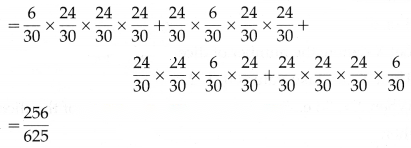
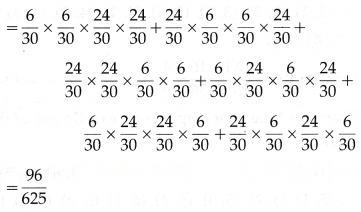
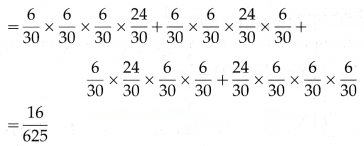
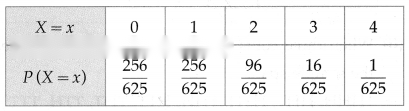
Here, the number of defective bulbs is the random variable. Let the number of defective bulbs be denoted by X. ∴ X can take the value 0, 1, 2, 3, 4. Since the draws are done with replacement, therefore the four draws are independent experiments. Total number of bulbs is 30 which include 6 defectives. ∴ P(X = 0) = P(0) = P(all 4 non-defective bulbs) = = P(X = 1) = P (1) = P (1 defective and 3 non-defective bulbs) P(X = 2) = P(2) = P(2 defective and 2 non-defective) P(X = 3) = P(3) = P(3 defectives and 1 non-defective) P(X = 4) = P(4) = P(all 4 defectives) = = ∴ the required probability distribution is
Solution & Step-by-Step Answer:
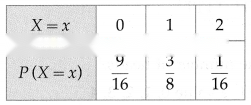
Given a biased coin such that heads is 3 times as likely as tails. ∴ P(H) = and P(T) = The coin is tossed twice. Let X can be the random variable for the number of tails. Then X can take the value 0, 1, 2. ∴ P(X = 0) = P(HH) = P(X = 1) = P(HT, TH) = P(X = 2) = P(TT) = ∴ the required probability distribution is
Solution & Step-by-Step Answer:
(i) Since P (x) is a probability distribution of x, ⇒ P(0) + P(1) + P(2) + P(3) + P(4) + P(5) + P(6) + P(7) = 1 ⇒ 0 + k + 2k + 2k + 3k + k2 + 2k2 + 7k2 + k = 1 ⇒ 10k2 + 9k – 1 = 0 ⇒ 10k2 + 10k – k – 1 = 0 ⇒ 10k(k + 1) – 1(k + 1) = 0 ⇒ (k + 1)(10k – 1) = 0 ⇒ 10k – 1 = 0 ……..[∵ k ≠ -1] ⇒ k =

(ii) P(X< 3) = P(0) + P(1) + P(2)
= 0 + k + 2k
= 3k
= 3()
=
(iii) P(0 < X < 3) = P (1) + P (2)
= k + 2k
= 3k
= 3()
=
Solution & Step-by-Step Answer:
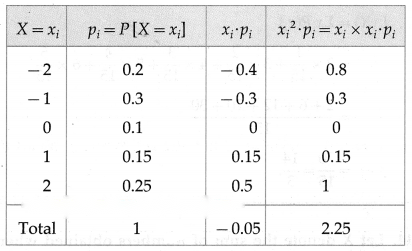
We construct the following table to calculate E(X) and V(X): From the table, Σxipi = -0.05 and = 2.25 ∴ E(X) = Σxipi = -0.05 and V(X) = = 2.25 – (-0.05)2 = 2.25 – 0.0025 = 2.2475 Hence, E(X) = -0.05 and V(X) = 2.2475.

Solution & Step-by-Step Answer:
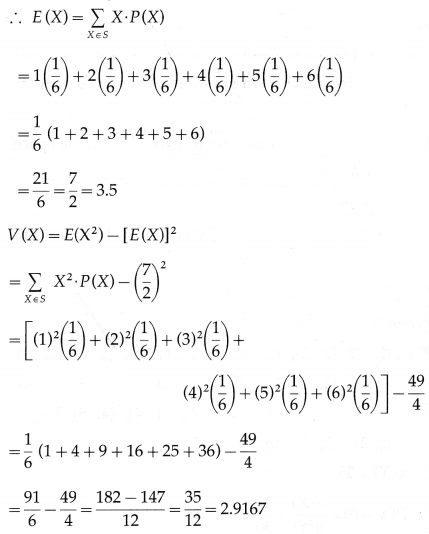
If a die is tossed, then the sample space for the random variable X is S = {1, 2, 3, 4, 5, 6} ∴ P(X) = ; X = 1, 2, 3, 4, 5, 6. Hence, E(X) = 3.5 and V(X) = 2.9167.
Solution & Step-by-Step Answer:
When three coins are tossed the sample space is {HHH, HHT, THH, HTH, HTT, THT, TTH, TTT} ∴ n(S) = 8 Let X denote the number of heads when three coins are tossed. Then X can take values 0, 1, 2, 3 P(X = 0) = P(0) = P(X = 1) = P(1) = P(X = 2) = P(2) = P(X = 3) = P(3) = ∴ mean = E(X) = ΣxiP(xi) = = = = 1.5
Solution & Step-by-Step Answer:
When two dice are thrown, the sample space S has 6 × 6 = 36 sample points. ∴ n(S) = 36 Let X denote the number of sixes when two dice are thrown. Then X can take values 0, 1, 2 When X = 0, then X = {(1, 1), (1, 2), (1, 3), (1, 4), (1, 5), (2, 1), (2, 2), (2, 3), (2, 4), (2, 5), (3, 1), (3, 2), (3, 3), (3, 4), (3, 5), (4, 1), (4, 2), (4, 3), (4, 4), (4, 5), (5, 1), (5, 2), (5, 3), (5, 4), (5, 5)} ∴ n(X) = 25 ∴ P(X = 0) = When X = 1, then X = {(1, 6), (2, 6), (3, 6), (4, 6), (5, 6), (6, 1), (6, 2), (6, 3), (6, 4), (6, 5)} ∴ n(X) = 10 ∴ P(X = 1) = When X = 2, then X = {(6, 6)} ∴ n(X) = 1 ∴ P(X = 2) = ∴ E(X) = ΣxiP(xi) = = =
Solution & Step-by-Step Answer:
Two numbers are chosen from the first 6 positive integers. ∴ n(S) = = 15 Let X denote the larger of the two numbers. Then X can take values 2, 3, 4, 5, 6. When X = 2, the other positive number which is less than 2 is 1. ∴ n(X) = 1 ∴ P(X = 2) = P(2) = When X = 3, the other positive number less than 3 can be 1 or 2 and hence can be chosen in 2 ways. ∴ n(X) = 2 P(X = 3) = P(3) = Similarly, P(X = 4) = P(4) = P(X = 5) = P(5) = P(X = 6) = P(6) = ∴ E(X) = ΣxiP(xi) = = = =
Solution & Step-by-Step Answer:
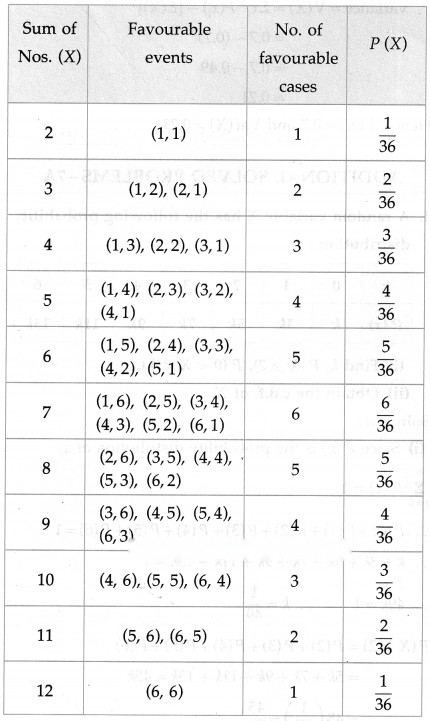
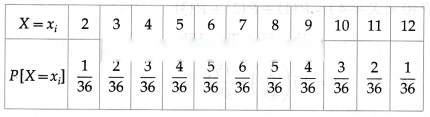
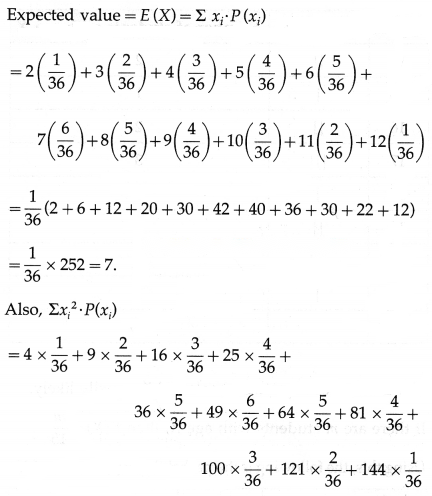
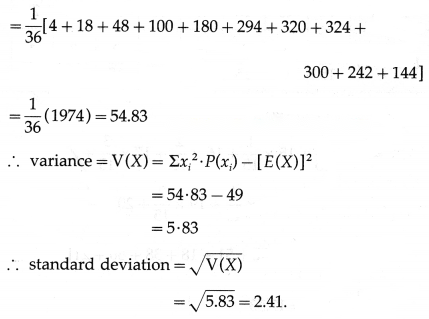
If two fair dice are rolled then the sample space S of this experiment is S = {(1, 1), (1, 2), (1, 3), (1, 4), (1, 5), (1, 6), (2, 1), (2, 2), (2, 3), (2, 4), (2, 5), (2, 6), (3, 1), (3, 2), (3, 3), (3, 4), (3, 5), (3, 6), (4, 1), (4, 2), (4, 3), (4, 4), (4, 5), (4, 6), (5, 1), (5, 2), (5, 3), (5, 4), (5, 5), (5, 6), (6, 1), (6, 2), (6, 3), (6, 4), (6, 5), (6, 6)} ∴ n(S) = 36 Let X denote the sum of the numbers on uppermost faces. Then X can take the values 2, 3, 4, 5, 6, 7, 8, 9, 10, 11, 12 ∴ the probability distribution of X is given by
Solution & Step-by-Step Answer:
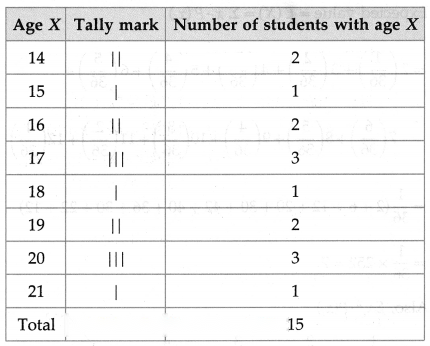
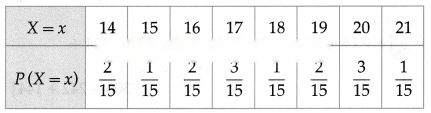
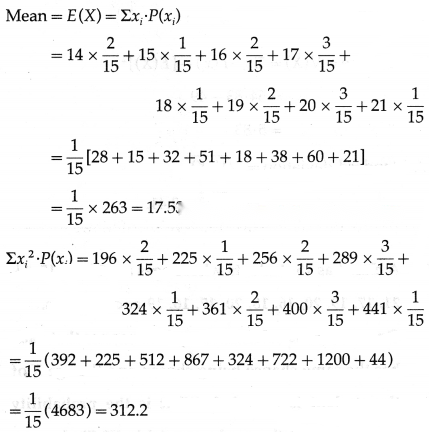
Let X denote the age of the chosen student. Then X can take values 14, 15, 16, 17, 18, 19, 20, 21. We make a frequency table to find the number of students with age X: The chances of any student selected are equally likely. If there are m students with age X, then P(X) = Using this, the following is the probability distribution of X: Variance = V(X) = . P(xi) – [E(X)]2 = 312.2 – (17.53)2 = 312.2 – 307.3 = 4.9 Standard deviation = √V(X) = √4.9 = 2.21 Hence, mean = 17.53, variance = 4.9 and standard deviation = 2.21.
Solution & Step-by-Step Answer:
X takes values 0 and 1. It is given that P(X = 0) = P(0) = 30% = = 0.3 P(X = 1) = P(1) = 70% = = 0.7 ∴ E(X) = Σxi. P(xi) = 0 × 0.3 + 1 × 0.7 = 0.7 Also, = 0 × 0.3 + 1 × 0.7 = 0.7 ∴ Variance = V(X) = = 0.7 – (0.7)2 = 0.7 – 0.49 = 0.21 Hence, E(X) = 0.7 and Var(X) = 0.21.