Balbharti12th Maharashtra State Board Maths Solutions BookPdf Chapter 7 Linear Programming Miscellaneous Exercise 7 Questions and Answers.
Maharashtra State Board 12th Maths Solutions Chapter 7 Linear Programming Miscellaneous Exercise 7
I) Select the appropriate alternatives for each of the following :
Question 1.
The value of objective function is maximum under linear constraints _______.
(A) at the centre of feasible region
(B) at (0, 0)
(C) at a vertex of feasible region
(D) the vertex which is of maximum distance from (0, 0)
Solution:
(C) at a vertex of feasible region
Solution & Step-by-Step Answer:
(C) if L.P.P. has two optimal solutions then it has infinite number of optimal solutions
Solution & Step-by-Step Answer:
(B) a function to be maximized or minimized
Solution & Step-by-Step Answer:
(C)
Solution & Step-by-Step Answer:
(A) 56
Solution & Step-by-Step Answer:
(D) (40, 15)
Solution & Step-by-Step Answer:
(C) at vertex of feasible region
Solution & Step-by-Step Answer:
(B) all of the given constraints
Solution & Step-by-Step Answer:
(A) x = 0, y =
Solution & Step-by-Step Answer:
(B) (0, 0), (, 0), (3, 1), (0, 4)
Solution & Step-by-Step Answer:
(B) (2, 0)
Solution & Step-by-Step Answer:
(B) 13
Solution & Step-by-Step Answer:
(A) (2, 2)
Solution & Step-by-Step Answer:
(C) (0, 0)
Solution & Step-by-Step Answer:
(C) (3, 4)
II) Solve the following :
Question 1.
Solve each of the following inequations graphically using X Y plane.
(i) 4x – 18 ≥ 0
Solution:
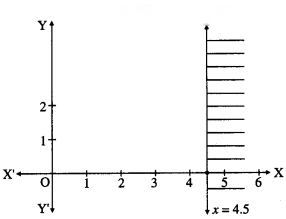
Consider the line whose equation is 4x – 18 ≥ 0 i.e. x = = 4.5
This represents a line parallel to Y-axis passing3through the point (4.5, 0)
Draw the line x = 4.5
To find the solution set we have to check the position of the origin (0, 0).
When x = 0, 4x – 18 = 4 × 0 – 18 = -18 > 0
∴ the coordinates of the origin does not satisfy thegiven inequality.
∴ the solution set consists of the line x = 4.5 and the non-origin side of the line which is shaded in the graph.
(ii) -11x – 55 ≤ 0
Solution:
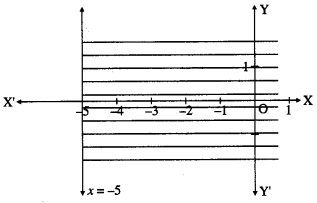
Consider the line whose equation is -11x – 55 ≤ 0 i.e. x = -5
This represents a line parallel to Y-axis passing3through the point (-5, 0)
Draw the line x = – 5
To find the solution set we have to check the position of the origin (0, 0).
When x = 0, -11x – 55 = – 11(0) – 55 = -55 > 0
∴ the coordinates of the origin does not satisfy thegiven inequality.
∴ the solution set consists of the line x = -5 and the non-origin side of the line which is shaded in the graph.
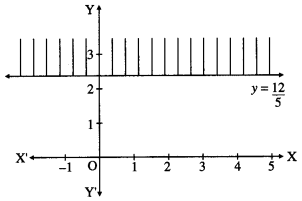
(iii) 5y – 12 ≥ 0
Solution:
Consider the line whose equation is 5y – 12 ≥ 0 i.e. y =
This represents a line parallel to X-axis passing through the point (o, )
Draw the line y =
To find the solution set, we have to check the position of the origin (0, 0).
When y = 0, 5y – 12 = 5(0) – 12 = -12 > 0
∴ the coordinates of the origin does not satisfy the given inequality.
∴ the solution set consists of the line y = and the non-origin side of the line which is shaded in the graph.
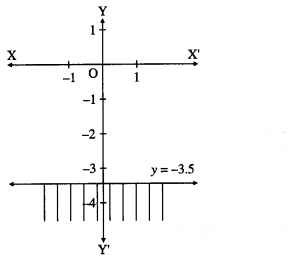
(iv) y ≤ -3.5
Solution:
Consider the line whose equation is y ≤ – 3.5 i.e. y = – 3.5
This represents a line parallel to X-axis passing3through the point (0, -3.5)
Draw the line y = – 3.5
To find the solution set, we have to check the position of the origin (0, 0).
∴ the coordinates of the origin does not satisfy the given inequality.
∴ the solution set consists of the line y = – 3.5 and the non-origin side of the line which is shaded in the graph.
Solution & Step-by-Step Answer:
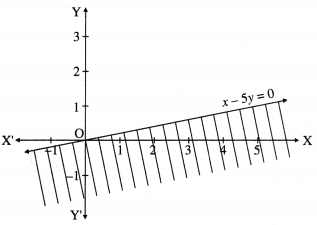
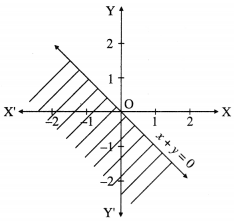
(ii) x + y≤ 0
Solution:
(iii) 2y – 5x ≥ 0
Solution:
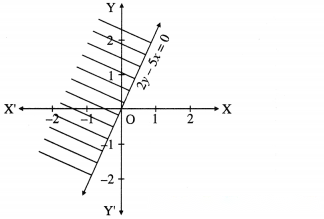
(iv) |x + 5| ≤ y
Solution:
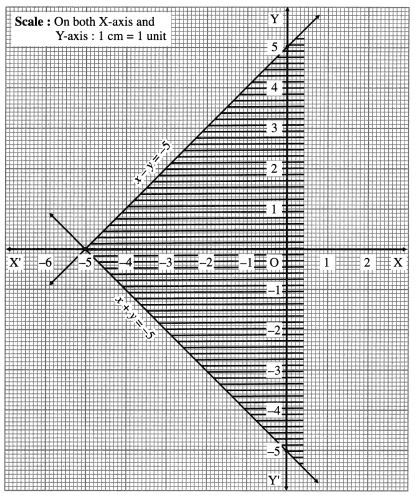
|x + 5| ≤ y
∴ -y ≤ x + 5 ≤ y
∴ -y ≤ x + 5 and x + 5 ≤ y
∴ x + y ≥ -5 and x – y ≤ -5
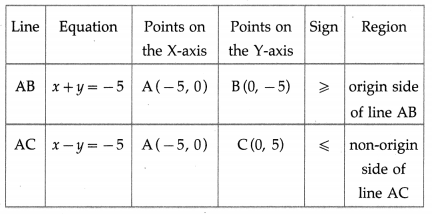
First we draw the lines AB and AC whose equations are
x + y= -5 and x – y = -5 respectively.
The graph of |x + 5| ≤ y is as below:
Solution & Step-by-Step Answer:
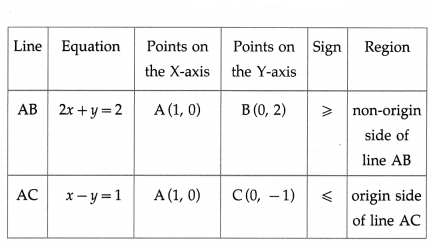
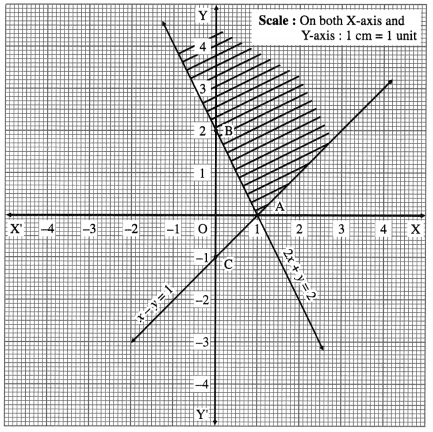
First we draw the lines AB and AC whose equations are 2x + y = 2 and x – y = 1 respectively. The solution set of the given system of inequalities is shaded in the graph.
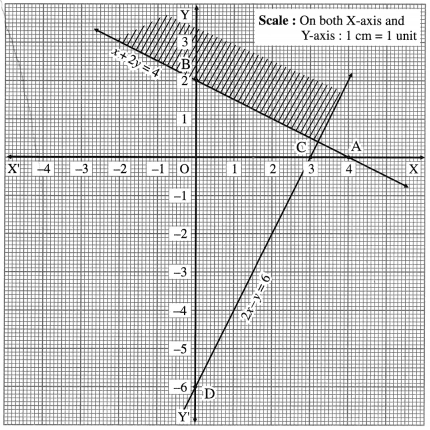
(ii) x + 2y ≥ 4, 2x – y ≤ 6
Solution:
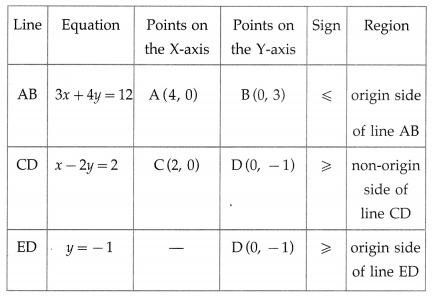
(iii) 3x + 4y ≤ 12, x – 2y ≥ 2, y ≥ -1
Solution:
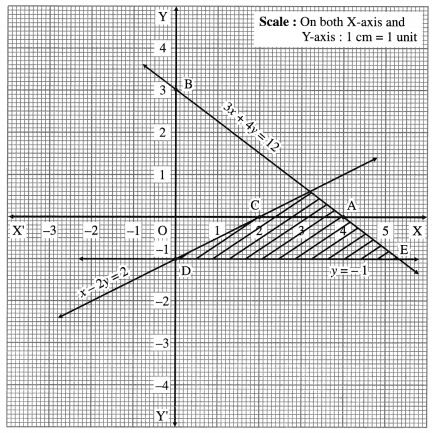
First we draw the lines AB, CD and ED whose equations are 3x + 4y = 12, x – 2y = 2 and y = -1 respectively.
The solution set of given system of inequation is shaded in the graph.
Solution & Step-by-Step Answer:
The feasible solution is OCPBO.
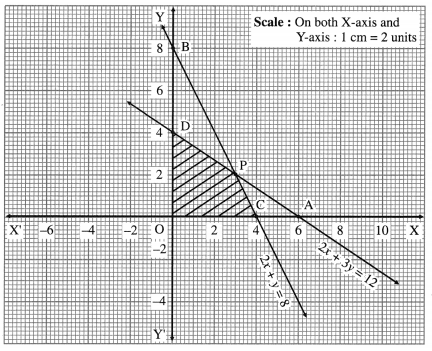
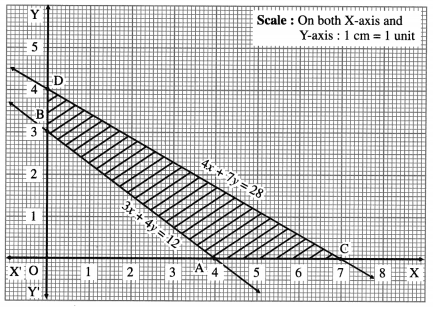
(ii) 3x + 4y ≥ 12, 4x + 7y ≤ 28, x ≥ 0, y ≥ 0
Solution:
The feasible solution is ACDBA.
Solution & Step-by-Step Answer:
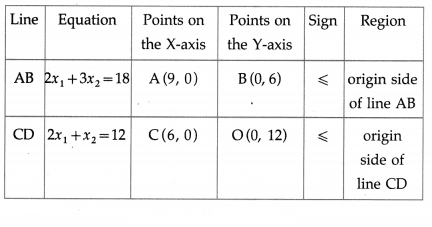
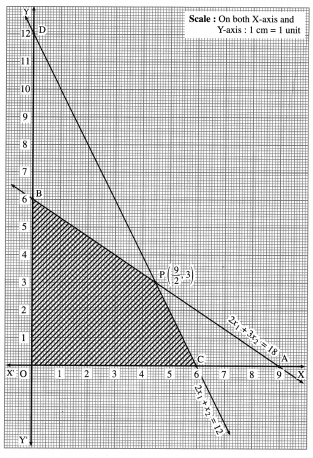
First we draw the lines AB and CD whose equations are 2x1 + 3x2 = 18 and 2x1 + x2 = 12 respectively. The feasible region is OCPBO which is shaded in the graph. The vertices of the feasible region are O(0, 0), C(6, 0), P and B (0,6). P is the point of intersection of the lines 2x1 + 3x2 = 18 ….(1) and 2x1 + x2 = 12 On subtracting, we get 2x2 = 6 ∴ x2 = 3 Substituting x2 = 3 in (2), we get 2x1 + 3 = 12 ∴ x2 = 9 ∴ P is (, 3) The values of objective function z = 5x1 + 6x2 at these vertices are z(O) = 5(0) + 6(0) = 0 + 0 = 0 z(C) = 5(6) + 6(0) = 30 + 0 = 30 z(P) = 5() + 6(3) = + 18 = = 40.5 z(B) = 5(0) + 6(3) = 0 + 18 = 18 Maximum value of z is 40.5 when x1 = 9/2, y = 3.
(ii) Maximize z = 4x + 2y subject to 3x + y ≥ 27, x + y ≥ 21
Question is modified.
Maximize z = 4x + 2y subject to 3x + y ≤ 27, x + y ≤ 21, x ≥ 0, y ≥ 0
Solution:
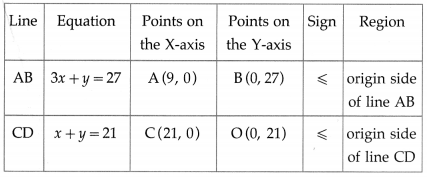
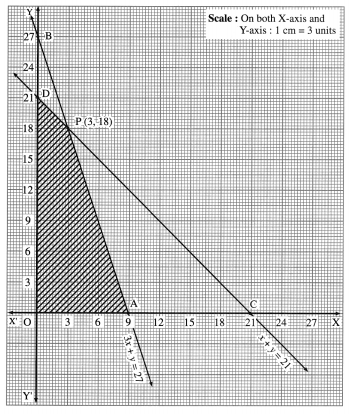
First we draw the lines AB and CD whose equations are 3x + y = 27 and x + y = 21 respectively.
The feasible region is OAPDO which is shaded region in the graph. The vertices of the feasible region are 0(0, 0), A (9, 0), P and D(0, 21). P is the point of intersection of lines
3x + y = 27 … (1)
and x + y = 21 … (2)
On substracting, we get 2x = 6 ∴ x = 3
Substituting x = 3 in equation (1), we get
9 + y = 27 ∴ y = 18
∴ P = (3, 18)
The values of the objective function z = 4x + 2y at these vertices are
z(O) = 4(0) + 2(0) = 0 + 0 = 0
z(a) = 4(9) + 2(0) = 36 + 0 = 36
z(P) = 4(3) + 2(18) = 12 + 36 = 48
z (D) = 4(0) + 2(21) = 0 + 42 = 42
∴ 2 has minimum value 48 when x = 3, y = 18.
(iii) Maximize z = 6x + 10y subject to 3x + 5y ≤ 10, 5x + 3y ≤ 15, x ≥ 0, y ≥ 0
Solution:
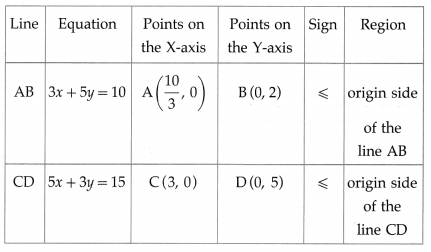
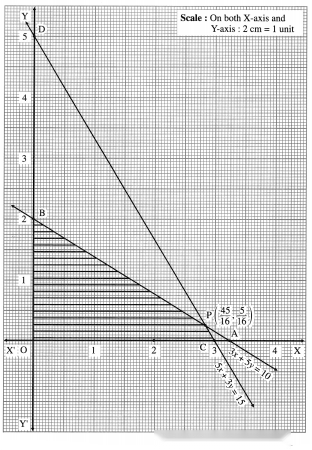
First we draw the lines AB and CD whose equations are 3x + 5y = 10 and 5x + 3y = 15 respectively.
The feasible region is OCPBD which is shaded in the graph.
The vertices of the feasible region are 0(0, 0), C(3, 0), P and B (0, 2).
P is the point of intersection of the lines
3x + 5y = 10 … (1)
and 5x + 3y = 15 … (2)
Multiplying equation (1) by 5 and equation (2) by 3, we get
15x + 25y = 50
15x + 9y = 45
On subtracting, we get
16y = 5 ∴ y =
Substituting y = in equation (1), we get
3x + = 10 ∴ 3x = 10 –
∴ x = ∴ P ≡
The values of objective function z = 6x + 10y at these vertices are
z(O) = 6(0) + 10(0) = 0 + 0 = 0
z(C) = 6(3) + 10(0) = 18 + 0 = 18
z(P) = 6 + 10 = = 20
z(B) = 6(0) + 10(2) = 0 + 20 = 20
The maximum value of z is 20 at P and B (0, 2) two consecutive vertices.
∴ z has maximum value 20 at each point of line segment PB where B is (0, 2) and P is .
Hence, there are infinite number of optimum solutions.
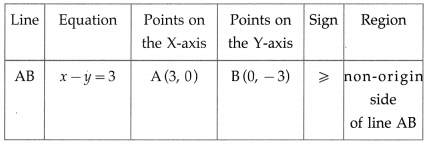
(iv) Maximize z = 2x + 3y subject to x – y ≥ 3, x ≥ 0, y ≥ 0
Solution:
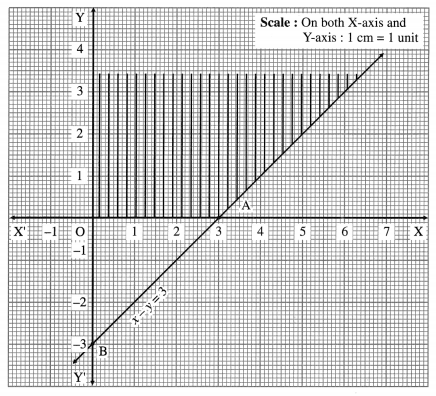
First we draw the lines AB whose equation is x – y = 3.
The feasible region is shaded which is unbounded.
Therefore, the value of objective function can be in- j creased indefinitely. Hence, this LPP has unbounded solution.
Solution & Step-by-Step Answer:
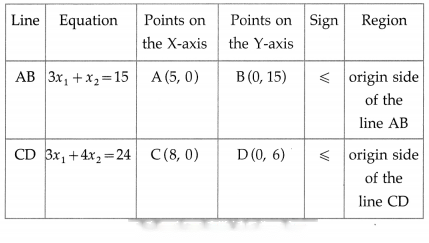
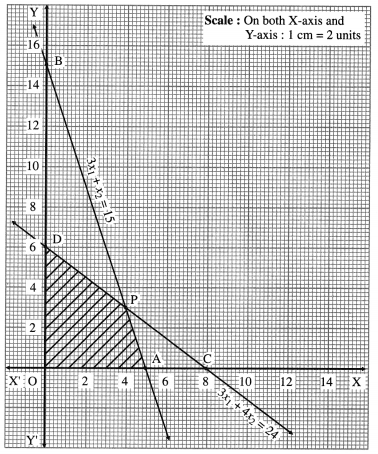
We first draw the lines AB and CD whose equations are 3x1 + x2 = 15 and 3x1 + 4x2 = 24 respectively. The feasible region is OAPDO which is shaded in the graph. The Vertices of the feasible region are 0(0, 0), A(5, 0), P and D(0, 6). P is the point of intersection of lines. 3x1 + 4x2 = 24 … (1) and 3x1 + x2 = 15 … (2) On subtracting, we get 3x2 = 9 ∴ x2 = 3 Substituting x2 = 3 in (2), we get 3x1 + 3 = 15 ∴ 3x1 = 12 ∴ x1 = 4 ∴ P is (4, 3) The values of objective function z = 4x1 + 3x2 at these vertices are z(O) = 4(0) + 3(0) = 0 + 0 = 0 z(a) = 4(5) + 3(0) = 20 + 0 = 20 z(P) = 4(4) + 3(3) = 16 + 9 = 25 z(D) = 4(0) + 3(6) = 0 + 18 = 18 ∴ z has maximum value 25 when x = 4 and y = 3.
(ii) Maximize z = 60x + 50y subject to x + 2y ≤ 40, 3x + 2y ≤ 60, x ≥ 0, y ≥ 0
Solution:
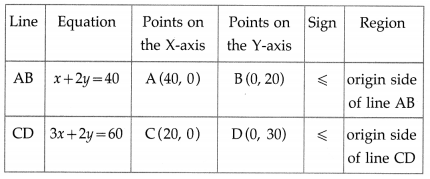
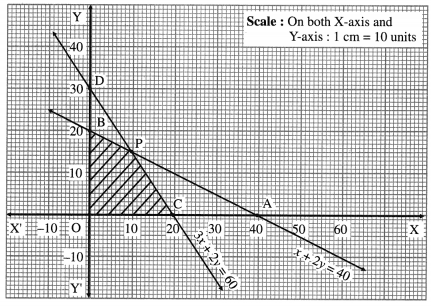
We first draw the lines AB and CD whose equations are x + 2y = 40 and 3x + 2y = 60 respectively.
The feasible region is OCPBO which is shaded in the graph.
The vertices of the feasible region are O (0, 0), C (20, 0), P and B (0, 20).
P is the point of intersection of the lines.
3x + 2y = 60 … (1)
and x + 2y = 40 … (2)
On subtracting, we get
2x = 20 ∴ x = 10
Substituting x = 10 in (2), we get
10 + 2y = 40
∴ 2y = 30 ∴ y = 15 ∴ P is (10, 15)
The values of the objective function z = 60x + 50y at these vertices are
z(O) = 60(0) + 50(0) = 0 + 0 = 0
z(C) = 60(20) + 50(0) = 1200 + 0 = 1200
z(P) = 60(10) + 50(15) = 600 + 750 = 1350
z(B) = 60(0) + 50(20) = 0 + 1000 = 1000.
∴ z has maximum value 1350 at x = 10, y = 15.
(iii) Maximize z = 4x + 2y subject to 3x + y ≥ 27, x + y ≥ 21, x + 2y ≥ 30; x ≥ 0, y ≥ 0
Solution:
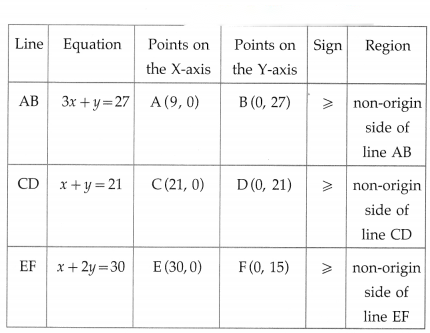
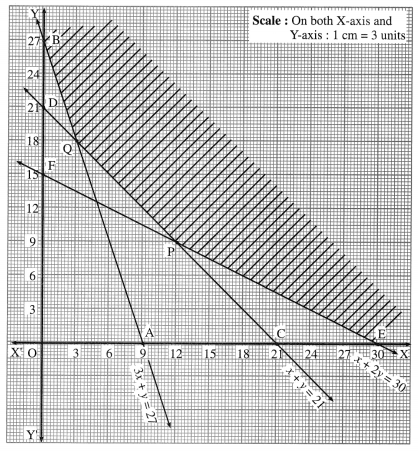
We first draw the lines AB, CD and EF whose equations are 3x + y = 27, x + y = 21, x + 2y = 30 respectively.
The feasible region is XEPQBY which is shaded in the graph.
The vertices of the feasible region are E (30,0), P, Q and B (0,27).
P is the point of intersection of the lines
x + 2y = 30 … (1)
and x + y = 21 … (2)
On subtracting, we get
y = 9
Substituting y = 9 in (2), we get
x + 9 = 21 ∴ x = 12
∴ P is (12, 9)
Q is the point of intersection of the lines
x + y = 21 … (2)
and 3x + y = 27 … (3)
On subtracting, we get
2x = 6 ∴ x = 3
Substituting x = 3 in (2), we get
3 + y = 21 ∴ y = 18
∴ Q is (3, 18).
The values of the objective function z = 4x + 2y at these vertices are
z(E) = 4(30) + 2(0) = 120 + 0 = 120
z(P) = 4(12) + 2(9) = 48 + 18 = 66
z(Q) = 4(3) + 2(18) = 12 + 36 = 48
z(B) = 4(0) + 2(27) = 0 + 54 = 54
∴ z has minimum value 48, when x = 3 and y = 18.
Solution & Step-by-Step Answer:
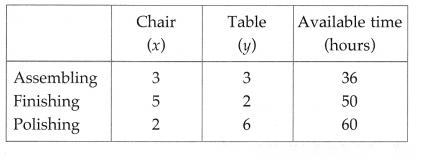
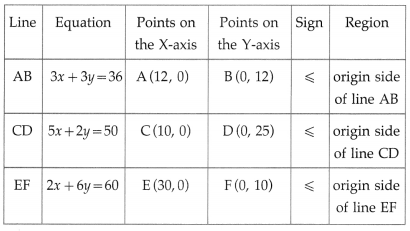
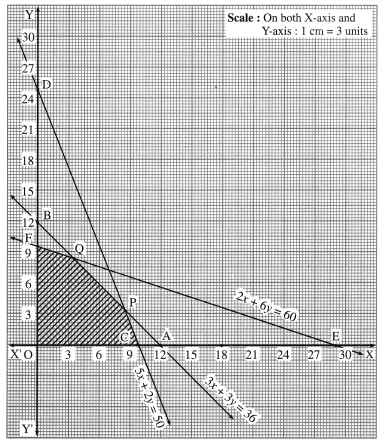
Let the number of chairs and tables made by the carpenter be x and y respectively. The profits are ₹ 140 per chair and ₹ 210 per table. ∴ total profit z = ₹ (140x + 210y) This is the objective function which is to be maximized. The constraints are as per the following table : From the table, the constraints are 3x + 3y ≤ 36, 5x + 2y ≤ 50, 2x + 6y ≤ 60. The number of chairs and tables cannot be negative. ∴ x ≥ 0, y ≥ 0 Hence, the mathematical formulation of given LPP is : Maximize z = 140x + 210y, subject to 3x + 3y ≤ 36, 5x + 2y ≤ 50, 2x + 6y ≤ 60, x ≥ 0, y ≥ 0. We first draw the lines AB, CD and EF whose equations are 3x + 3y = 36, 5x + 2y = 50 and 2x + 6y = 60 respectively. The feasible region is OCPQFO which is shaded in the graph. The vertices of the feasible region are O (0, 0), C (10, 0), P, Q and F (0, 10). P is the point of intersection of the lines 5x + 2y = 50 … (1) and 3x + 3y = 36 … (2) Multiplying equation (1) by 3 and equation (2) by 2, we get 15x + 6y = 150 6x + 6y = 72 On subtracting, we get 26 9x = 78 ∴ x = Substituting x = in (2), we get 3 + 3y = 36 3y = 1o y = Q is the point of intersection of the lines 3x + 3y = 36 … (2) and 2x + 6y = 60 … (3) Multiplying equation (2) by 2, we get 6x + 6 y = 72 Subtracting equation (3) from this equation, we get 4x = 12 ∴ x = 3 Substituting x = 3 in (2), we get 3(3) + 3y = 36 ∴ 3y = 27 ∴ y = 9 ∴ Q is (3, 9). Hence, the vertices of the feasible region are O (0, 0), C(10, 0), P, Q(3, 9) and F(0, 10). The values of the objective function z = 140x + 210y at these vertices are z(O) = 140(0) + 210(0) = 0 + 0 = 0 z(C) = 140 (10) + 210(0) = 1400 + 0 = 1400 z(P) = 140 + 210 = = 1913.33 z(Q) = 140(3) + 210(9) = 420 + 1890 = 2310 z(F) = 140(0) + 210(10) = 0 + 2100 = 2100 ∴ z has maximum value 2310 when x = 3 and y = 9 Hence, the carpenter should make 3 chairs and 9 tables to get the maximum profit of ₹ 2310.

Solution & Step-by-Step Answer:
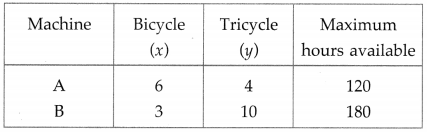
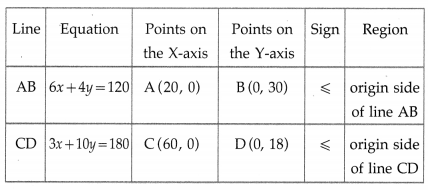
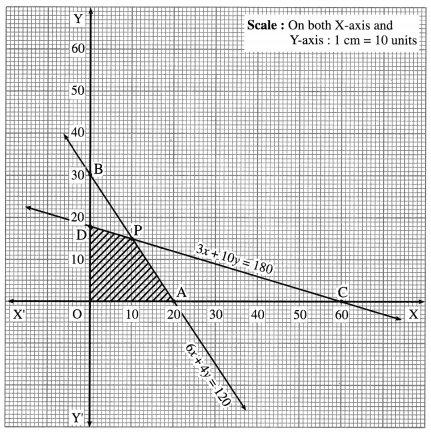
Let x bicycles and y tricycles are to be manu¬factured. Then the total profit is z = ₹ (180x + 220y) This is a linear function which is to be maximized. Hence, it is the objective function. The constraints are as per the following table : From the table, the constraints are 6x + 4y ≤ 120, 3x +10y ≤ 180 Also, the number of bicycles and tricycles cannot be i negative. ∴ x ≥ 0, y ≥ 0. Hence, the mathematical formulation of given LPP is : Maximize z = 180x + 220y, subject to 6x + 4y ≤ 120, 3x + 10y ≤ 180, x ≥ 0, y ≥ 0. First we draw the lines AB and CD whose equations are 6x + 4y = 120 and 3x + 10y = 180 respectively. The feasible region is OAPDO which is shaded in the graph. The vertices of the feasible region are O(0, 0), A(20, 0) P and D(0, 18). P is the point of intersection of the lines 3x + 10y = 180 … (1) and 6x + 4y = 120 … (2) Multiplying equation (1) by 2, we get 6x + 20y = 360 Subtracting equation (2) from this equation, we get 16y = 240 ∴ y = 15 ∴ from (1), 3x + 10(15) = 180 ∴ 3x = 30 ∴ x = 10 ∴ P = (10, 15) The values of the objective function z = 180x + 220y at these vertices are z(O) = 180(0) + 220(0) = 0 + 0 = 0 z(a) = 180(20) + 220(0) = 3600 + 0 = 3600 z(P) = 180(10) + 220(15) = 1800 + 3300 = 5100 z(D) = 180(0) +220(18) = 3960 ∴ the maximum value of z is 5100 at the point (10, 15). Hence, 10 bicycles and 15 tricycles should be manufactured in order to have the maximum profit of ₹ 5100.
Solution & Step-by-Step Answer:
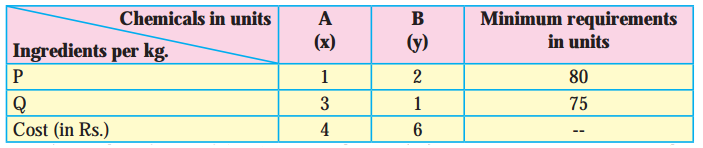
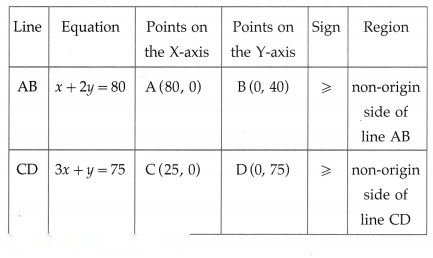
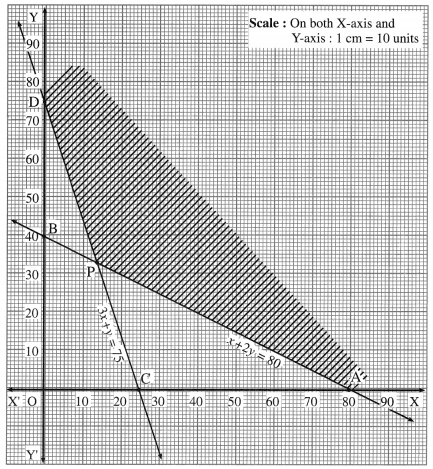
Let the factory produce x units of chemical A and y units of chemical B. Then the total cost is z = ₹ (4x + 6y). This is the objective function which is to be minimized. From the given table, the constraints are x + 2y ≥ 80, 3x + y ≥ 75. Also, the number of units x and y of chemicals A and B cannot be negative. ∴ x ≥ 0, y ≥ 0. ∴ the mathematical formulation of given LPP is Minimize z = 4x + 6y, subject to x + 2y ≥ 80, 3x + y ≥ 75, x ≥ 0, y ≥ 0. First we draw the lines AB and CD whose equations are x + 2y = 80 and 3x + y = 75 respectively. The feasible region is shaded in the graph. The vertices of the feasible region are A (80, 0), P and D (0, 75). P is the point of intersection of the lines x + 2y = 80 … (1) and 3x + y = 75 … (2) Multiplying equation (2) by 2, we get 6x + 2 y = 150 Subtracting equation (1) from this equation, we get 5x = 70 ∴ x = 14 ∴ from (2), 3(14) + y = 75 ∴ 42 + y = 75 ∴ y = 33 ∴ P = (14, 33) The values of the objective function z = 4x + 6y at these vertices are z(a) = 4(80)+ 6(0) =320 + 0 = 320 z(P) = 4(14)+ 6(33) = 56+ 198 = 254 z(D) = 4(0) + 6(75) = 0 + 450 = 450 ∴ the minimum value of z is 254 at the point (14, 33). Hence, 14 units of chemical A and 33 units of chemical B are to be produced in order to have the j minimum cost of ₹ 254.
Solution & Step-by-Step Answer:
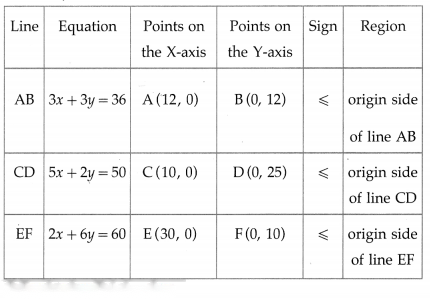
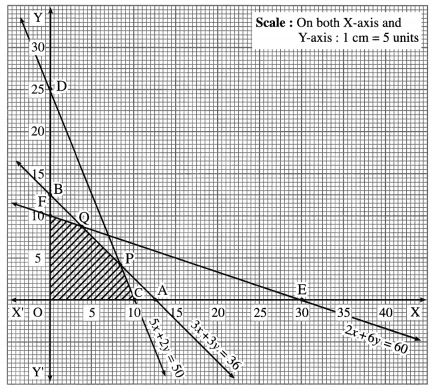
Let the company produce x mixers and y food processors. Then the total profit is z = ₹ (2000x + 3000y) This is the objective function which is to be maximized. From the given table in the problem, the constraints are 3x + 3y ≤ 36, 5x + 2y ≤ 50, 2x + 6y ≤ 60 Also, the number of mixers and food processors cannot be negative, ∴ x ≥ 0, y ≥ 0. ∴ the mathematical formulation of given LPP is Maximize z = 2000x + 3000y, subject to 3x + 3y ≤ 36, 5x + 2y ≤ 50, 2x + 6y ≤60, x ≥ 0, y ≥ 0. First we draw the lines AB, CD and EF whose equations are 3x + 3y = 36, 5x + 2y = 50 and 2x + 6y = 60 respectively. The feasible region is OCPQFO which is shaded in the graph. The vertices of the feasible region are O(0, 0), C(10, 0), P, Q and F(0,10). P is the point of intersection of the lines 3x + 3y = 36 … (1) and 5x + 2y = 50 … (2) Multiplying equation (1) by 2 and equation (2) by 3, we get 6x + 6y = 72 15x + 6y = 150 On subtracting, we get 9x = 78 ∴ x = ∴ from (1), 3 + 3y = 36 ∴ 3y = 10 ∴ y = ∴ P = Q is the point of intersection of the lines 3x + 3y = 36 … (1) and 2x + 6y = 60 … (3) Multiplying equation (1) by 2, we get 6x + 6y = 72 Subtracting equation (3), from this equation, we get 4x = 12 ∴ x = 3 ∴ from (1), 3(3) + 3y = 36 ∴ 3y = 27 ∴ y = 9 ∴ Q = (3, 9) The values of the objective function z = 2000x + 3000y at these vertices are z(O) = 2000(0) + 3000(0) = 0 + 0 = 0 z(C) = 2000(10) + 3000(0) = 20000 + 0 = 20000 z(P) = 2000 + 3000 = z(Q) = 2000(3) + 3000(9) = 6000 + 27000 = 33000 z(F) = 2000(0) + 3000(10) = 30000 + 0 = 30000 ∴ the maximum value of z is 33000 at the point (3, 9). Hence, 3 mixers and 9 food processors should be produced in order to get the maximum profit of ₹ 33,000.

Solution & Step-by-Step Answer:
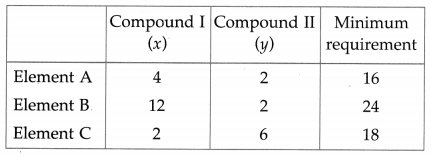
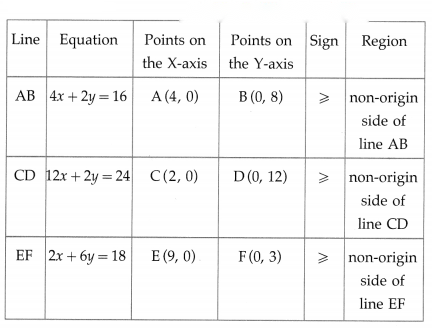
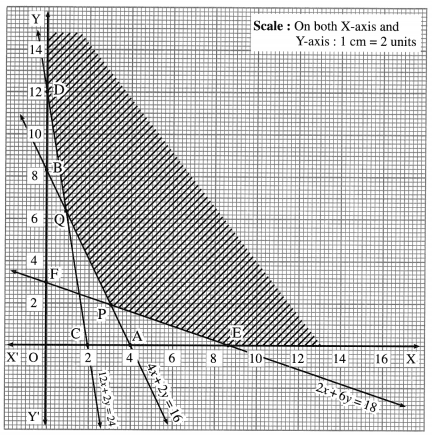
Let the company buy x units of compound I and y units of compound II. Then the total cost is z = ₹(800x + 640y). This is the objective function which is to be minimized. The constraints are as per the following table : From the table, the constraints are 4x + 2y ≥ 16, 12x + 2y ≥ 24, 2x + 6y ≥ 18. Also, the number of units of compound I and compound II cannot be negative. ∴ x ≥ 0, y ≥ 0. ∴ the mathematical formulation of given LPP is Minimize z = 800x + 640y, subject to 4x + 2y ≥ 16, 12x + 2y ≥ 24, 2x + 6y ≥ 18, x ≥ 0, y ≥ 0. First we draw the lines AB, CD and EF whose equations are 4x + 2y = 16, 12x + 2y = 24 and 2x + 6y = 18 The feasible region is shaded in the graph. The vertices of the feasible region are E(9, 0), P, Q, and D(0, 12). P is the point of intersection of the lines 2x + 6y = 18 … (1) and 4x + 2y = 16 … (2) Multiplying equation (1) by 2, we get 4x + 12y = 36 Subtracting equation (2) from this equation, we get 10y = 20 ∴ y = 2 ∴ from (1), 2x + 6(2) = 18 ∴ 2x = 6 ∴ x = 3 ∴ P = (3, 2) Q is the point of intersection of the lines 12x + 2y = 24 … (3) and 4x + 2y = 16 … (2) On subtracting, we get 8x = 8 ∴ x = 1 ∴ from (2), 4(1) + 2y = 16 ∴ 2y = 12 ∴ y = 6 ∴ Q = (1, 6) The values of the objective function z = 800x + 640y at these vertices are z(E) = 800(9)+ 640(0) =7200 + 0 = 7200 z(P) = 800(3) + 640(2) = 2400 + 1280 = 3680 z(Q) = 800(1) + 640(6) =800 + 3840 =4640 z(D) = 800(0) + 640(12) = 0 + 7680 = 7680 ∴ the minimum value of z is 3680 at the point (3, 2). Hence, the company should buy 3 units of compound I and 2 units of compound II to have the minimum cost of ₹ 3680.
Solution & Step-by-Step Answer:
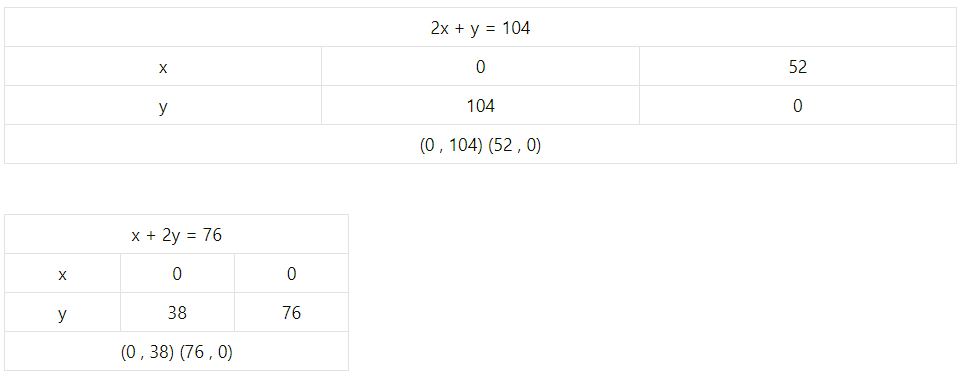
Let x: number of gift item A y: number of gift item B As numbers of the items are never negative x ≥ 0; y ≥ 0 Total time required for the cutter = 4x + 2y Maximum available time 208 hours ∴ 4x+ 2y ≤ 208 Total time required for the finisher 2x +4y Maximum available time 152 hours 2x + 4y ≤ 152 Total Profit is 75x + 125y ∴ L.P.P. of the above problem is Minimize z = 75x + 125y Subject to 4x+ 2y ≤ 208 2x + 4y ≤ 152 x ≥ 0; y ≥ 0 Graphical solution Corner points Now, Z at x = (75x + 125y) O(0, 0) = 75 × 0 + 125 × 0 = 0 A(52,0) = 75 × 52 + 125 × 0 = 3900 B(44, 16) = 75 × 44 + 125 × 16 = 5300 C(0, 38) = 75 × 0 + 125 × 38 = 4750 A person should make 44 items of type A and 16 Uems of type Band his returns are ₹ 5,300.

Solution & Step-by-Step Answer:
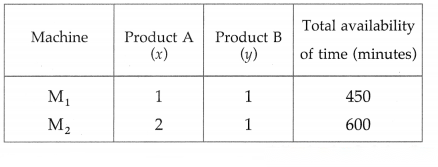
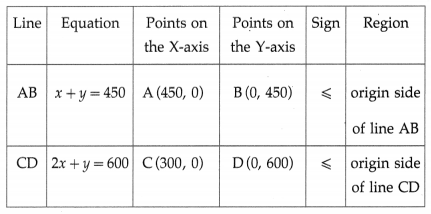
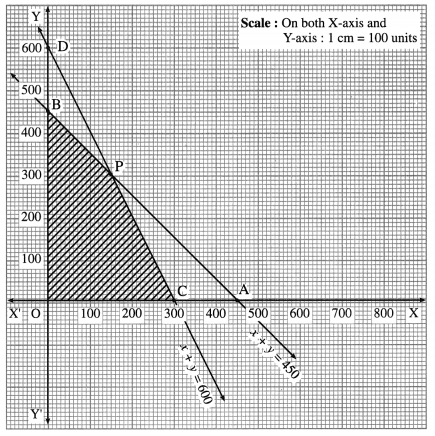
Let the firm manufactures x units of product A and y units of product B. The profit earned per unit of A is ₹3 and B is ₹ 4. Hence, the total profit is z = ₹ (3x + 4y). This is the linear function which is to be maximized. Hence, it is the objective function. The constraints are as per the following table : From the table, the constraints are x + y ≤ 450, 2x + y ≤ 600 Since, the number of gift items cannot be negative, x ≥ 0, y ≥ o. ∴ the mathematical formulation of LPP is, Maximize z = 3x + 4y, subject to x + y ≤ 450, 2x + y ≤ 600, x ≥ 0, y ≥ 0. Now, we draw the lines AB and CD whose equations are x + y = 450 and 2x + y — 600 respectively. The feasible region is OCPBO which is shaded in the graph. The vertices of the feasible region are O(0, 0), C(300, 0), P and B (0, 450). P is the point of intersection of the lines 2x + y = 600 … (1) and x + y = 450 … (2) On subtracting, we get ∴ x = 150 Substituting x = 150 in equation (2), we get 150 + y = 450 ∴ y = 300 ∴ P = (150, 300) The values of the objective function z = 3x + 4y at these vertices are z(O) = 3(0) + 4(0) = 0 + 0 = 0 z(C) = 3(300) + 4(0) = 900 + 0 = 900 z(P) = 3(150) + 4(300) = 450 + 1200 = 1650 z(B) = 3(0) + 4(450) = 0 + 1800 = 1800 ∴ z has the maximum value 1800 when x = 0 and y = 450 Hence, the firm gets maximum profit of ₹ 1800 if it manufactures 450 units of product B and no unit product A.
Solution & Step-by-Step Answer:
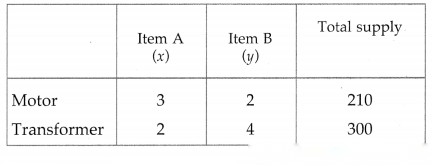
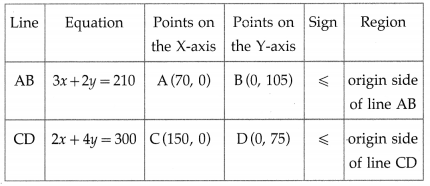
Let the firm manufactures x units of item A and y units of item B. Firm can make profit of ₹ 20 per unit of A and ₹ 30 per unit of B. Hence, the total profit is z = ₹ (20x + 30y). This is the objective function which is to be maximized. The constraints are as per the following table : From the table, the constraints are 3x + 2y ≤ 210, 2x + 4y ≤ 300 Since, number of items cannot be negative, x ≥ 0, y ≥ 0. Hence, the mathematical formulation of given LPP is : Maximize z = 20x + 30y, subject to 3x + 2y ≤ 210, 2x + 4y ≤ 300, x ≥ 0, y ≥ 0. We draw the lines AB and CD whose equations are 3x + 2y = 210 and 2x + 4y = 300 respectively. The feasible region is OAPDO which is shaded in the graph. The vertices of the feasible region are O (0, 0), A (70, 0), P and D (0, 75). P is the point of intersection of the lines 2x + 4y = 300 … (1) and 3x + 2y = 210 … (2) Multiplying equation (2) by 2, we get 6x + 4y = 420 Subtracting equation (1) from this equation, we get ∴ 4x = 120 ∴ x = 30 Substituting x = 30 in (1), we get 2(30) + 4y = 300 ∴ 4y = 240 ∴ y = 60 ∴ P is (30, 60) The values of the objective function z = 20x + 30y at these vertices are z(O) = 20(0) + 30(0) = 0 + 0 = 0 z(A) = 20(70) + 30(0) = 1400 + 0 = 1400 z(P) = 20(30) + 30(60) = 600 + 1800 = 2400 z(D) = 20(0) + 30(75) = 0 + 2250 = 2250 ∴ z has the maximum value 2400 when x = 30 and y = 60. Hence, the firm should manufactured 30 units of item A and 60 units of item B to get the maximum profit of ₹ 2400.