Balbharti12th Maharashtra State Board Maths Solutions BookPdf Chapter 6 Line and Plane Miscellaneous Exercise 6B Questions and Answers.
Maharashtra State Board 12th Maths Solutions Chapter 6 Line and Plane Miscellaneous Exercise 6B
Question 1
Maharashtra Board Solution
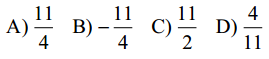
If the line = z is perpendicular to the line then the value of k is:
Solution & Step-by-Step Answer:
(b)
Question 2
Maharashtra Board Solution
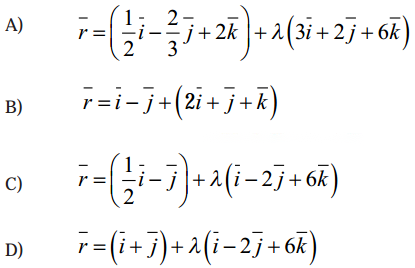
The vector equation of line 2x – 1 = 3y + 2 = z – 2 is
Solution & Step-by-Step Answer:
(a)
Question 3
Maharashtra Board Solution
The direction ratios of the line which is perpendicular to the two lines and are (A) 4, 5, 7 (B) 4, -5, 7 (C) 4, -5, -7 (D) -4, 5, 8
Solution & Step-by-Step Answer:
(A) 4, 5, 7
Question 4
Maharashtra Board Solution
The length of the perpendicular from (1, 6, 3) to the line (A) 3 (B) (C) (D) 5
Solution & Step-by-Step Answer:
(C )
Question 5
Maharashtra Board Solution
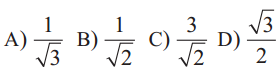
The shortest distance between the lines and is Question is modified. The shortest distance between the lines and is
Solution & Step-by-Step Answer:
(c)
Question 6
Maharashtra Board Solution
The lines and . and coplanar if (A) k = 1 or -1 (B) k = 0 or -3 (C) k = + 3 (D) k = 0 or -1
Solution & Step-by-Step Answer:
(B ) k = 0 or -3
Question 7
Maharashtra Board Solution
The lines and and are (A) perpendicular (B) inrersecting (C) skew (D) coincident
Solution & Step-by-Step Answer:
(B) inrersecting
Question 8
Maharashtra Board Solution
Equation of X-axis is (A) x = y = z (B) y = z (C) y = 0, z = 0 (D) x = 0, y = 0
Solution & Step-by-Step Answer:
(C) y = 0, z = 0
Question 9
Maharashtra Board Solution
The angle between the lines 2x = 3y = -z and 6x = -y = -4z is (A ) 45º (B ) 30º (C ) 0º (D ) 90º
Solution & Step-by-Step Answer:
(D ) 90º
Question 10
Maharashtra Board Solution
The direction ratios of the line 3x + 1 = 6y – 2 = 1 – z are (A ) 2, 1, 6 (B ) 2, 1, -6 (C ) 2, -1, 6 (D ) -2, 1, 6
Solution & Step-by-Step Answer:
(B ) 2, 1, -6
Question 11
Maharashtra Board Solution
The perpendicular distance of the plane 2x + 3y – z = k from the origin is units, the value of k is (A ) 14 (B ) 196 (C ) (D )
Solution & Step-by-Step Answer:
(A ) 14
Question 12
Maharashtra Board Solution
The angle between the planes and and is
Solution & Step-by-Step Answer:
(d) cos-1

Question 13
Maharashtra Board Solution
If the planes and are parallel, then the values of λ and μ are respectively.
Solution & Step-by-Step Answer:
(d) , 2

Question 14
Maharashtra Board Solution
The equation of the plane passing through (2, -1, 3) and making equal intercepts on the coordinate axes is (A ) x + y + z =1 (B ) x + y + z = 2 (C ) x + y + z = 3 (D ) x + y + z = 4
Solution & Step-by-Step Answer:
(D ) x + y + z = 4
Question 15
Maharashtra Board Solution
Measure of angle between the planes 5x – 2y + 3z – 7 = 0 and 15x – 6y + 9z + 5 = 0 is (A ) 0º (B ) 30º (C ) 45º (D ) 90º
Solution & Step-by-Step Answer:
(A ) 0º
Question 16
Maharashtra Board Solution
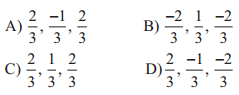
The direction cosines of the normal to the plane 2x – y + 2z = 3 are
Solution & Step-by-Step Answer:
(a)
Question 17
Maharashtra Board Solution
The equation of the plane passing through the points (1, -1, 1), (3, 2, 4) and parallel to Y-axis is : (A ) 3x + 2z – 1 = 0 (B ) 3x – 2z = 1 (C ) 3x + 2z + 1 = 0 (D ) 3x + 2z = 2
Solution & Step-by-Step Answer:
(B ) 3x – 2z = 1
Question 18
Maharashtra Board Solution
The equation of the plane in which the line and lie, is (A ) 17x – 47y – 24z + 172 = 0 (B ) 17x + 47y – 24z + 172 = 0 (C ) 17x + 47y + 24z +172 = 0 (D ) 17x – 47y + 24z + 172 = 0
Solution & Step-by-Step Answer:
(A ) 17x – 47y – 24z + 172 = 0
Question 19
Maharashtra Board Solution
If the line lies in the plane 3x – 14y + 6z + 49 = 0, then the value of m is: (A ) 5 (B ) 3 (C ) 2 (D ) -5
Solution & Step-by-Step Answer:
(A ) 5
Question 20
Maharashtra Board Solution
The foot of perpendicular drawn from the point (0,0,0) to the plane is (4, -2, -5) then the equation of the plane is (A ) 4x + y + 5z = 14 (B ) 4x – 2y – 5z = 45 (C ) x – 2y – 5z = 10 (D ) 4x + y + 6z = 11
Solution & Step-by-Step Answer:
(B ) 4x – 2y – 5z = 45
II. Solve the following :
Question 1.
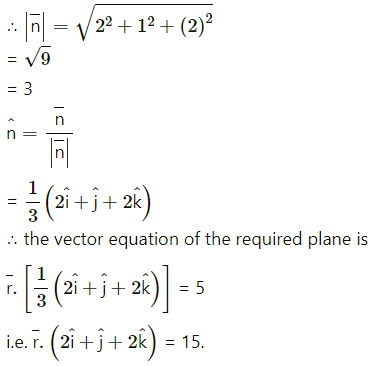
Find the vector equation of the plane which is at a distance of 5 unit from the origin and which is normal to the vector
Solution:
If is a unit vector along the normal and p i the length of the perpendicular from origin to the plane, then the vector equation of the plane = p
Here, and p = 5
Question 2
Maharashtra Board Solution
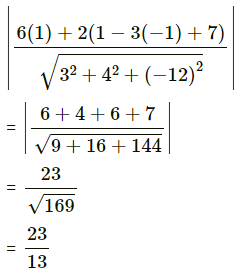
Find the perpendicular distance of the origin from the plane 6x + 2y + 3z – 7 = 0
Solution & Step-by-Step Answer:
The distance of the point (x1, y1, z1) from the plane ax + by + cz + d is ∴ the distance of the point (1, 1, -1) from the plane 6x + 2y + 3z – 7 = 0 is = 1units.
Question 3
Maharashtra Board Solution
Find the coordinates of the foot of the perpendicular drawn from the origin to the plane 2x + 3y + 6z = 49.
Solution & Step-by-Step Answer:
The equation of the plane is 2x + 3y + 6z = 49 Dividing each term by = = 7 we get x + y – z = = 7 This is the normal form of the equation of plane. ∴ the direction cosines of the perpendicular drawn from the origin to the plane are l = , m = , n = and length of perpendicular from origin to the plane is p = 7. the coordinates of the foot of the perpendicular from the origin to the plane are (lp, ∓, np)i.e.(2, 3, 6)
Question 4
Maharashtra Board Solution
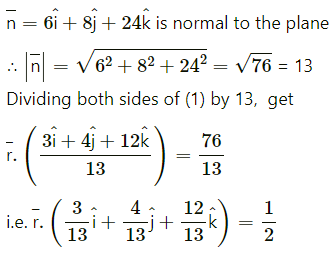
Reduce the equation to normal form and hence find (i) the length of the perpendicular from the origin to the plane (ii) direction cosines of the normal.
Solution & Step-by-Step Answer:
The normal form of equation of a plane is = p where is unit vector along the normal and p is the length of perpendicular drawn from origin to the plane. Given pane is …(1) This is the normal form of the equation of plane. Comparing with = p, (i) the length of the perpendicular from the origin to plane is . (ii) direction cosines of the normal are
Question 5
Maharashtra Board Solution
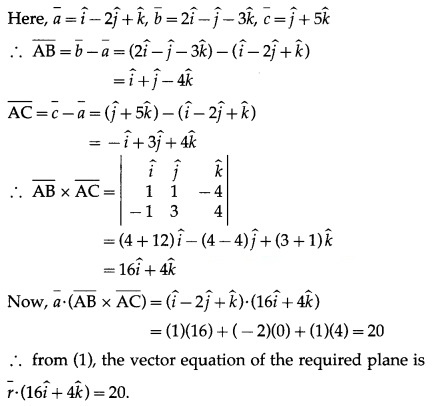
Find the vector equation of the plane passing through the points A(1, -2, 1), B (2, -1, -3) and C (0, 1, 5).
Solution & Step-by-Step Answer:
The vector equation of the plane passing through three non-collinear points A(), B() and C() is … (1)
Question 6
Maharashtra Board Solution
Find the Cartesian equation of the plane passing through A(1, -2, 3) and the direction ratios of whose normal are 0, 2, 0.
Solution & Step-by-Step Answer:
The Cartesian equation of the plane passing through (x1, y1, z1), the direction ratios of whose normal are a, b, c, is a(x – x1) + b(y – y1) + c(z – z1) = 0 ∴ the cartesian equation of the required plane is o(x + 1) + 2(y + 2) + 5(z – 3) = 0 i.e. 0 + 2y – 4 + 10z – 15 = 0 i.e. y + 2 = 0.
Question 7
Maharashtra Board Solution
Find the Cartesian equation of the plane passing through A(7, 8, 6) and parallel to the plane
Solution & Step-by-Step Answer:
The cartesian equation of the plane is 6x + 8y + 7z = 0 The required plane is parallel to it ∴ its cartesian equation is 6x + 8y + 7z = p …(1) A (7, 8, 6) lies on it and hence satisfies its equation ∴ (6)(7) + (8)(8) + (7)(6) = p i.e., p = 42 + 64 + 42 = 148. ∴ from (1), the cartesian equation of the required plane is 6x + 8y + 7z = 148.
Question 8
Maharashtra Board Solution
The foot of the perpendicular drawn from the origin to a plane is M(1, 2,0). Find the vector equation of the plane.
Solution & Step-by-Step Answer:
The vector equation of the plane passing through A() and perpendicular to is . M(1, 2, 0) is the foot of the perpendicular drawn from origin to the plane. Then the plane is passing through M and is perpendicular to OM. If is the position vector of M, then = . Normal to the plane is = = = = 5 ∴ the vector equation of the required plane is = 5
Question 9
Maharashtra Board Solution
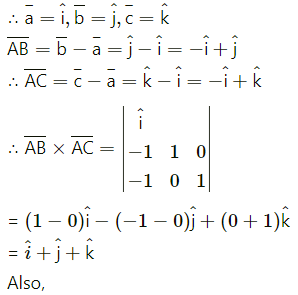
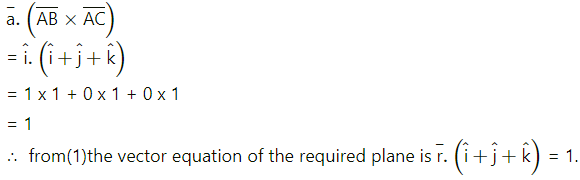
A plane makes non zero intercepts a, b, c on the co-ordinates axes. Show that the vector equation of the plane is = abc
Solution & Step-by-Step Answer:
The vector equation of the plane passing through A(), B().. C(), where A, B, C are non collinear is …(1) The required plane makes intercepts 1, 1, 1 on the coordinate axes. ∴ it passes through the three non collinear points A = (1, 0, 0), B = (0, 1, 0), C = (0,, 1)
Question 10
Maharashtra Board Solution
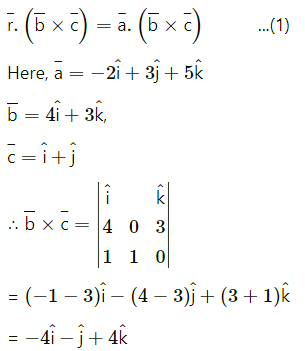
Find the vector equation of the plane passing through the pointA(-2, 3, 5) and parallel to vectors and
Solution & Step-by-Step Answer:
The vector equation of the plane passing through the point A() and parallel to the vectors and is = (-2)(-4) + (7)(-1) + (5)(4) = 8 – 7 + 8 = 35 ∴ From (1), the vector equation of the required plane is = 35.

Question 11
Maharashtra Board Solution
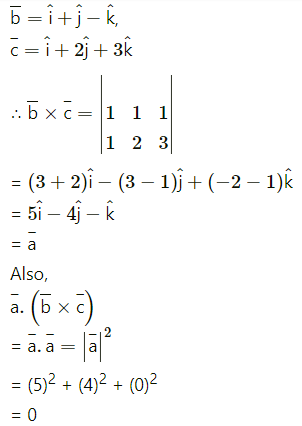
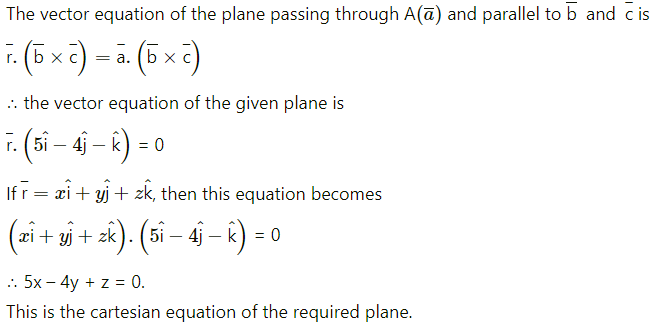
Find the Cartesian equation of the plane
Solution & Step-by-Step Answer:
The equation represents a plane passing through a point having position vector and parallel to vectors and . Here,
Question 12
Maharashtra Board Solution
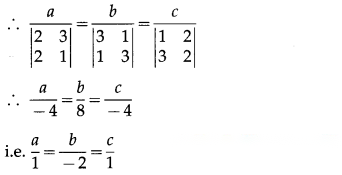
Find the vector equations of planes which pass through A(1, 2, 3), B (3, 2, 1) and make equal intercepts on the co-ordinates axes. Question is modified Find the cartesian equations of the planes which pass through A(1, 2, 3), B(3, 2, 1) and make equal intercepts on the coordinate axes.
Solution & Step-by-Step Answer:
Case 1 : Let all the intercepts be 0. Then the plane passes through the origin. Then the cartesian equation of the plane is ax + by + cz = 0 …..(1) (1, 2, 3) and (3, 2, 1) lie on the plane. ∴ a + 2b + 3c = 0 and 3a + 2b + c = 0 ∴ a, b, c are proportional to 1, -2, 1 ∴ from (1), the required cartesian equation is x – 2y + z = 0. Case 2 : Let the plane make non zero intercept p on each axis. then its equation is = 1 i.e. x + y + z = p …(2) Since this plane pass through (1, 2, 3) and (3, 2, 1) ∴ 1 + 2 + 3 = p and 3 + 2 + 1 = p ∴ p = 6 ∴ from (2), the required cartesian equation is x + y + z = 6 Hence, the cartesian equations of required planes are x + y + z = 6 and x – 2y + z = 0.
Question 13
Maharashtra Board Solution
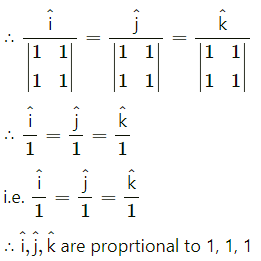
Find the vector equation of the plane which makes equal non-zero intercepts on the co-ordinates axes and passes through (1, 1, 1).
Solution & Step-by-Step Answer:
Case 1 : Let all the intercepts be 0. Then the plane passes through the origin. Then the vector equation of the plane is ax + by + cz …(1) (1, 1, 1) lie on the plane. ∴ 1a + 1b + 1c = 0 ∴ from (1), the required cartesian equation is x – y + z = 0 Case 2 : Let he plane make non zero intercept p on each axis. then its equation is = 1 i.e. = p ….(2) Since this plane pass through (1, 1, 1) ∴ 1 + 1 + 1 = p ∴ p = 3 ∴ from (2), the required cartesian equation is = 3 Hence, the cartesian equations of required planes are
Question 14
Maharashtra Board Solution
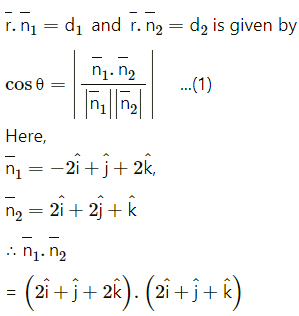
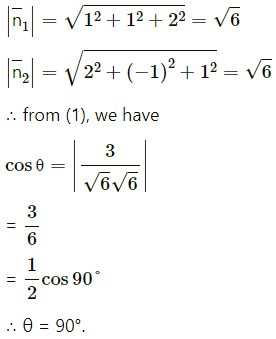
Find the angle between planes and .
Solution & Step-by-Step Answer:
The acute angle between the planes = (1)(2) + (1)(1) + (2)(1) = 2 + 1 + 2 = 5 Also,
Question 15
Maharashtra Board Solution
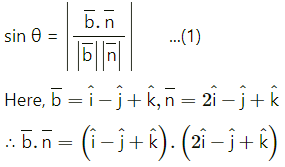
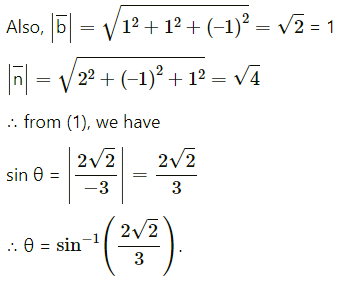
Find the acute angle between the line and the plane
Solution & Step-by-Step Answer:
The acute angle θ between the line and the plane = d is given by = (2)(2) + (3)(-1) + (-6)(1) = 4 – 3 – 6 = -5
Question 16
Maharashtra Board Solution
Show that lines and
Solution & Step-by-Step Answer:
Question 17
Maharashtra Board Solution
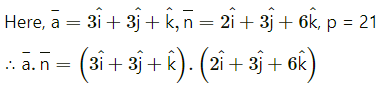
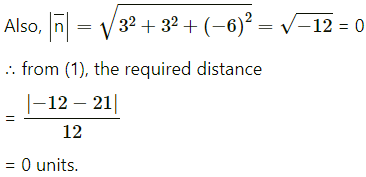
Find the distance of the point from the plane
Solution & Step-by-Step Answer:
The distance of the point A() from the plane = p is given by d = ……(1) = (3)(2) + (3)(3) + (1)(-6) = 6 + 9 – 6 = 9
Question 18
Maharashtra Board Solution
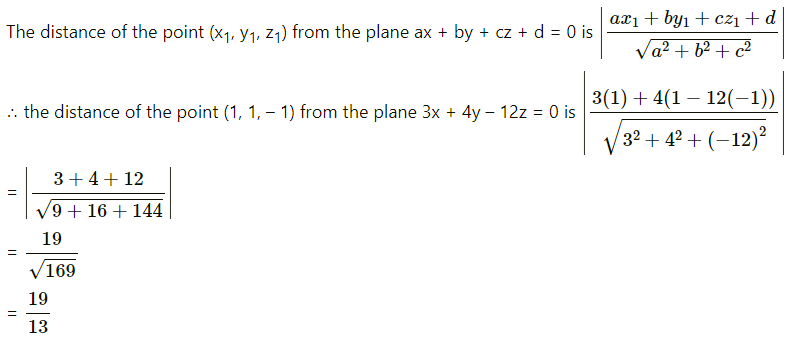
Find the distance of the point (13, 13, -13) from the plane 3x + 4y – 12z = 0.
Solution & Step-by-Step Answer:
= 19units.
Question 19
Maharashtra Board Solution
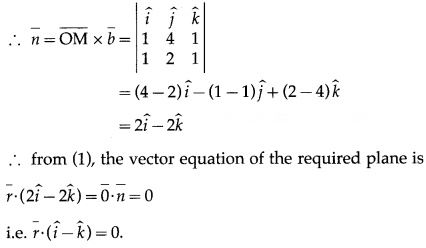
Find the vector equation of the plane passing through the origln and containing the line .
Solution & Step-by-Step Answer:
The vector equation of the plane passing through A() and perpendicular to the vector is … (1) We can take = since the plane passes through the origin. The point M with position vector = lies on the line and hence it lies on the plane..’. lies on the plane. The plane contains the given line which is parallel to Let be normal to the plane. Then is perpendicular to as well as
Question 20
Maharashtra Board Solution
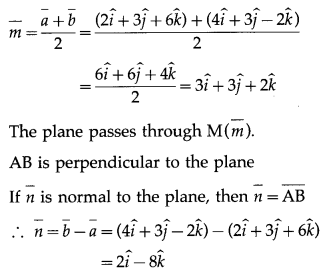
Find the vector equation of the plane which bisects the segment joining A(2, 3, 6) and B( 4, 3, -2) at right angle.
Solution & Step-by-Step Answer:
The vector equation of the plane passing through A() and perpendicular to the vector is ….(1) The position vectors and of the given points A and B are and If M is the midpoint of segment AB, the position vector of M is given by
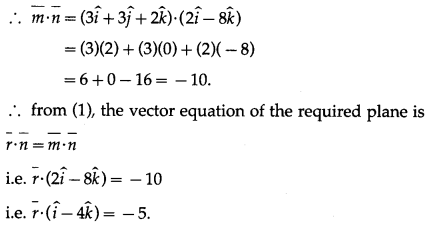
Question 21
Maharashtra Board Solution
Show thatlines x = y, z = 0 and x + y = 0, z = 0 intersect each other. Find the vector equation of the plane determined by them.
Solution & Step-by-Step Answer:
Given lines are x = y, z = 0 and x + y = 0, z = 0. It is clear that (0, 0, 0) satisfies both the equations. ∴ the lines intersect at O whose position vector is Since z = 0 for both the lines, both the lines lie in XY- plane. Hence, we have to find equation of XY-plane. Z-axis is perpendicular to XY-plane. ∴ normal to XY plane is . 0() lies on the plane. By using , the vector equation of the required plane is i.e. . Hence, the given lines intersect each other and the vector equation of the plane determine by them is .