Balbharti12th Maharashtra State Board Maths Solutions BookPdf Chapter 6 Line and Plane Ex 6.2 Questions and Answers.
Maharashtra State Board 12th Maths Solutions Chapter 6 Line and Plane Ex 6.2
Solution & Step-by-Step Answer:
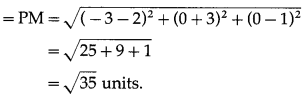
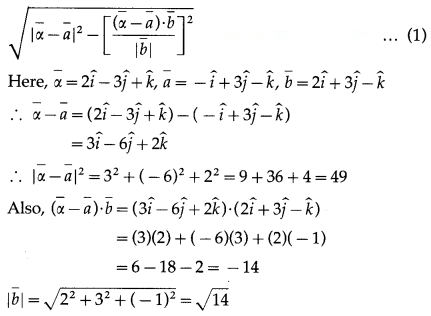
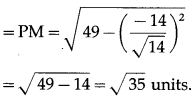
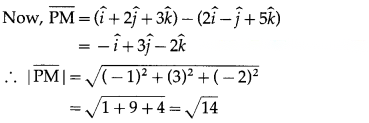
Let PM be the perpendicular drawn from the point P (2, -3, 1) to the line = λ …(Say) The coordinates of any point on the line are given by x = -1 + 2λ, y = 3 + 3λ, z = -1 – λ Let the coordinates of M be (-1 + 2λ, 3 + 3λ, -1 – λ) … (1) The direction ratios of PM are -1 + 2λ – 2, 3 + 3λ + 3, -1 – λ – 1 i.e. 2λ – 3, 3λ + 6, -λ – 2 The direction ratios of the given line are 2, 3, -1. Since PM is perpendicular to the given line, we get 2(2λ – 3) + 3(3λ + 6) – 1(-λ – 2) = 0 ∴ 4λ – 6 + 9λ + 18 + λ + 2 = 0 ∴ 14λ + 14 = 0 ∴ λ = -1. Put λ = -1 in (1), the coordinats of M are (-1 – 2, 3 – 3, -1 + 1) i.e. (-3, 0,0). ∴ length of perpendicular from P to the given line Alternative Method: We know that the perpendicular distance from the point P to the line is given by Substituting these values in (1), we get length of perpendicular from P to given line
Solution & Step-by-Step Answer:
Let M be the foot of perpendicular drawn from the point P () on the line . Let the position vector of the point M be Then = Position vector of M – Position vector of P = [(11 + 10λ) + (-2 – 4λ) + -8 – 11λ) ] – (2 – + 5) = (9 + 10λ) + (-1 – 4λ) + (-13 – 11λ) Since PM is perpendicular to the given line which is parallel to , ⊥r ∴ = 0 ∴ [(9 + 10λ) + ( – 1 – 4λ) + (-13 – 11λ)]-(10 – 4 – 11) = 0 ∴ 10(9 +10λ) – 4( -1 – 4λ) – 11( -13 – 11λ) = 0 ∴ 90 + 100λ + 4 + 16λ + 143 +121λ = 0 ∴ 237λ + 237 = 0 ∴ λ = -1 Putting this value of λ, we get the position vector of M as . ∴ coordinates of the foot of perpendicular M are (1, 2, 3). Hence, the coordinates of the foot of perpendicular are (1,2, 3) and length of perpendicular = units.

Solution & Step-by-Step Answer:
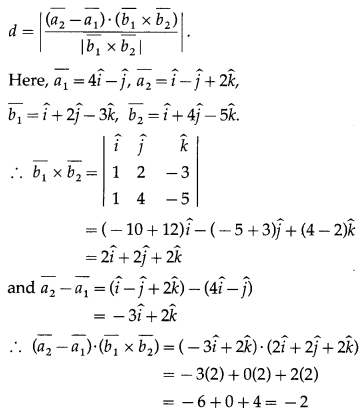
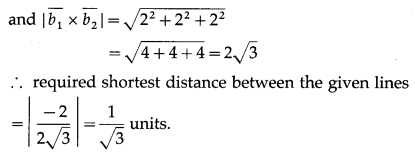
We know that the shortest distance between the skew lines and is given by
Solution & Step-by-Step Answer:
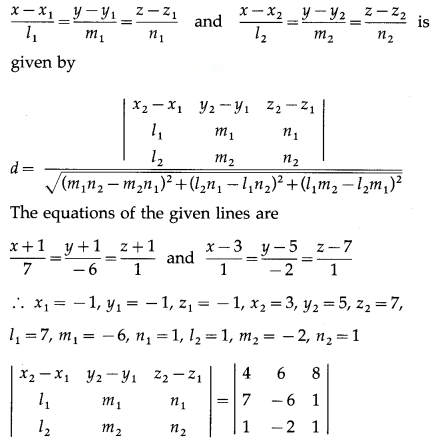
The shortest distance between the lines = 4(-6 + 2) – 6(7 – 1) + 8(-14 + 6) = -16 – 36 – 64 = -116 and (m1n2 – m2n1)2 + (l2n1 – l1n2)2 + (l1m2 – l2m1)2 = (-6 + 2)2 + (1 – 7)2 + (-14 + 6)2 = 16 + 36 + 64 = 116 Hence, the required shortest distance between the given lines = = = units
Solution & Step-by-Step Answer:
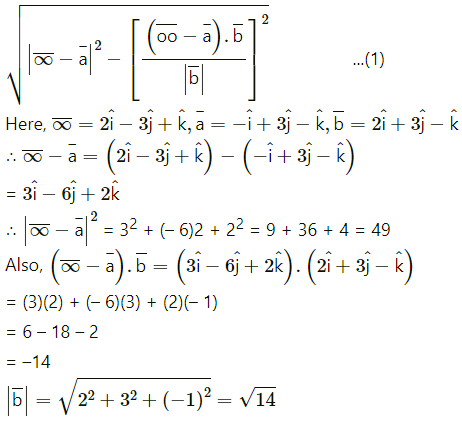
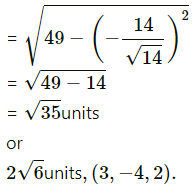
Let PM be the perpendicular drawn from the point (1, 0, 0) to the line = λ …(Say) The coordinates of any point on the line are given by x = -1 + 2λ, y = 3 + 2λ, z = 8 – λ Let the coordinates of M be (-1 + 2λ, 3 + 3λ, -1 – λ) …..(1) The direction ratios of PM are -1 + 2λ – 2, 3 + 3λ + 3, -1 – λ – 1 i.e. 2λ – 3, 3λ = 6, -λ – 2 The direction ratios of the given line are 2, 3, 8. Since PM is perpendicular to the given line, we get 2(2λ – 3) + 3(3λ + 6) – 1(-λ – 2) = O ∴ 4λ – 6 + 9λ + 18 + λ + 2 = 0 ∴ 14λ + 14 = 0 ∴ λ = -1 Put λ in (1), the coordinates of M are (-1 – 2, 3 – 3, -1 + 1) i.e. (-3, 0, 0). ∴ length of perpendicular from P to the given line = PM = = = units. Alternative Method : We know that the perpendicular distance from the point Substitutng tese values in (1), w get length of perpendicular from P to given line = PM
Solution & Step-by-Step Answer:
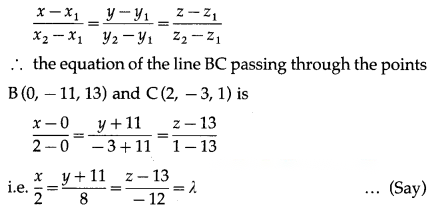
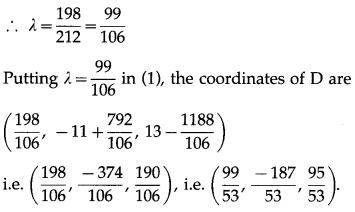
Equation of the line passing through the points (x1, y1, z1) and (x2, y2, z2) is AD is the perpendicular from the point A (1, 0, 4) to the line BC. The coordinates of any point on the line BC are given by x = 2λ, y = -11 + 8λ, z = 13 – 12λ Let the coordinates of D be (2λ, -11 + 8λ, 13 – 12λ) … (1) ∴ the direction ratios of AD are 2λ – 1, -1λ + 8λ – 0, 13 – 12λ – 4 i.e. 2λ – 1, -11 + 8λ, 9 – 12λ The direction ratios of the line BC are 2, 8, -12. Since AD is perpendicular to BC, we get 2(2λ – 1) + 8(-11 + 8λ) – 12(9 – 12λ) = 0 ∴ 42λ – 2 – 88 + 64λ – 108 + 144λ = 0 ∴ 212λ – 198 = 0
Solution & Step-by-Step Answer:
The shortest distance between the lines Hence, the given lines do not intersect.
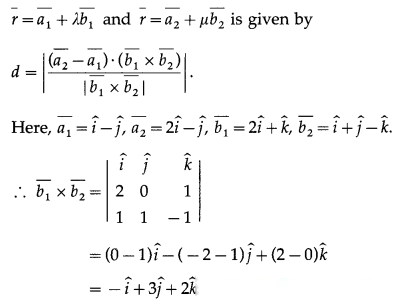
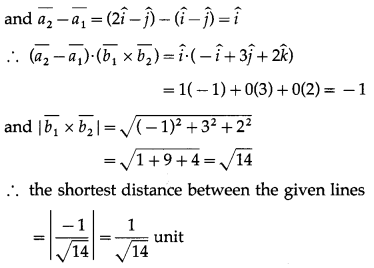
(ii) and
Solution:
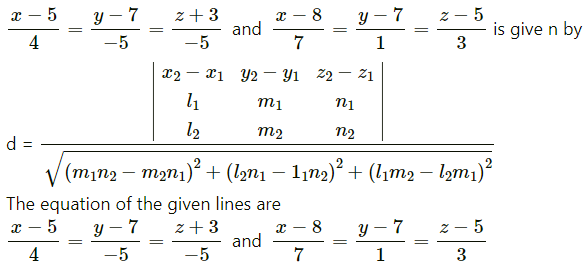
The shortest distance between the lines
∴ x1= -1, y1= -1, z1= -1, x2= 3, y2= 5, z2= 7,
l1= 7, m1= -6, n1= 1, l2= 1, m2= -2, n2= 1
≤ft|{array}{ccc}
x_{2}-x_{1} & y_{2}-y_{1} & z_{2}-z_{1} \\
l_{1} & m_{1} & n_{1} \\
l_{2} & m_{2} & n_{2}
{array}| = ≤ft|{array}{ccc}
4 & 6 & 8 \\
4 & -5 & -5 \\
7 & 1 & 3
{array}
= 4(- 6 + 2) – 6(7 – 1) + 8(-14 + 6)
= -16 – 36 – 64
= -116
and
(m1n2– m2n1)2+ (l2n1– l1n2)2+ (l1m2– l2m1)2
= (-6 + 2)2+ (1 – 7)2+ (-14 + 6)2
= 16 + 36 + 64
= 116
Hence, the required shortest distance between the given lines
=
=
= units
or
The shortest distance between the lines
= units
Hence, the gives lines do not intersect.
Solution & Step-by-Step Answer:
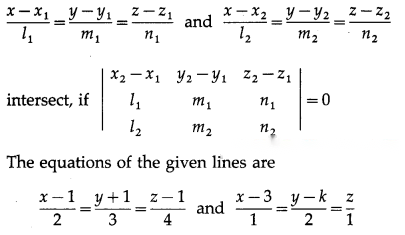
The lines ∴ x1 = 1, y1 = -1, z1 = 1, x2 = 3, y2 = k, z2 = 0, l1 = 2, m1 = 3, n1 = 4, l2 = 1, m2 = 2, n2 = 1. Since these lines intersect, we get = 0 ∴ 2 (3 – 8) – (k + 1)(2 – 4) – 1 (4 – 3) = 0 ∴ -10 + 2(k + 1) – 1 = 0 ∴ 2(k + 1) = 11 ∴ k + 1 = ∴ k =