Latest Maharashtra State Board (SSC & HSC) 2026-27 Syllabus Digest & Solutions Updated!
Class 12 (HSC Board)Mathematics & Statistics2026-27 Syllabus

Chapter 6 Differential Equations Ex 6.2 Solutions

Complete Maharashtra State Board Balbharati & Yuvakbharati textbook solutions for Chapter 6 Differential Equations Ex 6.2. Step-by-step solved exercises, numerical problems, and digest answers.

7 Solved Questions29 Diagrams1145 words

Balbharti12th Maharashtra State Board Maths Solutions BookPdf Chapter 6 Differential Equations Ex 6.2 Questions and Answers.

Maharashtra State Board 12th Maths Solutions Chapter 6 Differential Equations Ex 6.2

Question 1 Maharashtra Board Solution
Obtain the differential equation by eliminating the arbitrary constants from the following equations: (i) x3 + y3 = 4ax
Solution & Step-by-Step Answer:
x3 + y3 = 4ax ……..(1) Differentiating both sides w.r.t. x, we get 3x2 + 3y2 = 4a × 1 ∴ 3x2 + 3y2 = 4a Substituting the value of 4a in (1), we get x3 + y3 = (3x2 + 3y2 ) x ∴ x3 + y3 = 3x3 + 3xy2 ∴ 2x3 + 3xy2 – y3 = 0 This is the required D.E.

(ii) Ax2+ By2= 1
Solution:
Ax2+ By2= 1
Differentiating both sides w.r.t. x, we get
A × 2x + B × 2y = 0
∴ Ax + By = 0 ……..(1)
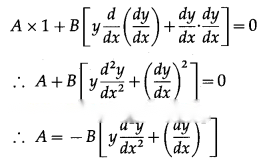
Differentiating again w.r.t. x, we get

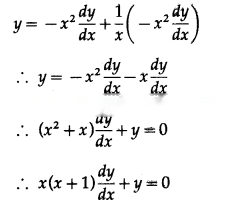
Substituting the value of A in (1), we get

This is the required D.E.
Alternative Method:
Ax2+ By2= 1 ……..(1)
Differentiating both sides w.r.t. x, we get
A × 2x + B × 2y = 0
∴ Ax + By = 0 ……….(2)
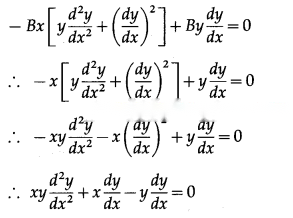
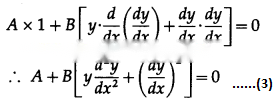
Differentiating again w.r.t. x, we get,

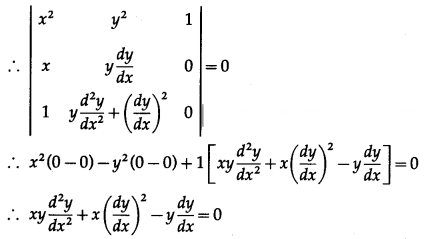
The equations (1), (2) and (3) are consistent in A and B.
∴ determinant of their consistency is zero.

This is the required D.E.

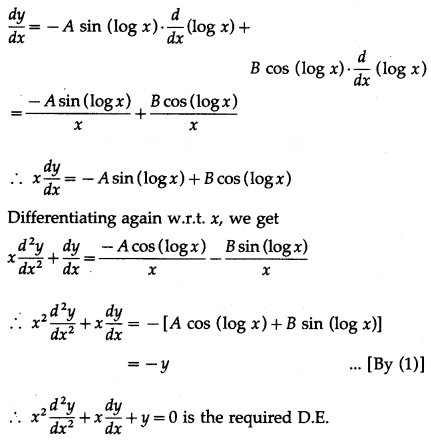
(iii) y = A cos(log x) + B sin(log x)
Solution:
y = A cos(log x) + B sin (log x) ……. (1)
Differentiating w.r.t. x, we get

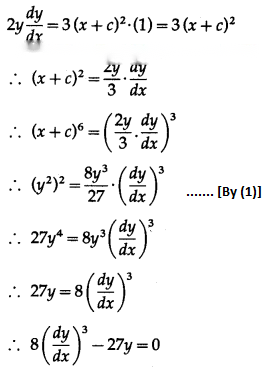
(iv) y2= (x + c)3
Solution:
y2= (x + c)3
Differentiating w.r.t. x, we get

This is the required D.E.

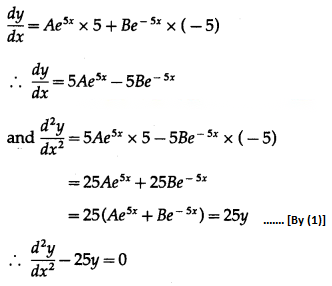
(v) y = Ae5x+ Be-5x
Solution:
y = Ae5x+ Be-5x……….(1)
Differentiating twice w.r.t. x, we get

This is the required D.E.

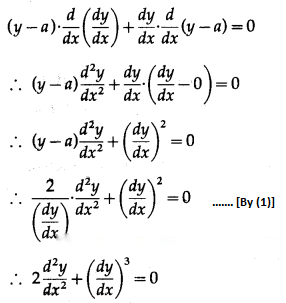
(vi) (y – a)2= 4(x – b)
Solution:
(y – a)2= 4(x – b)
Differentiating both sides w.r.t. x, we get
2(y – a). (y – a) = 4 (x – b)
∴ 2(y – a). ( – 0) = 4(1 – 0)
∴ 2(y – a) = 4
∴ (y – a) = 2 ……..(1)
Differentiating w.r.t. x, we get

This is the required D.E.

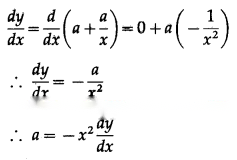
(vii) y = a +
Solution:
y = a +
Differentiating w.r.t. x, we get

Substituting the value of a in (1), we get

This is the required D.E.
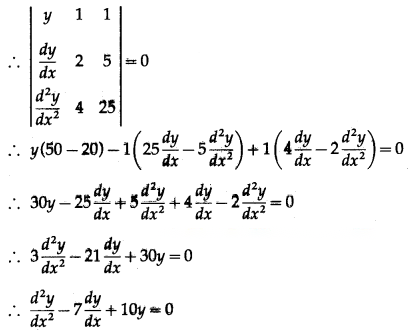
(viii) y = c1e2x+ c2e5x
Solution:
y = c1e2x+ c2e5x………(1)
Differentiating twice w.r.t. x, we get
= c1e2x× 2 + c2e5x× 5

The equations (1), (2) and (3) are consistent in c1e2xand c2e5x
∴ determinant of their consistency is zero.

This is the required D.E.
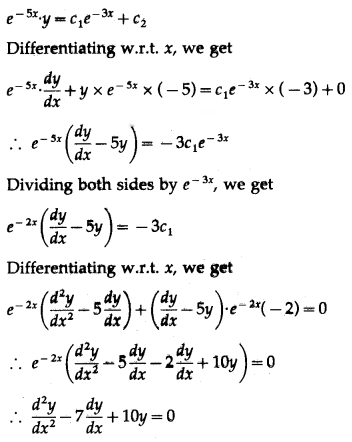
Alternative Method:
y = c1e2x+ c2e5x
Dividing both sides by e5x, we get

This is the required D.E.

(ix) c1x3+ c2y2= 5.
Solution:
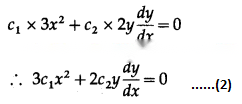
c1x3+ c2y2= 5 ……….(1)
Differentiating w.r.t. x, we get

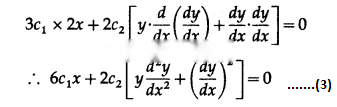
Differentiating again w.r.t. x, we get

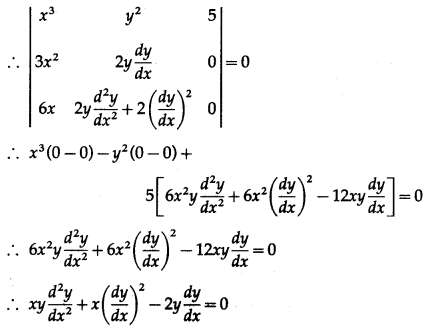
The equations (1), (2) and (3) in c1, c2are consistent.
∴ determinant of their consistency is zero.

This is the required D.E.
(x) y = e-2x(A cos x + B sin x)
Solution:
y = e-2x(A cos x + B sin x)
∴ e2x. y = A cos x + B sin x ………(1)
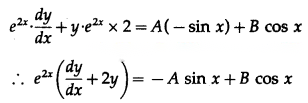
Differentiating w.r.t. x, we get

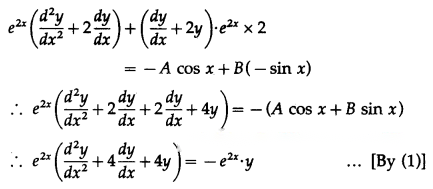
Differentiating again w.r.t. x, we get


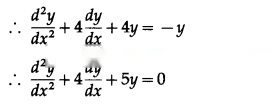
This is the required D.E.
Question 2 Maharashtra Board Solution
Form the differential equation of family of lines having intercepts a and b on the coordinate axes respectively.
Solution & Step-by-Step Answer:
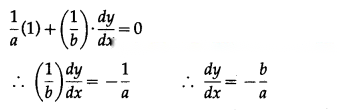
The equation of the line having intercepts a and b on the coordinate axes respectively, is ……….(1) where a and b are arbitrary constants. [For different values of a and b, we get, different lines. Hence (1) is the equation of family of lines.] Differentiating (1) w.r.t. x, we get Differentiating again w.r.t. x, we get This is the required D.E.
Question 3 Maharashtra Board Solution
Find the differential equation all parabolas having length of latus rectum 4a and axis is parallel to the X-axis.
Solution & Step-by-Step Answer:
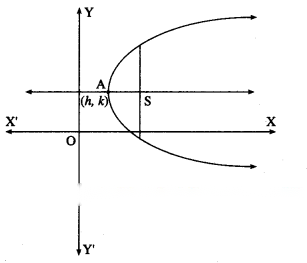
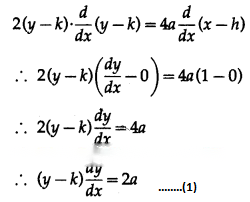
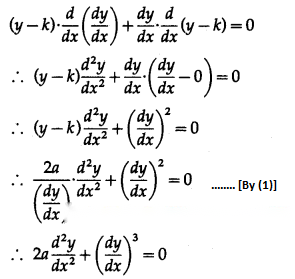
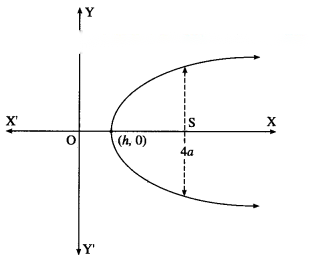
Let A(h, k) be the vertex of the parabola whose length of latus rectum is 4a. Then the equation of the parabola is (y – k)2 = 4a (x – h), where h and k are arbitrary constants. Differentiating w.r.t. x, we get Differentiating again w.r.t. x, we get This is the required D.E.
Question 4 Maharashtra Board Solution
Find the differential equation of the ellipse whose major axis is twice its minor axis.
Solution & Step-by-Step Answer:
Let 2a and 2b be lengths of major axis and minor axis of the ellipse. Then 2a = 2(2b) ∴ a = 2b ∴ equation of the ellipse is i.e., ∴ ∴ x2 + 4y2 = 4b2 Differentiating w.r.t. x, we get 2x + 4 × 2y = 0 ∴ x + 4y = 0 This is the required D.E.
Question 5 Maharashtra Board Solution
Form the differential equation of family of lines parallel to the line 2x + 3y + 4 = 0.
Solution & Step-by-Step Answer:
The equation of the line parallel to the line 2x + 3y + 4 = 0 is 2x + 3y + c = 0, where c is an arbitrary constant. Differentiating w.r.t. x, we get 2 × 1 + 3 + 0 = 0 ∴ 3 + 2 = 0 This is the required D.E.
Question 6 Maharashtra Board Solution
Find the differential equation of all circles having radius 9 and centre at point (h, k).
Solution & Step-by-Step Answer:
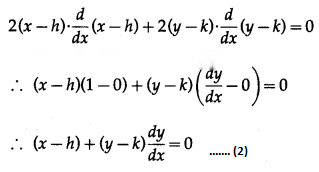
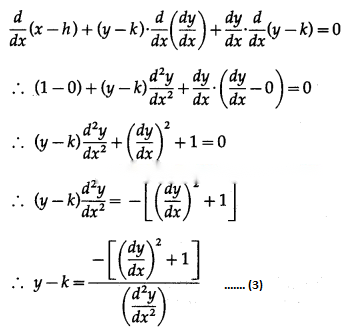
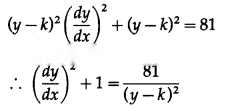
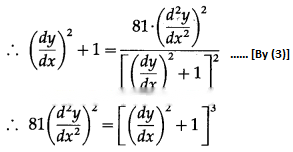
Equation of the circle having radius 9 and centre at point (h, k) is (x – h)2 + (y – k)2 = 81 …… (1) where h and k are arbitrary constant. Differentiating (1) w.r.t. x, we get Differentiating again w.r.t. x, we get From (2), x – h = -(y – k) Substituting the value of (x – h) in (1), we get This is the required D.E.
Question 7 Maharashtra Board Solution
Form the differential equation of all parabolas whose axis is the X-axis.
Solution & Step-by-Step Answer:
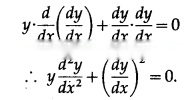
The equation of the parbola whose axis is the X-axis is y2 = 4a(x – h) …… (1) where a and h are arbitrary constants. Differentiating (1) w.r.t. x, we get 2y = 4a(1 – 0) ∴ y = 2a Differentiating again w.r.t. x, we get This is the required D.E.