Balbharti12th Maharashtra State Board Maths Solutions BookPdf Chapter 5 Vectors Ex 5.4 Questions and Answers.
Maharashtra State Board 12th Maths Solutions Chapter 5 Vectors Ex 5.4
Question 1
Maharashtra Board Solution
If = , = find ( + ) × ( – )
Solution & Step-by-Step Answer:

Question 2
Maharashtra Board Solution
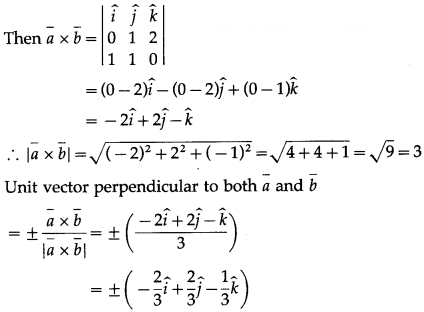
Find a unit vector perpendicular to the vectors and .
Solution & Step-by-Step Answer:
Let = , =
Question 3
Maharashtra Board Solution
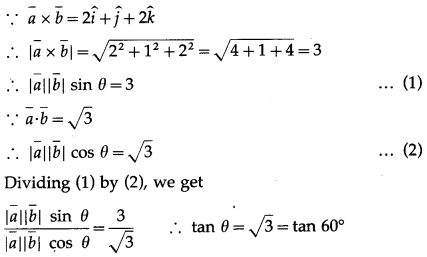
If = and = , find the angle between and .
Solution & Step-by-Step Answer:
Let θ be the angle between and ∴ θ = 60°.
Question 4
Maharashtra Board Solution
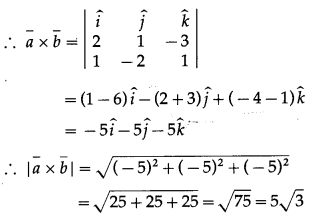
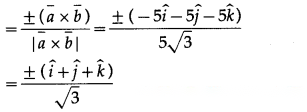
If = and = , find a vector of magnitude 5 perpendicular to both and .
Solution & Step-by-Step Answer:
Given : = and = ∴ unit vectors perpendicular to both the vectors and . ∴ required vectors of magnitude 5 units = ±
Question 5
Maharashtra Board Solution
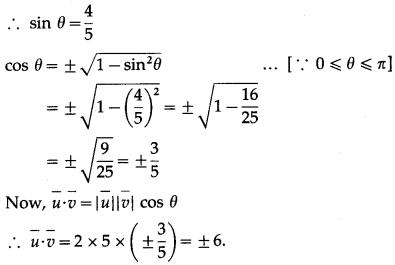
Find (i) ∙ if = 2, = 5, = 8
Solution & Step-by-Step Answer:
Let θ be the angle between and . Then = 8 gives sin θ = 8 ∴ 2 × 5 × sin θ = 8
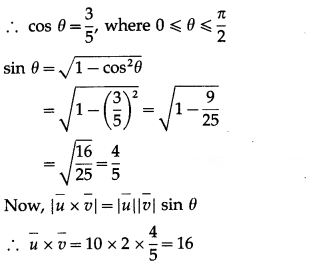
(ii) if = 10, = 2, = 12
Solution:
Let θ be the angle between and .
Then = 12 gives
cos θ = 12
∴ 10 × 2 × cos θ = 12
Question 6
Maharashtra Board Solution
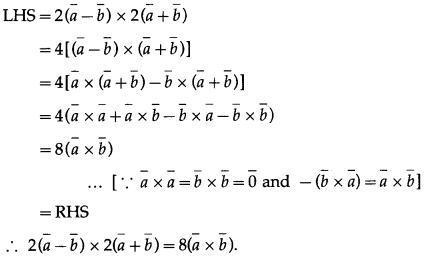
Prove that 2( – ) × 2( + ) = 8( × )
Solution & Step-by-Step Answer:
Question 7
Maharashtra Board Solution
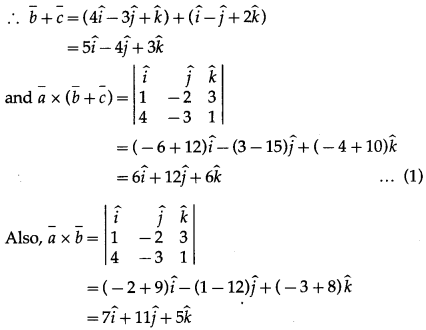
If = , = , and = , verify that × ( + ) = × + ×
Solution & Step-by-Step Answer:
Given : = , = , =

Question 8
Maharashtra Board Solution
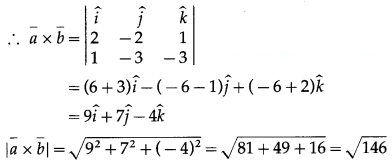
Find the area of the parallelogram whose adjacent sides are the vectors = and = .
Solution & Step-by-Step Answer:
Given : = , = Area of the parallelogram whose adjacent sides are and is = sq units.
Question 9
Maharashtra Board Solution
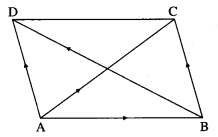
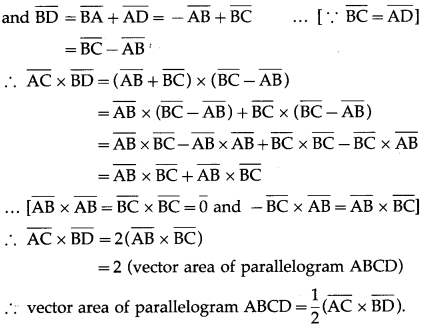
Show that vector area of a quadrilateral ABCD is ( × ), where AC and BD are its diagonals.
Solution & Step-by-Step Answer:
Let ABCD be a parallelogram. Then = +
Question 10
Maharashtra Board Solution
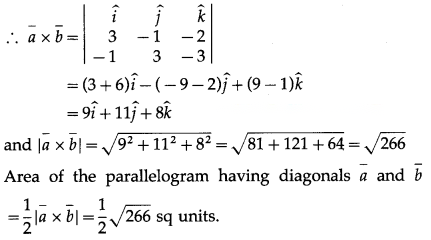
Find the area of parallelogram whose diagonals are determined by the vectors = , and =
Solution & Step-by-Step Answer:
Given: = , =
Question 11
Maharashtra Board Solution
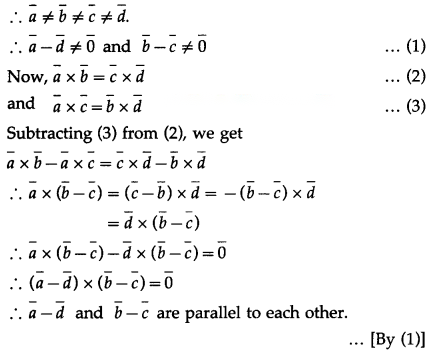
If , , and are four distinct vectors such that and , prove that – is parallel to – .
Solution & Step-by-Step Answer:
, , and are four distinct vectors
Question 12
Maharashtra Board Solution
If = and, = , find a vector satisfying × = and = 3
Solution & Step-by-Step Answer:
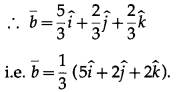
Given = , = By equality of vectors, z – y = 0 ….(2) x – z = 1 ……(3) y – x = -1 ……(4) From (2), y = z. From (3), x = 1 + z Substituting these values of x and y in (1), we get 1 + z + z + z = 3 ∴ z = ∴ y = z = ∴ x = 1 + z =1 +

Question 13
Maharashtra Board Solution
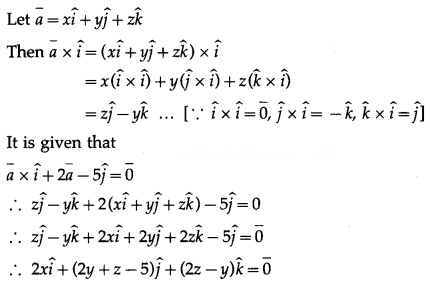
Find , if .
Solution & Step-by-Step Answer:
By equality of vectors 2x = 0 i.e. x = 0 2y + z – 5 = 0 … (1) 2z – y = 0 … (2) From (2), y = 2z Substituting y = 2z in (1), we get 4z + z = 5 ∴ z = 1 ∴ y = 2z = 2(1) = 2 ∴ x = 0, y = 2, z = 1 ∴
Question 14
Maharashtra Board Solution
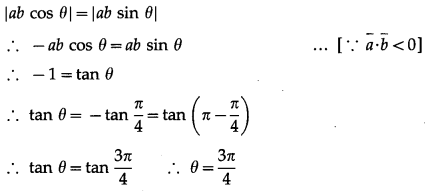
If = and < 0, then find the angle between and
Solution & Step-by-Step Answer:
Let θ be the angle between and . Then = gives Hence, the angle between and is .
Question 15
Maharashtra Board Solution
Prove by vector method that sin (α + β) = sinα∙cosβ+cosα∙sinβ.
Solution & Step-by-Step Answer:
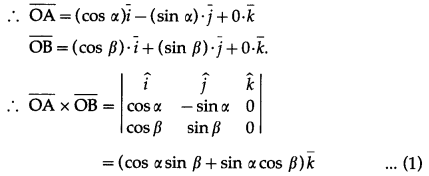
Let ∠XOP and ∠XOQ be in standard position and m∠XOP = -α, m∠XOQ = β. Take a point A on ray OP and a point B on ray OQ such that OA = OB = 1. Since cos (-α) = cos α and sin (-α) = -sin α, A is (cos (-α), sin (-α)), i.e. (cos α, – sin α) B is (cos β, sin β) The angle between and is α + β. Also , lie in the XY-plane. ∴ the unit vector perpendicular to and is . ∴ × = [OA∙OB sin (α + β)] = sin(α + β)∙ …(2) ∴ from (1) and (2), sin (α + β) = sin α cos β + cos α sin β.

Question 16
Maharashtra Board Solution
Find the direction ratios of a vector perpendicular to the two lines whose direction ratios are (i) -2, 1, -1 and -3, -4, 1
Solution & Step-by-Step Answer:
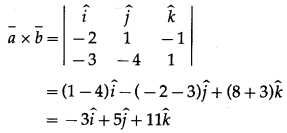
Let a, b, c be the direction ratios of the vector which is perpendicular to the two lines whose direction ratios are -2, 1, -1 and -3, -4, 1 ∴ -2a + b – c = 0 and -3a – 4b + c = 0 ∴ the required direction ratios are -3, 5, 11 Alternative Method: Let and be the vectors along the lines whose direction ratios are -2, 1, -1 and -3, -4, 1 respectively. Then = and = The vector perpendicular to both and is given by Hence, the required direction ratios are -3, 5, 11.

(ii) 1, 3, 2 and -1, 1, 2
Solution:
Question 17
Maharashtra Board Solution
Prove that two vectors whose direction cosines are given by relations al + bm + cn = 0 and fmn + gnl + hlm = 0 are perpendicular if = 0
Solution & Step-by-Step Answer:
Given, al + bm + cn = 0 …(1) and fmn + gnl + hlm = 0 …..(2) From (1), n = …..(3) Substituting this value of n in equation (2), we get (fm + gl)∙-≤ft( + hlm = 0 ∴ -(aflm + bfm2 + agl2 + bglm) + chlm = 0 ∴ agl2 + (af + bg – ch)lm + bfm2 = 0 … (4) Note that both l and m cannot be zero, because if l = m = 0, then from (3), we get n = 0, which is not possible as l2 + m2 + n2 = 1. Let us take m # 0. Dividing equation (4) by m2, we get ag + (af + bg – ch) + bf = 0 … (5) This is quadratic equation in . If l1, m1, n1 and l2, m2, n2 are the direction cosines of the two lines given by the equation (1) and (2), then and are the roots of the equation (5). From the quadratic equation (5), we get i.e. if = 0.

Question 18
Maharashtra Board Solution
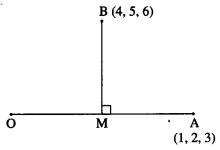
If A(1, 2, 3) and B(4, 5, 6) are two points, then find the foot of the perpendicular from the point B to the line joining the origin and point A.
Solution & Step-by-Step Answer:
Let M be the foot of the perpendicular drawn from B to the line joining O and A. Let M = (x, y, z) OM has direction ratios x – 0, y – 0, z – 0 = x, y, z OA has direction ratios 1 – 0, 2 – 0, 3 – 0 = 1, 2, 3 But O, M, A are collinear. ∴ = k …(Let) ∴ x = k, y = 2k, z = 3k ∴ M = (k, 2k, 3k) ∵ BM has direction ratios k – 4, 2k – 5, 3k – 6 BM is perpendicular to OA ∴ (l)(k – 4) + 2(2k – 5) + 3(3k – 6) ∴ = k – 4 + 4k – 10 + 9k – 18 = 0 ∴ 14k = 32 ∴ k = ∴ M = (k, 2k, 3k) = ()