Balbharti12th Maharashtra State Board Maths Solutions BookPdf Chapter 5 Vectors Ex 5.2 Questions and Answers.
Maharashtra State Board 12th Maths Solutions Chapter 5 Vectors Ex 5.2
Solution & Step-by-Step Answer:
It is given that the points P and Q have position vectors = and = respectively. (i) If R() divides the line segment PQ internally in the ratio 3 : 2, by section formula for internal division,
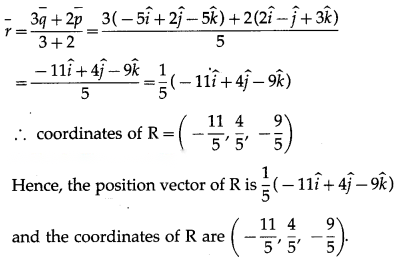
(ii) externally.
Solution:
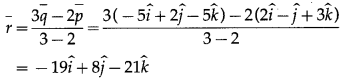
If R() divides the line segment joining P and Q externally in the ratio 3 : 2, by section formula for external division,
∴ coordinates of R = (-19, 8, -21).
Hence, the position vector of R is and coordinates of R are (-19, 8, -21).
Solution & Step-by-Step Answer:
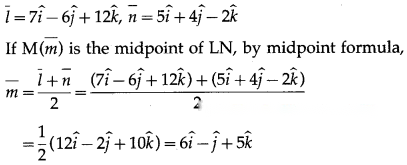
The position vectors and of the points L(7, -6, 12) and N (5, 4, -2) are given by ∴ coordinates of M = (6, -1, 5). Hence, position vector of M is and the coordinates of M are (6, -1, 5).
Solution & Step-by-Step Answer:
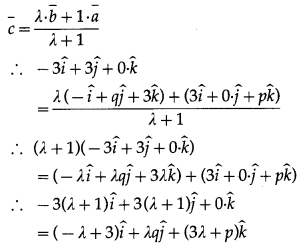
Let , and be the position vectors of A, B and C respectively. Then = , = and = . As the points A, B, C are collinear, suppose the point C divides line segment AB in the ratio λ : 1. ∴ by the section formula, By equality of vectors, we have, -3(λ + 1) = -λ + 3 … (1) 3(λ + 1 ) = λ q … (2) 0 = 3λ + p … (3) From equation (1), -3λ – 3 = -λ + 3 ∴ -2λ = 6 ∴ λ = -3 ∴ C divides segment AB externally in the ratio 3 : 1.
(ii) The values of p and q.
Solution:
Putting λ = -3 in equation (2), we get
3(-3 + 1) = -3q
∴ -6 = -3q ∴ q = 2
Also, putting λ = -3 in equation (3), we get
0 = -9 + p ∴ p = 9
Hence p = 9 and q = 2.
Solution & Step-by-Step Answer:
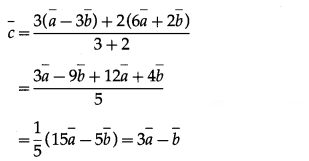
Let be the position vector of C. Since C divides AB in the ratio 3 : 2, Hence, the position vector of C is 3 – .
Solution & Step-by-Step Answer:
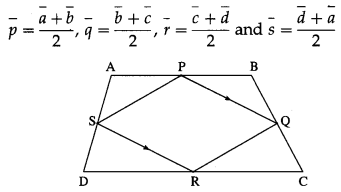
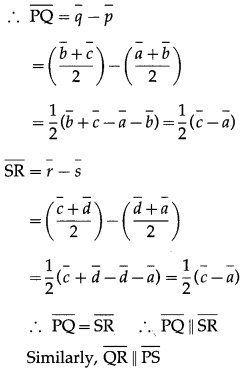
Let ABCD be a quadrilateral and P, Q, R, S be the midpoints of the sides AB, BC, CD and DA respectively. Let , , , , , , and s be the position vectors of the points A, B, C, D, P, Q, R and S respectively. Since P, Q, R and S are the midpoints of the sides AB, BC, CD and DA respectively, ∴ □PQRS is a parallelogram.
Solution & Step-by-Step Answer:
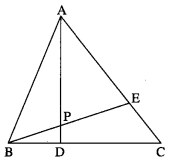
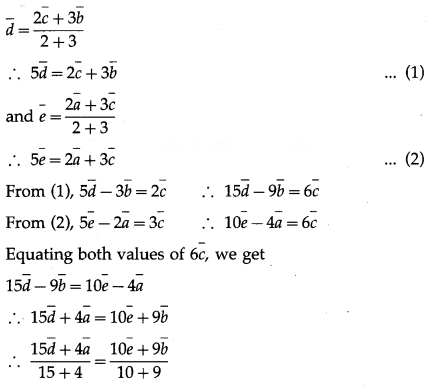
Let AD and BE intersect at P. Let A, B, C, D, E, P have position vectos , , , , , respectively. D and E divide segments BC and CA internally in the ratio 2 : 3. By the section formula for internal division, LHS is the position vector of the point which divides segment AD internally in the ratio 15 : 4. RHS is the position vector of the point which divides segment BE internally in the ratio 10 : 9. But P is the point of intersection of AD and BE. ∴ P divides AD internally in the ratio 15 : 4 and P divides BE internally in the ratio 10 : 9. Hence, the position vector of the point of interaction of AD and BE is = and it divides AD internally in the ratio 15 : 4 and BE internally in the ratio 10 : 9.
Solution & Step-by-Step Answer:
Let , , and be respectively the position vectors of the vertices A, B, C and D of the parallelogram ABCD. Then AB = DC and side AB || side DC. The position vectors of the midpoints of the diagonals AC and BD are ( + )/2 and ( + )/2. By (1), they are equal. ∴ the midpoints of the diagonals AC and BD are the same. This shows that the diagonals AC and BD bisect each other.
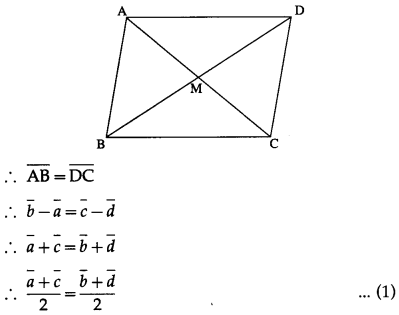
(ii) Conversely, suppose that the diagonals AC and BD
of □ ABCD bisect each other,
i. e. they have the same midpoint.
∴ the position vectors of these midpoints are equal.
∴ ∴
∴ – = – ∴ =
∴ || and =
∴ side AB || side DC and AB = DC.
∴ □ ABCD is a parallelogram.
Solution & Step-by-Step Answer:
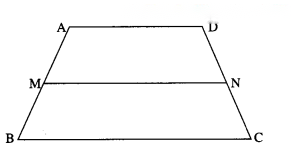
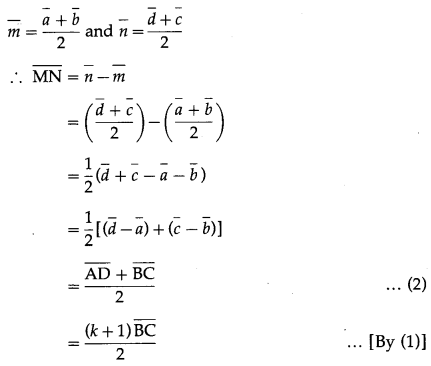
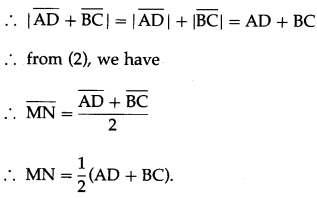
Let , , and be respectively the position vectors of the vertices A, B, C and D of the trapezium ABCD, with side AD || side BC. Then the vectors and are parallel. ∴ there exists a scalar k, such that = k∙ ∴ + = k∙ + = (k + 1)BC …(1) Let and be the position vectors of the midpoints M and N of the non-parallel sides AB and DC respectively. Then seg MN is the median of the trapezium. By the midpoint formula, Thus is a scalar multiple of ∴ and are parallel vectors ∴ || where || ∴ the median MN is parallel to the parallel sides AD and BC of the trapezium. Now and are collinear
Solution & Step-by-Step Answer:
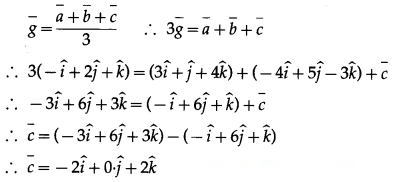
Let , , and be the position vectors of A, B, C and G respectively. Then = , = and = . Since G is the centroid of the ∆ABC, by the centroid formula, ∴ the coordinates of third vertex C are (-2, 0, 2).
Solution & Step-by-Step Answer:
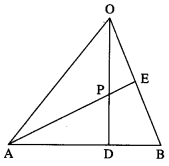
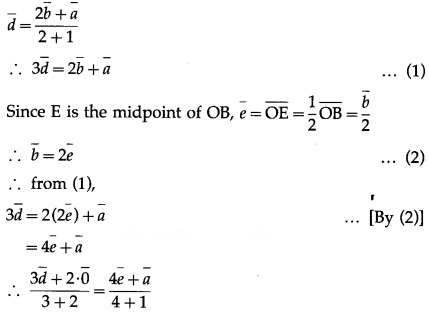
Let A, B, D, E, P have position vectors , , , , respectively w.r.t. O. ∵ AD : DB = 2 : 1. ∴ D divides AB internally in the ratio 2 : 1. Using section formula for internal division, we get LHS is the position vector of the point which divides OD internally in the ratio 3 : 2. RHS is the position vector of the point which divides AE internally in the ratio 4 : 1. But OD and AE intersect at P ∴ P divides OD internally in the ratio 3 : 2. Hence, OP : PD = 3 : 2.
Solution & Step-by-Step Answer:
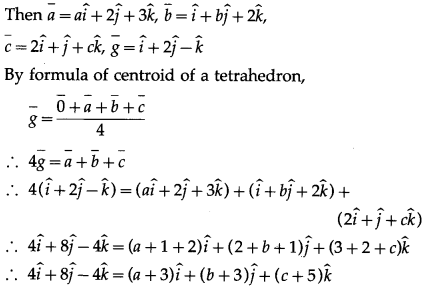
Let G = (1, 2, -1) be the centroid of the tetrahedron OABC. Let , , , be the position vectors of the points A, B, C, G respectively w.r.t. O. By equality of vectors a + 3 = 4, b + 3 = 8, c + 5= -4 ∴ a = 1, b = 5, c = -9 ∴ P = (a, b, c) = (1, 5, -9) Distance of P from origion = = =
Solution & Step-by-Step Answer:
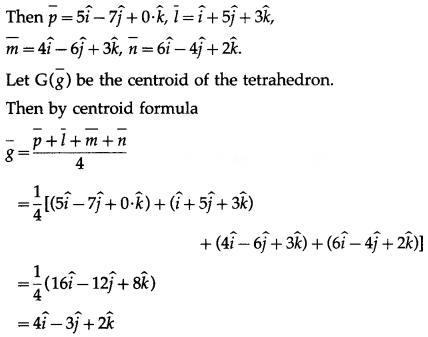
Let , , , be the position vectors of the points K, L, M, N respectively w.r.t. the origin O. Hence, the centroid of the tetrahedron is G = (4, -3, 2).