Balbharti12th Maharashtra State Board Maths Solutions BookPdf Chapter 5 Application of Definite Integration Miscellaneous Exercise 5 Questions and Answers.
Maharashtra State Board 12th Maths Solutions Chapter 5 Application of Definite Integration Miscellaneous Exercise 5
I. Choose the correct option from the given alternatives:
Solution & Step-by-Step Answer:
(a) 12 sq units
Solution & Step-by-Step Answer:
(a) 1 sq unit
Solution & Step-by-Step Answer:
(c) sq units
Solution & Step-by-Step Answer:
(b) sq units
Solution & Step-by-Step Answer:
(a) sq units
Solution & Step-by-Step Answer:
(d) 4 sq units
Solution & Step-by-Step Answer:
(b) sq units
Solution & Step-by-Step Answer:
(d) sq units
Solution & Step-by-Step Answer:
(a) sq units
Solution & Step-by-Step Answer:
(b) πab sq units
Solution & Step-by-Step Answer:
(a) sq units
Solution & Step-by-Step Answer:
(d) sq unit
Solution & Step-by-Step Answer:
(b) 9 sq units
Solution & Step-by-Step Answer:
(b) sq units
Solution & Step-by-Step Answer:
(c) sq unit
Solution & Step-by-Step Answer:
(c) sq units
Solution & Step-by-Step Answer:
(a) log 2 sq units
Solution & Step-by-Step Answer:
(d) sq units
Solution & Step-by-Step Answer:
(a) sq units
Solution & Step-by-Step Answer:
(c) sq units
(II) Solve the following:
Solution & Step-by-Step Answer:
(i) Required area = , where y = 2 = = = 2 × 5 – 0 = 10 sq units.
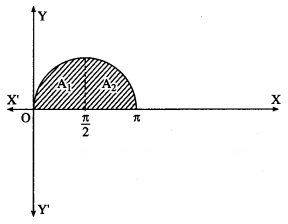
(ii) The curve y = sin x intersects the X-axis at x = 0 and x = π between x = 0 and x = π.
Two bounded regions A1and A2are obtained. Both the regions have equal areas.
∴ required area = A1+ A2= 2A1
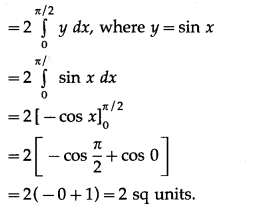
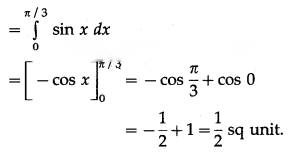
(iii) Required area = , where y = sin x
Solution & Step-by-Step Answer:
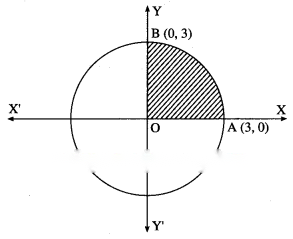
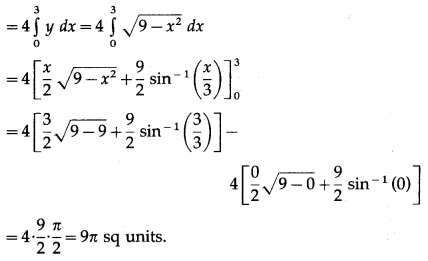
By the symmetry of the circle, its area is equal to 4 times the area of the region OABO. Clearly, for this region, the limits of integration are 0 and 3. From the equation of the circle, y2 = 9 – x2. In the first quadrant, y > 0 ∴ y = ∴ area of the circle = 4 (area of the region OABO)
Solution & Step-by-Step Answer:
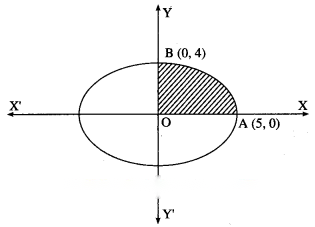
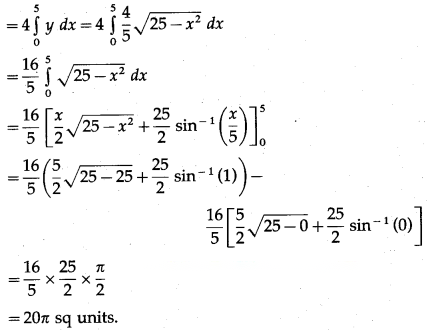
By the symmetry of the ellipse, its area is equal to 4 times the area of the region OABO. Clearly, for this region, the limits of integration are 0 and 5. From the equation of the ellipse ∴ y2 = (25 – x2) In the first quadrant y > 0 ∴ y = ∴ area of the ellipse = 4(area of the region OABO)
Solution & Step-by-Step Answer:
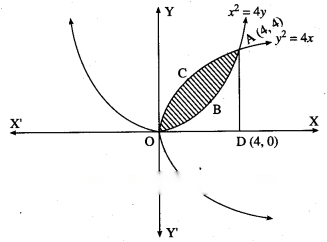
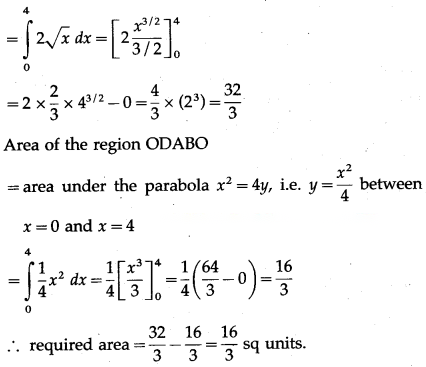
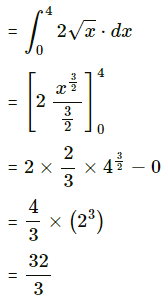
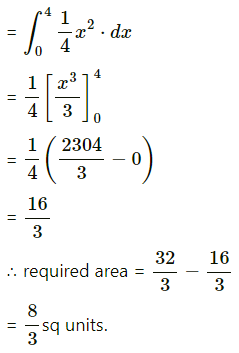
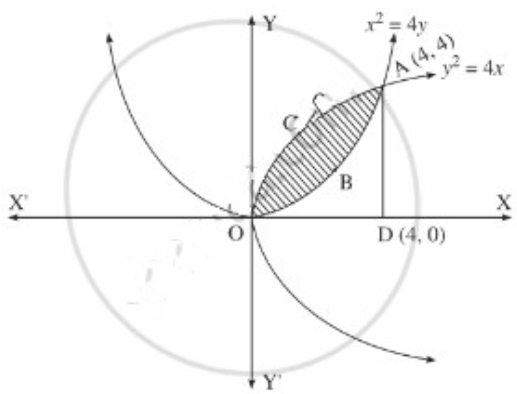
(i) For finding the points of intersection of the two parabolas, we equate the values of y2 from their equations. From the equation x2 = 4y, y = y = = 4x ∴ x4 – 64x = 0 ∴ x(x3 – 64) = 0 ∴ x = 0 or x3 = 64 i.e. x = 0 or x = 4 When x = 0, y = 0 When x = 4, y = = 4 ∴ the points of intersection are 0(0, 0) and A(4, 4). Required area = area of the region OBACO = [area of the region ODACO] – [area of the region ODABO] Now, area of the region ODACO = area under the parabola y2 = 4x, i.e. y = 2√x between x = 0 and x = 4
(ii)
For finding the points of intersection of the two parabolas, we equate the values of 4y2from their equations.
From the equation 3x2= 16y, y =
∴ y =
∴ = 9x
∴ 3x4– 2304x = 0
∴ x(x3– 2304) = 0
∴ x = 0 or x3= 2304 i.e. x = 0 or x = 4
When x = 0, y = 0
When x = 4, y =
∴ the points of intersection are O(0, 0) and A(4, 4).
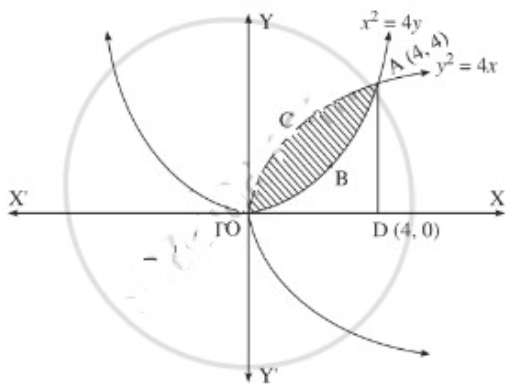
Required area = area of the region OBACO = [area of the region ODACO] – [area of the region ODABO]
Now, area of the region ODACO = area under the parabola y2= 4x,
i.e. y = 2√x between x = 0 and x = 4
Area of the region ODABO = area under the rabola x2= 4y,
i.e. y = between x = 0 and x = 4
(iii)
For finding the points of intersection of the two parabolas, we equate the values of y2from their equations.
From the equation x2= y, y =
∴ y =
∴ = x
∴ x2– y = 0
∴ x(x3– y) = 0
∴ x = 0 or x3= y
i.e. x = 0 or x = 4
When x = 0, y = 0
When x = 4, y = = 4
∴ the points of intersection are O(0, 0) and A(4, 4).
Required area = area of the region OBACO = [area of the region ODACO] – [area of the region ODABO]
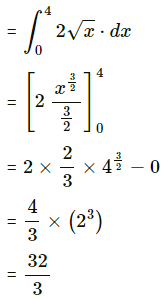
Now, area of the region ODACO = area under the parabola y2= 4x,
i.e. y = 2√x between x = 0 and x = 4
Area ofthe region ODABO = area under the rabola x2= 4y,
i.e. y = between x = 0 and x = 4
Solution & Step-by-Step Answer:
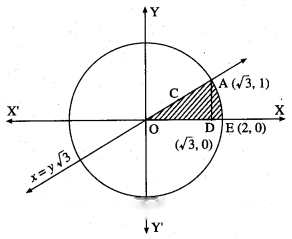
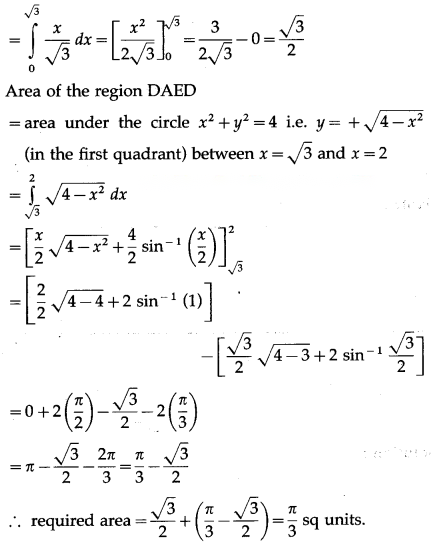
For finding the points of intersection of the circle and the line, we solve x2 + y2 = 4 ………(1) and x = y√3 ……..(2) From (2), x2 = 3y2 From (1), x2 = 4 – y2 3y2 = 4 – y2 4y2 = 4 y2 = 1 y = 1 in the first quadrant. When y = 1, r = 1 × √3 = √3 ∴ the circle and the line intersect at A(√3, 1) in the first quadrant Required area = area of the region OCAEDO = area of the region OCADO + area of the region DAED Now, area of the region OCADO = area under the line x = y√3, i.e. y = between x = 0 and x = √3
Solution & Step-by-Step Answer:
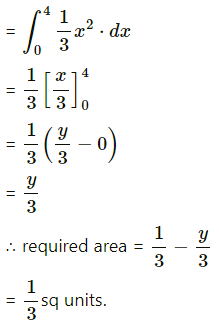
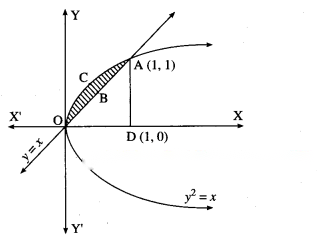
To obtain the points of intersection of the line and the parabola, we equate the values of x from both equations. ∴ y2 = y ∴ y2 – y = 0 ∴ y(y – 1) = 0 ∴ y = 0 or y = 1 When y = 0, x = 0 When y = 1, x = 1 ∴ the points of intersection are O(0, 0) and A(1, 1). Required area = area of the region OCABO = area of the region OCADO – area of the region OBADO Now, area of the region OCADO = area under the parabola y2 = x i.e. y = +√x (in the first quadrant) between x = 0 and x = 1 Area of the region OBADO = area under the line y = x between x = 0 and x = 1

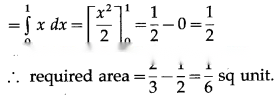
Solution & Step-by-Step Answer:
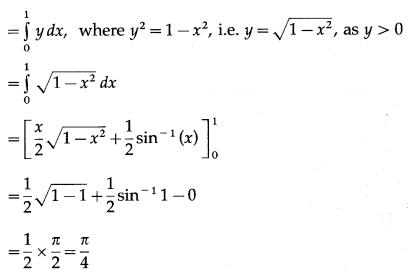
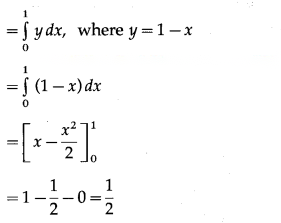
Required area = area of the region ACBPA = (area of the region OACBO) – (area of the region OADBO) Now, area of the region OACBO = area under the circle x2 + y2 = 1 between x = 0 and x = 1 Area of the region OADBO = area under the line x + y = 1 between x = 0 and x = 1 ∴ required area = sq units.

Solution & Step-by-Step Answer:
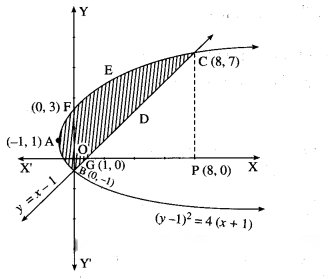
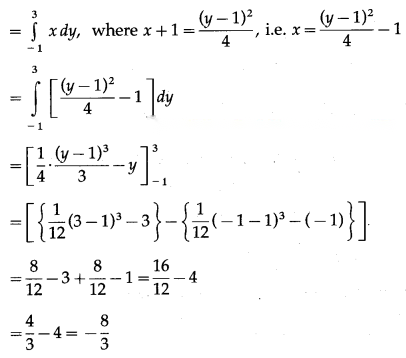
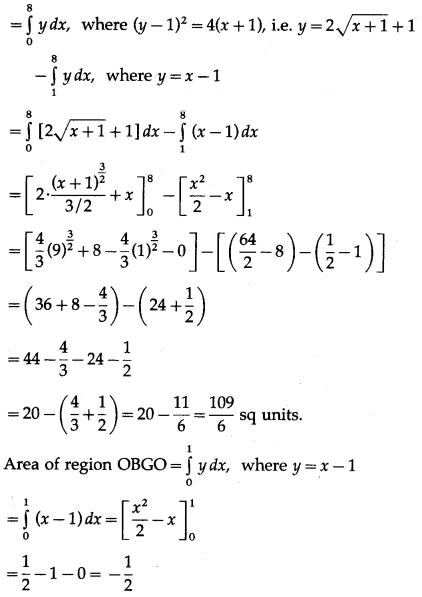
The equation of the curve is (y – 1)2 = 4(x + 1) This is a parabola with vertex at A (-1, 1). To find the points of intersection of the line y = x – 1 and the parabola. Put y = x – 1 in the equation of the parabola, we get (x – 1 – 1)2 = 4(x + 1) ∴ x2 – 4x + 4 = 4x + 4 ∴ x2 – 8x = 0 ∴ x(x – 8) = 0 ∴ x = 0, x = 8 When x = 0, y = 0 – 1 = -1 When x = 8, y = 8 – 1 = 7 ∴ the points of intersection are B (0, -1) and C (8, 7). To find the points where the parabola (y – 1)2 = 4(x + 1) cuts the Y-axis. Put x = 0 in the equation of the parabola, we get (y – 1)2 = 4(0 + 1) = 4 ∴ y – 1 = ±2 ∴ y – 1 = 2 or y – 1 = -2 ∴ y = 3 or y = -1 ∴ the parabola cuts the Y-axis at the points B(0, -1) and F(0, 3). To find the point where the line y = x – 1 cuts the X-axis. Put y = 0 in the equation of the line, we get x – 1 = 0 ∴ x = 1 ∴ the line cuts the X-axis at the point G (1, 0). Required area = area of the region BFAB + area of the region OGDCEFO + area of the region OBGO Now, area of the region BFAB = area under the parabola (y – 1)2 = 4(x + 1), Y-axis from y = -1 to y = 3 Since, the area cannot be negative, Area of the region BFAB = sq units. Area of the region OGDCEFO = area of the region OPCEFO – area of the region GPCDG Since, area cannot be negative, area of the region = sq units. ∴ required area = = = = sq units.
Solution & Step-by-Step Answer:
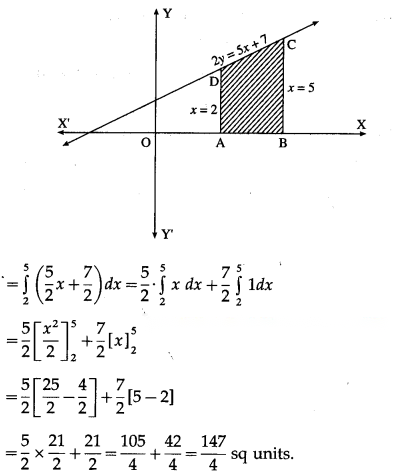
The equation of the line is 2y = 5x + 7, i.e., y = Required area = area of the region ABCDA = area under the line y = between x = 2 and x = 5
Solution & Step-by-Step Answer:
By symmetry of the parabola, the required area is 2 times the area of the region ABCD. From the equation of the parabola, x2 = In the first quadrant, x > 0 ∴ x = ∴ required area =