Balbharti12th Maharashtra State Board Maths Solutions BookPdf Chapter 4 Pair of Straight Lines Ex 4.1 Questions and Answers.
Maharashtra State Board 12th Maths Solutions Chapter 4 Pair of Straight Lines Ex 4.1
(ii) x + 2y – 1 = 0 and x – 3y + 2 = 0
Solution:
The combined equation of the lines x + 2y – 1 = 0 and x – 3y + 2 = 0 is
(x + 2y – 1)(x – 3y + 2) = 0
∴ x2– 3xy + 2x + 2xy – 6y2+ 4y – x + 3y – 2 = 0
∴ x2– xy – 6y2+ x + 7y – 2 = 0.
(iii) Passing through (2, 3) and parallel to the co-ordinate axes.
Solution:
Equations of the coordinate axes are x = 0 and y = 0.
∴ the equations of the lines passing through (2, 3) and parallel to the coordinate axes are x = 2 and
i.e. x – 2 = 0 and y – 3 = 0.
∴ their combined equation is
(x – 2)(y – 3) = 0.
∴ xy – 3x – 2y + 6 = 0.
(iv) Passing through (2, 3) and perpendicular to lines 3x + 2y – 1 = 0 and x – 3y + 2 = 0
Solution:
Let L1and L2be the lines passing through the point (2, 3) and perpendicular to the lines 3x + 2y – 1 = 0 and x – 3y + 2 = 0 respectively.
Slopes of the lines 3x + 2y – 1 = 0 and x – 3y + 2 = 0 are and respectively.
∴ slopes of the lines L1and L2are and -3 respectively.
Since the lines L1and L2pass through the point (2, 3), their equations are
y – 3 = (x – 2) and y – 3 = -3 (x – 2)
∴ 3y – 9 = 2x – 4 and y – 3= -3x + 6
∴ 2x – 3y + 5 = 0 and 3x – y – 9 = 0
∴ their combined equation is
(2x – 3y + 5)(3x + y – 9) = 0
∴ 6x2+ 2xy – 18x – 9xy – 3y2+ 27y + 15x + 5y – 45 = 0
∴ 6x2– 7xy – 3y2– 3x + 32y – 45 = 0.
(v) Passsing through (-1, 2),one is parallel to x + 3y – 1 = 0 and the other is perpendicular to 2x – 3y – 1 = 0.
Solution:
Let L1be the line passing through (-1, 2) and parallel to the line x + 3y – 1 = 0 whose slope is –.
∴ slope of the line L1is –
∴ equation of the line L1is
y – 2 = –(x + 1)
∴ 3y – 6 = -x – 1
∴ x + 3y – 5 = 0
Let L2be the line passing through (-1, 2) and perpendicular to the line 2x – 3y – 1 = 0
whose slope is .
∴ slope of the line L2is –
∴ equation of the line L2is
y – 2= –(x + 1)
∴ 2y – 4 = -3x – 3
∴ 3x + 2y – 1 = 0
Hence, the equations of the required lines are
x + 3y – 5 = 0 and 3x + 2y – 1 = 0
∴ their combined equation is
(x + 3y – 5)(3x + 2y – 1) = 0
∴ 3x2+ 2xy – x + 9xy + 6y2– 3y – 15x – 10y + 5 = 0
∴ 3x2+ 11xy + 6y2– 16x – 13y + 5 = 0
(ii) 5x2– 9y2= 0
Solution:
5x2– 9y2= 0
∴ ( x)2– (3y)2= 0
∴ (x + 3y)(x – 3y) = 0
∴ the separate equations of the lines are
x + 3y = 0 and x – 3y = 0.
(iii) x2– 4xy = 0
Solution:
x2– 4xy = 0
∴ x(x – 4y) = 0
∴ the separate equations of the lines are x = 0 and x – 4y = 0
(iv) 3x2– 10xy – 8y2= 0
Solution:
3x2– 10xy – 8y2= 0
∴ 3x2– 12xy + 2xy – 8y2= 0
∴ 3x(x – 4y) + 2y(x – 4y) = 0
∴ (x – 4y)(3x +2y) = 0
∴ the separate equations of the lines are x – 4y = 0 and 3x + 2y = 0.
(v) 3x2– xy – 3y2= 0
Solution:
3x2– 2xy – 3y2 = 0
∴ 3x2– 3xy + xy – 3y2= 0
∴ 3x(x – y) + y(x – y) = 0
∴ (x – y)(3x + y) = 0
∴ the separate equations of the lines are
∴ x – y = 0 and 3x + y = 0.
(vi) x2+ 2(cosec ∝)xy + y2= 0
Solution:
x2+ 2 (cosec ∝)xy – y2= 0
i.e. y2+ 2(cosec∝)xy + x2= 0
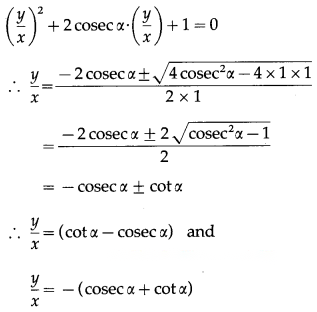
Dividing by x2, we get,
∴ the separate equations of the lines are
(cosec ∝ – cot ∝)x + y = 0 and (cosec ∝ + cot ∝)x + y = 0.
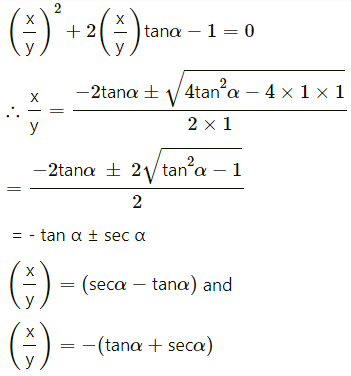
(vii) x2+ 2xy tan ∝ – y2= 0
Solution:
x2+ 2xy tan ∝ – y2= 0
Dividind by y2
The separate equations of the lines are
(sec∝ – tan ∝)x + y = 0 and (sec ∝ + tan ∝)x – y = 0
(ii) 5x2+ 2xy – 3y2= 0
Solution:
Comparing the equation 5x2+ 2xy – 3y2= 0 with ax2+ 2hxy + by2= 0, we get,
a = 5, 2h = 2, b = -3
Let m1and m2be the slopes of the lines represented by 5x2+ 2xy – 3y2= 0
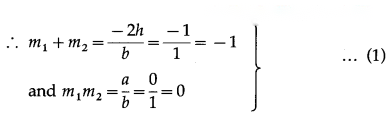
∴ m1+ m2= and m1m2= ..(1)
Now required lines are perpendicular to these lines
∴ their slopes are and
Since these lines are passing through the origin, their separate equations are
y = x and y = x
i.e. m1y = -x amd m2y = -x
i.e. x + m1y = 0 and x + m2y = 0
∴ their combined equation is
∴ (x + m1y)(x + m2y) = 0
x2+ (m1+ m2)xy + m1m2y2= 0
∴ x2+ xy – y = 0 …[By (1)]
∴ 3x2+ 2xy – 5y2= 0
(iii) xy + y2= 0
Solution:
Comparing the equation xy + y2= 0 with ax2+ 2hxy + by2= 0, we get,
a = 0, 2h = 1, b = 1
Let m1and m2be the slopes of the lines represented by xy + y2= 0
Now required lines are perpendicular to these lines
∴ their slopes are and .
Since these lines are passing through the origin, their separate equations are
y = x and y = x
i.e. m1y = -x and m2y = -x
i.e. x + m1y = 0 and x + m2y = 0
∴ their combined equation is
(x + m1y) (x + m2y) = 0
∴ x2+ (m1+ m2)xy + m1m2y2= 0
∴ x2– xy = 0.y2= 0 … [By (1)]
∴ x2– xy = 0.
Alternative Method :
Consider xy + y2= 0
∴ y(x + y) = 0
∴ separate equations of the lines are y = 0 and
3x2+ 8xy + 5y2= 0.
x + y = 0.
Let m1and m2be the slopes of these lines.
Then m1= 0 and m2= -1
Now, required lines are perpendicular to these lines.
∴ their slopes are and
Since, m1= 0, does not exist.
Also, m2= -1, = 1
Since these lines are passing through the origin, their separate equations are x = 0 and y = x,
i.e. x – y = 0
∴ their combined equation is
x(x – y) = 0
x2– xy = 0.
(iv) 3x2– 4xy = 0
Solution:
Consider 3x2– 4xy = 0
∴ x(3x – 4y) = 0
∴ separate equations of the lines are x = 0 and 3x – 4y = 0.
Let m1and m2be the slopes of these lines.
Then m1does not exist and and m1= .
Now, required lines are perpendicular to these lines.
∴ their slopes are and .
Since m1does not exist, = 0
Also m2=
Since these lines are passing through the origin, their separate equations are y = 0 and y = x,
i.e. 4x + 3y = 0
∴ their combined equation is
y(4x + 3y) = 0
∴ 4xy + 3y2= 0.
(ii) slopes of lines represent by 3x2+ kxy – y2= 0 differ by 4.
Solution:
(ii) Comparing the equation 3x2+ kxy – y2= 0 with ax2+ 2hxy + by2= 0, we get, a = 3, 2h = k, b = -1.
Let m1and m2be the slopes of the lines represented by 3x2+ kxy – y2= 0.
∴ m1+ m2= = k
and m12= = -3
∴ (m1– m2)2= (m1+ m2)2– 4m1m2
= k2– 4 (-3)
= k2+ 12 … (1)
But |m1– m2| =4
∴ (m1– m2)2= 16 … (2)
∴ from (1) and (2), k2+ 12 = 16
∴ k2= 4 ∴ k= ±2.
(iii) slope of one of the lines given by kx2+ 4xy – y2= 0 exceeds the slope of the other by 8.
Solution:
Comparing the equation kx2+ 4xy – y2= 0 with2+ 2hxy + by2= 0, we get, a = k, 2h = 4, b = -1. Let m1and m2be the slopes of the lines represented by kx2+ 4xy – y2= 0.
∴ m1+ m2= = 4
and m1m2= = -k
We are given that m2= m1+ 8
m1+ m1+ 8 = 4
∴ 2m1= -4 ∴ m1= -2 … (1)
Also, m1(m1+ 8) = -k
(-2)(-2 + 8) = -k … [By(1)]
∴ (-2)(6) = -k
∴ -12= -k ∴ k = 12.
(ii) the line 3x + y = 0 may be perpendicular to one of the lines given by ax2+ 2hxy + by2= 0.
Solution:
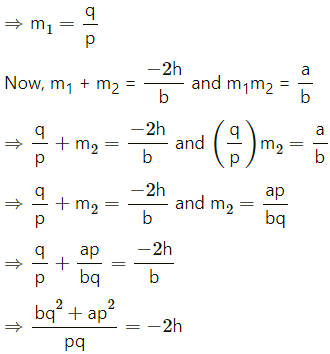
The auxiliary equation of the lines represented by ax2+ 2hxy + by2= 0 is bm2+ 2hm + a = 0.
Since one line is perpendicular to the line 3x + y = 0
whose slope is = -3
∴ slope of that line = m =
∴ m = is the root of the auxiliary equation bm2+ 2hm + a = 0.
∴ b + 2h + a = 0
∴ + a = 0
∴ b + 6h + 9a = 0
∴ 9a + b + 6h = 0
This is the required condition.