Latest Maharashtra State Board (SSC & HSC) 2026-27 Syllabus Digest & Solutions Updated!
Class 12 (HSC Board)Mathematics & Statistics2026-27 Syllabus

Chapter 2 Matrices Miscellaneous Exercise 2A Solutions

Complete Maharashtra State Board Balbharati & Yuvakbharati textbook solutions for Chapter 2 Matrices Miscellaneous Exercise 2A. Step-by-step solved exercises, numerical problems, and digest answers.

20 Solved Questions56 Diagrams2282 words

Balbharti12th Maharashtra State Board Maths Solutions BookPdf Chapter 2 Matrices Miscellaneous Exercise 2A Questions and Answers.

Maharashtra State Board 12th Maths Solutions Chapter 2 Matrices Miscellaneous Exercise 2A
Question 1 Maharashtra Board Solution
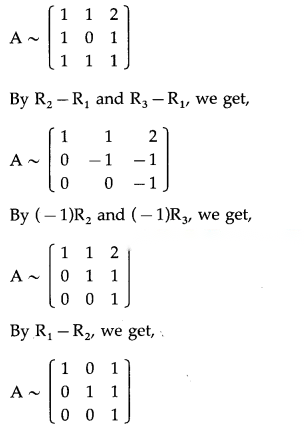
If A = then reduce it to I3 by using column transformations.
Solution & Step-by-Step Answer:
|A| = = 1(1 – 0) – 0 + 0 = 1 ≠ 0 ∴ A is a non-singular matrix. Hence, the required transformation is possible. Now, A = By C1 – 2C2, we get, A ~ By C1 + 3C3 and C2 – 3C3, we get, A ~ = I3.
Question 2 Maharashtra Board Solution
If A = , then reduce it to I3 by using row transformations.
Solution & Step-by-Step Answer:
|A| = = 2 (0 – 1) – 1(1 – 1) + 3 (1 – 0) = -2 – 0 + 3 = 1 ≠ 0 ∴ A is a non-singular matrix. Hence, the required transformation is possible. Now, A = By R1 – R2, we get, By R1 – R3 and By R2 – R3, we get A ~ = I3.

Question 3 Maharashtra Board Solution
Check whether the following matrices are invertible or not: (i)
Solution & Step-by-Step Answer:
Let A = Then, |A| = = 1 – 0 = 1 ≠ 0. ∴ A is a non-singular matrix. Hence, A-1 exists.

(ii) ≤ft[{array}{ll}
1 & 1 \\
1 & 1
{array}
Solution:
Let A = ≤ft[{array}{ll}
1 & 1 \\
1 & 1
{array}
Then, |A| = ≤ft|{array}{ll}
1 & 1 \\
1 & 1
{array} = 1 – 1 = 0.
∴ A is a singular matrix.
Hence, A-1does not exist.

(iii) ≤ft[{array}{ll}
1 & 2 \\
3 & 3
{array}
Solution:
Let A = ≤ft[{array}{ll}
1 & 2 \\
3 & 3
{array}
Then, |A| = ≤ft|{array}{ll}
1 & 2 \\
3 & 3
{array} = 3 – 6 = -3 ≠ 0.
∴ A is a non-singular matrix.
Hence, A-1exist.

(iv) ≤ft[{array}{ll}
2 & 3 \\
10 & 15
{array}
Solution:
Let A = ≤ft[{array}{ll}
2 & 3 \\
10 & 15
{array}
Then, |A| = ≤ft|{array}{ll}
2 & 3 \\
10 & 15
{array} = 30 – 30 = 0.
∴ A is a singular matrix.
Hence, A-1does not exist.

(v) ≤ft[{array}{rr}
θ & θ \\
- θ & θ
{array}
Solution:
Let A = ≤ft[{array}{rr}
θ & θ \\
- θ & θ
{array}
Then, |A| = ≤ft|{array}{cc}
θ & θ \\
θ & θ
{array}
= sec2θ – tan2θ = 1 ≠ 0.
∴ A is a non-singular matrix.
Hence, A-1exist.

(vii) ≤ft[{array}{lll}
3 & 4 & 3 \\
1 & 1 & 0 \\
1 & 4 & 5
{array}
Solution:
let A = ≤ft[{array}{lll}
3 & 4 & 3 \\
1 & 1 & 0 \\
1 & 4 & 5
{array}
Then, |A| = ≤ft|{array}{lll}
3 & 4 & 3 \\
1 & 1 & 0 \\
1 & 4 & 5
{array}
= 3(5 – 0) – 4(5 – 0) + 3(4 – 1)
= 15 – 20 + 9 = 4 ≠ 0
∴ A is a non-singular matrix.
Hence, A-1exist.

(viii) ≤ft[{array}{lll}
1 & 2 & 3 \\
2 & -1 & 3 \\
1 & 2 & 3
{array}
Solution:
Let A = ≤ft[{array}{lll}
1 & 2 & 3 \\
2 & -1 & 3 \\
1 & 2 & 3
{array}
Then, |A| = ≤ft|{array}{lll}
1 & 2 & 3 \\
2 & -1 & 3 \\
1 & 2 & 3
{array}
= 1 (-3 -6) – 2 (6 – 3) + 3 (4 + 1)
= -9 – 6 + 15 = 0
∴ A is a singular matrix.
Hence, A-1does not exist.

(ix) ≤ft[{array}{lll}
1 & 2 & 3 \\
3 & 4 & 5 \\
4 & 6 & 8
{array}
Solution:
Let A = ≤ft[{array}{lll}
1 & 2 & 3 \\
3 & 4 & 5 \\
4 & 6 & 8
{array}
Then, |A| = ≤ft|{array}{lll}
1 & 2 & 3 \\
3 & 4 & 5 \\
4 & 6 & 8
{array}
= 1(32 – 30) – 2(24 – 20) + 3(18 – 16)
= 2 – 8 + 6 = 0
∴ A is a singular matrix.
Hence, A-1does not exist.
Question 4 Maharashtra Board Solution
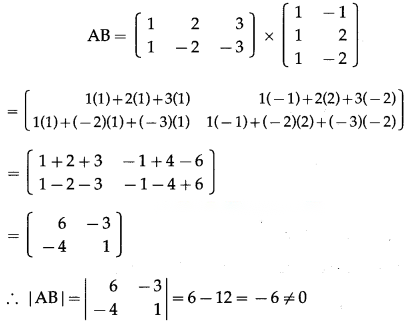
Find AB, if A = and B = Examine whether AB has inverse or not.
Solution & Step-by-Step Answer:
∴ A is a non-singular matrix. Hence, (AB)-1 exist.

Question 5 Maharashtra Board Solution
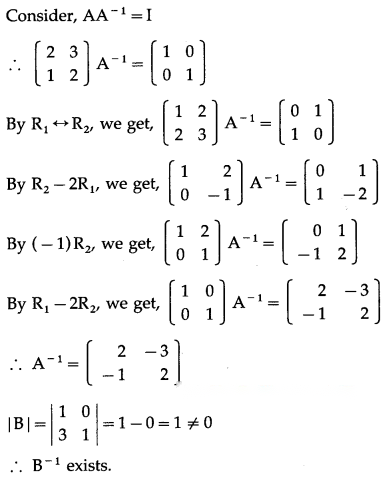
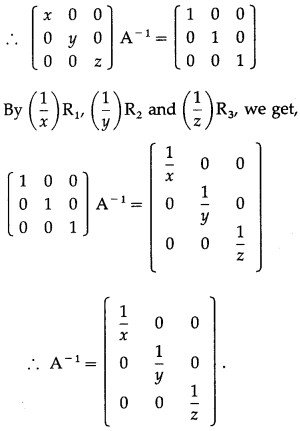
If A = is a nonsingular matrix then find A-1 by elementary row transformations. Hence, find the inverse of
Solution & Step-by-Step Answer:
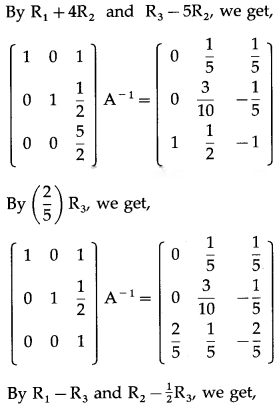
Since A is a non-singular matrix, then find A-1 by using elementary row transformations. We write AA-1 = I Comparing with , we get, x = 2, y = 1, z = -1 ∴ = , = = 1, = = -1 is .

Question 6 Maharashtra Board Solution
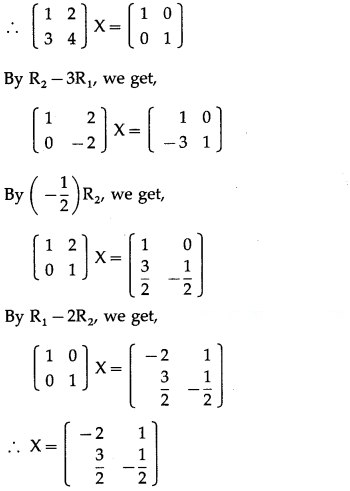
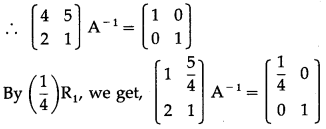
if A = and X is a 2 × 2 matrix such that AX = I, then find X.
Solution & Step-by-Step Answer:
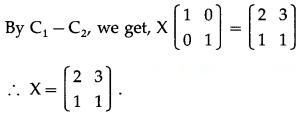
We will reduce the matrix A to the identity matrix by using row transformations. During this pro¬cess, I will be converted to the matrix X. We have AX = I.

Question 7 Maharashtra Board Solution
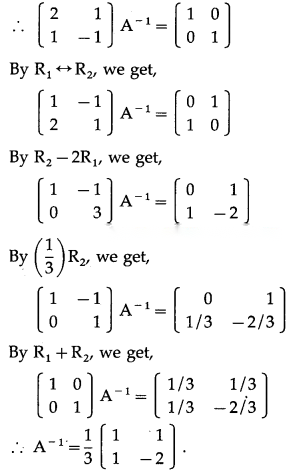
Find the inverse of each of the following matrices (if they exist). (i)
Solution & Step-by-Step Answer:
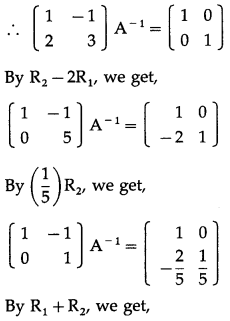
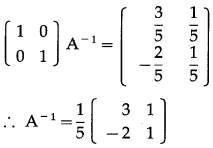
Let A = ∴ |A| = = 3 + 2 = 5 ≠ 0 ∴ A-1 exists. Consider AA-1 = I

(ii) ≤ft[{array}{ll}
2 & 1 \\
1 & -1
{array}
Solution:
Let A = ≤ft[{array}{ll}
2 & 1 \\
1 & -1
{array}
∴ |A| = ≤ft|{array}{ll}
2 & 1 \\
1 & -1
{array} = -2 – 1 = -3 ≠ 0
∴ A-1exists.
Consider AA-1= I
(iii) ≤ft[{array}{ll}
1 & 3 \\
2 & 7
{array}
Solution:
Let A = ≤ft[{array}{ll}
1 & 3 \\
2 & 7
{array}
∴ |A| = ≤ft|{array}{ll}
1 & 3 \\
2 & 7
{array} = 7 – 6 = 1 ≠ 0
∴ A-1exists.
Consider AA-1= I

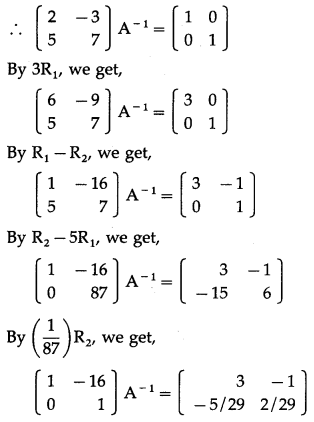
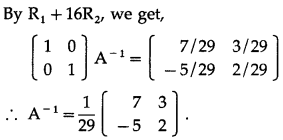
(iv) ≤ft[{array}{ll}
2 & -3 \\
5 & 7
{array}
Solution:
Let A = ≤ft[{array}{ll}
2 & -3 \\
5 & 7
{array}
∴ |A| = ≤ft|{array}{ll}
2 & -3 \\
5 & 7
{array} = 14 + 15 = 29 ≠ 0
∴ A-1exists.
Consider AA-1= I
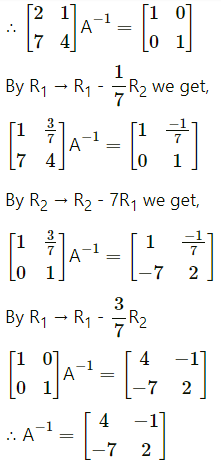
(v) ≤ft[{array}{ll}
2 & 1 \\
7 & 4
{array}
Solution:
Let A = ≤ft[{array}{ll}
2 & 1 \\
7 & 4
{array}
∴ |A| = ≤ft|{array}{ll}
2 & 1 \\
7 & 4
{array} = 8 – 7 = 1 ≠ 0
∴ A-1exists.
Consider AA-1= I
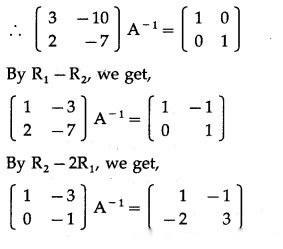
(vi) ≤ft[{array}{ll}
3 & -10 \\
2 & -7
{array}
Solution:
Let A = ≤ft[{array}{ll}
3 & -10 \\
2 & -7
{array}
∴ |A| = ≤ft|{array}{ll}
3 & -10 \\
2 & -7
{array} = -21 + 20 = -1 ≠ 0
∴ A-1exists.
Consider AA-1= I
(vii) ≤ft[{array}{lll}
2 & -3 & 3 \\
2 & 2 & 3 \\
3 & -2 & 2
{array}
Solution:
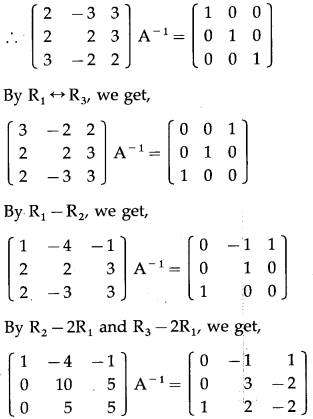
Let A = ≤ft[{array}{lll}
2 & -3 & 3 \\
2 & 2 & 3 \\
3 & -2 & 2
{array}
∴ |A| = ≤ft|{array}{lll}
2 & -3 & 3 \\
2 & 2 & 3 \\
3 & -2 & 2
{array}
= 2(4 + 6) +3(4 – 9) + 3(-4 – 6)
= 20 – 15 – 30 = -25 ≠ 0
∴ A-1exists.
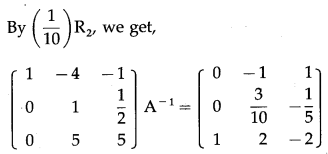
Consider AA-1= I
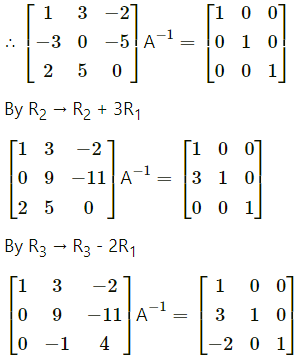
(viii) ≤ft[{array}{lll}
1 & 3 & -2 \\
-3 & 0 & -5 \\
2 & 5 & 0
{array}
Solution:
Let A = ≤ft[{array}{lll}
1 & 3 & -2 \\
-3 & 0 & -5 \\
2 & 5 & 0
{array}
∴ |A| = ≤ft|{array}{lll}
1 & 3 & -2 \\
-3 & 0 & -5 \\
2 & 5 & 0
{array}
= 1(0 + 25) + 3(0 + 10) + 2(-15 – 0)
= 25 + 30 -30
= 25 ≠ 0
∴ A-1exists.
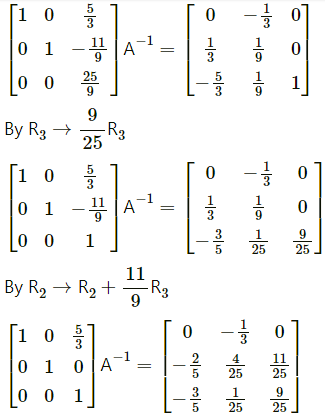
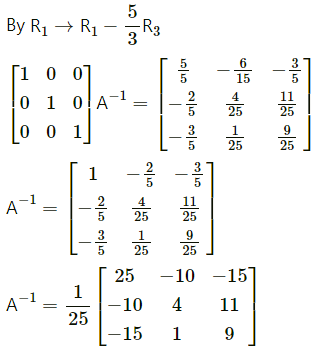
Consider AA-1= I

(ix) ≤ft[{array}{lll}
2 & 0 & -1 \\
5 & 1 & 0 \\
0 & 1 & 3
{array}
Solution:
Let A =≤ft[{array}{lll}
2 & 0 & -1 \\
5 & 1 & 0 \\
0 & 1 & 3
{array}
∴ |A| = ≤ft|{array}{lll}
2 & 0 & -1 \\
5 & 1 & 0 \\
0 & 1 & 3
{array}
= 2(3 – 0) – 0 – 1(5 – 0)
= 6 – 0 – 5 = 1 ≠ 0
∴ A-1exists.
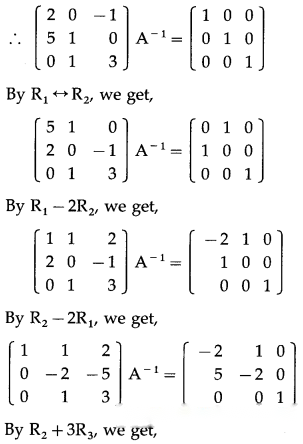
Consider AA-1= I
∴ A-1= ≤ft[{array}{lll}
3 & -1 & 1 \\
-15 & 6 & -5 \\
5 & -2 & 2
{array}
(x) ≤ft[{array}{lll}
1 & 2 & -2 \\
0 & -2 & 1 \\
-1 & 3 & 0
{array}
Solution:
Let A = ≤ft[{array}{lll}
1 & 2 & -2 \\
0 & -2 & 1 \\
-1 & 3 & 0
{array}
∴ A-1= ≤ft[{array}{lll}
1 & 2 & -2 \\
0 & -2 & 1 \\
-1 & 3 & 0
{array}
= 1≤ft|{array}{ll}
-2 & 1 \\
3 & 0
{array}| – 2≤ft|{array}{ll}
0 & 1 \\
-1 & 1
{array}| – 2≤ft|{array}{ll}
0 & -2 \\
-1 & 3
{array}
|A| = 1(0 – 3) – 2(0 + 1) – 2(0 – 2)
= -3 – 2 + 4
= -1 ≠ 0
∴ A-1exists.
We have
AA-1= I
∴ A-1= ≤ft[{array}{lll}
3 & 6 & 2 \\
1 & 2 & 1 \\
2 & 5 & 2
{array}

Question 8 Maharashtra Board Solution
Find the inverse of A = by (i) elementary row transformations
Solution & Step-by-Step Answer:
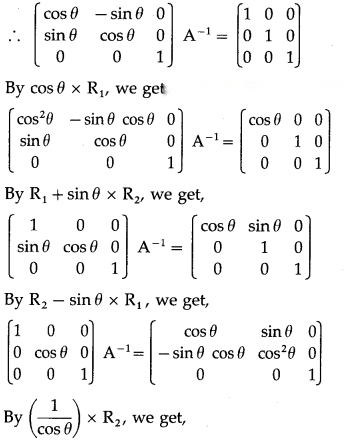
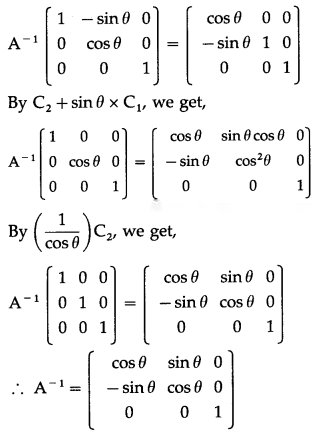
|A| = = cosθ (cosθ – 0) + sinθ (sinθ – 0) + 0 = cos2θ + sin2θ = 1 ≠ 0 ∴ A-1 exists. (i) Consider AA-1 = I

(ii) elementary column transformations
Solution:
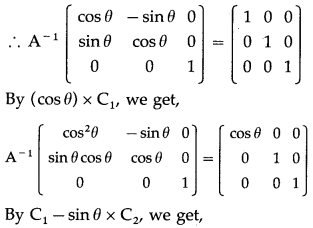
Consider A-1A = I
Question 9 Maharashtra Board Solution
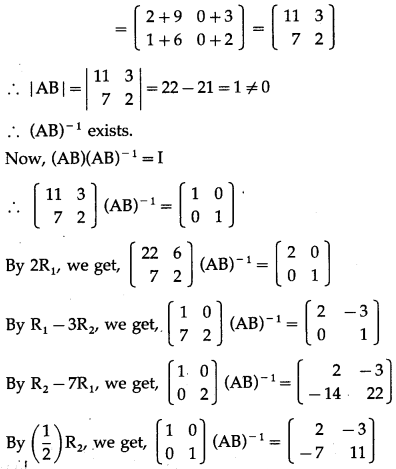
If A = , B = find AB and (AB)-1. Verify that (AB)-1 = B-1A-1
Solution & Step-by-Step Answer:
AB = From (1) and (2), (AB)-1 = B-1 ∙ A-1.

Question 10 Maharashtra Board Solution
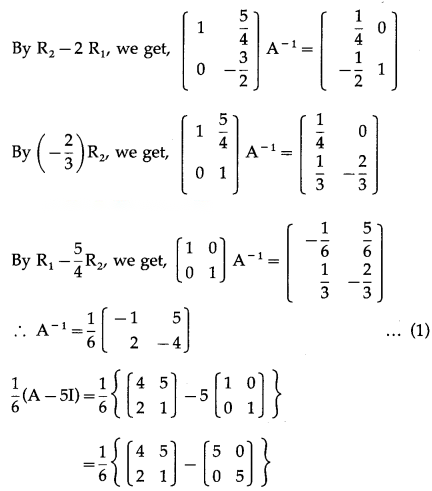
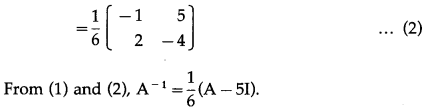
If A = , then show that A-1 = (A – 5I)
Solution & Step-by-Step Answer:
|A| = = 4 – 10 = -6 ≠ 0 ∴ A-1 exists. Consider AA-1 = I

Question 11 Maharashtra Board Solution
Find matrix X such that AX = B, where A = and B =
Solution & Step-by-Step Answer:
AX = B

Question 12 Maharashtra Board Solution
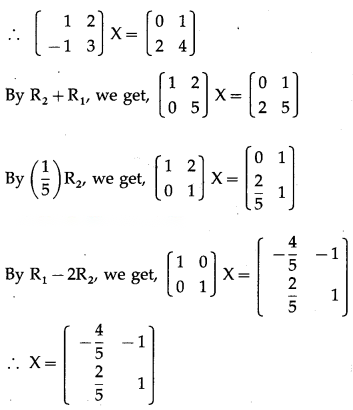
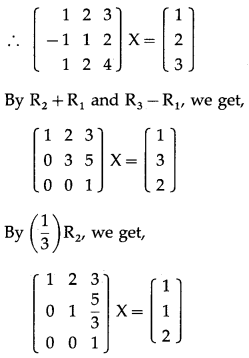
Find X, if AX = B where A = and B = .
Solution & Step-by-Step Answer:
AX = B

Question 13 Maharashtra Board Solution
If A = , B = and C = then find matrix X such that AXB = C.
Solution & Step-by-Step Answer:
AXB = C ∴ = First we perform the row transformations.

Question 14 Maharashtra Board Solution
Find the inverse of by adjoint method.
Solution & Step-by-Step Answer:
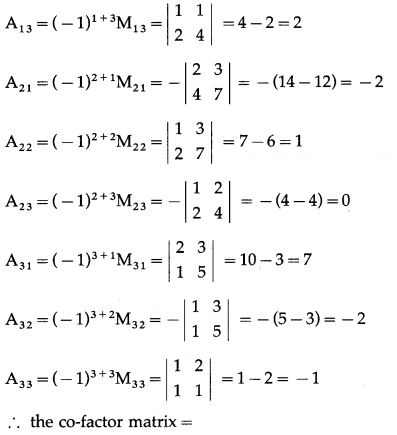
Let A = ∴ |A| = = 1(7 – 20) – 2(7 – 10) + 3(4 – 2) = -13 + 6 + 6 = -1 ≠ 0 ∴ A-1 exists. First we have to find the cofactor matrix = [Aij]3×3 where Aij = (-1)i+jMij Now, A11 = (-1)1+1M11 = = 7 – 20 = -13 A12 = (-1)1+2M12 = = -(7 – 10) = 3

Question 15 Maharashtra Board Solution
Find the inverse of by adjoint method.
Solution & Step-by-Step Answer:
where A = |A| = 1(2 – 6) – 0(0 – 3) + 1(0 – 2) |A| = -4 – 2 |A| = -6 ≠ 0 ∴ A-1 exists. First we have to find the cofactor matrix = [Aij]3×3, where Aij = (-1)i+jMij

Question 16 Maharashtra Board Solution
Find A-1 by adjoint method and by elementary transformations if A =
Solution & Step-by-Step Answer:
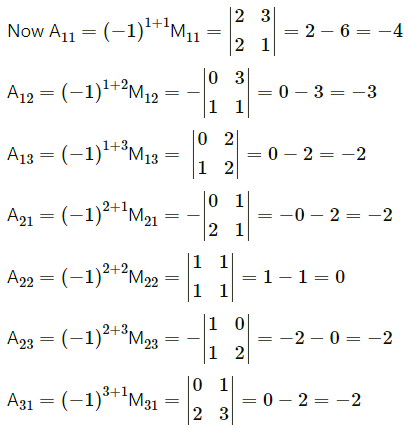
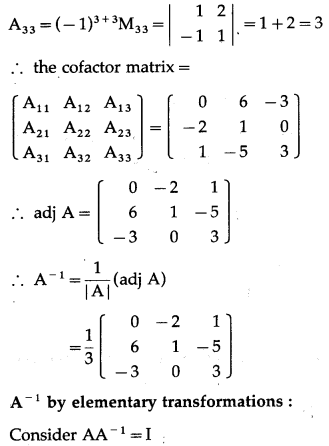
|A| = = 1(4 – 4) – 2(-4 – 2) + 3(-2 – 1) = 0 + 12 – 9 = 3 ≠ 0 ∴ A-1 exists. A-1by adjoint method : We have to find the cofactor matrix = [Aij]3×3, where Aij = (-1)i+j Mij

Question 17 Maharashtra Board Solution
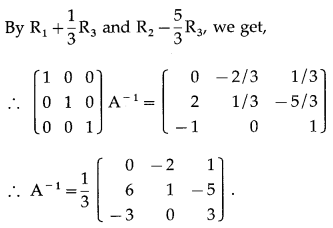
Find the inverse of A = by elementary column transformations.
Solution & Step-by-Step Answer:
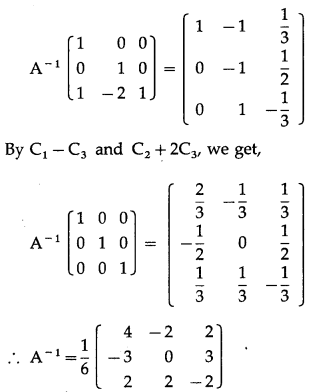
|A| = = 1 (2 – 6) – 0 + 1 (0 – 2) = -4 – 2= -6 ≠ 0 ∴ A-1 exists. Consider A-1A = I ∴ A-1 = By C3 – C1, we get,
Question 18 Maharashtra Board Solution
Find the inverse of by elementary row transformations.
Solution & Step-by-Step Answer:
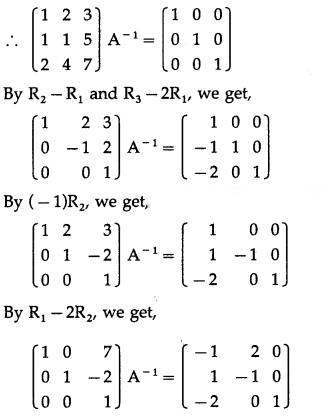
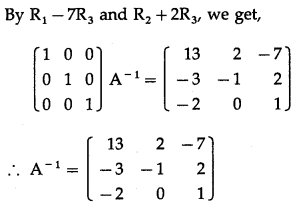
Let A = ∴ |A| = = 1(7 – 20) – 2(7 – 10) + 3(4 – 2) = -13 + 6 + 6 = -1 ≠ 0 ∴ A-1 exists. Consider AA-1 = I

Question 19 Maharashtra Board Solution
Show with usual notations that for any matrix A = [aij]3×3 (i) a11A21 + a12A22 + a13A23 = 0
Solution & Step-by-Step Answer:
A = [aij]3×3 = (i) A21 = (-1)2+1M21 = = -(a12a33 – a13a32) = -a12a33 + a13a32 A22 = (-1)2+2M22 = = a11a33 – a13a31 A23 = (-1)2+3M23 = = -(a11a32 – a12a31) = -a11a32+ a12a31 ∴ a11A21 + a12A22 + a13A23 = a11(-a1233 + a13a32) + a12(a11a33 – a13a31) + a13(-a11a32 + a12a31) = -a11a12a33 + a11a13a32 + a11a12a33 – a12a13a31 – a11a13a32 + a12a13a31 = 0

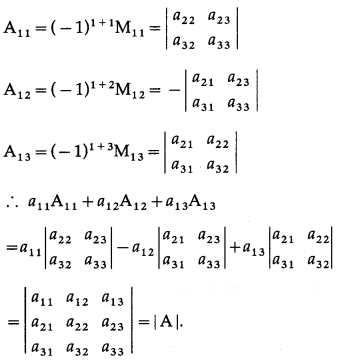
(ii) a11A11+ a12A12+ a13A13= |A|
Solution:
Question 20 Maharashtra Board Solution
If A = and B = , then find a matrix X such that XA= B.
Solution & Step-by-Step Answer:
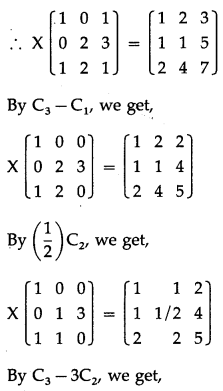
Consider XA = B