Maharashtra State Board Class 12 Geography Solutions Chapter 7 Region and Regional Development
1. Identify the correct group.
A | B | C | D |
Satpuda | Yavatmal | Thar | Marathwada |
Deccan | Amravati | Sahara | Khandesh |
Alps | Solapur | Himalaya | Vidarbha |
Rockies | Greater Mumbai | Gobi | Konkan |
D
Question 2
Maharashtra Board Solution
Solution & Step-by-Step Answer:
C
2. Differentiate between.
Question 1
Maharashtra Board Solution
Functional region and Formal region
Solution & Step-by-Step Answer:
Question 2
Maharashtra Board Solution
Physical and Political region
Solution & Step-by-Step Answer:
3. Write short notes on.
Question 1
Maharashtra Board Solution
Factors affecting regional development.
Solution & Step-by-Step Answer:
The physical factors like relief, climate, location, population and land use of the region affects the regional development.
Regional development occurs near areas with favourable location, plain relief, sufficient rainfall, developed agriculture, transportation, industries and trade. For example, Asian countries have developed agriculture and trade of agricultural goods. USA has developed industries and trade. There is poor development of economic activities in areas with unfavourable relief like mountains or hills and extreme climate. For example, in the northern part of Russia, economic development is poor due to extreme cold climate. Location of the region is an important factor. If there is a long and broken coastline, then there is development of ports and thus development of trade and economy. For example, Japan has economically developed in spite of limited natural resources, due to development of trade. On the other hand, landlocked countries remain isolated. They cannot develop trade due to absence of coastline. Such countries have poor economic development. For example, Afghanistan, Nepal. The economic development in any region depends upon the quantity and quality of its people. Where more suitable land is available, different economic activities are developed. For example, cities use land for various purposes such as industries, education, entertainment, transport, commerce, etc. Therefore, cities have economic development. Hence, physical factors are said to affect the economic development of the region.
Question 2
Maharashtra Board Solution
Measures to reduce regional imbalance.
Solution & Step-by-Step Answer:
4. Give geographical reasons.
Question 1
Maharashtra Board Solution
Regional development is dependent on physical setting.
Solution & Step-by-Step Answer:
Question 2
Maharashtra Board Solution
Factors like literacy, poverty affect the regional development.
Solution & Step-by-Step Answer:
Question 3
Maharashtra Board Solution
Development is not seen in the Himalayan region.
Solution & Step-by-Step Answer:
5. Answer the following questions in detail.
Question 1
Maharashtra Board Solution
What is a region?
Solution & Step-by-Step Answer:
The main characteristics of regions are : There are two types of regions – formal and functional regions. 2. In some formal regions, there are boundaries. Thus, district, state or country may be formal region. For example, USA and Canada are the examples of formal regions. 3. In functional regions characteristics are not important but functions are more important. 4. In one functional region, there may be many political or physical regions but due to one common function it is said to be functional. For example, Mumbai metropolitan or Pune metropolitan regions. 5. Functional regions act as a focal point that connects surrounding areas by transportation and communication. For example, Mumbai metropolitan city is well connected with its surrounding areas through transportation.
Question 2
Maharashtra Board Solution
On what factors are the regions differentiated? Give examples.
Solution & Step-by-Step Answer:
A region is an area of a country or any part of the world with same common features. Thus, regions are differentiated on the basis of physical or man-made or socio-cultural factors.
For example, Chota Nagpur plateau region has plateau relief. Himalayan mountain region has mountainous relief. The desert region of Rajasthan has shortage of rainfall and very high temperature. Northern plain region has plain relief, fertile soil and moderate climate. The region may be differentiated on the basis of man-made factors like political factors such as administrative boundaries or political boundaries. For example, Uttar Pradesh and Punjab are two different regions because they have different political boundaries and government bodies. The region may be differentiated on the basis of socio-cultural factors such as language, religion or ethnicity. For example, in Mumbai there is an area, where people speaking Gujarati language live in one region. The Middle East countries form one region where people of Muslim religion stay together. Thus, regions are differentiated on the basis of various factors.
Question 3
Maharashtra Board Solution
Per capita income is not the real indicator of regional development. Explain.
Solution & Step-by-Step Answer:
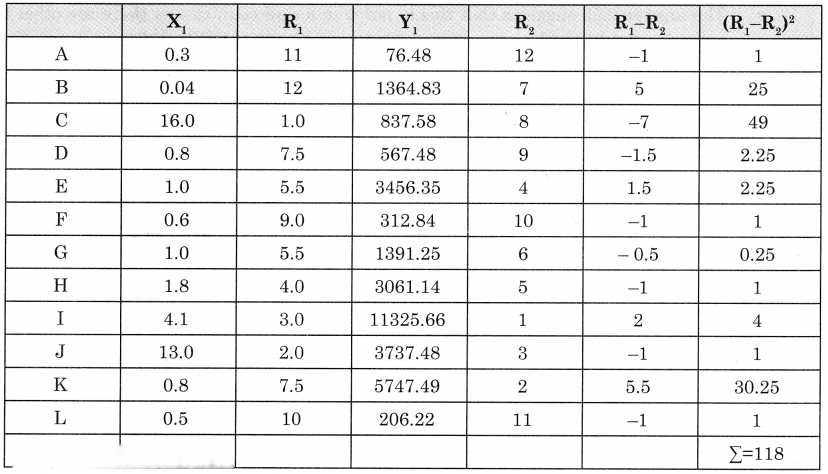
6. Find the correlation between land under permanent crops and GDP given in the table 7.5 using Spearman’s Rank Correlation. Write the conclusion in your own words.
It is not perfect positive correlation (+1.0). It is slightly less than this i.e. (+0.59). It means when the amount of land under permanent crops is more, GDP is also more and when the amount of land under permanent crops is less, GDP is also less. This is because the production of crops contributes to the growth of GDP. The answer 0.59 suggests that this is not true for all countries as there are other factors, activities, products which are responsible for the growth of GDP other than the production of crops. Class 12 Geography Chapter 7 Region and Regional Development Intext Questions and Answers Try this
Question 1
Maharashtra Board Solution
Given below are some geographical areas. Complete the table thinking about similarities between them and their types. Answer the questions that follow: (Textbook Page No. 66) (i) While completing the above table how did you decide the common factor between these areas? (ii) How did you differentiate one area from another? (iii) Is the common factor the only basis of differentiation? (iv) Make a list of characteristics which can be the basis of different area.
Solution & Step-by-Step Answer:
(i) We decide on the basis of the function of each geographical area.
Question 2
Maharashtra Board Solution
Here is the list of regions. Classify them into formal and functional regions. (Textbook Page No. 68) Ujani Dam catchment area, area served by Pune Municipal Transport (PMT), area served by Citi Cable Service, Uttar Pradesh, District Kolhapur, Taluka Haveli, rice producing region of Konkan, Black cotton soil region of India, areas served by local trains of Mumbai, area served by a Primary Health Centre
Solution & Step-by-Step Answer:
Question 3
Maharashtra Board Solution
In the following table, regions are given. At the same time, some geographical factors and effects are also given. Complete the table 7.3 accordingly, with the help of solved examples. (Textbook Page No. 69 & 70)
Solution & Step-by-Step Answer:
Question 4
Maharashtra Board Solution
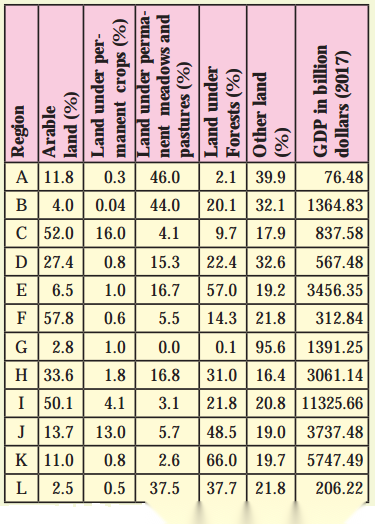
Look at the land use of the following regions in Table 7.5 and answer the questions that follow: (Textbook Page No. 72) (i) What does the table show? (ii) Which region has the highest land use under agriculture? (iii) Which region has the highest GDP? (iv) Which country (region) has more land use under forest? (v) Which region has the highest land use under category ‘other land’? What’s its GDP? (vi) Write your conclusion in few sentences.
Solution & Step-by-Step Answer:
(i) The table shows land use in different regions. (ii) The region C has the highest land use under agriculture. (iii) The region I has the highest GDP. (iv) The country (region) K has more land use under forest. (iv) The region G has the highest land use under category ‘other land’. Its GDP is 1391.5 billion dollars. (v) The region I is having highest GDP in which there is 50% arable land, it means agriculture must be major activity.
The region A is having lowest GDP where land under permanent meadows and pastures is highest. It means there is limited development of agricultural activities. It is surprising, region F where arable land is highest in percentage even then GDP is comparatively low, because the land under permanent crop is very less. In region K, GDP is 5747.49 and land under forest is 66%. It must be because the development of lumbering activities and forest-based industries is greater. The region G has the highest area under other land use (95.6%) and GDP 1391.25. This region must have developed activities other than agriculture and forestry. Use your brain power!
Question 1
Maharashtra Board Solution
Can you tell what the identifying characteristic in the following regions? (i) Pune Metropolitan Region (ii) Nagpur hub (iii) Dal Lake in Srinagar (iv) Alleppey tourism centre
Solution & Step-by-Step Answer:
(i) Pune Metropolitan Region – Functional region – Administration (ii) Nagpur hub – Functional region – Industrial complex (iii) Dal Lake in Srinagar – Functional region – Tourism (iv) Alleppey tourism centre – Functional region – Tourism
Question 2
Maharashtra Board Solution
(i) Identify your formal region. (ii) Can you identify and demarcate your own functional region? (iii) Which one is larger? (Textbook Page No. 68)
Solution & Step-by-Step Answer:
(i) Maharashtra State (ii) Yes, I can identify my functional region as government milk centre or D-mart departmental store. (iii) Area served by D-mart departmental store is larger than the government milk centre.
Can you tell?
Question 1
Maharashtra Board Solution
Read the table and answer the questions that follow. (Textbook Page No. 69) (i) In which region do you think there are more resources available? (ii) In which region do you think people are richer? (iii) In which region do you think people may be happier? Why? (iv) Do you think the given indicators or factors are enough to decide the standard of living of the people in the region? (v) In which region would you like to stay? Why?
Solution & Step-by-Step Answer:
(i) I think in region A more resources are available. (ii) I think in region A people are richer. (iii) People may be happier in region A because of higher per capita income, less population below poverty line, more urbanisation, more net sown area under irrigation. (iv) I do not think the given indicator or factors are enough to decide the standard of living because other important factors like literacy rate, enrolment ratio / dropout ratio, sex ratio, crime rate etc., are not taken into consideration (v) I will like to stay in region A because in this region per capita income is high, population below poverty line is low, percentage of urbanisation is highest, net sown and irrigated area is highest.
Question 2
Maharashtra Board Solution
(i) Looking at the five stages of demographic transition theory, countries in which stage do you think, will be called developed? (ii) Having looked at the various shapes of pyramids, which pyramid will represent a developed country? (Fig 2.1, Textbook Page No. 12) (iii) After having answered both the questions above, what can you comment upon the role of population in regional development? (Textbook Page No. 70)
Solution & Step-by-Step Answer:
(i) Countries in stage 4 and 5 will be called developed for e.g., USA, Sweden, Finland. (ii) The pyramid (C) will represent a developed country. (iii) The role of population in the regional development of any country is very important as man is a human resource. Quality of human resources is very important, which depends upon birth rate, death rate, expectancy of life, literacy ratio, male female ratio, mortality rate, etc.
A country having to qualitatively better population will help in the regional development of that country. For example, qualitatively population of the USA is better than population of India and hence, in USA there is better regional development than India. Think about it
Question 1
Maharashtra Board Solution
(i) Does development mean maximum utilisation of resources? (ii) Does development consider environment as an indicator? (iii) Can a region be called developed if it has sparse population or no population? (Textbook Page No. 69)
Solution & Step-by-Step Answer:
(i) Development does not mean maximum utilisation of resources. Development of a region is the function of its resources and its population. There are many factors which affect the development of a region. For the holistic development of regions, skilled human resources and optimum utilisation of natural resources is necessary.
(ii) We must consider the environment as an indicator of development. Development at the cost of the environment is not real development. Since we ignore the environment while developing economy in the past 50 years, we are now suffering by many environment problems like global warming, etc. (iii) Population is one of the most important factors in development. If there is sparse population or no population, then there will be shortage of man-power and resources will remain unutilized and therefore, quantity and quality of human resources is very important in the process of development. Give it try
Question 1
Maharashtra Board Solution
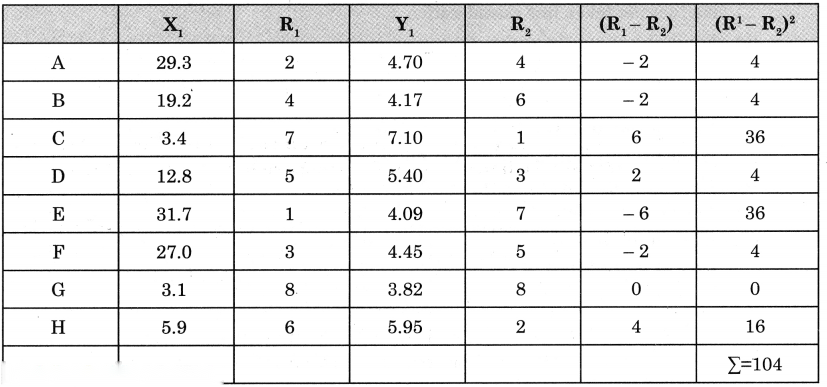
Draw a conclusion on the basis of the data given in table 7.4. Use Spearman’s Rank Correlation, find the correlation between the two variables. What can you comment about the development in this region? (Textbook Page No. 71)
Solution & Step-by-Step Answer:
X<sub>1</sub> Percentage of malnourished children about to enter school. Y<sub>1</sub> Government expenditure on education (% of total budget) R<sub>1</sub> = Rank – 1, R<sub>2</sub> = Rank – 2, n = 8 Rank correlation R = 1 – = 1 – = 1 – = 1 – = 1 – 1.24 = -0.24
The correlation between the percentage of malnourished children about to enter school and government expenditure on education is -0.24.
It means where the percentage of malnourished children about to enter school is more, the government expenditure on education is less e.g., in E region percentage of children is 31.7% but the expenditure is 4.09% and in C region percentage of children is only 3.4% but the expenditure is 7.10% (highest). Considering the fact, we cannot consider this as well developed. There is no logical sequence in distribution of government expenditure on education. It is necessary that government authorities should take into consideration actual status of the region, need of the region before releasing grant to that region. This will surely help in proper allocation of the funds and overall development of the region.
Question 2
Maharashtra Board Solution
Go through the fig. 7.2 and write two sentences on each factor. Tell how they will help in reducing regional imbalance. Also add some more to the list, if necessary. (Textbook Page No. 73)
Solution & Step-by-Step Answer:
No country, in the world is having uniform regional development and thus, there is regional imbalance in development. Hence, a country must have a regional imbalance reduction strategy. Regional imbalance can be reverted through provision of public/services to backward areas by providing drinking water, education facilities and electricity to all.
It can also be reverted by making provision of infrastructure stimulus by allotment of special funds, development of special skills, good governance, support to infrastructural project and policy review and reform.
Question 1
Maharashtra Board Solution
Look at the following data and answer the questions that follow: (Textbook Page No. 72) (i) In which region is contribution of primary activities the least? (ii) In which region is the contribution of primary activities the most? (iii) In which region the contribution of tertiary activities is the most? (iv) Which region has the highest HDI? (v) Can you draw a conclusion on basis of the answers from Q (i) to Q (iv)?
Solution & Step-by-Step Answer:
(i) In region A, the contribution of primary activities is the least. (ii) In region E, the contribution of primary activities is the most. (iii) In region B, the contribution of tertiary activities is the most. (iv) In region A, there is highest HDI. (v) We can conclude by saying that Human Development Index is high in countries where contribution of secondary and tertiary sector to GDP is high compared to the contribution of primary sector to GDP.
Region A, B, C and D have more than 30% contribution of secondary sector to GDP and more than 60% contribution of tertiary sector to GDP, it means these regions are developed regions. The contribution of primary sector to GDP in region E is more but the contribution from secondary and tertiary sector is less compared to other regions, so region E is in the developing stage. |