Latest Maharashtra State Board (SSC & HSC) 2026-27 Syllabus Digest & Solutions Updated!
Class 12 (HSC Board)Commerce Mathematics & Statistics2026-27 Syllabus

Chapter 8 Probability Distributions Miscellaneous Exercise 8 Solutions

Complete Maharashtra State Board Balbharati & Yuvakbharati textbook solutions for Chapter 8 Probability Distributions Miscellaneous Exercise 8. Step-by-step solved exercises, numerical problems, and digest answers.

59 Solved Questions43 Diagrams4073 words

Balbharati Maharashtra State Board12th Commerce Maths Solution Book PdfChapter 8 Probability Distributions Miscellaneous Exercise 8 Questions and Answers.

Maharashtra State Board 12th Commerce Maths Solutions Chapter 8 Probability Distributions Miscellaneous Exercise 8

(I) Choose the correct alternative.

Question 1 Maharashtra Board Solution
F(x) is c.d.f. of discreter r.v. X whose p.m.f. is given by P(x) = , for x = 0, 1, 2, 3, 4 & P(x) = 0 otherwise then F(5) = __________ (a) (b) (c) (d) 1
Solution & Step-by-Step Answer:
(d) 1
Question 2 Maharashtra Board Solution
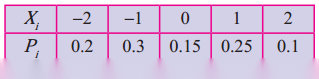
F(x) is c.d.f. of discrete r.v. X whose distribution is then F(-3) = __________ (a) 0 (b) 1 (c) 0.2 (d) 0.15
Solution & Step-by-Step Answer:
(a) 0

Question 3 Maharashtra Board Solution
X : number obtained on uppermost face when a fair die is thrown then E(X) = __________ (a) 3.0 (b) 3.5 (c) 4.0 (d) 4.5
Solution & Step-by-Step Answer:
(b) 3.5
Question 4 Maharashtra Board Solution
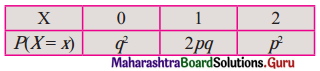
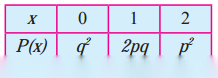
If p.m.f. of r.v. X is given below. then Var(X) = __________ (a) p2 (b) q2 (c) pq (d) 2pq
Solution & Step-by-Step Answer:
(d) 2pq
Question 5 Maharashtra Board Solution
The expected value of the sum of two numbers obtained when two fair dice are rolled is __________ (a) 5 (b) 6 (c) 7 (d) 8
Solution & Step-by-Step Answer:
(c) 7
Question 6 Maharashtra Board Solution
Given p.d.f. of a continuous r.v. X as f(x) = for -1 < x < 2 = 0 otherwise then F(1) = (a) (b) (c) (d)
Solution & Step-by-Step Answer:
(b)
Question 7 Maharashtra Board Solution
X is r.v. with p.d.f. f(x) = , 0 < x < 4 = 0 otherwise then E(X) = __________ (a) (b) (c) (d) 1
Solution & Step-by-Step Answer:
(b)
Question 8 Maharashtra Board Solution
If X follows B(20, ) then E(X) = __________ (a) 2 (b) 5 (c) 4 (d) 3
Solution & Step-by-Step Answer:
(a) 2
Question 9 Maharashtra Board Solution
If E(X) = m and Var(X) = m then X follows __________ (a) Binomial distribution (b) Possion distribution (c) Normal distribution (d) none of the above
Solution & Step-by-Step Answer:
(b) Possion distribution
Question 10 Maharashtra Board Solution
If E(X) > Var(X) then X follows __________ (a) Binomial distribution (b) Possion distribution (c) Normal distribution (d) none of the above
Solution & Step-by-Step Answer:
(a) Binomial distribution

(II) Fill in the blanks.

Question 1 Maharashtra Board Solution
The values of discrete r.v. are generally obtained by __________
Solution & Step-by-Step Answer:
counting
Question 2 Maharashtra Board Solution
The values of continuous r.v. are generally obtained by __________
Solution & Step-by-Step Answer:
measurement
Question 3 Maharashtra Board Solution
If X is dicrete random variable takes the values x1, x2, x3, …… xn then = __________
Solution & Step-by-Step Answer:
1
Question 4 Maharashtra Board Solution
If f(x) is distribution function of discrete r.v. X with p.m.f. p(x) = for x = 1, 2, 3, and p(x) = 0 otherwise then F(4) = __________
Solution & Step-by-Step Answer:
1
Question 5 Maharashtra Board Solution
If f(x) is distribution function of discrete r.v. X with p.m.f. p(x) = for x = 0, 1, 2, 3, 4, and p(x) = 0 otherwise then F(-1) = __________
Solution & Step-by-Step Answer:
0
Question 6 Maharashtra Board Solution
E(X) is considered to be __________ of the probability distribution of X.
Solution & Step-by-Step Answer:
centre of gravity
Question 7 Maharashtra Board Solution
If X is continuous r.v. and f(xi) = P(X ≤ xi) = then f(x) is called __________
Solution & Step-by-Step Answer:
Cumulative Distribution Function
Question 8 Maharashtra Board Solution
In Binomial distribution probability of success ________ from trial to trial.
Solution & Step-by-Step Answer:
remains constant/independent
Question 9 Maharashtra Board Solution
In Binomial distribution, if n is very large and probability success of p is very small such that np = m (constant) then ________ distribution is applied.
Solution & Step-by-Step Answer:
Possion

(III) State whether each of the following is True or False.

Question 1 Maharashtra Board Solution
If P(X = x) = for x = 0, 1, 2, 3, 4, then F(5) = when f(x) is c.d.f.
Solution & Step-by-Step Answer:
False
Question 2 Maharashtra Board Solution
If F(x) is c.d.f. of discrete r.v. X then F(-3) = 0.
Solution & Step-by-Step Answer:
True

Question 3 Maharashtra Board Solution
X is the number obtained on the uppermost face when a die is thrown the E(X) = 3.5.
Solution & Step-by-Step Answer:
True
Question 4 Maharashtra Board Solution
If p.m.f. of discrete r.v.X is then E(X) = 2p.
Solution & Step-by-Step Answer:
True

Question 5 Maharashtra Board Solution
The p.m.f. of a r.v. X is p(x) = , x = 1, 2,……n = 0 otherwise, Then E(X) =
Solution & Step-by-Step Answer:
True
Question 6 Maharashtra Board Solution
If f(x) = kx (1 – x) for 0 < x < 1 = 0 otherwise then k = 12
Solution & Step-by-Step Answer:
False
Question 7 Maharashtra Board Solution
If X ~ B(n, p) and n = 6 and P(X = 4) = P(X = 2) then p = .
Solution & Step-by-Step Answer:
True
Question 8 Maharashtra Board Solution
If r.v. X assumes values 1, 2, 3,………, n with equal probabilities then E(X) =
Solution & Step-by-Step Answer:
True
Question 9 Maharashtra Board Solution
If r.v. X assumes the values 1, 2, 3,………, 9 with equal probabilities, E(X) = 5.
Solution & Step-by-Step Answer:
True

(IV) Solve the following problems.

Part – I

Question 1 Maharashtra Board Solution
Identify the random variable as discrete or continuous in each of the following. Identify its range if it is discrete. (i) An economist is interested in knowing the number of unemployed graduates in the town with a population of 1 lakh.
Solution & Step-by-Step Answer:
X = No. of unemployed graduates in a town. ∵ The population of the town is 1 lakh ∴ X takes finite values ∴ X is a Discrete Random Variable ∴ Range of = {0, 1, 2, 4, …. 1,00,000}

(ii) Amount of syrup prescribed by a physician.
Solution:
X : Amount of syrup prescribed.
∴ X Takes infinite values
∴ X is a Continuous Random Variable.

(iii) A person on a high protein diet is interested in the weight gained in a week.
Solution:
X : Gain in weight in a week.
X takes infinite values
∴ X is a Continuous Random Variable.

(iv) Twelve of 20 white rats available for an experiment are male. A scientist randomly selects 5 rats and counts the number of female rats among them.
Solution:
X : No. of female rats selected
X takes finite values.
∴ X is a Discrete Random Variable.
Range of X = {0, 1, 2, 3, 4, 5}

(v) A highway safety group is interested in the speed (km/hrs) of a car at a checkpoint.
Solution:
X : Speed of car in km/hr
X takes infinite values
∴ X is a Continuous Random Variable.

Question 2 Maharashtra Board Solution
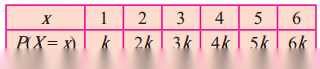
The probability distribution of a discrete r.v. X is as follows. (i) Determine the value of k. (ii) Find P(X ≤ 4), P(2 < X < 4), P(X ≥ 3).
Solution & Step-by-Step Answer:
(i) Assuming that the given distribution is a p.m.f. of X ∴ Each P(X = x) ≥ 0 for x = 1, 2, 3, 4, 5, 6 k ≥ 0 ΣP(X = x) = 1 and k + 2k + 3k + 4k + 5k + 6k = 1 ∴ 21k = 1 ∴ k =
(ii) P(X ≤ 4) = 1 – P(X > 4)
= 1 – [P(X = 5) + P(X = 6)]
= 1 – +
= 1 –
=
P(2 < X < 6) = p(3) + p(4) + p(5)
= 3k + 4k + 5k
=
=
=

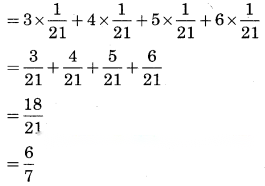
(iii) P(X ≥ 3) = p(3) + p(4) + p(5) + p(6)
= 3k + 4k + 5k + 6k
Question 3 Maharashtra Board Solution
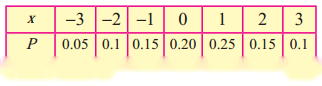
Following is the probability distribution of an r.v. X. Find the probability that (i) X is positive. (ii) X is non-negative. (iii) X is odd. (iv) X is even.
Solution & Step-by-Step Answer:
(i) P(X is positive) P(X = 0) = p(1) + p(2) + p(3) = 0.25 + 0.15 + 0.10 = 0.50
(ii) P(X is non-negative)
P(X ≥ 0) = p(0) + p(1) + p(2) + p(3)
= 0.20 + 0.25 + 0.15 + 0.10
= 0.70

(iii) P(X is odd)
P(X = -3, -1, 1, 3)
= p(- 3) +p(-1) + p(1) + p(3)
= 0.05 + 0.15 + 0.25 + 0.10
= 0.55

(iv) P(X is even)
= 1 – P(X is odd)
= 1 – 0.55
= 0.45

Question 4 Maharashtra Board Solution
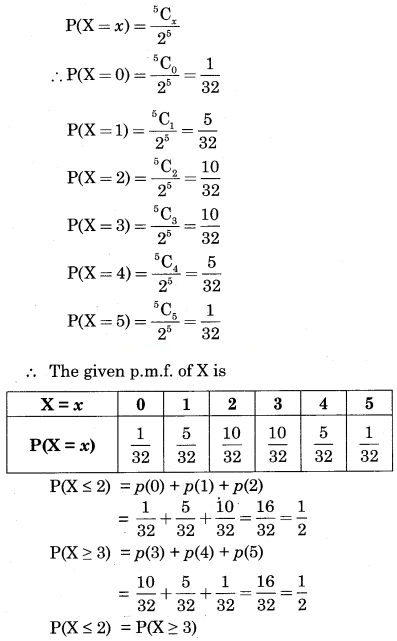
The p.m.f of a r.v. X is given by Show that P(X ≤ 2) = P(X ≥ 3).
Solution & Step-by-Step Answer:
For x = 0, 1, 2, 3, 4, 5
Question 5 Maharashtra Board Solution
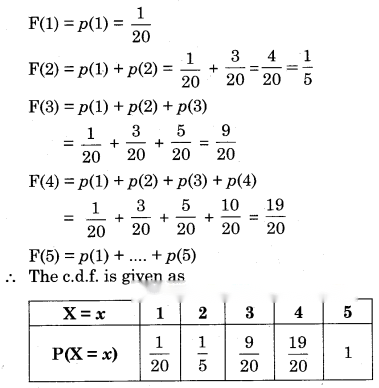
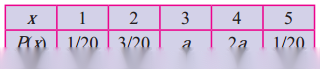
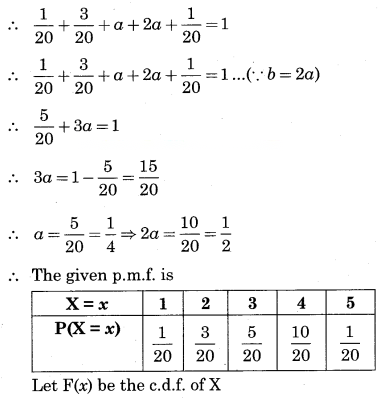
In the following probability distribution of an r.v. X Find a and obtain the c.d.f. of X.
Solution & Step-by-Step Answer:
Given distribution is p.m.f. of r.v. X ΣP(X = x) = 1 ∴ p(1) + p(2) + p(3) + p(4) + p(5) = 1
Question 6 Maharashtra Board Solution
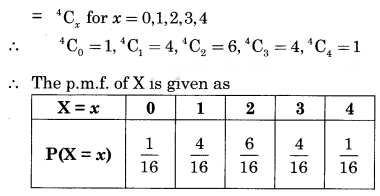
A fair coin is tossed 4 times. Let X denote the number of heads obtained. Identify the probability distribution of X and state the formula for p.m.f. of X.
Solution & Step-by-Step Answer:
A fair coin is tossed 4 times ∴ Sample space contains 16 outcomes Let X = Number of heads obtained ∴ X takes the values x = 0, 1, 2, 3, 4. ∴ The number of heads obtained in a toss is an even
Question 7 Maharashtra Board Solution
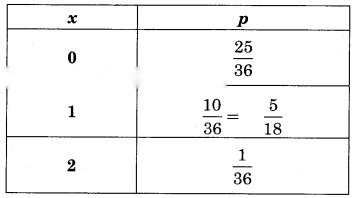
Find the probability of the number of successes in two tosses of a die, where success is defined as (i) number greater than 4 (ii) six appearing in at least one toss.
Solution & Step-by-Step Answer:
S : A die is tossed two times S = {(1, 1), (1, 2), (1, 3), (1, 4), (1, 5), (1, 6), (2, 1), (2, 2), (2, 3), (2, 4), (2, 5), (2, 6), (3, 1), (3, 2), (3, 3), (3, 4), (3, 5), (3, 6), (4, 1), (4, 2), (4, 3), (4, 4), (4, 5), (4, 6), (5, 1), (5, 2), (5, 3), (5, 4), (5, 5), (5, 6), (6, 1), (6, 2), (6, 3), (6, 4), (6, 5), (6, 6)} n(S) = 36 (i) X : No. is greater than 4 Range of X = {0, 1, 2}
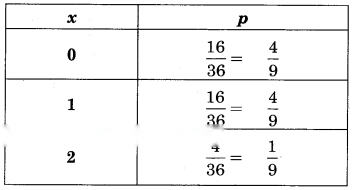
(ii) X : Six appears on aleast one die.
Range of X = {0, 1, 2}
Question 8 Maharashtra Board Solution
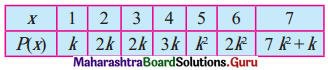
A random variable X has the following probability distribution. Determine (i) k, (ii) P(X < 3), (iii) P(X > 6), (iv) P(0 < X < 3).
Solution & Step-by-Step Answer:
(i) It is a p.m.f. of r.v. X Σp(x) = 1 p(1) + p(2) + p(3) + p(4) + p(5) + p(6) + p(7) = 1 k + 2k + 2k + 3k + k2 + 2k2 + 7k2 + k = 1 9k + 10k2 = 1 10k2 + 9k – 1 = 0 10k2 +10k – k – 1 = 0 ∴ 10k(k + 1) – 1(k + 1) = 0 ∴ (10k – 1) (k + 1) = 0 ∴ 10k – 1 = 0r k + 1 = 0 ∴ k = or k = -1 k = -1 is not accepted, p(x) ≥ 0, ∀ x ∈ R ∴ k =
(ii) P(X < 3) = p(1) + p(2)
= k + 2k
= 3k
= 3 ×
=

(iii) P(X > 6) = p(7)
= 7k2+ k
=
=
=

(iv) P(0 < X < 3) = p(1) + p(2)
= k + 2k
= 3k
= 3 ×
=

Question 9 Maharashtra Board Solution
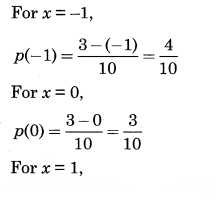
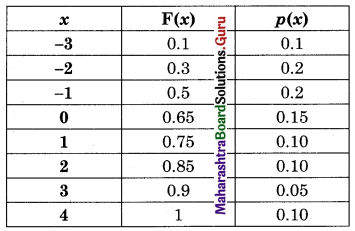
The following is the c.d.f. of a r.v. X. Find the probability distribution of X and P(-1 ≤ X ≤ 2).
Solution & Step-by-Step Answer:
P(-1 ≤ X ≤ 2) = p(-1) + p(0) + p(1) + p(2) = 0.2 + 0.15 + 0.10 + 0.10 = 0.55

Question 10 Maharashtra Board Solution
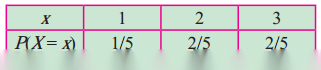
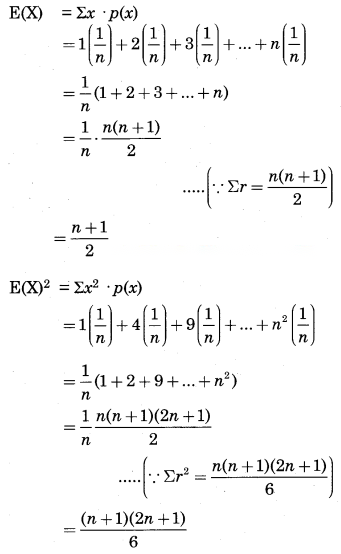
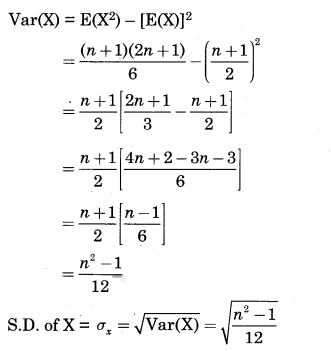
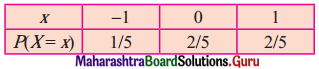
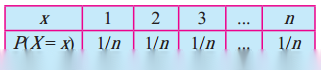
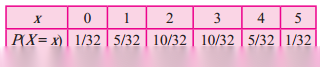
Find the expected value and variance of the r.v. X if its probability distribution is as follows. (i)
Solution & Step-by-Step Answer:

(ii)

Solution:
E(X) = Σx. p(x)
(iii)

Solution:
(iv)

Solution:

= 1.25
S.D. of X = σx= √Var(X)
= √1.25
= 1.118
Question 11 Maharashtra Board Solution
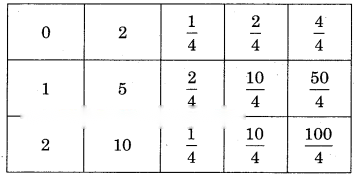
A player tosses two coins. He wins ₹ 10 if 2 heads appear, ₹ 5 if 1 head appears, and ₹ 2 if no head appears. Find the expected value and variance of the winning amount.
Solution & Step-by-Step Answer:
S : Two fair coin are tossed S = {HH, HT, TT, TH} n(S) = 4 ∴ Range of X = {0, 1, 2} ∴ Let Y = amount received corresponds to values of X Expected winning amount E(Y) = Σpy = = ₹ 5.5 V(Y) = Σpy2 – (Σpy)2 = – (5.5)2 = 38.5 – 30.25 = ₹ 8.25
Question 12 Maharashtra Board Solution
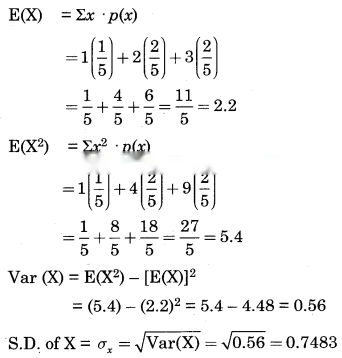
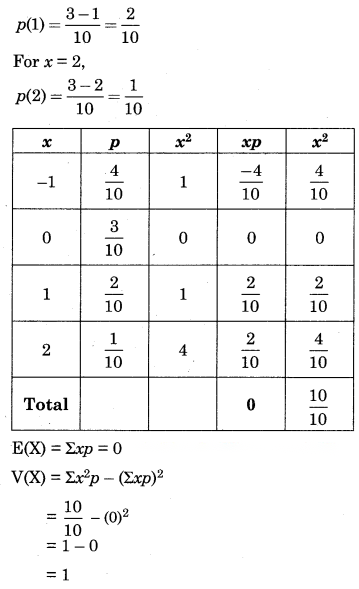
Let the p.m.f. of the r.v. X be Calculate E(X) and Var(X).
Solution & Step-by-Step Answer:

Question 13 Maharashtra Board Solution
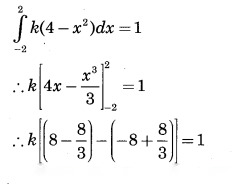
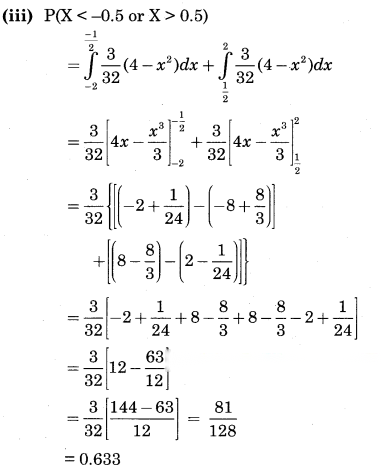
Suppose error involved in making a certain measurement is a continuous r.v. X with p.d.f. Compute (i) P(X > 0), (ii) P(-1 < X < 1), (iii) P(X < -0.5 or X > 0.5)
Solution & Step-by-Step Answer:
We know that
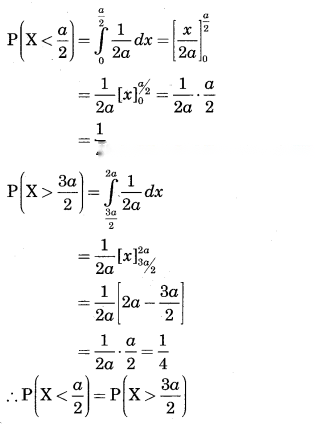
Question 14 Maharashtra Board Solution
The p.d.f. of the r.v. X is given by Show that P(X < ) = P(X > )
Solution & Step-by-Step Answer:

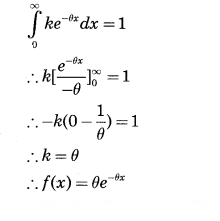
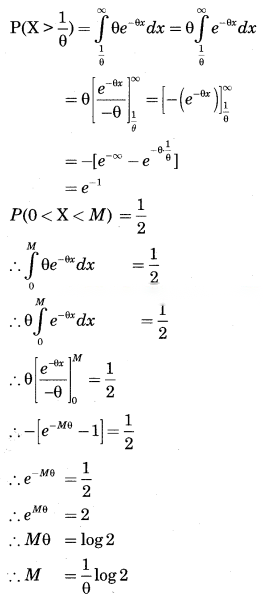
Question 15 Maharashtra Board Solution
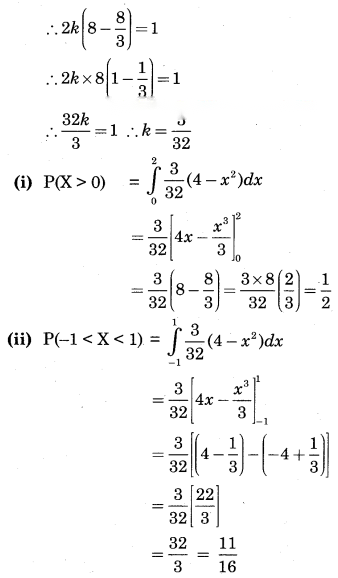
Determine k if is the p.d.f. of the r.v. X. Also find P(X > ). Find M if P(0 < X < M) =
Solution & Step-by-Step Answer:
We know that
Question 16 Maharashtra Board Solution
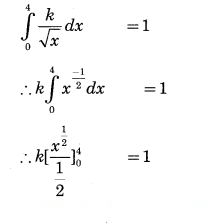
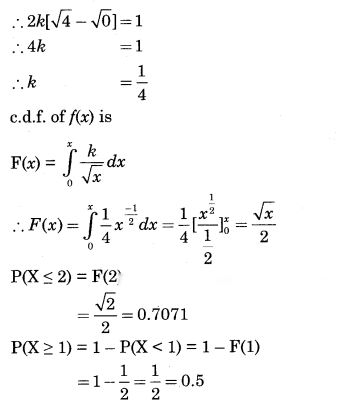
The p.d.f. of the r.v. X is given by Determine k, c.d.f. of X and hence find P(X ≤ 2) and P(X ≥ 1).
Solution & Step-by-Step Answer:
We know that
Question 17 Maharashtra Board Solution
Let X denote the reaction temperature (in °C) of a certain chemical process. Let X be a continuous r.v. with p.d.f. Compute P(X < 0).
Solution & Step-by-Step Answer:
Given p.d.f. is f(x) = , for -5 ≤ x ≤ 5 Let its c.d.f. F(x) be given by

Part – II

Question 1 Maharashtra Board Solution
Let X ~ B(10, 0.2). Find (i) P(X = 1) (ii) P(X ≥ 1) (iii) P(X ≤ 8)
Solution & Step-by-Step Answer:
X ~ B(10, 0.2) n = 10, p = 0.2 ∴ q = 1 – p = 1 – 0.2 = 0.8 (i) P(X = 1) = 10C1 (0.2)1 (0.8)9 = 0.2684

(ii) P(X ≥ 1) = 1 – P(X < 1)
= 1 – P(X = 0)
= 1 –10C0(0.2)0(0.8)10
= 1 – 0.1074
= 0.8926

(iii) P(X ≤ 8) = 1 – P(x > 1)
= 1 – [p(9) + p(10)]
= 1 – [10C9(0.2)9(0.8)1+10C10(0.2)10]
= 1 – 0.00000041984
= 0.9999

Question 2 Maharashtra Board Solution
Let X ~ B(n, p) (i) If n = 10 and E(X) = 5, find p and Var(X), (ii) If E(X) = 5 and Var(X) = 2.5, find n and p.
Solution & Step-by-Step Answer:
X ~ B(n, p) (i) n = 10, E(X) = 5 ∴ np = 5 ∴ 10p = 5 ∴ p = ∴ q = 1 – p = 1 – = V(X) = npq = 10 × × = 2.5

(ii) E(X) = 5, V(X) = 2.5
∴ np = 5, ∴ npq = 2.5
∴ 5q = 2.5
∴ q = = 0.5, p = 1 – 0.5 = 0.5
But np = 5
∴ n(0.5) = 5
∴ n = 10

Question 3 Maharashtra Board Solution
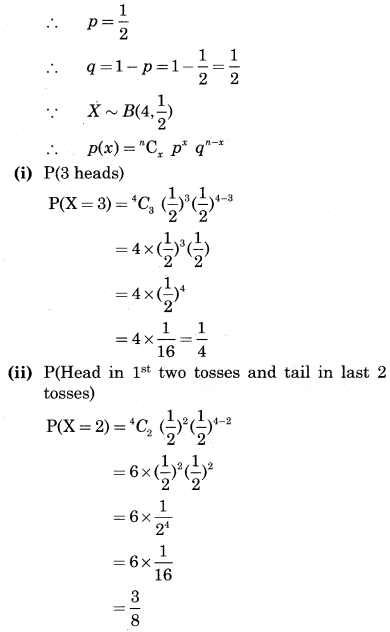
If a fair coin is tossed 4 times, find the probability that it shows (i) 3 heads, (ii) head in the first 2 tosses, and tail in the last 2 tosses.
Solution & Step-by-Step Answer:
n : No. of times a coin is tossed ∴ n = 4 X : No. of heads P : Probability of getting heads
Question 4 Maharashtra Board Solution
The probability that a bomb will hit the target is 0.8. Find the probability that, out of 5 bombs, exactly 2 will miss the target.
Solution & Step-by-Step Answer:
X : No. of bombs miss the target p : Probability that bomb miss the target ∴ q = 0.8 ∴ p = 1 – q = 1 – 0.8 = 0.2 n = No. of bombs = 5 ∴ X ~ B(5, 0.2) ∴ p(x) = nCx px qn-x P(X = 2) = 5C2 (0.2)2 (0.8)5-2 = 10 × 0.04 × (0.8)3 = 10 × 0.04 × 0.512 = 0.4 × 0.512 = 0.2048
Question 5 Maharashtra Board Solution
The probability that a lamp in the classroom will burn is 0.3. 3 lamps are fitted in the classroom. The classroom is unusable if the number of lamps burning in it is less than 2. Find the probability that the classroom can not be used on a random occasion.
Solution & Step-by-Step Answer:
X : No. of lamps not burning p : Probability that the lamp is not burning ∴ q = 0.3 ∴ p = 1 – q = 1 – 0.3 = 0.7 n = No. of lamps fitted = 3 ∴ X ~ B(3, 0.7) ∴ p(x) = nCx px qn-x P(classroom cannot be used) P(X < 2) = p(0) + p(1) = 3C0 (0.7)0 (0.3)3-0 + 3C1 (0.7)1 (0.3)3-1 = 1 × 1 × (0.3)3 + 3 × 0.7 × (0.3)2 = (0.3)2 [0.3 + 3 × 0.7] = 0.09 [0.3 + 2.1] = 0.09 [2.4] = 0.216
Question 6 Maharashtra Board Solution
A large chain retailer purchases an electric device from the manufacturer. The manufacturer indicates that the defective rate of the device is 10%. The inspector of the retailer randomly selects 4 items from a shipment. Find the probability that the inspector finds at most one defective item in the 4 selected items.
Solution & Step-by-Step Answer:
X : No. of defective items n : No. of items selected = 4 p : Probability of getting defective items ∴ p = 0.1 ∴ q = 1 – p = 1 – 0.1 = 0.9 P(At most one defective item) P(X ≤ 1) = p(0) + p(1) = 4C0 (0.1)0 (0.9)4-0 + 4C1 (0.1)1 (0.9)4-1 = 1 × 1 × (0.9)4 + 4 × 0.1 × (0.9)3 = (0.9)3 [0.9 + 4 × 0.1] = (0.9)3 × [0.9 + 0.4] = 0.729 × 1.3 = 0.9477
Question 7 Maharashtra Board Solution
The probability that a component will survive a check test is 0.6. Find the probability that exactly 2 of the next 4 components tested survive.
Solution & Step-by-Step Answer:
p = 0.6, q = 1 – 0.6 = 0.4, n = 4 x = 2 ∴ p(x) = nCx px qn-x P(X = 2) = 4C2 (0.6)2 (0.4)2 = 0.3456
Question 8 Maharashtra Board Solution
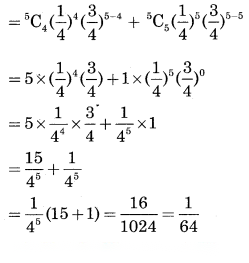
An examination consists of 5 multiple choice questions, in each of which the candidate has to decide which one of 4 suggested answers is correct. A completely unprepared student guesses each answer randomly. Find the probability that this student gets 4 or more correct answers.
Solution & Step-by-Step Answer:
n : No. of multiple-choice questions ∴ n = 5 X : No. of correct answers p : Probability of getting correct answer ∵ There are 4 options out of which one is correct ∴ p = ∴ q = 1 – p = 1 – = ∵ X ~ B(5, ) ∴ p(x) = nCx px qn-x P(Four or more correct answers) P(X ≥ 4) = p(4) + p(5)
Question 9 Maharashtra Board Solution
The probability that a machine will produce all bolts in a production run with in the specification is 0.9. A sample of 3 machines is taken at random. Calculate the probability that all machines will produce all bolts in a production run within the specification.
Solution & Step-by-Step Answer:
n : No. of samples selected ∴ n = 3 X : No. of bolts produce by machines p : Probability of getting bolts ∴ p = 0.9 ∴ q = 1 – p = 1 – 0.9 = 0.1 ∴ X ~ B(3, 0.9) ∴ p(x) = nCx px qn-x P(Machine will produce all bolts) P(X = 3) = 3C3 (0.9)3 (0.1)3-3 = 1 × (0.9)3 × (0.1)0 = 1 × (0.9)3 × 1 = (0.9)3 = 0.729
Question 10 Maharashtra Board Solution
A computer installation has 3 terminals. The probability that anyone terminal requires attention during a week is 0.1, independent of other terminals. Find the probabilities that (i) 0 (ii) 1 terminal requires attention during a week.
Solution & Step-by-Step Answer:
n : No. of terminals ∴ n = 3 X : No. of terminals need attention p : Probability of getting terminals need attention ∴ p = 0.1 ∴ q = 1 – p = 1 – 0.1 = 0.9 ∵ X ~ B(3, 0.1) ∴ p(x) = nCx px qn-x (i) P(No attention) ∴ P(X = 0) = 3C0 × (0.1)0 (0.9)3-1 = 1 × 1 × (0.9)3 = 0.729

(ii) P(One terminal need attention)
∴ P(X = 1) =3C1(0.1)1(0.9)3-1
= 3 × 0.1 × (0.9)2
= 0.3 × 0.81
= 0.243

Question 11 Maharashtra Board Solution
In a large school, 80% of the students like mathematics. A visitor asks each of 4 students, selected at random, whether they like mathematics, (i) Calculate the probabilities of obtaining an answer yes from all of the selected students, (ii) Find the probability that the visitor obtains the answer yes from at least 3 students.
Solution & Step-by-Step Answer:
X : No. of students like mathematics p: Probability that students like mathematics ∴ p = 0.8 ∴ q = 1 – p = 1 – 0.8 = 0.2 n : No. of students selected ∴ n = 4 ∵ X ~ B(4, 0.8) ∴ p(x) = nCx px qn-x (i) P(All students like mathematics) ∴ P(X = 4) = 4C4 (0.8)4 (0.2)4-4 = 1 × (0.8)4 × (0.2)0 = 1 × (0.8)4 × 1 = 0.4096

(ii) P(Atleast 3 students like mathematics)
∴ P(X ≥ 3) = p(3) + p(4)
=4C3(0.8)3(0.2)4-3+ 0.4096
= 4 × (0.8)3(0.2)1+ 0.4096
= 0.8 × (0.8)3+ 0.4096
= (0.8)4× 0.4096
= 0.4096 + 0.4096
= 0.8192

Question 12 Maharashtra Board Solution
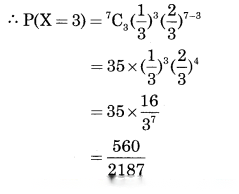
It is observed that it rains on 10 days out of 30 days. Find the probability that (i) it rains on exactly 3 days of a week. (ii) it rains at most 2 days a week.
Solution & Step-by-Step Answer:
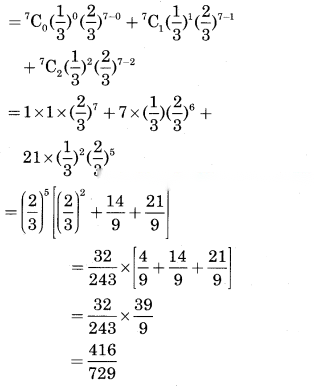
X : No. of days it rains in a week p : Probability that it rains ∴ p = ∴ q = 1 – p = 1 – = n : No. of days in a week ∴ n = 7 ∴ X ~ B(7, ) (i) P(Rains on Exactly 3 days of a week)
(ii) P(Rains on at most 2 days of a week)
∴ P(X ≤ 2) = p(0) + p(1) + p(2)
Question 13 Maharashtra Board Solution
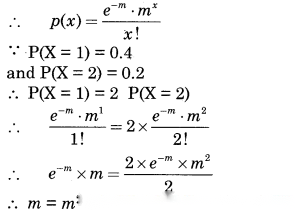
If X follows Poisson distribution such that P(X = 1) = 0.4 and P(X = 2) = 0.2, find variance of X.
Solution & Step-by-Step Answer:
X : Follows Possion Distribution ∴ m = 1 ∴ Mean = m = Variance of X = 1
Question 14 Maharashtra Board Solution
If X has Poisson distribution with parameter m, such that find probabilities P(X = 1) and P(X = 2), when X follows Poisson distribution with m = 2 and P(X = 0) = 0.1353.
Solution & Step-by-Step Answer:
Given that the random variable X follows the Poisson distribution with parameter m = 2 i.e. X ~ P(2) Its p.m.f. is satisfying the given equation. When x = 0, P(X = 1) = 2P(X = 0) = 2(0.1353) = 0.2706 When x = 1, P(X = 2) = P(X = 1) = 0.2706