Balbharati Maharashtra State Board12th Commerce Maths Solution Book PdfChapter 1 Mathematical Logic Ex 1.6 Questions and Answers.
Maharashtra State Board 12th Commerce Maths Solutions Chapter 1 Mathematical Logic Ex 1.6
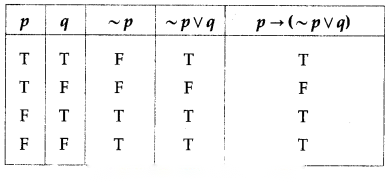
(ii) (~p ∨ q) ∧ (~p ∨ ~q)
Solution:

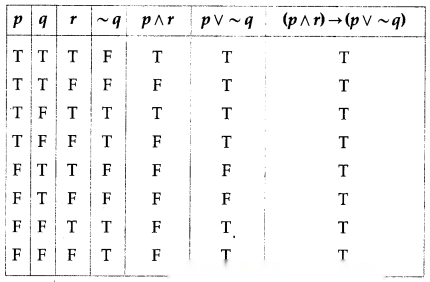
(iii) (p ∧ r) → (p ∨ ~q)
Solution:
Here are three statements and 4 connectives.
∴ there are 2 × 2 × 2 = 8 rows and 3 + 4 = 7 columns in the truth table.
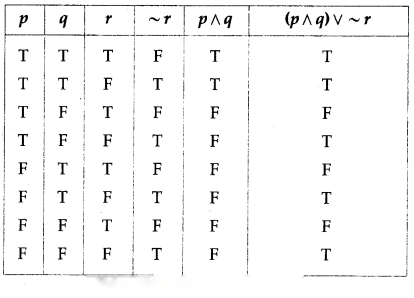
(iv) (p ∧ q) ∨ ~r
Solution:
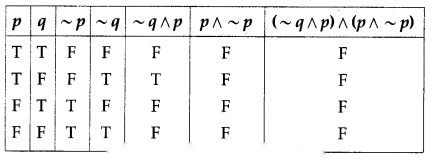
(ii) (~q ∧ p) ∧ (p ∧ ~p)
Solution:
All the entries in the last column of the above truth table are F.
∴ (~q ∧ p) ∧ (p ∧ ~p) is a contradiction.
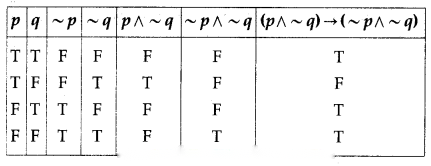
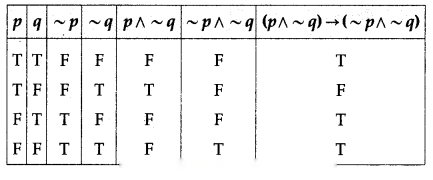
(iii) (p ∧ ~q) → (~p ∧ ~q)
Solution:
The entries in the last column are neither all T nor all F.
∴ (p ∧ ~q) → (~p ∧ ~q) is a contingency.
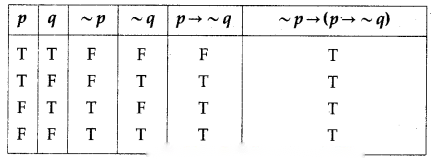
(iv) ~p → (p → ~q)
Solution:
All the entries in the last column of the truth table are T.
∴ p → (p → ~q) is a tautology.
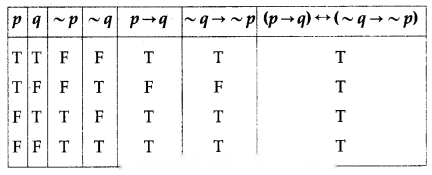
(ii) (p → q) ↔ (~q → ~p)
Solution:
All the entries in the last column of the above truth table are T.
∴ (p → q) ↔ (~q → ~p) is a tautology.
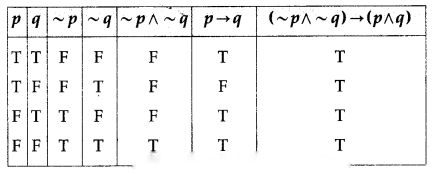
(iii) (~p ∧ ~q) → (p → q)
Solution:
All the entries in the last column of the above truth table are T.
∴ (~p ∧ ~q) → (p → q) is a tautology.
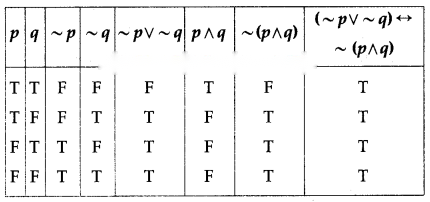
(iv) (~p ∨ ~q) ↔ ~(p ∧ q)
Solution:
All the entries in the last column of the above truth table are T.
∴ (~p ∨ ~q) ↔ ~(p ∧ q) is a tautology.
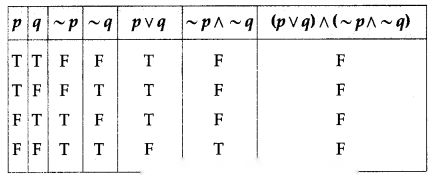
(ii) (p ∧ q) ∧ ~p
Solution:
All the entries in the last column of the above truth table are T.
∴ (p ∧ q) ∧ ~p is a contradiction.
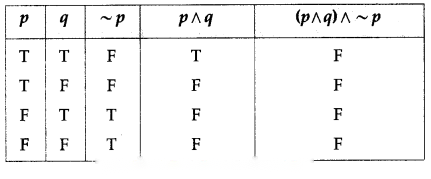
(iii) (p ∧ q) ∧ (~p ∨ ~q)
Solution:
All the entries in the last column of the above truth table are F.
∴ (p ∧ q) ∧ (~p ∨ ~q) is a contradiction.
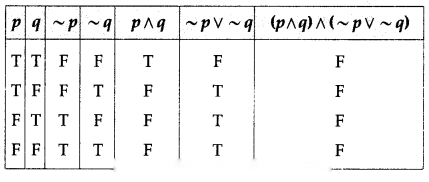
(iv) (p → q) ∧ (p ∧ ~q)
Solution:
All the entries in the last column of the above truth table are F.
∴ (p → q) ∧ (p ∧ ~q) is a contradiction.
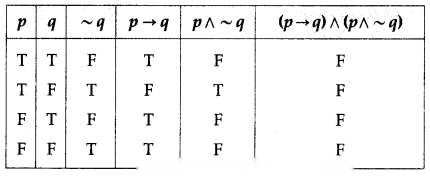
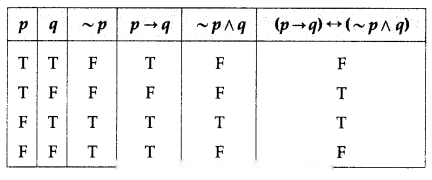
(ii) (p → q) ↔ (~p ∧ q)
Solution:
The entries in the last column of the above truth table are neither all T nor all F.
∴ (p → q) ↔ (~p ∧ q) is a contingency.
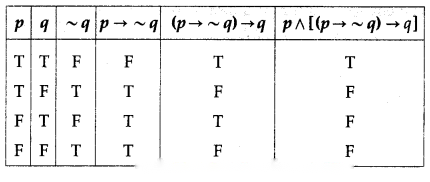
(iii) p ∧ [(p → ~q) → q]
Solution:
The entries in the last column of the above truth table are neither all T nor all F.
∴ p ∧ [(p → ~q) → q] is a contingency.
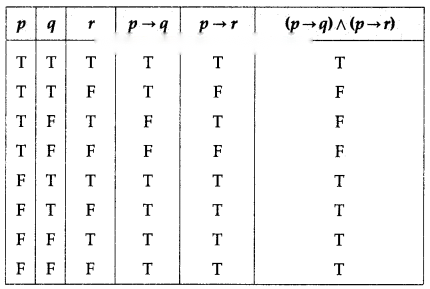
(iv) (p → q) ∧ (p → r)
Solution:
The entries in the last column of the above truth table are neither all T nor all F.
∴ (p → q) ∧ (p → r) is a contingency.
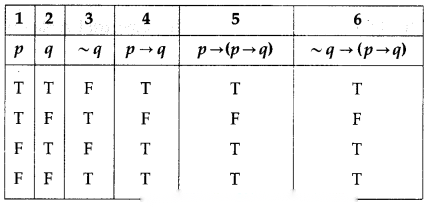
(ii) p → (p → q) ≡ ~q → (p → q)
Solution:
The entries in columns 5 and 6 are identical.
∴ p → (p → q) ≡ ~q → (p → q)
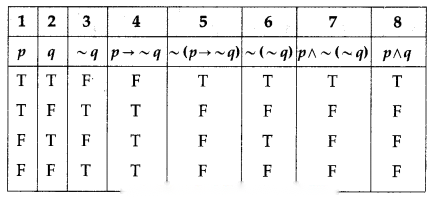
(iii) ~(p → ~q) ≡ p ∧ ~(~q) ≡ p ∧ q
Solution:
The entries in columns 5, 7 and 8 are identical.
∴ ~(p → ~q) ≡ p ∧ ~(~q) ≡ p ∧ q.
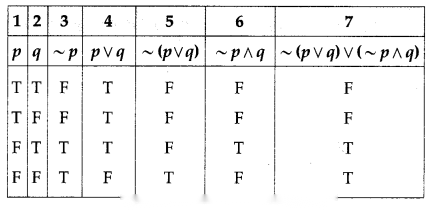
(iv) ~(p ∨ q) ∨ (~p ∧ q) ≡ ~p
Solution:
The entries in columns 3 and 7 are identical.
∴ ~(p ∨ q) ∨ (~p ∧ q) ≡ ~p.
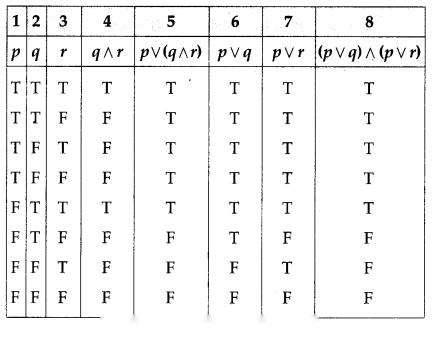
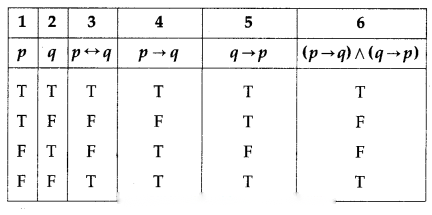
(ii) p ↔ q and (p → q) ∧ (q → p)
Solution:
The entries in columns 3 and 6 are identical.
∴ p ↔ q ≡ (p → q) ∧ (q → p)
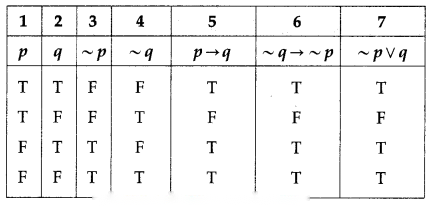
(iii) p → q and ~q → ~p and ~p ∨ q
Solution:
The entries in columns 5, 6 and 7 are identical.
∴ p → q ≡ ~q → ~p ≡ ~p ∨ q.
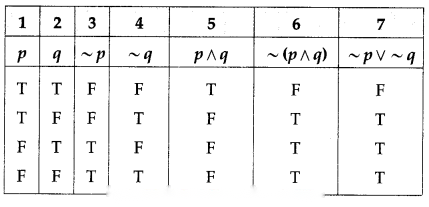
(iv) ~(p ∧ q) and ~p ∨ ~q
Solution:
The entries in columns 6 and 7 are identical.
∴ ~(p ∧ q) ≡ ~p ∨ ~q.