Maharashtra State Board 12th Chemistry Solutions Chapter 3 Ionic Equilibria
1. Choose the most correct answer :
Question i.
The pH of 10-8M of HCl is
(a) 8
(b) 7
(c) less than 7
(d) greater than 7
Answer:
(c) less than 7
Question ii.
Which of the following solution will have pH value equal to 1.0?
(a) 50 mL of 0.1M HCl + 50mL of 0.1 M NaOH
(b) 60 mL of 0.1M HCl + 40mL of 0.1 M NaOH
(c) 20 mL of 0.1M HCl + 80mL of 0.1 M NaOH
(d) 75 mL of 0.2M HCl + 25mL of 0.2 M NaOH
Answer:
(d) 75 mL of 0.2M HCl + 25mL of 0.2 M NaOH
Question iii.
Which of the following is a buffer solution ?
(a) CH3COONa + NaCl in water
(b) CH3COOH + HCl in water
(c) CH3COOH + CH3COONa in water
(d) HCl + NH4Cl in water
Answer:
(c) CH3COOH + CH3COONa in water
Question iv.
The solubility product of a sparingly soluble salt AX is 5.2 x 10⁻¹³. Its solubility in mol dm-3is
(a) 7.2 × 10⁻⁷
(b) 1.35 × 10⁻⁴
(c) 7.2 × 10⁻⁸
(d) 13.5 × 10⁻⁸
Answer:
(a) 7.2 × 10⁻⁷
Question v.
Blood in human body is highly buffered at pH of
(a) 7.4
(b) 7.0
(c) 6.9
(d) 8.1
Answer:
(a) 7.4
Question vi.
The conjugate base of [Zn(H2O)4]2+is
(a) [Zn(H2O)4]2+NH3
(b) [Zn(H2O)3]2+
(c) [Zn(H2O)3OH]+
(d) [Zn(H2O)H]3+
Answer:
(c) [Zn(H2O)3OH]+
Question vii.
For pH > 7 the hydronium ion concentration would be
(a) 10-7M
(b) < 10-7M
(c) > 10-7M
(d) ≥ 10-7M
Answer:
(b) < 10-7M
2. Answer the following in one sentence :
Question i.
Why cations are Lewis acids ?
Answer:
Since cations are deficient of electrons they accept a pair of electrons, hence they are Lewis acids.
Question ii.
Why is KCl solution neutral to litmus?
Answer:
Question iii.
How are basic buffer solutions prepared?
Answer:
Question iv.
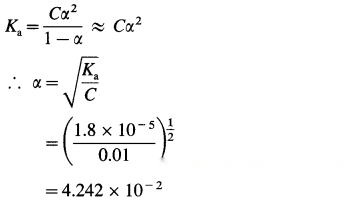
Dissociation constant of acetic acid is 1.8 × 10⁻⁵. Calculate percent dissociation of acetic acid in 0.01 M solution.
Answer:
Given : Ka= 1.8 x 10⁻⁵; C = 0.01 M
Percent dissociation = ?
∴ Percent dissociation = α × 100
= 4.242 × 10-2× 102
= 4.242%
Percent dissociation = 4.242%
Question v.
Write one property of a buffer solution.
Answer:
Properties (or advantages) of a buffer solution :
Question vi.
The pH of a solution is 6.06. Calculate its H+ion concentration.
Question vii.
Calculate the pH of 0.01 M sulphuric acid.
Answer:
Given : C = 0.01 M H2SO4, pH = ?
∴ [H3O+] = 2 × 0.01 = 0.02 M
PH = -log10[H3O+]
= -log100.02
= –
= 2 – 0.3010
= 1.6990
pH = 1.6990.
Question viii.
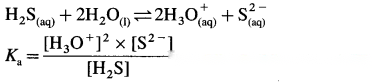
The dissociation of H2S is suppressed in the presence of HCl. Name the phenomenon.
Answer:
The weak dibasic acid H2S is dissociated as follows :
When HCl is added, it increases the concentration of common ion H3O+.
Hence by Le Chaterlier’s principle, the equilibrium is shifted from right to left, suppressing the dissociation of weak electrolyte H2S.
Question ix.
Why is it necessary to add H2SO4while preparing the solution of CuSO4?
Answer:
CuSO4is a salt of strong acid H2SO4and weak base Cu(OH)2. CuSO4in aqueous solution undergoes hydrolysis and forms a precipitate of Cu(OH)2and solution becomes turbid.
CuSO4+ 2H2O ⇌ CU(OH)2↓ + H2SO4
OR
CuSO4+ 4H2O ⇌ Cu(OH)2+ 2H3O++
When H2SO4is added, the hydrolysis equilibrium is shifted to left hand side and Cu(OH)2dissolves giving clear solution.
Question x.
Classify the following buffers into different types :
a. CH3COOH + CH3COONa
b. NH4OH + NH4Cl
c. Sodium benzoate + benzoic acid
d. Cu(OH)2+ CuCl2
Answer:
(a) Acidic buffer (CH3COOH + CH3COONa)
(b) Basic buffer (NH4OH + NH4Cl)
(c) Acidic buffer (Sodium benzoate + benzoic acid)
(d) Basic buffer (Cu(OH)2+ CuCl2)
[Note : Cu(OH)2being insoluble is not used to prepare a buffer solution.]
3. Answer the following in brief :
Question i.
What are acids and bases according to Arrhenius theory ?
Answer:
According to Arrhenius theory :
Acid : It is a substance which contains hydrogen and on dissolving in water produces hydrogen ions (H+) E.g. HCl
Base : It is a substance which contains OH group and on dissolving in water produces hydroxyl ions (OH–). E.g. NaOH
Question ii.
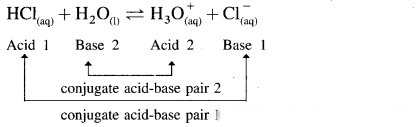
What is meant by conjugate acid-base pair?
Answer:
Conjugate acid-base pair : A pair of an acid and a base differing by a proton is called a conjugate acid-base pair.
Question iii.
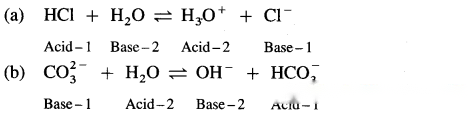
Label the conjugate acid-base pair in the following reactions
a. HCl + H2O ⇌ H3O++ Cl–
b. + H2O ⇌ OH–+
Answer:
Question iv.
Write a reaction in which water acts as a base.
Answer:
Since water accepts a proton, it acts as a base.

Question v.
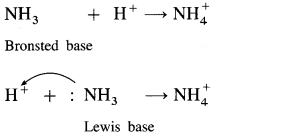
Ammonia serves as a Lewis base whereas AlCl3is Lewis acid. Explain.
Answer:
Question vi.
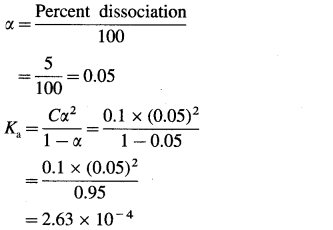
Acetic acid is 5% ionised in its decimolar solution. Calculate the dissociation constant of acid.
Answer:
Given : C = 0.1 M; Dissociation = 5%, Ka=2 Percent dissociation
Dissociation constant of acid = Ka= 2.63 × 10⁻⁴
Question vii.
Derive the relation pH + pOH = 14.
Answer:
The ionic product of water, Kw is given by,
Kw = [H3O+] × [OH–]
At 298 K, Kw= 1 × 10-14
∴ pKw= -log10Kw= log101 x 10-14= 14
∵ [H3O+] × [OH–] = 1 × 10-14
Taking logarithm to base 10 of both sides,
log10[H3O+] + log10[OH–] = log101 x 10-14
Multiplying both the sides by -1,
-log10[H3O+] -log10[OH–] = -log101 x 10-14
∵ pH = -log10[H3O+]; pOH = -log10[OH–];
pKw = – log10Kw
∴ pH + pOH = pKw
OR pH + pOH =14
Question viii.
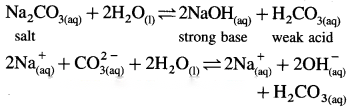
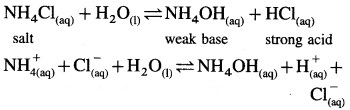
Aqueous solution of sodium carbonate is alkaline whereas aqueous solution of ammonium chloride is acidic. Explain.
Answer:
(A) (i) Sodium carbonate is a salt of weak acid and strong base.
(ii) In aqueous solution it undergoes hydrolysis.
(iii) Strong base dissociates completely while weak acid dissociates partially since [OH–] > [H3O+], the solution is basic.
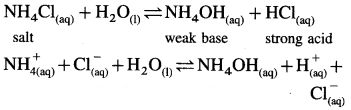
(B) (i) Ammonium chloride is a salt of strong acid and weak base.
(ii) In aqueous solution it undergoes hydrolysis
(iii) Since [H+] or [H3O+] > [OH–] the solution is acidic.
Question ix.
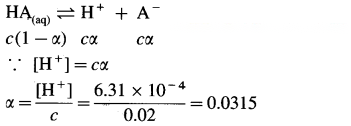
pH of a weak monobasic acid is 3.2 in its 0.02 M solution. Calculate its dissociation constant.
Answer:
Given : pH = 3.2; C = 0.02 M; Ka= ?
pH = -log10[H+]
∴ [H+] = Antilog – pH
= Antilog – 3.2
= Antilog
= 6.31 × 10⁻⁴M
Ka= cα2
= 0.02 × (0.0315)2
= 1.984 × 10⁻⁵
Dissociation constant = Ka= 1.984 × 10⁻⁵
Question x.
In NaOH solution [OH–] is 2.87 × 10⁻⁴. Calculate the pH of solution.
Answer:
Given : [OH–] = 2.87 × 10⁻⁴M, pH = ?
pOH = -log10[OH–]
= -log102.87 × 10-4
= –
= (4 – 0.4579)
= 3.5421
∵ pH + pOH = 14
∴ pH = 14 – pOH = 14 – 3.5421 = 10.4579
pH = 10.4579.
4. Answer the following :
Question i.
Define degree of dissociation. Derive Ostwald’s dilution law for the CH3COOH.
Answer:
(A) Degree of dissociation :
It is defined as a fraction of total number of moles of an electrolyte that dissociate into its ions at equilibrium.
It is denoted by a and represented by,
α =
Or α =
∴ Per cent dissociation = α × 100
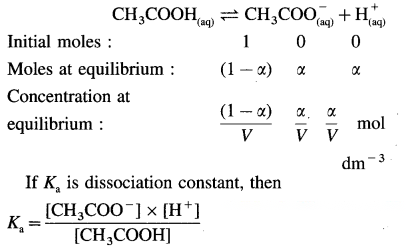
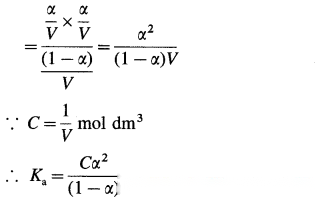
(B) Consider V dm3of a solution containing one mole of CH3COOH. Then the concentration of acid is, C = mol dm3. Let α be the degree of dissociation
This is Ostwald’s dilution law.
Question ii.
Define pH and pOH. Derive relationship between pH and pOH.
Answer:
(1) pH : The negative logarithm, to the base 10, of the molar concentration of hydrogen ions, H+is known as the pH of a solution.
pH = -log10[H+]
(2) pOH : The negative logarithm, to the base 10, of the molar concentration of hydroxyl ions, OH–is known as the pOH of a solution.
pOH = -log10[OH–]
Relationship between pH and pOH:
The ionic product of water, Kw is given by,
Kw= [H3O+] × [OH–]
At 298 K, Kw= 1 × 10-14
∴ pKw= -log10Kw= log101 x 10-14= 14
∵ [H3O+] × [OH–] = 1 × 10-14
Taking logarithm to base 10 of both sides,
log10[H3O+] + log10[OH–] = log101 x 10-14
Multiplying both the sides by -1,
-log10[H3O+] – log10[OH–] = -log101 x 10-14
∵ pH = -log10[H3O+]; pOH = -log10[OH–];
pKw= – log10Kw
∴ pH + pOH = pKw
OR pH + pOH =14
Question iii.
What is meant by hydrolysis ? A solution of CH3COONH4is neutral. why ?
Answer:
Hydrolysis : A reaction in which the cations or anions or both the ions of a salt react with water to produce acidity or basicity or sometimes neutrality is called hydrolysis.
A salt of weak acid and weak base for which Ka= Kb:
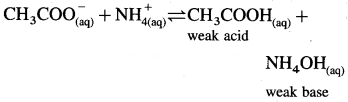
Consider hydrolysis of CH3COONH4.
Since Ka= Kb, the weak acid CH3COOH and weak base NH4OH dissociate to the same extent, hence, [H3O+] = [OH–] and the solution reacts neutral after hydrolysis.
Question iv.
Dissociation of HCN is suppressed by the addition of HCl. Explain.
Answer:
The weak acid HCN is dissociated as follows :
The dissociation constant Kais represented as,
Ka=
When HCl is added, it increases the concentration of H3O+, hence in order to keep the ratio constant, then by Le Chatelier’s principle, the equilibrium is shifted from right to left, suppressing the dissociation of HCN.
Question v.
Derive the relationship between degree of dissociation and dissociation constant in weak electrolytes.
Answer:
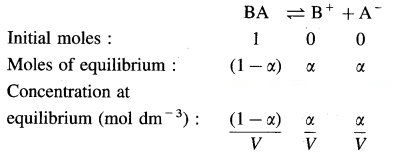
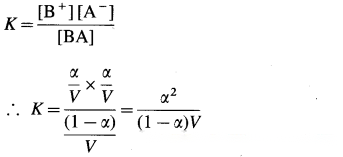
Expression of Ostwald’s dilution law in the case of a weak electrolyte : Consider the dissociation of a weak electrolyte BA. Let V dm3of a solution contain one mole of the electrolyte. Then the concentration of a solution is, C = mol dm-3. Let α be the degree of dissociation of the electrolyte.
Applying the law of mass action to this dissociation equilibrium, we have,
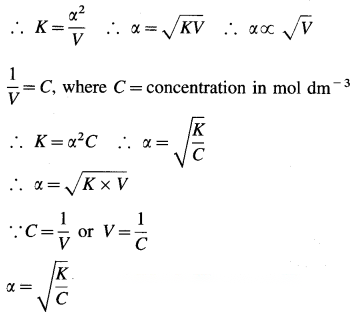
As the electrolyte is weak, α is very small as compared to unity, ∴ (1 – α) ≈ 1.
This is the expression of Ostwald’s dilution law. Thus, the degree of dissociation of a weak electrolyte is directly proportional to the square root of the volume of the solution containing 1 mole of an electrolyte.
Question vi.
Sulfides of cation of group II are precipitated in acidic solution (H2S + HCl) whereas sulfides of cations of group IIIB are precipitated in ammoniacal solution of H2S. Comment on the relative values of solubility product of sulfides of these.
Answer:
(1) In qualitative analysis, the cations of group II are precipitated as sulphides, namely HgS, CuS, PbS, etc., while cations of group IIIB are precipitated as sulphides, namely, CoS, NiS, ZnS.
(2) The sulphides of group II have extremely low solubility product (Ksp) about 10-29to 10-53while the sulphides of group IIIB have slightly higher Kspvalues about 10-20to 10-23.
(3) In group II, sulphides are precipitated by adding H2S in acidic solution while in IIIB group they are precipitated in a basic solution like ammonical solution.
(4) In acidic medium due to common ion H+, H2S is dissociated to very less extent but gives sufficient S2-ion to exceed solubility product of group II sulphides of cations and precipitate them.
(5) In basic medium, H+from H2S are removed by OH–in solution, or by NH4OH, increasing the dissociation of H2S and concentration of S2-, so that IP > Ksp.
(6) Therefore group II cations are precipitated in an acidic medium while cations of group IIIB are precipitated in ammonical solution.

Question vii.
Solubility of a sparingly soluble salt get affected in presence of a soluble salt having one common ion. Explain.
Answer:
Consider the solubility equilibrium of a sparingly soluble salt, AgCl.
The solubility product, Kspis given by,
Ksp= [Ag+] × [Cl–]
Consider addition of a strong electrolyte AgNO3with a common ion Ag+.
The concentration Ag+in the solution is increased, hence by Le Chatelier’s principle the equilibrium of AgCl is shifted to left hand side since the value of Kspis constant.
Thus in the presence of a common ion, the solubility of a sparingly soluble salt is suppressed.
Question viii.
The pH of rain water collected in a certain region of Maharashtra on particular day was 5.1. Calculate the H3O+ion concentration of the rain water and its percent dissociation.
Answer:
Given : pH = 5.1, [H3O+] = ?
PH = -log10[H3O+]
∴ log10[H3O+] = -pH
∴ [H3O+] = Antilog – pH
= Antilog – 5.1
= Antilog
= 7.943 × 10⁻⁶M
(H3O+in rainwater is due to dissolved gases, CO2, SO2, etc. forming acids which dissociate giving H3O+and acidity to rainwater.)
[H3O+] = 7.943 × 10⁻⁴M
Question ix.
Explain the relation between ionic product and solubility product to predict whether a precipitate will form when two solutions are mixed?
Answer:
If ionic product and solubility product are indicated by IP and Ksprespectively then,
(I) When IP = Ksp, the solution is saturated.
(II) When IP > Ksp, the solution is supersaturated and hence precipitation will occur, when two solutions are mixed.
(Ill) When IP < Ksp, the solution is unsaturated and precipitation will not occur, when two solutions are mixed.
12th Chemistry Digest Chapter 3 Ionic Equilibria Intext Questions and Answers
Use your brain power (Textbook Page No. 47)
Use your brain power (Textbook Page No. 49)

Use your brain power (Textbook Page No. 53)
Can you tell ? (Textbook Page No. 54)
(ii) HCOOK is a salt of weak acid HCOOH and strong base KOH. In aqueous solution it undergoes hydrolysis giving weak acid and strong base KOH which dissociates completely,
∴ [OH–] > [H3O+], and the solution reacts basic.

Can you think ? (Textbook Page No. 56)
Can you tell ? (Textbook Page No. 56)
Use your brain power (Textbook Page No. 59)
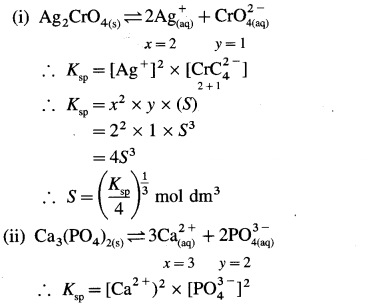
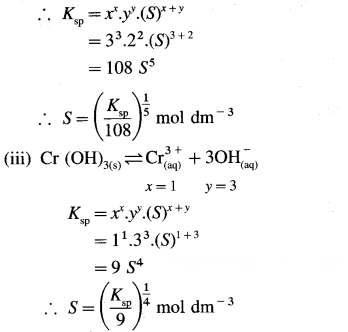
Can you tell ? (Textbook Page No. 60)