Maharashtra State Board 12th Biology Solutions Chapter 5 Origin and Evolution of Life
1. Multiple Choice Questions
2. Very short answer questions
(ii) Gene frequency
Answer:
The proportion of an allele in the gene pool as compared with other alleles at the same locus is termed as gene frequency.
(iii) Organic evolution
Answer:
Organic evolution can be defined as slow, gradual, continuous and irreversible changes through which the present-day complex forms of the life developed (or evolved) from their simple pre-existing forms.
(iv) Population
Answer:
All individuals of the same species form a group which is called a population.
(v) Speciation
Answer:
Formation of new species from the pre-existing single group of organisms is called speciation.
Short Answer Questions
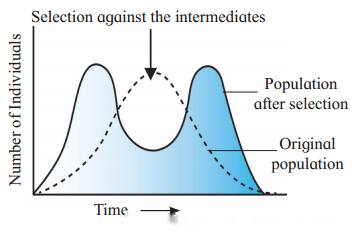
Example of disruptive selection:
African seed cracker finches are types of seed-feeder birds which have different sizes of beak. The seeds available to them were of small and large sized. Large beak sized birds feeds on large seeds while small beak sized birds feed on small seeds.
Such large and small birds thus thrive well. However, intermediate beak sized birds are unable to feed on either type of seeds so they starve and their population was decreased gradually. Natural selection eliminated them and thus the population of finches appear disrupted.
4. Match the columns
Column I | Column II |
(1) August Weismann | (a) Mutation theory |
(2) Hugo de Vries | (b) Germplasm theory |
(3) Charles Darwin | (c) Theory of acquired characters |
(4) Lamarck | (d) Theory of natural selection |
Column I | Column II | ||||||||||||||||||||
(1) August Weismann | (b) Germplasm theory | ||||||||||||||||||||
(2) Hugo de Vries | (a) Mutation theory | ||||||||||||||||||||
(3) Charles Darwin | (d) Theory of natural selection | ||||||||||||||||||||
(4) Lamarck | (c) Theory of acquired characters 5. Long Answer Questions
Question 1
Maharashtra Board Solution
Would you consider wings of butterfly and bat as homologous or analogous and why?
Solution & Step-by-Step Answer:
Wings of butterfly are made up of chitin. They neither have bones, nor muscles in the wings. The bat’s wings are actually patagium. They have muscles and bones just as those seen in all vertebrate limb series. Therefore, these two examples cannot be homologous. However, both the animals use the wings for flight. This is an indication that their function is similar but structure is different, hence they are analogous organs.
Question 2
Maharashtra Board Solution
What is adaptive radiation? Explain with suitable example.
Solution & Step-by-Step Answer:
Question 3
Maharashtra Board Solution
By talking industrial melanism as one example, explain the concept of natural selection. OR Explain natural selection in action by quoting the example of industrial melanism.
Solution & Step-by-Step Answer:
1. Industrial melanism is the best example of natural selection which was studied by Kettlewell. In U.K. there are two varieties of peppered moths, Biston betularia and Biston carbonaria.
2. Before industrialisation, in Great Britain, Biston betularia were more in number than Biston carbonaria. B. Betularia is greyish white while B.carbonaria is melanic form. 3. These nocturnal moths rest on tree trunk during day. White-winged moth can camouflage well with the lichen covered whitish barks of trees. They thus escaped the attention of the predatory birds. But at the same time melanic forms were visible due to white barks of the trees. Their number was thus reduced as they were preyed upon by birds. 4. Later there was an industrial revolution, which ultimately resulted in air pollution causing dark soot to settle on the barks of the trees. Lichens too were destroyed and the melanic forms were now at advantage. Melanic forms could camouflage with black tree trunks and their number increased. White-winged moth become clearly seen in changed colours of the trees and thus they were easily caught by predatory birds. This caused decrease in their number. 5. Natural selection thus acted in changed environmental conditions and helped in the establishment of a phenotypic traits. The changed traits were more adaptive and hence were selected. Natural selection encourages those genes or traits that assure highest degree of adaptive efficiency between population and its environment.
Question 4
Maharashtra Board Solution
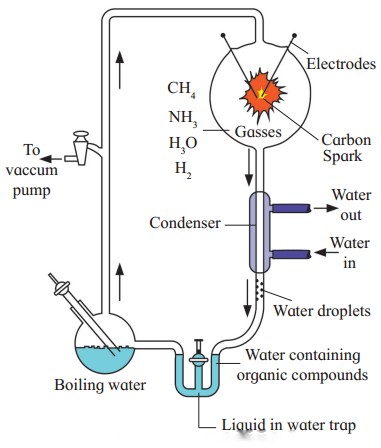
Describe the Urey and Miller’s experiment.
Solution & Step-by-Step Answer:
1. Urey and Miller performed an experiment to prove Oparin’s theory of chemical evolution.
2. They selected a spark discharge apparatus that consisted of closed system of glass having tungsten electrodes, flask for water boiling, a side tube connected to a vacuum pump, a cooling jacket and U-shaped trap. 3. The entire apparatus was first evacuated and made sterile and pre-biotic atmosphere was created in it. 4. The flask was filled with some water and mixture of methane, ammonia and hydrogen in the ratio of 1 : 2 : 2 were slowly passed through the stopcock, without allowing air. 5. Heat was supplied to the flask at very low temperature causing water to boil. The flask simulated the ocean present on primitive earth. Process of evaporation and precipitation was simulated by using heating mantle and condenser respectively. 6. Water vapours along with other gases were circulated continuously through continuous electric sparks. These sparks were given to the mixture for several days causing the gases to interact. This too simulated lightning. 7. Mixture of CH4, NH3and H2gases passed through a condenser and was condensed to liquid. 8. The liquefied mixture was collected in the U-shaped trap, present at the bottom of the apparatus. It was found that variety of simple organic compounds (urea, amino acids, lactic acid and sugars) were formed in the apparatus. This experiment provides the evidence in support to the fact that simple molecules present in the earth’s early atmosphere combined to form the organic building blocks of life.
Question 5
Maharashtra Board Solution
What is Isolation? Describe the different types of reproductive isolations.
Solution & Step-by-Step Answer:
1. Isolation means separation of the population of a particular species into smaller units. The organisms belonging to these subunits are prevented from interbreeding due to some barrier. These barriers are called isolating mechanisms.
2. They prevent the genetic exchange and gene flow. 3. Due to isolating mechanisms in nature the divergence among organisms takes place gradually leading to speciation. The isolating mechanisms are of two types namely, geographical isolation and reproductive isolation. I. Geographical Isolation : The barrier in the form of physical distance or geographical barrier is called geographical isolation. The original population gets divided into two or more groups by geographical barriers such as river, ocean, mountain, glacier, etc. Organisms cannot cross the barriers on their own and hence interbreeding is prevented between isolated groups. The separated groups experience different environmental factors and they acquire new traits by mutations. The separated populations develop distinct gene pool and they do not interbreed. Each subgroup then evolves differently which results into formation of new species. E.g. Darwin’s Finches, African elephant, Loxodonta and Indian elephant, Elephas. II. Reproductive Isolation : Two populations may be occupying the same area, they may not be separated by geographical barrier, but then also they are reproductively isolated. Such reproductive isolation occurs due to change in genetic material, gene pool and structure of genital organs. Such differences prevent interbreeding between population. Such isolation later leads to speciation. III. Different types of reproductive isolations : Reproductive isolation is of two types, viz. pre-zygotic and post-zygotic isolating mechanisms.
Question 6
Maharashtra Board Solution
What is Genetic variations? Explain the different factors responsible for genetic variations.
Solution & Step-by-Step Answer:
Genetic variations : The change in gene and gene frequencies is known as genetic variation. Genetic variations are caused by following factors: (i) Mutations : Sudden permanent heritable change is called mutation. Mutation can occur in the gene, in the chromosome structure and in chromosome number. Mutation that occurs within the single gene is called point mutation or gene mutation. This leads to the change in the phenotype of the organism, causing variations.
(ii) Genetic recombination : In sexually reproducing organisms, during gamete formation, exchange of genetic material occurs between non-sister chromatids of homologous chromosomes. This is called crossing over. It produces new genetic combinations which result in variation. Fertilization between opposite mating gametes leads to various recombinations resulting into the phenotypic variations. These result in change in the frequencies of alleles. (iii) Gene flow : Gene flow is movement of genes into or out of a population. Gene movement may be in the form of migration of organism, or gametes (dispersal of pollens) or segments of DNA (transformation). Gene flow also alters gene frequency causing evolutionary changes. (iv) Genetic drift : Any random fluctuation (alteration) in allele frequency, occurring in the natural population by pure chance, is called genetic drift. For example, when the size of a population is severely reduced due to natural disasters like earthquakes, floods, fires, etc. elimination of particular alleles from a population becomes possible. Smaller populations have greater chances for genetic drift. It results in the change in the gene frequency. Genetic drift is also an important factor for evolutionary change. (v) Chromosomal aberrations : The structural, morphological change in chromosome due to rearrangement of genes is called chromosomal aberrations. Due to changes in the gene arrangement or gene sequence variations are caused. 6. Complete the chart
Answer:
|