Maharashtra State Board 12th Biology Solutions Chapter 12 Biotechnology
1. Multiple choice questions
2. Very short answer questions
Question 5
Maharashtra Board Solution
Fill in the blanks and complete the chart.
Solution & Step-by-Step Answer:
3. Short answer type questions.
Question 1
Maharashtra Board Solution
Explain the properties of a good or ideal cloning vector for r-DNA technology.
Solution & Step-by-Step Answer:
Desired characteristics of ideal cloning vector are as follows:
Question 2
Maharashtra Board Solution
A PCR machine can rise temperature up to 100 °C but after that it is not able to lower the temperature below 70 °C automatically. Which step of PCR will be hampered first in this faulty machine? Explain why?
Solution & Step-by-Step Answer:
Question 3
Maharashtra Board Solution
In the process of r-DNA technology, if two separate restriction enzymes are used to cut vector and donor DNA then which problem will arise in the formation of r-DNA or chimeric DNA? Explain.
Solution & Step-by-Step Answer:
In the process of r-DNA technology, if two separate restriction enzymes are used to cut vector and donor DNA, then it will result in fragments with different sticky ends which will not be complementary to each other.
Question 4
Maharashtra Board Solution
|
Recombinent protein | Its use in or for |
(1) Platelet derived growth factor | (a) Anemia |
(2) a-antitrypsin | (b) Cystic fibrosis |
(3) Relaxin | (c) Haemophilia A |
(4) Eryhthropoietin | (d) Diabetes |
(5) Factor VIII | (e) Emphysema |
(6) DNA ase | (f) Parturition |
(g) Atherosclerosis |
Recombinent protein | Its use in or for |
(1) Platelet derived growth factor | (g) Atherosclerosis |
(2) a-antitrypsin | (e) Emphysema |
(3) Relaxin | (f) Parturition |
(4) Eryhthropoietin | (a) Anemia |
(5) Factor VIII | (c) Haemophilia A |
(6) DNA ase | (b) Cystic fibrosis 4. Long answer type questions.
Question 1
Maharashtra Board Solution
(i) Define and explain the terms Bioethics.
Solution & Step-by-Step Answer:
Ethical aspects pertaining to the use of biotechnology are: (ii) Define and explain the term Biopiracy. Following are the examples of biopiracy: (b) Patenting of Basmati: (c) Haldi (Turmeric) Biopiracy: (iii) Define and explain the term Biopatent. This patent was not granted by Indian government. Such a patent is considered morally unacceptable and fundamentally unequitable. Such patents would pose a threat to global food security as financially powerful corporations would acquire monopoly over biotechnological process.
Question 2
Maharashtra Board Solution
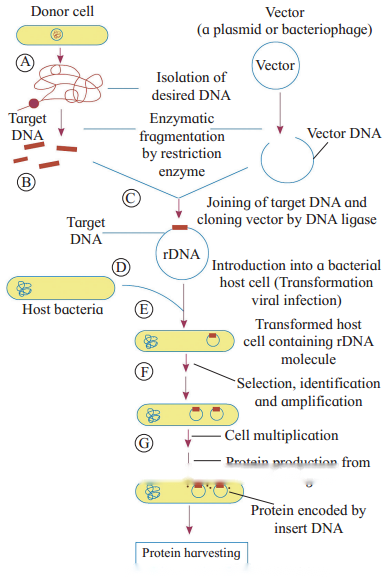
Explain the steps in process of r-DNA technology with suitable diagrams.
Solution & Step-by-Step Answer:
The steps involved in gene cloning are as follows: (1) Isolation of DNA (gene) from the donor organism:
(2) Insertion of desired foreign gene into a cloning vector (vehicle DNA): (3) Transfer of r-DNA into suitable competent host or cloning organism: (4) Selection of the transformed host cell: (5) Multiplication of transformed host cell: (6) Expression of gene to obtain desired product. Then desired products like enzymes, antibiotiocs etc. separated and purified through down stream processing using bioreactors.
Question 3
Maharashtra Board Solution
Explain the gene therapy. Give two types of it.
Solution & Step-by-Step Answer:
Gene therapy is the treatment of genetic disorders by replacing, altering or supplementing a gene that is absent or abnormal and whose absence or abnormality is responsible for the disease. Types of gene therapy: (a) Germ line gene therapy:
(b) Somatic cell gene therapy:
Question 4
Maharashtra Board Solution
How are the transgenic mice used in cancer research?
Solution & Step-by-Step Answer:
Question 5
Maharashtra Board Solution
Give the steps in PCR or polymerase chain reaction with suitable diagrams.
Solution & Step-by-Step Answer:
(1) The DNA segment and excess of two primer molecules, four types of dNTPs, the thermostable DNA polymerase are mixed together in ‘eppendorf tube’. (2) One PCR cycle is of 3-4 minutes duration and it involves following steps: (3) In an automatic thermal cycler, the above three steps are automatically repeated 20-30 times.
Question 6
Maharashtra Board Solution
What is a vaccine? Give advantages of oral vaccines or edible vaccines.
Solution & Step-by-Step Answer:
Question 7
Maharashtra Board Solution
Enlist different types of restriction enzymes commonly used in r-DNA technology? Write on their role.
Solution & Step-by-Step Answer:
Question 8
Maharashtra Board Solution
Enlist and write in brief about the different biological tools required in r-DNA technology.
Solution & Step-by-Step Answer:
The biological tools used in r-DNA technology are various enzymes, cloning vectors and competent hosts. (1) Enzymes:
(2) Vectors: (3) Competent host cells: |