Maharashtra State Board Class 11 Sociology Solutions Chapter 3 Basic Concepts in Sociology
1. (A) Choose the correct alternative and complete the statements.
1. (B) Correct the incorrect pair.
1. (C) Identify the appropriate term from the given options.
(Role, Folkways, Society)
Question 1.
Punctuality in class is the duty of a student.
Answer:
Role
1. (D) Correct underlined words and complete the sentence.
2. Write short notes.
(ii) Society includes difference : A society together with likeness is also based on differences. Differences is an important factor for a healthy society. Different types of personalities are essential in our society in order to satisfy the different needs. These differences are based on sex, age, physical strength, intelligence, talent, personality and unequal possessions of material objects and wealth.
(iii) Interdependence : Individuals in a society depend upon one another for the satisfaction of needs. One group, one nation, one community depends upon the other for its development, t Interdependence is seen in family groups as well. The existence of society depends upon different types of social relationships.
(iv) Co-operation : Every society is characterized by co-operation and division of labour. It is necessary for survival.
(v) Normative nature : In a society, social behaviour is evaluated by social control. These controlling means are known as norms. Norms control the misbehaviour or the acts which are harmful to society thus protecting the society.
(vi) Society is dynamic : No society is static. It changes continuously; old customs, traditions, I values, norms and institutions replace the new customs, traditions, values, norms and institutions.
Mores : Mores are more rigid than folkways. They are instruments of social control and deals with higher values of people. Example, sexual relations before marriage are not permitted.
Law : Law is an important and essential element of society.
They are deliberately formulated rules of behaviour. It is universal in nature and common for all to follow. There are two types of law- Customary Law and Enacted Law.
3. Differentiate between.
Primary Group | Secondary Group |
(i) Primary group is a group in which relationships are personal, informal, face to face and intimate in nature. | (i) Secondary group is a group in which relationships are impersonal, formal and contractual in nature. |
(ii) This group is small in size. | (ii) This group is large in size. |
(iii) Relationships are personal, so physical proximity is more. | (iii) Due to formal relationships there is no physical proximity between the members. |
(iv) Relations are permanent. | (iv) Relations are temporary. |
(v) Behaviour is controlled in an informal way. | (v) Behaviour is controlled in a formal way. |
(vi) Example Family, peer group, neighbourhood, etc. | (vi) Example Nation, State, Labour unions, etc. |
Voluntary Group | Involuntary Group |
(i) Membership is based on choice. | (i) Membership is based on birth. |
(ii) It may be temporary or permanent in nature. | (ii) It is mostly permanent in nature. |
(iii) Individual has choice to continue or to leave the membership. | (iii) One cannot leave the membership or it may be difficult to leave the group. |
(iv) Example : Political parties, youth organisation, cultural association, etc. | (iv) Example : Family, caste, race, religion, etc. |
4. Explain the following concept with suitable examples.
Reference Groups are of two types Informal and Formal.
Example: A boss will suffer role conflict if forced to fine an employee who is also a close friend. A newly married bride experiences role conflict because she has to adjust with her in-laws, household work and office work.
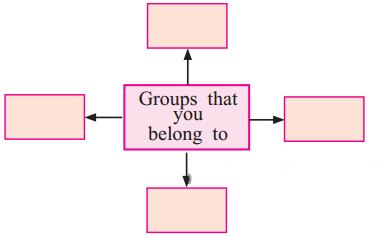
5. (A) Complete the concept maps.

5. (B) State whether the following statements are true or false with reasons.
2. Changes in any one of this is reflected in the changes in relationship and interaction among the individuals. Change is a universal phenomenon. No single society is static. Factors like, westernisation, modernisation, industrialisation, education have brought various changes in society.
3. Today, educational system, family patterns, norms, values, needs, etc., are changed. People have become more self-centred. Individual freedom, consciousness towards one’s own rights are increasing. Hence, society is changing continuously.
6. Give your personal response.
Laws are deliberately formulated rules of behaviour that are enforced by a special authority, e.g., there are laws that can punish people for marrying more than one person. Hindu Marriage Act, 1955.
Mores, folkways and laws are taught through the process of socialisation by various sources like family, friends, peer groups, schools, etc. However, these three clash each other in various ways. In today’s complex, competitive society, one finds it difficult to cope up with these three elements of society. Example: there is a man who belongs to a poor family and has the responsibility of marriage of his sister. Being born in a poor family, he doesn’t have enough money for his sister’s marriage. As per the laws, asking for dowry is illegal, but due to his financial condition, he has to ask for dowry from his in-laws to get his sister married. In such situation folkways, mores and law clash each other.
Example: A woman working as a nurse in the hospital, has to look after her sick in-laws at home, because of which she can’t pay proper attention towards her duty. A husband who has to attend urgent meeting as a manager, can’t give time to his family. One has to perform multiple roles in a complex society. That is why role conflict is inevitable in social life.
7. Answer the following in detail (About 150-200 words).
People are always very busy and it is necessary to have appointments before meeting. Secondary group are heterogeneous and formal in natural. People are given time to meet but for that purpose only. People do not meet for long term goals. Free expressions of emotions, feelings and intimacy is not allowed. In secondary group, members have to follow rules and regulations strictly.
Example : (i) Student of a college
(ii) Member of NSUI – National Students Union of India (or) ABVP – Akhil Bhartiya Vidhyarthi Parishad
Characteristics of secondary group with reference to the above mentioned group. Large Size: In college or in NSUI number of students and members is large. Here, the membership is unlimited as compared to primary group.
Indirect relations : Due to large size, direct relations among all the students and members are not possible. To convey any message, we take help of modern means of communication, e.g., mobile phones, e-mail, WhatsApp, etc.
Impersonal relations : As the members are large in size personal interactions is very rarely seen. Here, we do not know each other personally. That is why, relationship is not personal.
Formal relations : Informal relations is not possible because face to face contact can’t take place. People are more goal oriented. Membership is strictly based upon laws and regulations.
11th Sociology Digest Chapter 3 Basic Concepts in Sociology Intext Questions and Answers
ACTIVITY (Textbook Page No. 25)
(ii) Rural Community : The rural community is largely homogeneous. The main occupation of the people in this community is agriculture and non-agricultural occupations such as dairy farming, poultry, etc. This community is influenced by nature and they worship it as God or Goddess.
The rural community is influenced by the institution of family and characterized by primary relations. Joint family continues to exist in rural areas though some modification has occurred.
(iii) Urban Community : The urban community is large in size and consists of mostly nuclear families. It is a settlement of socially heterogeneous people. Occupations of the urban people are non agricultural. There is more scope for division of labour. This community is greatly impacted by artificial or man-made environment rather than natural environment on the urban community.
Understanding 2:
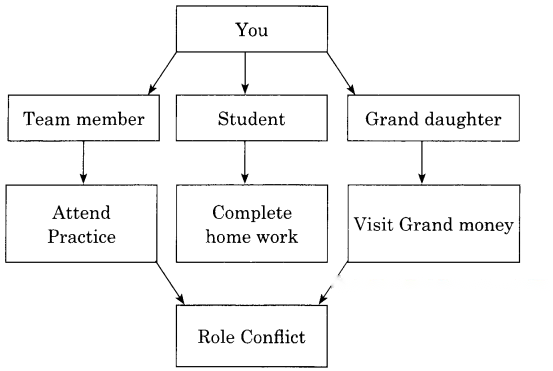
Role Conflict:
Role conflict occurs when conflicting expectations arise from two or more statuses than an individual occupies.
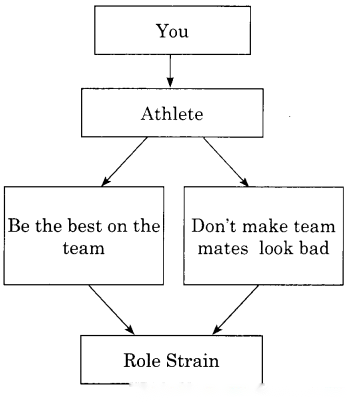
Role Strain:
Role strain arises when conflicting expectations are built into a single status.
Mores : “More are the popular habits and traditions when they include a judgment that are conductive to social welfare and when they exert a coercion on an individual to conform to them”.
More are stricter than folkways, as they determine what is considered moral and ethical behaviour. Mores structure the difference between right and wrong. Violation of mores results in disapproval or ostracizing. As such mores play a key role in shaping our value, beliefs, behaviour, and interactions than folkways.