Latest Maharashtra State Board (SSC & HSC) 2026-27 Syllabus Digest & Solutions Updated!
Class 11 (FYJC / HSC)Psychology2026-27 Syllabus

Chapter 8 Memory Solutions

Complete Maharashtra State Board Balbharati & Yuvakbharati textbook solutions for Chapter 8 Memory. Step-by-step solved exercises, numerical problems, and digest answers.

37 Solved Questions1 Diagrams1263 words

Maharashtra State Board Class 11 Psychology Solutions Chapter 8 Memory

1A. Complete the following statements.

Question 1 Maharashtra Board Solution
One of the important processes for storage of information in the LTM is _____________ a. perception b. elaborative rehearsal c. encoding
Solution & Step-by-Step Answer:
b. elaborative rehearsal
Question 2 Maharashtra Board Solution
Memory is a/an _____________ a. activity b. process c. performance
Solution & Step-by-Step Answer:
b. process
Question 3 Maharashtra Board Solution
_____________ memory has the shortest duration. a. Sensory b. Short Term c. Long Term
Solution & Step-by-Step Answer:
c. Long Term
Question 4 Maharashtra Board Solution
_____________ memory is also known as Working Memory. a. Long Term b. Accidental c. Short Term
Solution & Step-by-Step Answer:
c. Short Term
Question 5 Maharashtra Board Solution
_____________ memory has unlimited capacity. a. Sensory b. Short Term c. Long Term
Solution & Step-by-Step Answer:
a. Sensory
Question 6 Maharashtra Board Solution
The span of Short-Term Memory is _____________ a. 5+/-2 b. 7+/-2 c. 9+/-2
Solution & Step-by-Step Answer:
b. 7+/-2

1B. State whether the following statements are true or false. If false, correct them. If true, explain why.

Question 1 Maharashtra Board Solution
Our sense organs also have memory.
Solution & Step-by-Step Answer:
True Explanation: Our sense organs have the capacity to retain the sensory impression received through the five senses for a very short time even after the source stimulus is withdrawn. It is known as sensory memory.
Question 2 Maharashtra Board Solution
Short-term memory has an unlimited capacity.
Solution & Step-by-Step Answer:
False Reason: STM holds the information between 15 to 30 seconds and the capacity of STM is about seven items at a time. Fleece, has limited capacity.
Question 3 Maharashtra Board Solution
Conscious memory of facts and events is called explicit memory.
Solution & Step-by-Step Answer:
True Explanation: Explicit memory is a type of LTM that contains conscious memories of facts and events.
Question 4 Maharashtra Board Solution
Implicit memory is the memory of skills.
Solution & Step-by-Step Answer:
True Explanation: Implicit memory is the unconscious memory of skills and how we do things, regarding the use of objects or movements of the body.
Question 5 Maharashtra Board Solution
When we memorize meanings, concepts, and principles, it is called episodic memory.
Solution & Step-by-Step Answer:
False Reason: Episodic memory is a memory of experiences and specific events which we recall step by step to reconstruct actual events.
Question 6 Maharashtra Board Solution
The method of relearning is also known as the saving method.
Solution & Step-by-Step Answer:
True Explanation: In relearning method, there is a saving of time taken to learn the same material. Fleece, this method is also known as the saving method.
Question 7 Maharashtra Board Solution
The most vivid memory is flashbulb memory.
Solution & Step-by-Step Answer:
True Explanation: Flashbulb memories are vivid memories of what we were doing at the time of an emotion-provoking event.

1C. Identify the odd item from the following.

Question 1 Maharashtra Board Solution
Encoding, Storage, Tip of the tongue (TOT), Retrieval
Solution & Step-by-Step Answer:
Tip of the tongue (TOT)
Question 2 Maharashtra Board Solution
Keyword method, Method of Loci, Chunking, Rote learning, First letter technique
Solution & Step-by-Step Answer:
Rote learning
Question 3 Maharashtra Board Solution
Sensory register, STM, Flashbulb memory, LTM
Solution & Step-by-Step Answer:
Sensory register
Question 4 Maharashtra Board Solution
Recall, Recognition, Relearning, Trace decay
Solution & Step-by-Step Answer:
Trace decay

1D. Match the following pairs.

Question 1 Maharashtra Board Solution

A

B

1. A technique to improve memory

a. Short-term memory

2. The most vivid memory

b. Declarative memory

3. Working memory

c. Implicit memory

4. Most organized memory

d. Flashbulb memory

5. Playing the harmonium after a long time

e. Method of Loci

6. Writing an essay on perceptual process

f. LTM

g. Recall method

h. Relearning method

Solution & Step-by-Step Answer:

A

B

1. A technique to improve memory

e. Method of Loci

2. The most vivid memory

d. Flashbulb memory

3. Working memory

a. Short-term memory

4. Most organized memory

f. LTM

5. Playing the harmonium after a long time

c. Implicit memory

6. Writing an essay on perceptual process

g. Recall method

2. Answer the following questions in around 35-40 words each.

Question 1 Maharashtra Board Solution
Explain any one example of Flashbulb memory from your life.
Solution & Step-by-Step Answer:
Question 2 Maharashtra Board Solution
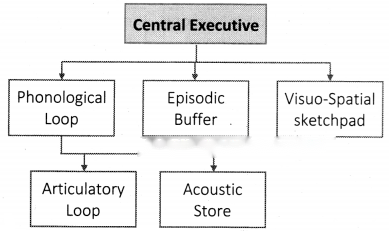
Explain the model of working memory proposed by Baddeley.
Solution & Step-by-Step Answer:

Question 3 Maharashtra Board Solution
Explain the Tip of the tongue (TOT) phenomenon with an example.
Solution & Step-by-Step Answer:
Question 4 Maharashtra Board Solution
Give an example of episodic memory.
Solution & Step-by-Step Answer:
Question 5 Maharashtra Board Solution
What is motivated forgetting?
Solution & Step-by-Step Answer:

3. Compare and contrast.

Question 1 Maharashtra Board Solution
STM and LTM
Solution & Step-by-Step Answer:
Question 2 Maharashtra Board Solution
Implicit Memory and Explicit Memory
Solution & Step-by-Step Answer:
Question 3 Maharashtra Board Solution
Semantic memory and Episodic memory
Solution & Step-by-Step Answer:
Question 4 Maharashtra Board Solution
Storage failure and Retrieval failure
Solution & Step-by-Step Answer:
Question 5 Maharashtra Board Solution
Recall method and Recognition method
Solution & Step-by-Step Answer:

4. What will you do if…

Question 1 Maharashtra Board Solution
You have to prepare a long speech covering all the activities in your college and present at the annual function
Solution & Step-by-Step Answer:
Question 2 Maharashtra Board Solution
How will you apply ‘POWER’ to prepare for the final exam of Psychology?
Solution & Step-by-Step Answer:

5. Short Notes.

Question 1 Maharashtra Board Solution
Characteristics of Memory
Solution & Step-by-Step Answer:
Question 2 Maharashtra Board Solution
Techniques to improve memory
Solution & Step-by-Step Answer:
Some techniques to improve memory are as follows:
Question 3 Maharashtra Board Solution
Motivated forgetting
Solution & Step-by-Step Answer:
Question 4 Maharashtra Board Solution
Causes of forgetting
Solution & Step-by-Step Answer:

6. Answer the following questions in 150-200 words.

Question 1 Maharashtra Board Solution
Explain the process of human memory in detail.
Solution & Step-by-Step Answer:
Question 2 Maharashtra Board Solution
Explain the theories of forgetting in detail.
Solution & Step-by-Step Answer:

7. Arrange the following elements in concepts of memory in ascending order.

Question 1 Maharashtra Board Solution
Elaborative rehearsal, Short Term Memory, Receiving information from the environment, Long Term Memory, Retrieval
Solution & Step-by-Step Answer:

Activities

Activity 1 (Textbook Page No. 87)

Do you remember your first picnic at your school? Do you remember your primary school teacher? Now can you remember what food you ate last Monday? Why you can remember some incidents from the past clearly while you cannot remember some things which happened yesterday?
Answer:
We remember some incidents from the past clearly when they are a part of our long-term memory. Similarly, we cannot remember certain incidents from the recent past whey they form a part of our sensory or short-term memory.

Activity 2 (Textbook Page No. 87)

Why does this happen? 25 workers used to work in Thomas Edison’s Bulb and Phonogram unit of industries. There was a huge tree near his company. After 6 months, Edison asked his workers about the huge tree but not a single worker could give information about that tree. Why do you think this happened despite seeing the tree every day?
Answer:
I feel the none of the workers could give information about the tree near their company since it was a part of their sensory memory, i.e., they perceived the stimulus (tree) with sense organs but did not rehearse it enough for it to become a part of their long term memory.