Maharashtra State Board Class 11 Political Science Solutions Chapter 8 Development Administration
1. State the appropriate concept for the given statement.
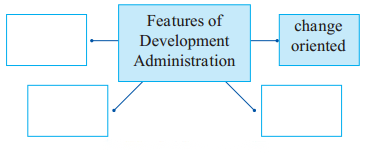
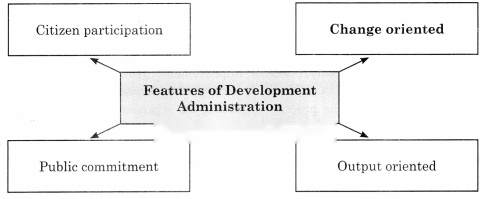
2. Complete the concept maps.
3. State whether the following statements are true or false with reasons.
4. Explain the co-relation between the following.
An approach to have innovative planning towards growth is called development administration. The need for this was felt due to limitations in the traditional approach to public administration, which covered areas such as
The new approach to public administration and public policy focuses on socio-economic development, political modernization, and adaptation of new technologies in administration.
Development administration has two important aspects viz.
5. Answer the following.
The Planning Commission has now been replaced by the NITI Aayog (established on 1st January 2015). The Prime Minister is the ex-officio chairman of NITI Aayog. Since India has moved from centralized planning to decentralized planning, this body proposes grassroots level planning from village and district levels to be harmonized with state-level planning and finally with national planning.
NITI Aayog has Governing Council comprising the Chief Ministers of all 29 states and of Delhi and Puducherry and Lt. Governors of Union Territories. As of 2019 Vice-Chairman is Rajiv Kumar and CEO is Amitabh Kant.
6. Express your opinion of the following.
An approach to have innovative planning towards growth is called Development Administration. The need for this was felt due to limitations in the traditional approach to public administration.
The new approach to public administration and public policy focuses on socio-economic development, political modernization, and adaptation of new technologies in administration.
Development Administration has two important aspects viz.
If the process of development is cut off from the grassroots then it eventually fails to materialize the objectives it has set. This necessitates peoples’ participation in the process of planning, implementation, and eventual evaluation.
In a diverse society like India people’s participation is necessary. In India, the needs, requirements, and choices of people may vary vastly according to region. The Indian government had introduced a Community Development Programme in 1952 followed by National Extension Service in 1953. The focus was to promote development in the rural and remote areas. The experience of these programmes helped the government to focus on rural India. The purpose of the participation of the rural and urban citizens was sought through the 73rd and 74th Constitutional Amendment Acts.