Maharashtra State Board Class 11 Political Science Solutions Chapter 3 Equality and Justice
1A. Choose the correct alternative and complete the following statements.
Solution & Step-by-Step Answer:
democracy
Solution & Step-by-Step Answer:
distributive
1B. State the appropriate concept for the given statement.
Solution & Step-by-Step Answer:
Equality of opportunity
Solution & Step-by-Step Answer:
Political equality
Solution & Step-by-Step Answer:
Economic equality
1C. Complete the following sentence using appropriate reason.
Solution & Step-by-Step Answer:
(c) social inequality can be controlled by State legislation
2. Complete the concept map/maps.
Solution & Step-by-Step Answer:
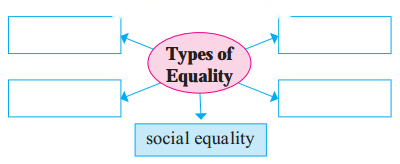
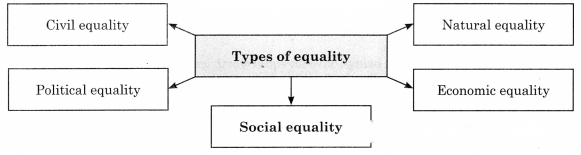
3. State whether the following statements are true or false with reasons.
Solution & Step-by-Step Answer:
This statement is False.
Solution & Step-by-Step Answer:
This statement is True.
Solution & Step-by-Step Answer:
This statement is True.
4. Explain the co-relation between the following.
Solution & Step-by-Step Answer:
Equality refers to equal rights and opportunities for all persons irrespective of their race, creed, gender, etc. It means no person or group will be discriminated against socially, economically, or politically. Similarly, no person or group will have special privileges that are denied to the vast majority in society.
Justice refers to that state of affairs in which every individual gets exactly those burdens and benefits that are due to him. It refers to the absence of socio-economic, political, and legal injustices.
In the absence of equality, there will be a denial of justice and the progress of society will be hindered. Justice aims at the reconciliation of individual rights and larger social interests.
Solution & Step-by-Step Answer:
Legal justice is the application of the abstract concept of justice through the implementation of the law. Justice is a precondition to the law as, without it, the law may become an instrument of tyranny and suppression. Austin considers law as a means to suppress injustice as well as to establish justice. Legal justice signifies an independent and impartial judiciary that observes specific rules for judicial proceedings. Any accused should be charged keeping in mind his/her human rights.
Social justice is both reformative and distributive. It aims at a revision of the social order by doing away with socio-economic evils for e.g. to eradicate untouchability, there is Article 17 of the constitution as well as laws passed by Parliament.
Procedural justice demands equality before the law as well as correct interpretation and application of the law. Social justice is also reformative i.e., equitable distribution of goods and services so that underprivileged sections can get an adequate share in this distribution.
5. Express your opinion of the following.
Solution & Step-by-Step Answer:
The caste system is one of the basic features of Indian society. It implies divisions in society based merely on one’s birth into a particular section of society. There was a caste hierarchy in which the upper castes enjoyed privileges that were denied to the lower castes. Even, within the four main Chaturvaranas, hierarchies began to develop.
Casteism began to become a social evil, as it resulted in untouchability as well as the exploitation and segregation of lower castes. They were denied equal opportunities to have socio-economic and political rights. Casteism did not permit upward mobility in the caste hierarchy due to marriage or achievement. The intermingling of castes was prohibited. Lower castes were often discriminated against in educational, political, and employment facilities. In some cases, they were denied access to public places like water bodies, hospitals, etc.
Social equality means that there has to be no favouring of or discrimination against any person/group on irrelevant aspects like caste and creed. It means that the dignity and intrinsic worth of every person must be recognized. Thus, the rigid hierarchies and discrimination perpetuated by casteism hinder social equality.
6. Answer the following.
Solution & Step-by-Step Answer:
There exist different kinds of inequalities in India, such as those created through the caste system, through the patriarchal system, etc. Dr. Babasaheb Ambedkar argued that justice would be achieved when the structure and values associated with these systems undergo a change. He also related the concept of justice to the concept of the distribution of resources. The Constitution of India ensures justice through both, procedural justice and social justice. This can be achieved through the educational and economic development of the backward classes.
Justice is implemented through the following policies: