Maharashtra State Board 11th Physics Solutions Chapter 11 Electric Current Through Conductors
1. Choose the correct Alternative.
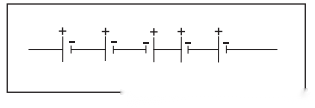
2. Give reasons / short answers
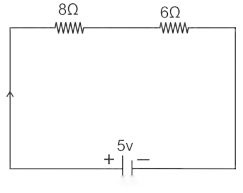
ii. Potential difference across 8 Ω resistor will be larger.
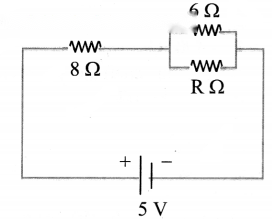
Reason: As per question, the new circuit diagram will be
When any resistor is connected parallel to 6 Ω resistance. Then the resistance across that branch (6 Ω and R Ω) will become less than 6 Ω. i.e., equivalent resistance of the entire circuit will decrease and hence current will increase. Since, V = IR, the potential difference across 8 Ω resistor will be larger.
ii. All the electrons move with the same drift speed vd and the current I is the same throughout the cross section (A) of the wire.
iii. Let L be the length of the wire and n be the number of free electrons per unit volume of the wire. Then the total number of free electrons in the length L of the conducting wire is nAL.
iv. The total charge in the length L is,
q = nALe ………….. (1)
where, e is the charge of electron.
v. Equation (1) is total charge that moves through any cross section of the wire in a certain time interval t.
∴ t = ………….. (2)
vi. Current is given by,
I = = ……………. [From Equations (1) and (2)]
= n Avde
Hence
vd=
= …………. (∵ J = )
Hence for constant ‘ne’, current density of a metallic conductor is directly proportional to the drift speed of electrons, J ∝ vd.
3. Answer the following questions.
Ohmic substances | Non-ohmic substances |
1. Substances which obey ohm’s law are called ohmic substances. | Substances which do not obey ohm’s law are called non-ohmic substances. |
2. Potential difference (V) versus current (I) curve is a straight line. | Potential difference (V) versus current (I) curve is not a straight line. |
3. Resistance of these substances is constant i.e. they follow linear I-V characteristic. | Resistance of these substances |
Expression for resistance is, R = | Expression for resistance is, |
Examples: Gold, silver, copper etc. | Examples: Liquid electrolytes, vacuum tubes, junction diodes, thermistors etc. |
4. Solve the following problems.
Colour | Blue (x) | Green (y) | Red (z) | Gold (T%) |
Code | 6 | 5 | 2 | ± 5 |
From formula,
Value of resistance = (65 × 10² ± 5%) Ω
Value of resistance = 6.5 kΩ ± 5%
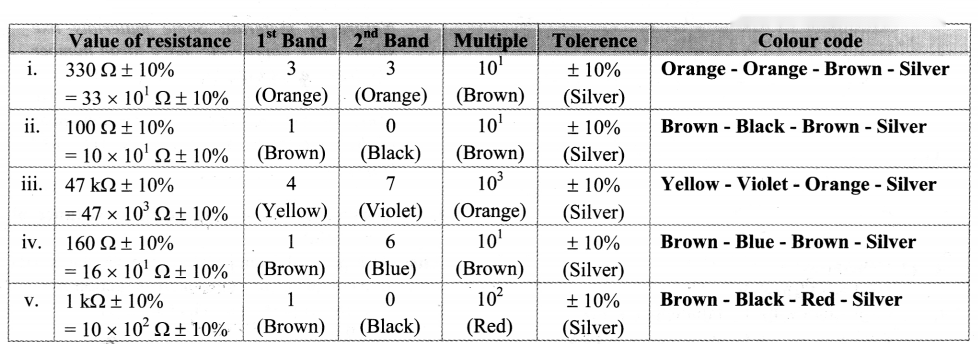
ii. Given: Brown – Black – Red – Silver
To find: Value of resistance
Formula: Value of resistance
= (xy × 10z+ T%) Ω
Calculation:
Colour | Brown (x) | Black (y) | Red (z) | sliver (T%) |
Code | 1 | 0 | 2 | ± 10 |
From formula,
Value of resistance = (10 × 10² ± 10%) Ω
Value of resistance = 1.0 kΩ ± 10%
iii. Given: Red – Red – Orange – Gold
To find: Value of the resistance
Formula: Value of the resistance
= (xy × 10z± T%)
Calculation:
Colour | Red (x) | Red (y) | Orange (z) | Gold (T%) |
Code | 2 | 2 | 3 | ± 5 |
From formula,
Value of resistance = (22 × 10³ ± 5%)Ω
Value of resistance = 22 kΩ ± 5%
[Note: The answer given above is presented considering correct order of magnitude.]
iv. Given: Orange – White – Red – Gold
To find: Value of the resistance
Formula: Value of the resistance
= (xy × 10z± T%)
Calculation:
Colour | Ornage (x) | White (y) | Red (z) | Gold (T%) |
Code | 3 | 9 | 2 | ± 5 |
From formula,
Value of resistance = (39 × 10² ± 5%) Ω
Value of resistance = 3.9 kΩ ± 5%
v. Given: Yellow-Violet-Brown-Silver
To find: Value of the resistance
Formula: Value of the resistance
= (xy × 10z± T%)
Calculation:
Colour | Yellow (x) | violet (y) | Brown (z) | Sliver (T%) |
Code | 4 | 7 | 1 | ± 10 |
From formula,
Value of resistance = (47 × 10 ± 10%) Ω
Value of resistance = 470 Ω ± 10%
[Note: The answer given above is presented considering correct order of magnitude.]
11th Physics Digest Chapter 11 Electric Current Through Conductors Intext Questions and Answers
Can you recall? (Textbookpage no. 207)
An electric current in a metallic conductor such as a wire is due to the flow of electrons, the negatively charged particles in the wire. What is the role of the valence electrons which are the outermost electrons of an atom?
Answer:
i. The valence electrons become de-localized when a large number of atoms come together in a metal.
ii. These electrons become conduction electrons or free electrons constituting an electric current when a potential difference is applied across the conductor.
Internet my friend (Textbook page no. 218)
activity physics
[Students are expected to visit the above-mentioned website and Collect more information about superconductivity.]